
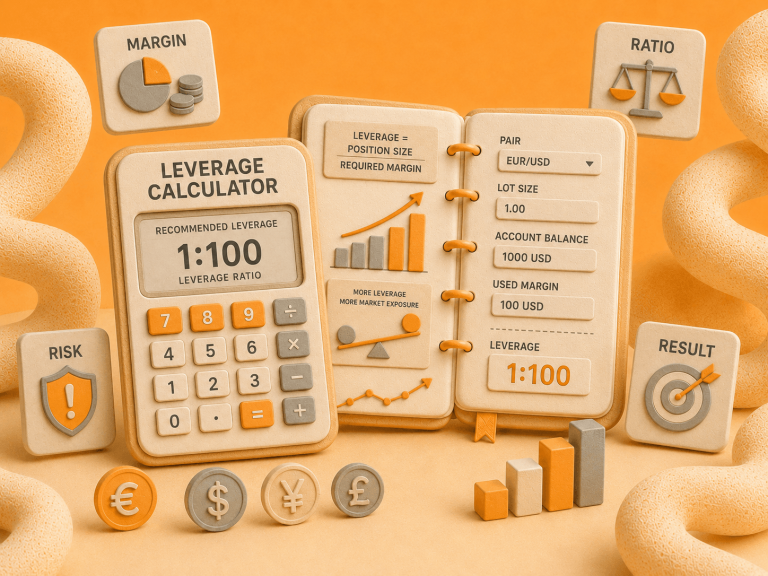
Leverage lets you control a larger market position with a smaller amount of your own money held as margin. It is used in forex, crypto, CFDs, commodities, indices and other margin-based instruments. The core formula is the same:
Required margin = position value / leverage
If a position is worth $10,000 and the leverage is 1:20, the required margin is $500. If the leverage is 1:100, the required margin is $100. But the position still behaves like a $10,000 trade. Leverage changes the margin needed to open the position; it does not shrink the market movement of the position itself.
Use the calculator below to estimate position value, required margin, effective leverage and risk at your stop. Choose Forex for lot-and-pip calculations, or Crypto / CFD for instruments where position size is based on quantity, contract size or notional value.
What the calculator actually answers
Most leverage explanations say something like “1:20 means you control 20 times more money.” That is true, but it is not enough for trading decisions.
Before opening a leveraged position, you need to know:
- Position value: how much market exposure the position creates.
- Required margin: how much capital is held to open the trade.
- Effective leverage: position value divided by account balance.
- Risk at stop: the estimated loss if price reaches your planned stop.
- Move sensitivity: how much a 1% move, or a one-pip move in forex, is worth.
The most important number is usually not the maximum leverage available on the asset. It is effective leverage. A trader can have access to high leverage and still trade conservatively with small size. Another trader can use moderate leverage and still take too much risk by opening a position that is too large for the account.
The universal leverage formula
The broad margin formula is:
Margin = position value / leverage
The part that changes by asset class is how you calculate position value.
| Instrument type | Position value usually comes from | Risk is usually measured by |
|---|---|---|
| Forex | lot size x contract size x pair price | pips x pip value |
| Crypto margin / crypto CFD | coin quantity or contract quantity x price | price move % or stop price |
| Index CFD | contracts x index price x multiplier | point move or % move |
| Commodity CFD | contracts x commodity price x multiplier | point move or % move |
| Stock CFD | shares/contracts x stock price | price move or stop price |
This is why a leverage calculator should not be limited to forex. Forex traders think in lots and pips. Crypto and CFD traders usually think in quantity, contracts, price movement and percentage risk.
Forex example: same position, different leverage
Imagine a trader with a $1,000 account opens 0.10 lots of EUR/USD around 1.0850 with a 30-pip stop.
The position value is about $10,850. The pip value is about $1 per pip, so the stop risk is about $30.
| Leverage | Required margin | Effective leverage | Risk at 30-pip stop |
|---|---|---|---|
| 1:10 | ~$1,085 | 10.85x | ~$30 |
| 1:30 | ~$362 | 10.85x | ~$30 |
| 1:100 | ~$109 | 10.85x | ~$30 |
| 1:500 | ~$22 | 10.85x | ~$30 |
The required margin changes a lot. The stop-loss risk does not change, because the position size and stop distance did not change.
That is the key lesson: leverage controls the entry requirement; position size controls the exposure.
Crypto example: BTC position with leverage
Now compare a crypto-style example.
Suppose BTC/USD is trading near $65,000 and a trader opens 0.02 BTC with 1:10 leverage.
The position value is:
0.02 x $65,000 = $1,300
The required margin is:
$1,300 / 10 = $130
If BTC moves 5% against the position, the approximate loss before fees and slippage is:
$1,300 x 5% = $65
Again, leverage did not decide the loss by itself. The position value and price move did. A smaller BTC quantity would reduce the exposure; a tighter or wider stop would change the planned risk.
Leverage vs margin vs risk
These three terms are connected, but they are not the same.
| Term | What it means | What beginners often get wrong |
|---|---|---|
| Leverage | The ratio between position value and required margin. | Thinking higher leverage automatically means a bigger position. |
| Margin | The amount held to open or maintain the position. | Treating margin as the maximum possible loss. |
| Risk | The money you may lose if the market reaches your stop or moves sharply against you. | Forgetting that risk depends on position size and price movement. |
Higher leverage lowers the margin requirement. It does not make the underlying asset less volatile. A 5% move in BTC is still a 5% move. A 100-point move in an index is still a 100-point move. A 30-pip move in EUR/USD is still a 30-pip move.
Effective leverage is the number to watch
Effective leverage is:
Effective leverage = total position value / account balance
If your account is $1,000 and your open position is worth $10,000, your effective leverage is 10x. If your total open positions are worth $50,000, your effective leverage is 50x.
This matters because the advertised leverage and the actual account exposure can be very different. A platform may offer high leverage on an instrument, but you can still use it modestly by trading small size. The reverse is also true: several open positions can make your total exposure much larger than it looks trade by trade.
For beginners, this is a useful starting point:
| Effective leverage | Practical reading |
|---|---|
| 1x to 3x | Conservative for most learning accounts. |
| 3x to 10x | Usable if stop-loss risk is controlled. |
| 10x to 20x | Requires discipline and clear exposure limits. |
| 20x+ | Small market moves can dominate the account. |
These are not universal rules. A crypto day trader, forex scalper and equity CFD swing trader may use different exposure levels. The point is to know the number before the trade is open.
Why high leverage feels safer than it is
High leverage can make a trade look smaller because the required margin is smaller. That is the psychological trap.
Suppose two traders open the same $20,000 position.
- Trader A uses 1:20 leverage and needs about $1,000 margin.
- Trader B uses 1:200 leverage and needs about $100 margin.
Trader B may feel safer because less money is locked as margin. But both traders still control the same $20,000 position. If the market moves 1%, both positions move about $200 before spread, slippage, fees or financing adjustments.
The market does not care how much margin was required. It cares how large the position is.
How leverage works on IQ Option
On IQ Option, leverage is available through margin-based trading instruments, and available leverage may vary depending on the asset, region and current trading conditions. In many cases, traders do not manually choose any leverage number they want; the platform defines the available leverage for the instrument.
That means the practical decision is usually not only “which leverage should I choose?” The practical decision is:
- Which asset am I trading?
- What leverage is available for that asset?
- What position size am I opening?
- What margin will be held?
- How much could I lose if the market reaches my stop?
- Do I already have other positions with similar market exposure?
Before opening a deal, check the instrument’s trading conditions and the order panel. The platform’s live values should be treated as the execution reference because contract specifications, asset availability and regional rules can change.
A better pre-trade checklist
If you use leverage, keep the checklist short and strict:
- Confirm the asset and direction.
- Check the available leverage for that instrument.
- Enter the position size.
- Check required margin.
- Estimate the risk at your stop.
- Check effective leverage.
- Compare total open exposure across all trades.
The last step matters. A trader can keep each individual trade small and still build too much risk by opening several correlated positions. Long EUR/USD, long GBP/USD and short USD/CHF can all be versions of the same USD exposure. Several crypto positions can all depend on the same broader crypto market move.
Common leverage mistakes
Thinking leverage is the same as position size. Leverage is the financing ratio. Position size is the market exposure. Risk begins with exposure.
Using maximum leverage because it is available. Maximum available leverage is a limit, not a recommendation.
Looking only at margin. A trade with low margin can still have high exposure and large stop-loss risk.
Using forex logic everywhere. Pips and lots make sense for forex. Crypto and CFDs often need quantity, contract multiplier and percentage move instead.
Forgetting about effective leverage. A single position may look fine, but several open positions can push total exposure much higher than expected.
Ignoring margin level. If equity drops and margin level falls, the account may lose the ability to open new positions or may face automatic closures according to platform rules.
What leverage is reasonable for beginners?
There is no single correct leverage for every asset. Crypto can move differently from EUR/USD. Gold can behave differently from a stock CFD. Indices can gap around news and market opens.
For beginners, the safer approach is:
- Keep risk per trade around 0.5% to 1% while learning.
- Keep effective leverage modest until you have a trade journal with enough data.
- Use smaller size on more volatile assets.
- Reduce size before major news events or unusually volatile sessions.
- Avoid opening several positions that depend on the same market driver.
- Use the platform’s demo account to understand margin, equity and available funds before trading live.
In practice, traders using lower effective leverage usually make cleaner decisions. They are less likely to close winners too early, move stops emotionally or keep adding to losing positions.