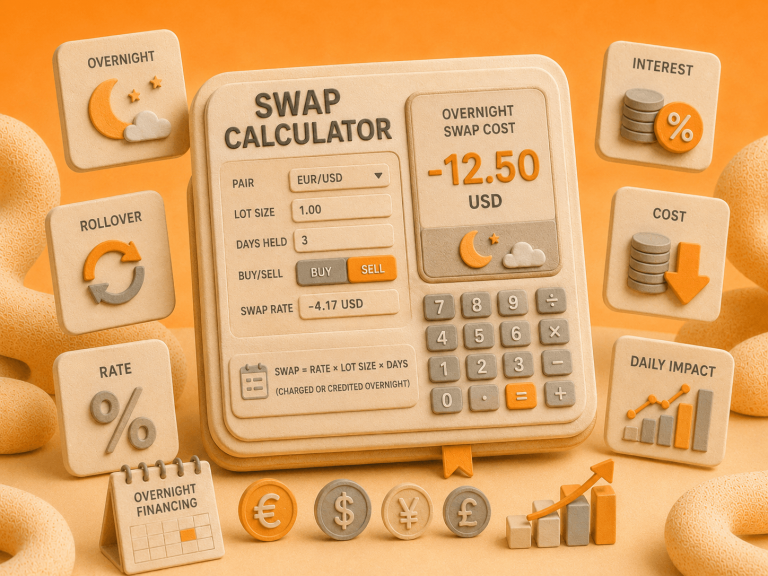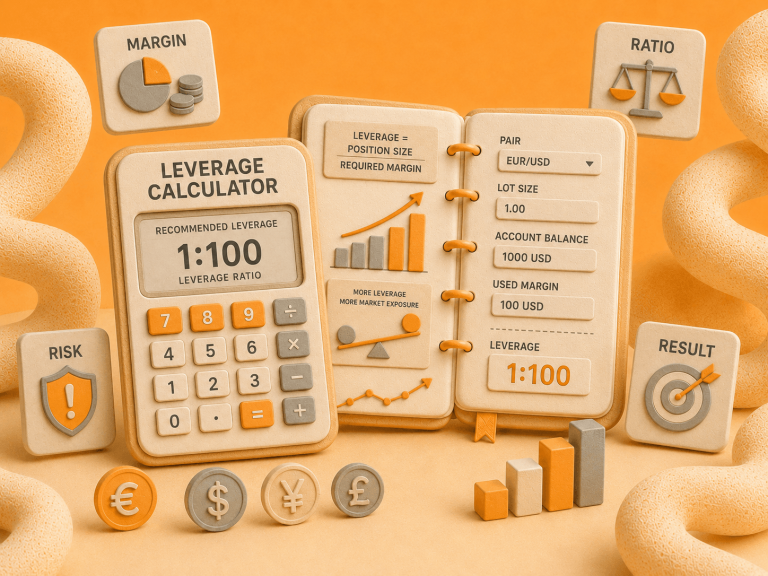

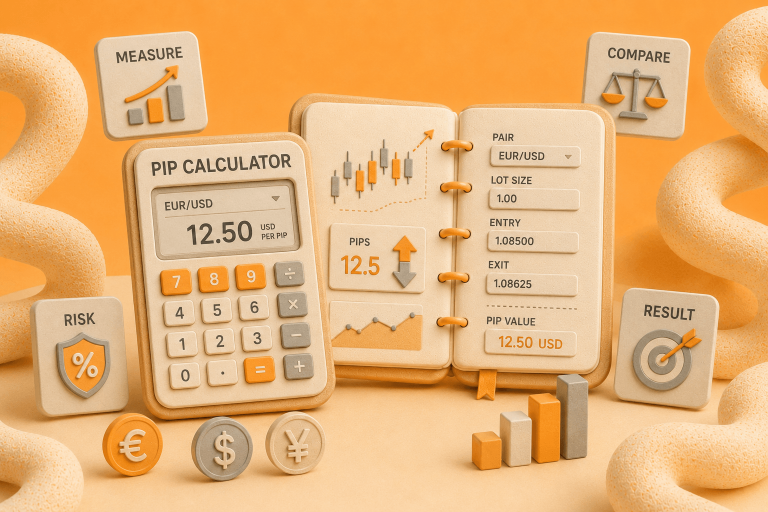
Pip value tells you how much money you gain or lose when a forex pair moves by one pip. For most USD-quoted pairs, such as EUR/USD or GBP/USD, the quick benchmark is simple: 1 standard lot is about $10 per pip, 0.10 lots is about $1 per pip, and 0.01 lots is about $0.10 per pip when your account currency is USD.
That benchmark is useful, but it is not universal. Pip value changes when your position size changes. It also changes when the quote currency is not your account currency, which is why USD/JPY, EUR/GBP, GBP/JPY and many cross pairs confuse beginners. The calculator below helps you convert pips into money before you place the trade.
Use it for a simple question: “If this trade moves 1 pip, 10 pips, or hits my stop loss, how much does that mean in account currency?”
Educational estimate only. Live platform values may differ because of current conversion rates, instrument specifications, spreads, and rounding. Use the platform’s live order ticket for final execution checks.
The short formula
For most forex pairs, the pip value calculation starts like this:
Pip value = position size x pip size
Then, if needed, convert the result into your account currency.
For non-JPY pairs, one pip is usually 0.0001. For JPY pairs, one pip is usually 0.01. That difference is the reason USD/JPY and GBP/JPY calculations look different from EUR/USD calculations.
Here is the standard convention:
| Position size | Units of base currency | EUR/USD pip value in a USD account |
|---|---|---|
| 1 standard lot | 100,000 units | $10 per pip |
| 0.10 lots, or 1 mini lot | 10,000 units | $1 per pip |
| 0.01 lots, or 1 micro lot | 1,000 units | $0.10 per pip |
| 0.001 lots, or 1 nano lot | 100 units | $0.01 per pip |
In practice, this table is the fastest way to sanity-check a forex order. If your EUR/USD position is 0.20 lots, your pip value should be around $2 per pip. If the platform shows something wildly different, check whether you selected the correct instrument, lot size, or account currency.
Why pip value matters more than “how many pips you made”
New traders often say things like “I made 40 pips today” or “my stop is only 15 pips.” That sounds precise, but it does not tell you whether the trade was small, reasonable, or reckless.
A 40-pip move on 0.01 lots of EUR/USD is about $4. The same 40-pip move on 1 lot is about $400. Same chart, same entry, same number of pips, completely different account impact.
That is why experienced traders translate pips into money before entering a position. The pip count tells you distance. The pip value tells you financial exposure.
The useful workflow is:
- Choose the trade setup.
- Decide where the stop loss belongs on the chart.
- Measure the stop distance in pips.
- Calculate pip value for the position size.
- Check whether the total risk fits your account.
If the total risk is too high, the answer is usually not “move the stop closer.” The cleaner answer is to reduce the position size.
Worked example: EUR/USD
Suppose you trade EUR/USD in a USD account.
- Position size: 0.10 lots
- Units: 10,000 EUR
- Pip size: 0.0001
- Stop loss: 25 pips
The pip value is:
10,000 x 0.0001 = $1 per pip
If your stop is 25 pips away:
25 pips x $1 = $25 risk
This is the kind of trade that is easy to understand. USD is the quote currency in EUR/USD, and your account is also in USD, so there is no extra conversion step.
Worked example: USD/JPY
JPY pairs are where many beginners make mistakes. USD/JPY uses a pip size of 0.01, not 0.0001.
Suppose USD/JPY is trading near 150.00 and you open 0.10 lots.
- Position size: 0.10 lots
- Units: 10,000 USD
- Pip size: 0.01 JPY
- Pair price: 150.00
First calculate pip value in JPY:
10,000 x 0.01 = 100 JPY per pip
Then convert that into USD:
100 JPY / 150.00 = about $0.67 per pip
So a 25-pip stop on 0.10 lots of USD/JPY is not $25. It is about:
25 x $0.67 = $16.75
This is why assuming “0.10 lots equals $1 per pip” across every pair is wrong. It is close for EUR/USD and GBP/USD in a USD account. It is not universal.
Worked example: EUR/GBP in a USD account
Cross pairs need one extra step because the pip value is first calculated in the quote currency.
Suppose you trade 0.10 lots of EUR/GBP.
- Position size: 10,000 EUR
- Pip size: 0.0001 GBP
- Pip value before conversion: 10,000 x 0.0001 = 1 GBP per pip
- Account currency: USD
- GBP/USD conversion rate: 1.25
The pip value in USD is:
1 GBP x 1.25 = $1.25 per pip
If your stop is 30 pips, the risk is:
30 x $1.25 = $37.50
This is the part most simplified pip articles skip. If the quote currency is not your account currency, you need a conversion rate. The exact number moves with the market, but the logic is always the same.
A practical way to use pip value before every trade
In real trading, pip value should not be a trivia fact. It should be part of your pre-trade checklist.
Before entering a forex trade, answer these four questions:
| Question | Why it matters |
|---|---|
| What is my position size? | This sets the pip value. |
| What is the pip value? | This converts chart movement into money. |
| How many pips to my stop? | This sets the trade’s technical risk. |
| What is my account risk in money and percent? | This decides whether the trade is acceptable. |
Example: you have a $1,000 account and want to risk 1%, or $10. Your setup needs a 25-pip stop.
If the pip value is $1 per pip, the trade risks $25. Too large.
If the pip value is $0.40 per pip, the trade risks $10. Acceptable.
The setup did not change. The position size did.
That small adjustment is the difference between planned risk and accidental risk.
The most useful benchmark numbers
For a USD account, these are good rough benchmarks:
| Pair type | 1 standard lot | 0.10 lots | 0.01 lots | Notes |
|---|---|---|---|---|
| EUR/USD, GBP/USD, AUD/USD, NZD/USD | ~$10/pip | ~$1/pip | ~$0.10/pip | Cleanest calculation for USD accounts. |
| USD/JPY near 150.00 | ~$6.67/pip | ~$0.67/pip | ~$0.07/pip | Changes as USD/JPY price changes. |
| USD/CHF near 0.9000 | ~$11.11/pip | ~$1.11/pip | ~$0.11/pip | Changes as USD/CHF price changes. |
| USD/CAD near 1.3500 | ~$7.41/pip | ~$0.74/pip | ~$0.07/pip | Changes as USD/CAD price changes. |
| EUR/GBP in USD account, GBP/USD 1.25 | ~$12.50/pip | ~$1.25/pip | ~$0.13/pip | Needs quote-currency conversion. |
Do not memorize all of this. Memorize the process. The calculator can do the arithmetic, but you should understand enough to catch obvious mistakes.
Pip value and leverage: the common misunderstanding
Leverage does not change pip value. Position size changes pip value.
If you buy 1 standard lot of EUR/USD, the pip value is about $10 per pip in a USD account. That is true whether the margin requirement is low or high. Leverage changes how much margin is needed to open the position. It does not change how much a one-pip move is worth.
This matters because beginners sometimes look at available leverage and think it makes the trade “cheaper.” It may make the position easier to open, but the P/L movement is still tied to position size. A 50-pip loss on 1 lot is still about $500, regardless of how little margin was required to enter.
The safer order of thinking is:
- First calculate pip value.
- Then calculate risk at the stop loss.
- Then check margin.
If you start with margin, it is easy to open a position that is technically allowed but much too large for the account.
Pip value vs spread vs profit
Pip value is the money value of a one-pip move. Spread is the cost of entering the market, also measured in pips. Profit or loss is the final result after price movement, spread, and any other costs.
Example:
- Pip value: $1 per pip
- Spread: 1.5 pips
- Price moves in your favor: 20 pips
The gross move is worth $20. The spread cost is about $1.50. The result is closer to $18.50 before any other fees or adjustments.
This is why pip value is especially important for short-term traders. If your target is only 8 pips and the spread is 1.5 pips, the spread is almost 19% of the gross target. On a 100-pip swing trade, the same spread is much less important.
Common mistakes when calculating pip value
Assuming every pair is $10 per pip. This is the classic mistake. It works for one standard lot of many USD-quoted pairs in a USD account. It fails on JPY pairs, cross pairs, and non-USD accounts.
Confusing pips with pipettes. Many platforms quote fractional pips. If EUR/USD moves from 1.08500 to 1.08510, that is 1 pip, not 10 pips. The fifth decimal place is usually a pipette.
Ignoring the account currency. A EUR account, GBP account, or JPY account changes the final conversion. The market movement is the same, but your account result is different.
Calculating pip value after entering. Pip value should be known before the trade. If you only notice the money impact after the position is open, the position was not sized deliberately.
Letting leverage decide the trade size. Margin availability is not a risk plan. The stop-loss distance and pip value are what define real trade risk.
How to connect pip value with position sizing
Pip value is not the final step. It is one input in position sizing.
Once you know pip value, the risk calculation is simple:
Trade risk = pip value x stop-loss pips
If your risk limit is $20 and your stop is 40 pips, your pip value needs to be:
$20 / 40 = $0.50 per pip
That means you should choose a position size that gives roughly $0.50 per pip. On EUR/USD in a USD account, that is about 0.05 lots.
This is the cleanest way to think about it:
- Pip value answers: “How much is one pip worth?”
- Stop distance answers: “How many pips am I risking?”
- Position sizing answers: “How big can the trade be?”
Do the calculation in that order, and a lot of beginner risk problems disappear.
What to check on the IQ Option platform
If you trade forex on IQ Option, pay attention to the order panel before opening the deal. The important fields are the instrument, quantity or lot size, margin requirement, pip value, stop loss, and take profit.
In practice, I would check them in this order:
- Confirm the pair and direction.
- Set the quantity or lot size.
- Look at the pip value shown by the platform.
- Set the stop loss in pips.
- Multiply pip value by stop distance.
- Make sure the result fits your account risk limit.
If the platform’s shown pip value differs from your manual estimate, trust the platform’s live contract specification for execution, then work out why the estimate differed. Usually the reason is account currency conversion, JPY pip size, or an instrument-specific contract setting.
A simple rule for beginners
Until the calculation feels automatic, keep the risk boring:
- Risk about 0.5% to 1% of account balance per trade while learning.
- Use smaller size when the stop is wider.
- Avoid increasing size after losses.
- Recalculate pip value whenever you change pair or position size.
- Treat leverage as a margin tool, not as a reason to trade bigger.
The point is not to predict every pip correctly. The point is to know what every pip costs before it happens.