
Take two traders with the same strategy.
Same entries. Same exits. Same win rate. Same losing streak.
The first trader risks 1% per trade. After a bad week, the account is bruised but intact. They are annoyed, they review the trades, and they can still take the next setup without feeling like the account is on fire.
The second trader risks 10% per trade. The same bad week does not feel like feedback. It feels like damage. Every new trade now carries the emotional weight of “getting it back.” The strategy may not have changed at all, but the person executing it has.
That is the part of risk per trade most people learn too late. The number is not just a money-management setting. It changes how long you survive, how much you need to recover, and how cleanly you can think while a trade is open.
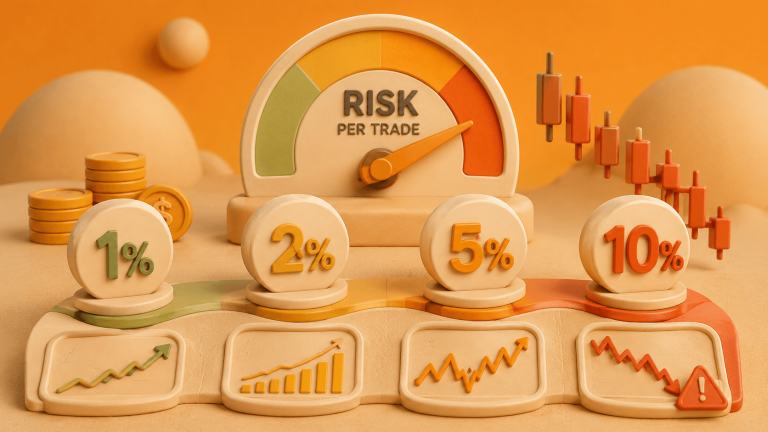
The difference between 1%, 2%, 5%, and 10% does not really show up after one loss. It shows up after the kind of losing streak every trader eventually meets.
| Losses in a row | Risk 1% | Risk 2% | Risk 5% | Risk 10% |
|---|---|---|---|---|
| 3 losses | -3.0% | -5.9% | -14.3% | -27.1% |
| 5 losses | -4.9% | -9.6% | -22.6% | -41.0% |
| 10 losses | -9.6% | -18.3% | -40.1% | -65.1% |
| 15 losses | -14.0% | -26.1% | -53.7% | -79.4% |
| 20 losses | -18.2% | -33.2% | -64.2% | -87.8% |
The trap: one loss tells you almost nothing
Most traders judge risk by the pain of one trade.
On a $500 account, risking 5% means risking $25. That sounds harmless enough. It is dinner money, not a life-changing number. So the trader thinks, “Why would I risk only 1%? That is just $5. I will never grow the account like that.”
The problem is that accounts do not usually fail because of one ordinary loss. They fail because of a sequence.
It usually looks more like this:
- The first loss is normal.
- The second loss is frustrating.
- The third loss makes the trader question the setup.
- The fourth trade is taken a little early because they want the drawdown to stop.
- The fifth trade is too large because the account needs “one good win.”
- By the time the trader finally pauses, the damage is no longer small.
Risk per trade decides how expensive that sequence becomes.
At 1%, a messy five-trade stretch is something you can study. At 10%, it can define the month.
What the numbers are really saying
Here is the cleanest way to read the table.
If you risk 1% per trade, ten losses in a row cost about 9.6% of the account. Nobody enjoys that, but you are still in a normal review zone. The account is not broken. Your head is probably still usable.
At 2%, ten losses cost about 18.3%. Now the drawdown has weight. You can recover, but you will feel it. The next few trades will test your discipline.
At 5%, ten losses cost about 40.1%. This is where the conversation changes. You are not just trying to trade well anymore. You are trying to climb out of a hole.
At 10%, ten losses cost about 65.1%. That is not a rough patch. That is account survival territory.
The important point is not that you will definitely lose ten trades in a row tomorrow. The point is that a serious risk plan has to survive a streak before it arrives, because you do not get to redesign your risk model in the middle of panic.
The math, without making this a math lecture
If you risk a fixed percentage of your current balance, each loss gets slightly smaller in dollar terms as the account falls. That is good. It slows the damage.
The basic formula is:
Balance after losses = Starting balance x (1 – risk %) ^ number of losses
For example, start with $1,000 and risk 5% per trade.
After one loss, you have $950.
After five losses, you have about $774.
After ten losses, you have about $599.
You did not lose half the account, because the position size shrank along the way. But you still lost about 40%, and that is more than enough to change how most people trade.
The math is not complicated. Living through it is the hard part.
Recovery is where oversized risk gets ugly
A 10% drawdown needs 11.1% to recover. That is manageable.
A 20% drawdown needs 25%. Harder, but still realistic.
A 40% drawdown needs 66.7%. Now you need a strong run just to return to where you started.
A 50% drawdown needs 100%. Double the remaining account, just to break even.
This is why the 5% and 10% risk levels are so dangerous. They do not only create bigger drawdowns. They push the trader into a recovery zone where normal trading returns are no longer enough emotionally. The account starts asking for a comeback.
And comeback trading is usually worse trading.
You take profits too early because you are desperate to lock something in. You skip good setups because another loss would hurt too much. Or you do the opposite and force trades because waiting feels unbearable.
The recovery number is not just a percentage. It is pressure.
Risking 1% per trade: slow, but you can still think
Risking 1% per trade is not exciting. That is the whole point.
On a $1,000 account, one loss is $10. On a $10,000 account, one loss is $100. The dollar amount changes, but the account damage is the same.
After ten losses in a row, the account is down about 9.6%. That is a real drawdown, not a rounding error. But it is still small enough that you can do useful work:
- Check whether the setups actually matched your rules.
- Compare planned risk with actual risk.
- See whether losses came from one market condition.
- Reduce trade frequency without feeling desperate.
- Keep trading only if the next setup is genuinely valid.
The hidden benefit of 1% is not the math. It is behavior.
Most traders can accept a 1% loss without trying to immediately repair their self-image. They can let a stop work. They can write down what happened without turning the journal into a confession.
That makes 1% a good learning size. It gives you enough real feedback to care, but not so much pain that every trade becomes personal.
Risking 2% per trade: serious, but still workable
Two percent is where the trade starts to have weight.
It can be reasonable for a trader who has a tested setup, a journal, and a clear daily stop. But for beginners, 2% should feel like the ceiling, not the starting point.
The reason is simple: 2% makes normal losing streaks emotionally louder.
Five losses in a row cost about 9.6%. Ten losses cost about 18.3%. Fifteen losses cost about 26.1%.
At that point, the trade after the streak is no longer just “the next trade.” It feels like a referendum on the whole strategy. This is when traders start editing rules mid-session, cutting winners too soon, or taking trades they would have skipped on demo.
If you want to use 2%, earn it. Not with confidence, but with evidence:
- At least 50-100 tracked trades on the setup.
- A clear maximum daily loss.
- No habit of increasing size after losses.
- A journal that shows you actually follow the plan.
- A drawdown level where you automatically reduce risk.
Without those guardrails, 2% often behaves like 5% emotionally.
Risking 5% per trade: the account starts trading you
Five percent is the size that tempts small-account traders the most.
It makes the account feel alive. A 1% win on a $300 account is $3. A 5% win is $15. Still not a fortune, but at least the number moves. That visible movement is seductive.
The problem is that the same visibility appears on the way down.
At 5%, five losses take the account down about 22.6%. Ten losses take it down about 40.1%. Fifteen losses take it down about 53.7%.
That is no longer “I had a bad streak.” That is “I need to rebuild.”
And the moment you start trading from a rebuild mindset, your strategy is no longer the only thing on the screen. Your damaged balance is there too. It comments on every candle.
This is why 5% can look brilliant during a winning streak and then become almost impossible to execute during a losing streak. The strategy may still have positive expectancy, but the trader may not be able to sit through the variance.
If a trading plan requires emotional perfection to survive, it is not a good plan.
Risking 10% per trade: one ordinary streak can decide everything
Ten percent per trade is not “high conviction.” It is a structure that leaves almost no room for normal randomness.
Three losses: down about 27.1%.
Five losses: down about 41%.
Ten losses: down about 65.1%.
A strategy does not need to be terrible for that to happen. Even a decent strategy can produce ugly sequences over enough trades. Markets shift. Volatility expands. Spreads widen. A trader gets tired. One or two bad decisions sneak into an otherwise valid system.
At 10%, ordinary imperfection becomes account-level damage.
The worst thing about 10% risk is that it can work for a while. A trader can double an account quickly during a good run and believe the size is justified. Then one normal losing sequence returns the account to reality.
That is not risk management. That is timing luck.
Try the numbers with your own balance
The simulator below is useful because it removes the drama. Put in your actual balance, the risk percentage you are considering, and a losing streak that feels unpleasant but possible.
Then look at two numbers:
- The ending balance.
- The return needed to recover.
The second number is usually the one that changes people’s minds.
The part calculators miss: position size changes the trader
Most calculators assume you behave the same at every risk level.
You probably do not.
At 1%, you might let the trade breathe.
At 2%, you may watch it more closely.
At 5%, you may start checking the open profit every few seconds.
At 10%, many traders are no longer trading the chart. They are trading the account balance.
This is not a character flaw. It is exposure. Money changes attention. Attention changes decisions. Decisions change results.
That is why a strategy can look solid in backtesting and fall apart live. The backtest did not include the feeling of being down 25% and needing the next trade to be right.
When choosing risk per trade, ask a more honest question than "How much can I afford to lose?"
Ask: At what size do I still make the same decisions I made when I was calm?
That number is usually lower.
The small-account problem
The argument for risking 5% or 10% usually comes from small accounts:
"If I risk 1%, the account will never grow."
I get it. A tiny gain on a tiny account can feel insulting. But oversized risk does not turn a training account into a business. It usually turns it into a short experiment.
If a small account cannot grow at 1-2% risk, one of four things is probably true:
- The strategy does not have an edge yet.
- The sample size is too small to know.
- Trading costs are too high for the style.
- The trader is expecting income from an account that should still be used for practice.
The honest job of a small account is not to pay you. It is to teach you whether your process survives real money.
Once the process is real, adding capital makes more sense than forcing the existing account to grow by risking too much.
Fixed dollar risk can quietly become more aggressive
Some traders do not risk a percentage. They risk the same dollar amount every time.
That can be fine if the account is stable. It becomes dangerous in drawdown.
Imagine a $1,000 account risking $50 per trade. At the start, that is 5%.
If the account falls to $800, the same $50 is now 6.25%.
If the account falls to $600, the same $50 is now 8.3%.
The trader feels consistent because the dollar amount is unchanged. But the account is experiencing more risk as it gets weaker.
Fixed percentage does the opposite. If the account drops, the dollar risk drops with it. If the account grows, the dollar risk grows gradually. It removes one emotional decision at exactly the time you are least qualified to make it.
How to choose your risk number
Do not choose risk based on how fast you want the account to grow. Everyone wants the account to grow fast. That is not a risk model.
Choose it based on what the account and your behavior can survive.
Before increasing risk, answer these questions in writing:
- What is the worst losing streak I have actually seen in this strategy?
- What losing streak should I plan for beyond that?
- What drawdown makes me start breaking rules?
- Do I reduce size automatically after a certain drawdown?
- How many trades are in my sample?
- Are my wins larger than my losses, or am I relying only on win rate?
- Do I have a daily loss limit?
- Am I already exposed through correlated trades?
If you cannot answer those, the risk is probably too high already.
When higher risk is reasonable
There are cases where a trader can use more than 1%.
A trader with a long journal, a stable setup, positive expectancy after costs, and a low rule-breaking rate might risk 1.5% or 2% on A-grade trades. Some traders use lower risk during normal conditions and only step up when the setup, volatility, and account state all line up.
But the key word is rules.
Higher risk should be decided before the trade exists. Not because the setup "looks amazing" in the moment. Not because you lost yesterday. Not because the account is close to a round number.
Reasonable conditions for increasing risk:
- The setup has been tracked across at least 100 trades.
- The strategy is positive after spread, commissions, and slippage.
- The account is not in a meaningful drawdown.
- Daily and weekly loss limits are already written down.
- No correlated positions are quietly multiplying the same risk.
- You can still take the loss without changing the next trade.
If those conditions are not true, higher risk is usually impatience with better vocabulary.
A practical risk ladder
The table below is not a universal law. It is a reality check for how each risk level tends to behave in real accounts.
| Risk | Best fit | Main danger | Verdict |
|---|---|---|---|
| 1% | Defined setups, live learning, normal trading. | Can feel slow on small accounts. | Most sustainable default. |
| 2% | Experienced traders with data and strict limits. | Drawdowns become emotionally heavy. | Upper limit for many traders. |
| 5% | Rare, small experiments with money you can lose. | Ten losses create a 40% drawdown. | Too high as a normal model. |
| 10% | Short-term gambling, not serious risk management. | Normal losing streaks can break the account. | Avoid as a default. |
For most traders, the useful number is the one that lets them take three losses in a row and still follow the plan on trade four.
If three losses make you want to double size, skip setups, or change indicators, the risk level is too high.
What to do after a losing streak
The worst time to invent rules is after a loss. Write the response in advance.
A simple version:
After 2 losses in a row: no size increase. Take the next trade only if it is a clean setup.
After 3 losses in a row: cut risk in half for the rest of the session or the next three trades.
After 5 losses in a row: stop live trading and review. Check whether the market condition changed, whether the setup is still appearing cleanly, and whether the losses followed the plan.
After a 10% account drawdown: reduce risk until the account stabilizes. Do not return to full risk because of one winning trade.
The exact numbers can change. The important part is that the response is automatic. If you wait until you are angry or scared to decide, the decision will usually serve the emotion, not the account.
What happens after a winning streak?
Winning streaks can be more dangerous than losing streaks because they feel like permission.
Risking 5% or 10% can produce fast growth when the market cooperates. That fast growth teaches the wrong lesson: "This size is working."
But a winning streak does not remove variance. It often increases the danger because confidence rises at the exact moment the trader is most tempted to loosen rules.
Keep the percentage stable. Let compounding do its slow work. If the account grows from $1,000 to $1,200, 1% risk automatically grows from $10 to $12. No celebration trade required.
Good risk management matters after wins too.
What if your win rate is high?
A high win rate does not automatically justify high risk.
First, many win rates are measured on samples that are too small. Twenty trades can lie. Forty trades can lie. A strategy can look nearly perfect in one market condition and ordinary in the next.
Second, high-win-rate systems often hide their risk in the losing trades. A strategy can win 80% of the time and still lose money if the losing trades are much larger than the winners.
Third, the emotional problem remains. Risking 10% on a strategy with an 80% win rate still means the occasional ugly sequence can hurt badly enough that the trader abandons the rules.
Win rate matters. But risk per trade should come from expectancy, drawdown tolerance, sample size, and behavior. Not one attractive percentage.
What I would write into a trading plan
If you are still building skill, keep it simple:
- 0.25% to 0.5% while testing a new strategy live.
- 1% once the setup is defined and journaled.
- 2% only after real data proves you can handle it.
- 5% only for money you are fully prepared to lose as an experiment.
- 10% never as a normal trading model.
Then add three limits:
- Max risk per trade.
- Max loss per day.
- Max open risk across all trades.
That last one matters. Three trades risking 1% each can become one 3% bet if they all depend on the same market driver. Long EUR/USD, long GBP/USD, and long AUD/USD are not three independent ideas if the whole trade is really "USD weak."
Risk per trade is only the first layer. Account risk is the real subject.
The line that matters
The market does not reward you for risking more. It exposes you faster.
At 1%, a losing streak is survivable. At 2%, it is serious but manageable. At 5%, it becomes a recovery problem. At 10%, normal variance can break the account before the trader has learned anything useful.
Choose the risk percentage that lets you follow the plan after three losses in a row.
If you cannot do that, the size is too high.