
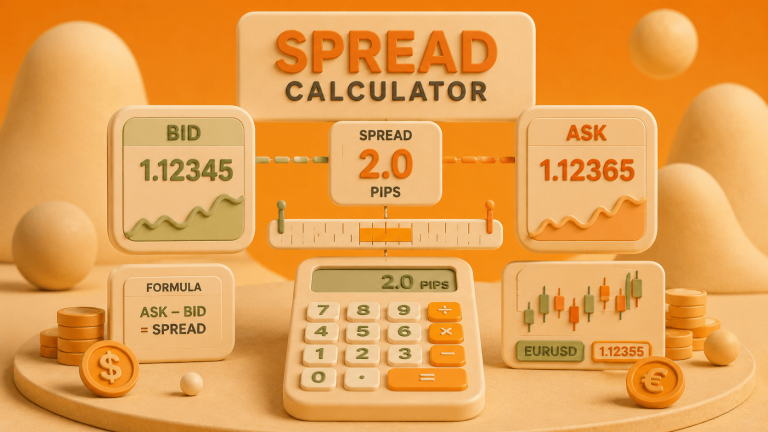
To calculate spread in forex, subtract the bid price from the ask price. Then convert the difference into pips.
If EUR/USD is quoted at 1.08500 / 1.08512, the spread is 0.00012, or 1.2 pips. If your pip value is $2, that spread costs about $2.40 for the trade.
That is the clean version. The part traders usually feel later is what the spread does to a small target, a tight stop, or a strategy that trades too often.
Use the calculator below to estimate spread cost per trade, break-even pips, monthly cost, and how much of your target is eaten by trading costs.
First, calculate the spread in pips
The spread is the difference between the bid price and the ask price.
Spread = ask price - bid price
For most major forex pairs, one pip is 0.0001. For JPY pairs, one pip is usually 0.01.
Example with EUR/USD:
- Bid: 1.08500
- Ask: 1.08512
- Difference: 0.00012
- Spread: 1.2 pips
A long trade usually opens at the ask and closes at the bid. A short trade usually opens at the bid and closes at the ask. That gap is one of the ways trading costs show up.
The reason spread is easy to underestimate is that it does not feel like a separate fee. No one sends you an invoice that says "spread paid: $3.60." Instead, the trade often starts slightly negative, and the trader gets used to seeing it.
That familiarity is dangerous. A cost you stop noticing is still a cost.
Then calculate the spread cost in money
Once you know the spread in pips, the money calculation is simple:
Spread cost = spread in pips x pip value
If the spread is 1.5 pips and your pip value is $2 per pip, the estimated spread cost is:
1.5 x $2 = $3.00
That is the cost of the spread for that position size. If you take 20 similar trades in a month, it becomes:
$3.00 x 20 = $60
The math is easy. The painful part is remembering to do it before you fall in love with a strategy that depends on small targets.
Why spread matters more than it looks
For a swing trader aiming for 150 pips, a 1.2-pip spread may be almost irrelevant. For a scalper aiming for 6 pips, the same spread is a major part of the trade.
Same market. Same spread. Completely different impact.
Why position size changes everything
Spread is measured in pips, but paid in money.
That means the same 1.5-pip spread can be tiny or expensive depending on lot size.
| Position size | Pip value | 0.8-pip spread | 1.5-pip spread | 2.5-pip spread |
|---|---|---|---|---|
| 0.01 lots | $0.10 / pip | $0.08 | $0.15 | $0.25 |
| 0.10 lots | $1.00 / pip | $0.80 | $1.50 | $2.50 |
| 1.00 lot | $10.00 / pip | $8.00 | $15.00 | $25.00 |
Look at the difference between 0.01 lots and 1 lot. The spread is the same. The account impact is not.
Saying "the spread is only 1 pip" is incomplete. One pip on 0.01 lots of EUR/USD is roughly $0.10. One pip on 1 standard lot is roughly $10. A trader taking large positions or frequent trades cannot afford to treat spread as background noise.
Spread cost is not only a scalper problem
Scalpers feel spread immediately because their targets are small. If your target is 5 pips and the spread is 1 pip, the spread is already 20% of the gross target.
But spread matters for other styles too.
Day traders may enter several times during a session. A spread that looks small on one trade can become meaningful across a week.
Swing traders may care less about spread per trade, but they still need to compare costs across pairs. A wide-spread exotic pair can make a clean technical setup less attractive than it looks.
Beginners are especially vulnerable because they often overtrade. The spread does not need to be large if the number of trades is large.
Cost as a percentage of your target
This is the comparison most traders should make.
Do not ask only, "How many pips is the spread?"
Ask, "How much of my planned target is the spread?"
If your target is 50 pips, a 1.5-pip spread is a small cost. If your target is 5 pips, it is huge. The spread did not change. The strategy did.
Very short-term trading needs tighter cost control than longer-term trading. A strategy can be directionally right and still struggle if the target is too small relative to the spread.
Worked example: EUR/USD scalp
Imagine a trader scalps EUR/USD.
- Position size: 0.20 lots
- Pip value: about $2 per pip
- Spread: 1.2 pips
- Target: 8 pips
- Stop: 8 pips
The spread cost is:
1.2 x $2 = $2.40
The gross target is:
8 x $2 = $16
So the spread is about 15% of the target before slippage or other costs.
That does not mean the trade is bad. It means the trader needs a real edge. A setup that looks profitable before costs can become average after costs. A setup that is only slightly profitable before costs can become negative.
This is where a lot of scalping systems fall apart. The chart example looks clean. The backtest looks fine. Then live trading feels strangely worse, because the first 1-2 pips are gone before the trade has even started working.
Worked example: USD/JPY quote
JPY pairs confuse beginners because the pip is usually counted at the second decimal place, not the fourth.
Imagine USD/JPY is quoted at 156.240 / 156.255.
- Bid: 156.240
- Ask: 156.255
- Difference: 0.015
- Spread: 1.5 pips
If your pip value is about $1.35 for the position size you are trading, the estimated spread cost is:
1.5 x $1.35 = $2.03
The exact pip value changes with pair, account currency, and position size. That is why the calculator lets you choose a pair or enter a custom pip value.
Worked example: same spread, different style
Now take the same trader, same pair, same lot size, same 1.2-pip spread.
But this time the target is 60 pips.
Spread cost is still:
$2.40
Gross target is:
60 x $2 = $120
Now the spread is only 2% of the target.
The trade still has risk. The setup can still fail. But the spread is no longer the main obstacle. That is why swing traders can tolerate wider spreads than scalpers, while scalpers need to be almost obsessive about entry cost.
Spread, commission, and slippage are different costs
Spread is only one part of trading cost.
Commission is a separate fee some brokers or account types charge. It may appear per side, per lot, or as a round-turn cost.
Slippage is the difference between the price you expected and the price you actually received. It is more common during fast markets, low liquidity, news releases, and market opens.
These costs hit different traders in different ways:
| Cost | When you feel it | Why it matters |
|---|---|---|
| Spread | Almost every trade | Affects entry cost and break-even distance |
| Commission | On accounts/instruments that charge it | Can make low-spread accounts less cheap than they look |
| Slippage | During fast or thin markets | Can turn a good planned entry into a worse real entry |
| Swap | When holding overnight | Matters more for swing trades and leveraged positions |
The calculator includes commission and slippage inputs because spread alone can understate the real cost of frequent trading.
What "break-even pips" means
Break-even pips are the number of pips the market has to move in your favor before the trade covers its entry costs.
If the spread is 1.2 pips and there is no commission or slippage, your break-even cost is roughly 1.2 pips.
If the spread is 1.2 pips, total slippage is 0.3 pips, and commission equals another 0.5 pips, your break-even cost is about 2 pips.
That matters a lot if the target is 6 pips. It matters less if the target is 80 pips.
A good trade idea should not need perfect execution to survive normal costs. If the setup only works when the spread is at its absolute tightest and there is no slippage, it may be too fragile for live trading.
Why spreads widen
Spreads are not fixed in all market conditions.
They can widen when liquidity drops or uncertainty rises. Common moments include:
- Market open and close periods
- Major news releases
- Central bank decisions
- Holidays and thin sessions
- Exotic or less liquid currency pairs
- Periods of sudden volatility
A spread you saw at 10:00 GMT may not be the spread you get during a news release. A strategy built on a 0.8-pip spread can behave very differently when the spread widens to 2.5 pips.
For short-term traders, checking the spread is not a one-time task. It is part of the trade.
Where to check the spread before trading
Before placing a forex trade, look at the current buy/sell or bid/ask prices for the asset you want to trade. Do not rely only on an average spread from a market overview, especially if you trade around news or during quieter sessions.
Use the spread you see at the moment of entry. If the spread suddenly widens, recalculate the cost before you open the position. For short-term trades, this check can matter more than finding a slightly better chart pattern.
The spread check before entering a trade
Here is a practical pre-trade check that takes less than 20 seconds.
The key question is not whether the spread is "high" or "low" in isolation. The key question is whether the spread makes sense for this trade's target, timeframe, and position size.
A 2-pip spread can be fine on a 100-pip swing trade. It can be terrible on a 5-pip scalp.
When a tighter spread is not automatically cheaper
Some traders choose the lowest visible spread and assume they found the cheapest trade. Not always.
An account with a very low spread may charge commission. Another account may have no visible commission but a wider spread. One pair may have a tight average spread but poor execution during the exact session you trade.
The real comparison is all-in cost:
All-in cost = spread cost + commission + expected slippage
If Account A has a 0.2-pip spread plus commission, and Account B has a 1.0-pip spread with no commission, the cheaper choice depends on position size, commission structure, and execution quality.
For most retail traders, chasing the lowest advertised spread is the wrong game. Measure the cost on the pairs you actually trade, at the time you actually trade them.
How spread changes your win rate requirement
Costs raise the bar.
Imagine a strategy that targets 10 pips and risks 10 pips. Without costs, it needs a win rate slightly above 50% to be profitable.
Now add a 1.5-pip spread. The winner is no longer worth the full 10 pips net. The loser is effectively worse too, because the trade starts behind. The strategy now needs a higher win rate, a larger target, a tighter spread, or better entries.
Spread belongs in risk management, not only in broker comparison.
If your risk/reward math ignores spread, the strategy will look better on paper than it feels in real trading.
How much spread is "too much"?
There is no universal number.
A spread is too much when it takes a large share of the trade's realistic target.
As a rough working guide:
- Under 5% of target: usually manageable.
- 5-15% of target: worth paying attention to.
- 15-30% of target: the strategy needs strong execution and a clear edge.
- Above 30% of target: usually too expensive for short-term trading.
Those ranges are not rules. They are a sanity check.
If your target is 100 pips, a 2-pip spread is 2%. Fine.
If your target is 5 pips, a 2-pip spread is 40%. That means price has to move a lot just to make the trade worthwhile.
How to reduce spread cost without overcomplicating it
You do not need a complicated system to reduce spread drag.
Start with the obvious:
- Trade the most liquid pairs for your strategy.
- Avoid entering during major news unless the strategy is built for it.
- Check spreads before placing short-term trades.
- Reduce unnecessary re-entries.
- Avoid scalping pairs where the spread is a large share of the target.
- Track actual trading cost in your journal, not just gross pips.
That last point matters. A trader who journals only wins and losses may miss the pattern. A trader who tracks spread cost can see when a strategy is being quietly drained by execution.
A journal field most traders should add
Add one field to your journal:
Estimated cost in pips
For example:
- Spread: 1.2 pips
- Slippage: 0.2 pips
- Commission equivalent: 0.4 pips
- Estimated cost: 1.8 pips
After 50 trades, sort your journal by cost. You may find that some losing setups were not bad ideas. They were simply too small for the cost structure. You may also find that your best trades happen during specific sessions when spreads are consistently tighter.
This is how spread stops being an invisible annoyance and becomes a measurable part of the strategy.
Common mistakes when calculating forex spread
The calculation is simple, but a few mistakes make the result misleading.
- Confusing points with pips. Some platforms show fractional pips. A 1.2-pip spread may appear as 12 points, depending on the quote format.
- Forgetting the JPY rule. Most pairs use 0.0001 as one pip. JPY pairs usually use 0.01.
- Using average spread instead of current spread. Average spread is useful for comparison. Current spread is what affects the trade you are about to place.
- Ignoring commission. A low-spread account can still be expensive if commission is high.
- Testing a strategy without costs. A scalping backtest that ignores spread and slippage is usually too optimistic.
- Comparing spread without comparing target size. A 2-pip spread is not automatically good or bad. It depends on whether your target is 5 pips or 100 pips.
What to remember
The spread is not just a broker number. It is the first hurdle every trade has to clear.
For long-term trades, it may be small enough to ignore most of the time. For short-term trades, it can decide whether a strategy has room to breathe.
Do not judge spread only by pips. Convert it into money. Compare it with your target. Multiply it by how often you trade. Then decide whether the strategy still makes sense.
The trade does not start at zero. It starts after cost.