
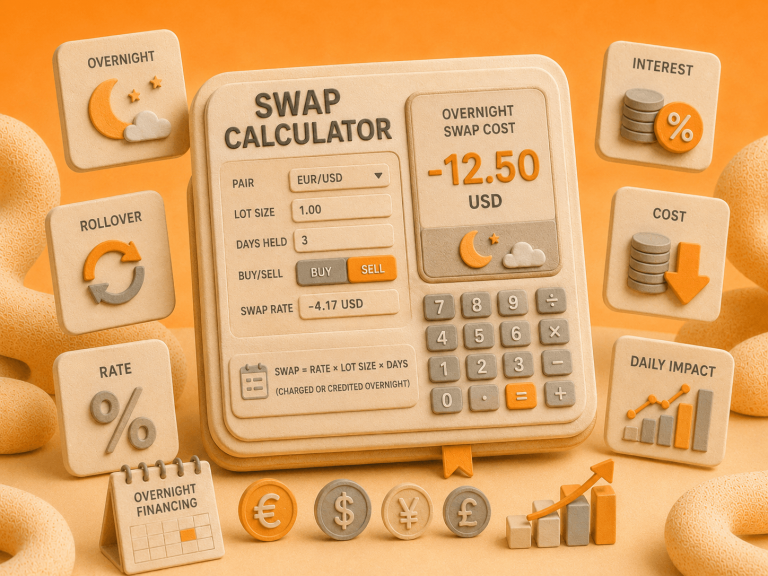
A swap fee, also called an overnight fee or overnight funding, is the cost or credit for keeping a leveraged position open after the daily rollover time. It is most relevant for forex, CFDs, commodities, indices, ETFs and crypto-style margin positions. If a trade is opened and closed before rollover, there is usually no overnight fee to calculate.
The practical formula depends on how the platform shows the swap:
- If swap is shown as a percentage: swap = position value x daily swap rate x chargeable nights
- If swap is shown per lot: swap = lot size x swap per lot x chargeable nights
The important phrase is chargeable nights. A position held over a weekend may count as more than one overnight charge because markets settle across non-trading days. Many platforms apply a triple rollover on a specific day of the week, but the exact day and rate can vary by asset and broker. Always use the live trading conditions in the platform before holding a trade overnight.
Use the calculator below to estimate the overnight fee before you decide whether a trade is worth holding.
How to use this swap calculator
The fastest way to use the calculator is:
- Choose how the platform shows swap: percentage or per lot.
- Enter the position value or lot size.
- Enter the long and short swap values separately.
- Enter how many nights you plan to hold the position.
- Turn on triple rollover if the holding period crosses the platform’s weekend adjustment.
- Compare the long and short estimates with your planned take-profit.
The calculator intentionally shows both long and short results because swap is often direction-dependent. A buy position may have a negative overnight cost while a sell position on the same instrument may have a smaller cost or even a credit.
Use positive rates for fees and negative rates for credits in the percentage mode. In per-lot mode, enter the sign exactly as it appears in the platform: for example, -6.00 if the platform shows a cost, or +2.00 if it shows a credit.
Why long and short swap can be different
Swap is not just a random platform fee. In forex, it is connected to the difference between the interest rates of the two currencies in the pair. In CFDs, it may reflect financing, liquidity and instrument-specific holding costs.
That is why the long and short side can be different:
- Going long means you are effectively holding one side of the instrument.
- Going short means you are holding the opposite exposure.
- The financing calculation can favor one direction more than the other.
- Broker markups and asset-specific rules can also affect the final number.
This does not mean traders should choose direction because of swap alone. Direction should come from the trade setup. But if two setups are similar and one has a much worse overnight cost, swap becomes part of the decision.
What the calculator actually tells you
Most traders understand spread because they see it immediately when they open a position. Swap is easier to ignore because it appears later.
The calculator answers four practical questions:
- How much can one overnight hold cost?
- What happens if the position crosses a triple-rollover day?
- How does the fee change when position size increases?
- Is the overnight cost small enough compared with the trade target?
The last question is the one that matters. A $2 overnight fee is not automatically bad. It may be irrelevant on a trade targeting $150. It may be very expensive on a small scalping idea where the target is only $8.
In practice, swap should be checked before a trade becomes a swing trade by accident.
The basic swap formula
If the overnight fee is quoted as a daily percentage of position value, use:
Swap fee = position value x daily swap rate x chargeable nights
Example:
- Position value: $1,000
- Daily overnight rate: 0.05%
- Chargeable nights: 3
Calculation:
$1,000 x 0.05% x 3 = $1.50
If the platform shows swap as a value per lot, use:
Swap fee = lot size x swap per lot x chargeable nights
Example:
- Lot size: 0.20
- Swap per lot: -$6.00
- Chargeable nights: 3
Calculation:
0.20 x -$6.00 x 3 = -$3.60
A negative result means the swap is a cost. A positive result means the swap is a credit. In many beginner trades, especially leveraged CFD trades, traders should expect swap to be a cost unless the live platform shows otherwise.
If swap is shown in points
Some platforms show swap in points instead of account currency or percentage. In that case, the exact conversion depends on the instrument specification: contract size, point size, quote currency and account currency.
A simplified forex-style formula is:
Swap = lot size x contract size x point size x swap points x chargeable nights
Example:
- Lot size: 0.10
- Contract size: 100,000
- Point size: 0.00001
- Swap points: -5.2
- Chargeable nights: 3
Calculation:
0.10 x 100,000 x 0.00001 x -5.2 x 3 = -$1.56 before any currency conversion.
This is why the platform’s specification matters. A point-based swap value cannot be interpreted safely without knowing what one point is worth for that asset.
What counts as position value?
Position value is the full market exposure of the trade, not just the margin held.
This is the mistake many beginners make. If you open a leveraged position, the overnight fee is usually connected to the position value, not the small amount of margin visible on the order ticket.
For example:
- Account balance: $500
- Position value: $2,000
- Margin held: $100
- Daily swap rate: 0.05%
The swap estimate is based on the $2,000 position value:
$2,000 x 0.05% = $1.00 per chargeable night
Not:
$100 x 0.05% = $0.05
That difference looks small in one trade. It becomes meaningful if the position is large, held for several days, or crosses a weekend.
What is triple swap?
Triple swap is an overnight charge that counts more than one day at once. It exists because financial instruments may settle across weekends or non-trading days even though the platform is not open every hour for every market.
For a trader, the practical effect is simple:
- One overnight hold may count as three chargeable nights
- A normal one-night fee can suddenly look three times larger
- The exact timing may vary by instrument and broker
Do not memorize “Friday is always triple swap” as a universal rule. For many instruments, weekend adjustment is commonly applied near the end of the trading week, but the live trading conditions are the only safe reference.
If you plan to hold a leveraged position for several days, check whether one of those days has a weekend/rollover adjustment. That single line can change the trade’s cost.
Example 1: forex CFD held for one night
Imagine a trader opens a forex CFD position worth $1,500. The platform shows an overnight rate of 0.04%.
If the position is held for one chargeable night:
$1,500 x 0.04% x 1 = $0.60
That may be small enough to ignore for a larger swing trade. But it is still part of the trade cost. If the trader holds for 10 chargeable nights, the same rate becomes:
$1,500 x 0.04% x 10 = $6.00
The trade has to overcome spread, possible slippage and $6 of overnight cost before it is truly profitable.
Example 2: CFD held through a triple rollover
Now imagine a trader opens a position worth $3,000 with a daily overnight rate of 0.06%.
One normal night:
$3,000 x 0.06% = $1.80
If that overnight hold counts as three chargeable nights:
$3,000 x 0.06% x 3 = $5.40
This is why a trade that looks cheap on Wednesday can feel expensive after the rollover adjustment. The market may barely move, but the position still has a holding cost.
Example 3: swap shown per lot
Some forex platforms show swap as a value per lot for long and short positions.
Suppose the long swap for a pair is -$7.50 per lot, and a trader holds 0.10 lots for five chargeable nights.
0.10 x -$7.50 x 5 = -$3.75
If the short swap on the same pair is +$2.00 per lot, a 0.10-lot short position for five chargeable nights would estimate:
0.10 x $2.00 x 5 = +$1.00
This is why direction matters. Long and short swaps can be different because they reflect different financing and rate conditions.
Swap vs spread vs commission
Swap is only one trading cost.
| Cost | When it appears | What beginners often miss |
|---|---|---|
| Spread | When opening and closing the trade | It affects almost every trade immediately |
| Commission | When opening, closing, or both, depending on instrument | Some instruments may have separate transaction costs |
| Swap / overnight fee | When the position stays open after rollover | It can grow over time and may triple around weekends |
| Slippage | When execution differs from expected price | It is more likely around volatility, gaps and low liquidity |
Short-term traders usually focus on spread. Swing traders need to care more about swap because the fee repeats.
When swap matters most
Swap is not equally important in every trade.
It matters more when:
- The position is leveraged
- The position value is large compared with the account
- The trade is held for several days
- The trade crosses a weekend adjustment
- The target profit is small
- The asset has a high overnight rate
- The trader keeps losing positions open longer than planned
It matters less when:
- The trade is intraday and closed before rollover
- The position size is small
- The target is much larger than the overnight cost
- The trade is planned with a clear holding period
The dangerous situation is not paying a small swap fee. The dangerous situation is holding a trade without knowing whether the fee changes the expected outcome.
A practical pre-hold checklist
Before leaving a CFD or forex position open overnight, check:
- What is the current position value?
- What is the live overnight rate or swap value?
- Is the swap different for long and short positions?
- How many chargeable nights will the trade likely be open?
- Is there a triple-rollover day during the planned hold?
- How much is the swap compared with the planned take-profit?
- Would the trade still make sense if the market goes sideways for two or three days?
If the trade only works when it moves quickly in your favor, it may not be a good overnight trade.
Common swap mistakes
Using margin instead of position value. Overnight fees are usually connected to the full exposure, not only the margin held.
Ignoring triple rollover. A trader may expect one small overnight fee and then see a larger weekend adjustment.
Assuming long and short swaps are the same. They often are not. Direction can change the fee.
Holding a day trade because it is slightly negative. This is how a small intraday mistake becomes a multi-day position with extra cost.
Checking swap after opening the trade. The fee should be part of the plan before the trade is opened.
Forgetting that rates can change. Swap values are not permanent. They may change with market conditions, interest rates, liquidity and broker settings.
How to reduce overnight-fee surprises
You cannot remove swap from every leveraged position, but you can avoid most surprises.
Use a simple rule:
- If the trade is intraday, know the rollover time.
- If the trade is multi-day, calculate swap before entry.
- If the trade crosses a weekend, calculate the triple adjustment.
- If the swap is large compared with the target, reduce size or skip the hold.
For beginners, the cleanest approach is to decide before entry whether the trade is intraday or swing. Mixing the two creates poor decisions. A trade entered for a 20-minute setup should not become a five-day hold just because it went negative.
FAQ
What is swap in trading?
Swap is an overnight fee or credit applied when a leveraged forex or CFD position remains open after the daily rollover time. It reflects the cost of holding exposure overnight.
How do I calculate swap?
If the platform shows a percentage, use: position value x daily swap rate x chargeable nights. If it shows swap per lot, use: lot size x swap per lot x chargeable nights.
Is swap always a fee?
Not always. Some instruments and directions may show a positive swap credit. Many CFD trades, however, have a negative overnight cost. Check the live long and short swap values before holding.
What is triple swap?
Triple swap means one rollover counts as three chargeable nights, usually to account for weekend settlement. The exact timing can vary by instrument and broker, so check the trading conditions in the platform.
Does swap apply to every trade?
No. Swap usually applies to leveraged positions held overnight, such as forex and CFDs. Short-term option-style products that are not held overnight generally do not have swap.
Bottom line
A swap calculator is useful because it turns an easy-to-ignore fee into a number you can compare with your trade plan.
If the overnight fee is tiny compared with your expected profit, it may not matter much. If the fee is large, repeated, or tripled near the weekend, it can quietly damage the trade’s risk/reward.
Before holding a leveraged position overnight, check the position value, swap rate, direction, chargeable nights and rollover schedule. That small habit can prevent a lot of “why did my balance change?” moments later.