
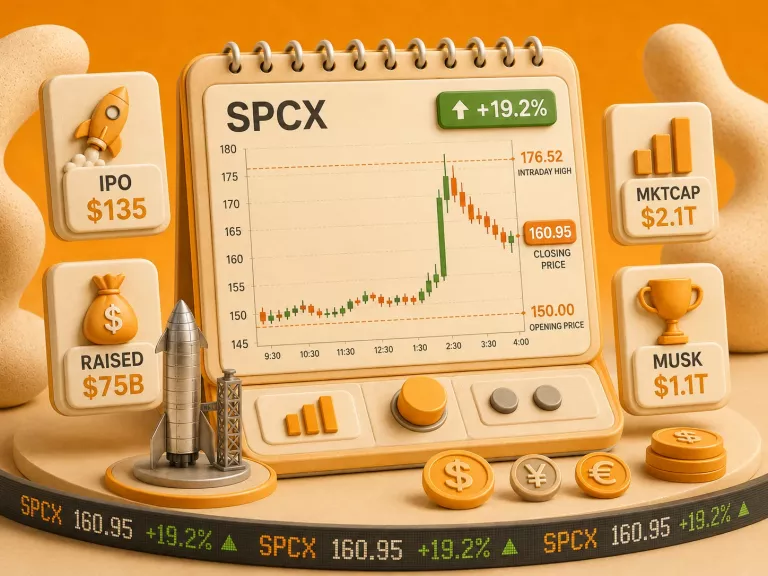
Yesterday SpaceX went public under the ticker SPCX at a valuation of $1.77–1.8 trillion and raised $75 billion — twice the previous record set by Saudi Aramco.
Markets are in full euphoria mode: shares were initially priced at $135 each, but on the very first day of trading they opened at $150, up 11%, then rocketed to $176.52 (a 30% premium over the IPO price) before closing at $160.95 — a first-day gain of 19.2%.
The company’s market cap has already surpassed $2.1 trillion, making SpaceX the sixth-largest public company in the United States.
Demand was enormous — retail investors who placed orders totaling over $100 billion received an unusually high allocation of 20 to 25 percent of all shares on offer.
The listing made Elon Musk the world’s first trillionaire in history: his ~42% stake in SpaceX is now worth up to $982 billion depending on the calculation methodology; add his $280 billion Tesla stake, plus holdings in Neuralink and The Boring Company at roughly $3 billion each, and Musk’s total net worth hits $1.1 trillion (!). To put that in perspective — that’s more than the combined wealth of the next five richest people on the planet, and exceeds the entire GDP of countries like Sweden or Ireland.
What SpaceX Plans to Do With $75 Billion
The capital raised will fund several ambitious projects:
First, accelerating development of the Starship super-heavy rocket, building out a lunar economy, and laying the groundwork for a Mars colony by 2030.
Second, deploying an orbital network of AI data centers capable of running on solar power and cooled naturally by the vacuum of space.
A portion of the funds will also go toward repaying a $20 billion bridge loan that SpaceX took on to consolidate with AI startup xAI and the social platform X (formerly Twitter), refinancing older debt in the process.
$2 Trillion Valuation, $4.9 Billion Loss: The Real Picture
That said, SpaceX’s current financials look pretty modest against a $2 trillion valuation: in 2025, the company posted $18.7 billion in revenue, a net loss of $4.9 billion, and negative free cash flow of $13.8 billion.
The entire bet, however, is on the future.
Goldman Sachs projects SpaceX revenue will reach $474 billion by 2030, with $322 billion of that coming from AI-related operations.
Morgan Stanley goes even further: their analysts forecast total revenue growing 182x by 2040 to $3.4 trillion, with net income swinging from a $4.9 billion loss to a $2.7 trillion profit.
Not Everyone Is Buying the Story
The IPO prospectus, for its part, runs to 38 pages of risk factors — including the company’s dependence on Musk personally and fierce competition in the AI space.
The SpaceX IPO has already rippled through the market — shares in competitors like Rocket Lab dropped more than 10% — while the success of the listing has “cleared the runway” for Anthropic and OpenAI, both of which are preparing their own trillion-dollar IPOs later this year.
Critics, however, are calling SpaceX’s valuation heavily inflated: Morningstar estimates there’s a 43% probability of a bear-case scenario in which the company’s value could fall below $611 billion.
And even with all those records, SpaceX may find itself upstaged within a month: tech giant Alphabet, Google’s parent company, has announced plans to raise $85 billion to fund AI expansion — and if it goes through, that offering could become the largest listing of 2026, eclipsing even SpaceX’s debut.
For a structured, trader-focused view of what comes next for SPCX — including key price levels, Starlink metrics, AI spending, and post-IPO share supply — see our full SpaceX post-IPO guide.