

Cross margin uses your entire account balance as collateral for every open position. Isolated margin assigns a fixed amount of collateral to each trade individually. The difference determines how much you can lose when a trade goes wrong – and how quickly liquidation kicks in.
Key takeaway: Cross margin gives positions more room before liquidation but puts your full balance at risk. Isolated margin caps your maximum loss per trade but triggers liquidation sooner. Most experienced traders use cross margin for hedged portfolios and isolated margin for speculative bets where they want strict risk limits.
What Is Margin Trading?
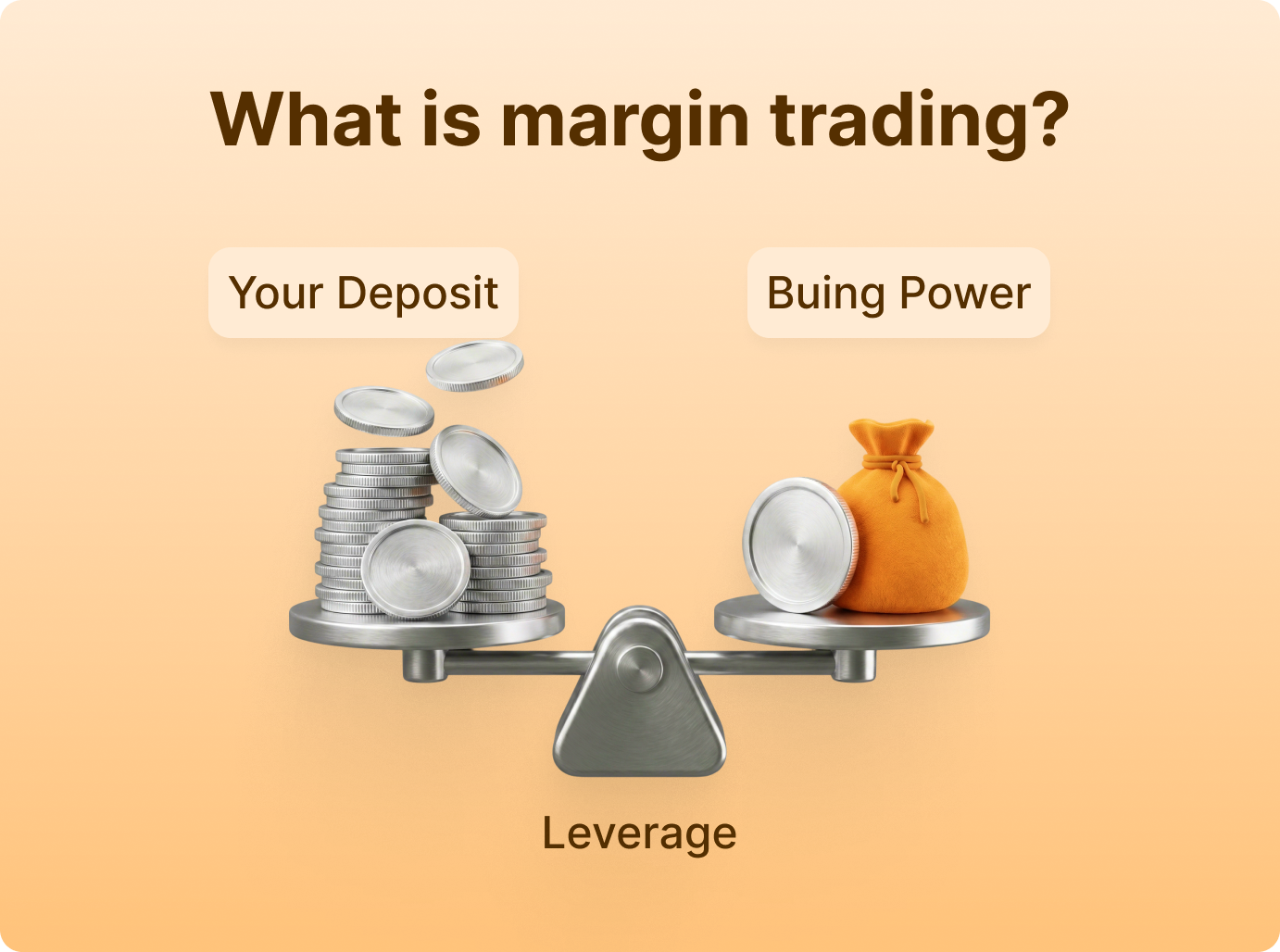
Margin trading lets you open positions larger than your account balance by borrowing against your deposited funds. Your deposit acts as collateral – called “margin” – and the ratio between your position size and margin is your leverage.
For example, with $1,000 margin and 20x leverage, you control a $20,000 position. If the trade goes your way, gains are amplified. If it goes against you, losses are amplified too – and if your collateral drops below a threshold, the platform liquidates your position to prevent further loss.
The question is: how does the platform calculate that collateral? That’s where cross margin and isolated margin differ.
What Is Cross Margin?
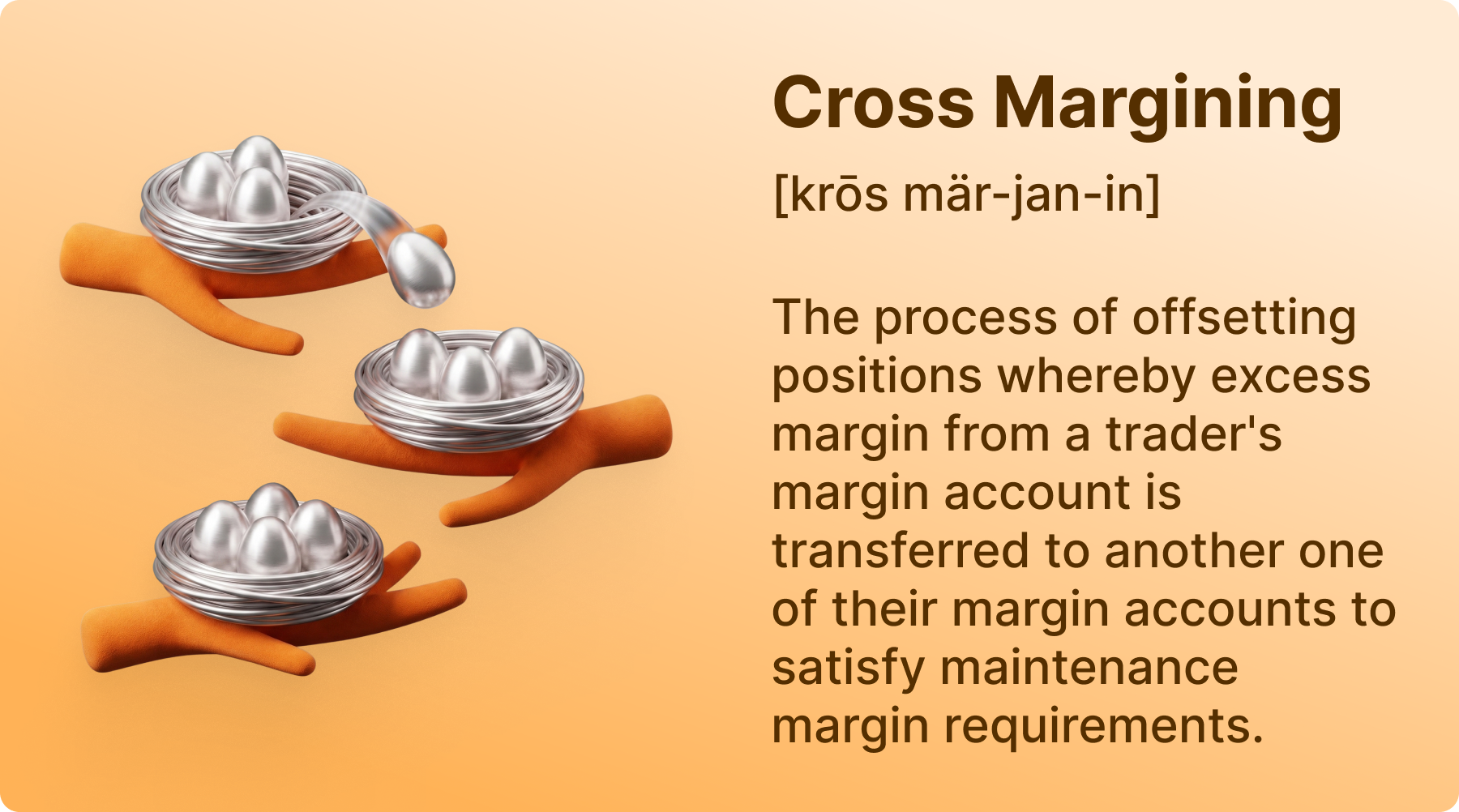
Cross margin – sometimes called “spread margin” – pools your entire available account balance as shared collateral across all open positions. Every position draws from the same pool. Unrealized profits from one trade can offset losses on another.
How Cross Margin Works
Say you have $10,000 in your account and open two positions:
- Position A: Long EUR/USD, $5,000 margin, 20x leverage ($100,000 notional)
- Position B: Long gold, $3,000 margin, 10x leverage ($30,000 notional)
You’ve used $8,000 in margin. With cross margin, the remaining $2,000 – plus any unrealized profit from either position – also acts as a buffer against liquidation on both trades.
If Position A moves against you, the platform dips into that $2,000 surplus (and any gains from Position B) before liquidating. This means your EUR/USD trade can survive a larger adverse price move compared to isolated margin.
But if both positions go wrong at the same time, you can lose all $10,000. There’s no firewall between trades.
Advantages
- More breathing room – positions survive larger price swings before liquidation
- Capital efficient – unrealized profits can support new positions or cover losses elsewhere
- Better for hedging – offsetting positions (long one asset, short a correlated one) naturally reduce net exposure
- Lower liquidation frequency – temporary wicks are less likely to trigger forced closes
Risks
- Full account exposure – one bad trade can drain your entire balance
- Cascading liquidation – if one position eats into shared margin, it can trigger liquidation on other positions too
- Harder to track risk per trade – your exposure is blended across everything
What Is Isolated Margin?
Isolated margin assigns a specific amount of collateral to each individual position. That amount – and only that amount – is at risk. The rest of your account balance stays untouched, no matter what happens to the trade.
How Isolated Margin Works
Same scenario: $10,000 account, two positions:
- Position A: Long EUR/USD, $5,000 isolated margin, 20x leverage
- Position B: Long gold, $3,000 isolated margin, 10x leverage
If Position A goes against you, the platform can only liquidate that position’s $5,000. Your $3,000 on gold and the $2,000 free balance are completely protected.
The trade-off: your EUR/USD position has less buffer. It gets liquidated at a smaller adverse price move than it would under cross margin, because only $5,000 backs it instead of $10,000.
Most platforms let you manually add more margin to an isolated position if you see it approaching liquidation. This gives you the control of isolated margin with the flexibility to extend a trade’s runway when you choose to.
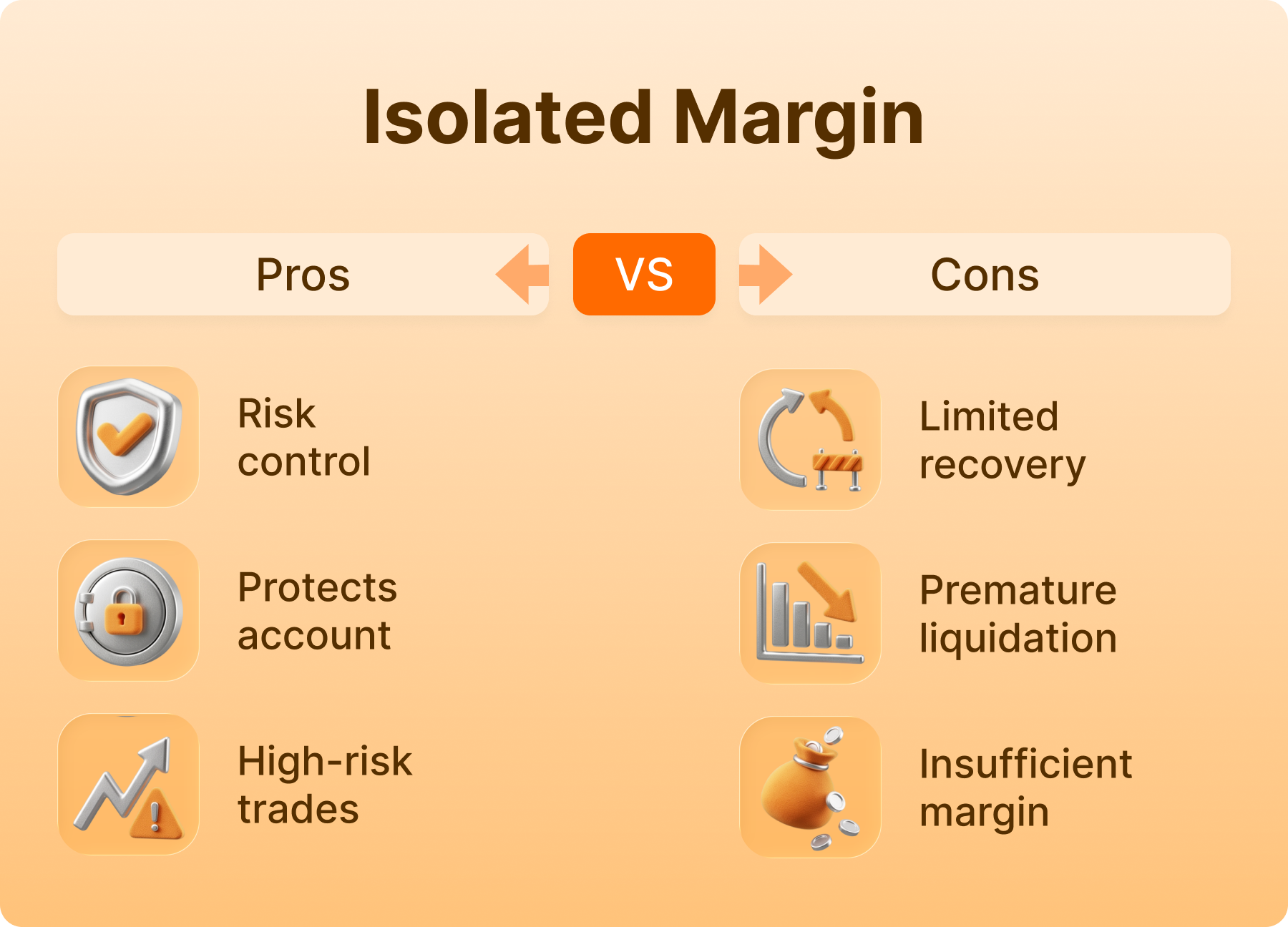
Advantages
- Capped downside – you know your maximum loss before entering the trade
- No cascading risk – one bad trade can’t wipe out positions in unrelated assets
- Clearer risk accounting – you can see exactly how much is at stake per position
- Good for experimentation – test higher-leverage strategies without risking your core balance
Risks
- Faster liquidation – less collateral means the liquidation price is closer to your entry
- Vulnerable to wicks – short-lived price spikes can liquidate a position that would have survived under cross margin
- Less capital efficient – funds locked in one position can’t help another
Cross Margin vs Isolated Margin: Key Differences
| Dimension | Cross Margin | Isolated Margin |
| Collateral scope | Entire account balance | Fixed amount per position |
| Maximum loss | Full account balance | Only the assigned margin |
| Liquidation threshold | Further from entry (more buffer) | Closer to entry (less buffer) |
| Capital efficiency | High – profits offset losses across positions | Lower – funds locked per position |
| Risk isolation | No – positions share exposure | Yes – each position is independent |
| Best for | Hedging, correlated positions, experienced traders | Directional bets, high leverage, strict risk limits |
| Cascading liquidation | Possible | Not possible |
| Manual margin adjustment | Automatic (balance shared) | Manual (add margin per position) |
When to Use Cross Margin
Cross margin works best when your positions are related and you want maximum capital flexibility.
Hedged portfolios. If you’re long EUR/USD and short GBP/USD, those positions partially offset each other. Cross margin lets the net exposure determine your margin requirement rather than treating each trade independently.
Multiple correlated positions. Running several trades across related instruments (forex pairs, index CFDs, sector ETFs) benefits from shared collateral. Gains on one offset temporary drawdowns on another.
Lower-leverage strategies. With moderate leverage (5-10x), the risk of full account liquidation is lower. Cross margin gives you efficient capital use without extreme downside.
Volatile markets where wicks are common. If you trade assets prone to sharp intraday reversals, cross margin reduces the chance of getting liquidated on a temporary spike that reverses within minutes.
Experienced traders with active risk management. If you monitor positions closely and use stop-losses consistently, cross margin’s capital efficiency is an advantage rather than a liability.
When to Use Isolated Margin
Isolated margin works best when you want to strictly control how much you can lose on a single trade.
High-leverage directional bets. Using 50x or 100x leverage on a single trade? Isolated margin means you only lose the margin you assigned – not your entire account – if the trade goes wrong.
Testing a new strategy. Trying out an unfamiliar asset, timeframe, or approach? Isolated margin lets you experiment without putting your core portfolio at risk.
Uncorrelated positions. If your trades have no logical relationship to each other, sharing margin doesn’t help you. Isolated margin gives you a clean view of risk per position.
Risk-per-trade rules. Many traders follow a “risk no more than 1-2% of capital per trade” rule. Isolated margin enforces this mechanically – you assign the exact amount you’re willing to lose.
When you can’t actively monitor. If you set a trade and walk away, isolated margin limits damage even if the market moves sharply while you’re offline.
Which Is Better for Beginners?
Isolated margin. Almost always.
New traders are still learning how leverage amplifies both gains and losses. Isolated margin puts a hard ceiling on what any single mistake can cost. A beginner using 20x leverage in cross margin mode could lose their full deposit on one trade that goes wrong overnight. With isolated margin, they lose only what they allocated.
Start with isolated margin, learn how liquidation actually works on your platform, and switch to cross margin once you have a tested strategy and active risk management habits in place.
Common Margin Trading Mistakes
Regardless of which mode you use, these mistakes catch traders at every experience level.
Ignoring the liquidation price. Every position has a liquidation level. Know it before you enter. If you can’t accept that price being hit, reduce your leverage or position size.
Using cross margin without stop-losses. Cross margin without risk management is effectively “all-in” on every trade. The flexibility is pointless if you don’t use it deliberately.
Over-leveraging in isolated margin. Just because your loss is capped doesn’t mean you should use maximum leverage. A 100x isolated margin trade with $500 still means you lose $500 – and positions at extreme leverage get liquidated by the smallest price moves.
Holding too many cross-margin positions at once. Each new position in cross margin mode adds exposure that draws from the same collateral pool. What looked like four reasonable trades individually might be one concentrated bet when they’re all correlated.
Forgetting about funding rates and fees. In perpetual futures and leveraged CFDs, holding costs accumulate. A position that’s not getting liquidated can still drain your margin slowly through overnight fees, swaps, or funding rates.
Not checking your margin mode before placing a trade. On many platforms, margin mode defaults to one setting and stays there until you change it. Double-check before every trade, especially if you switch between modes.
Treating margin mode as a substitute for a trading plan. Isolated margin limits your downside per trade, but it doesn’t fix a bad entry, a missing stop-loss, or position sizing that’s too aggressive. Margin mode is a risk tool, not a strategy.
Margin Regulation: What Traders Should Know
Regulators in major markets set strict rules around margin trading to protect retail traders. If you trade through a regulated broker, these rules affect you directly.
ESMA (European Securities and Markets Authority) caps leverage for EU retail traders at:
- 30:1 for major currency pairs (3.33% margin)
- 20:1 for non-major forex, gold, and major indices (5% margin)
- 10:1 for commodities and non-major indices (10% margin)
- 5:1 for individual equities (20% margin)
- 2:1 for cryptocurrencies (50% margin)
ESMA also requires a margin close-out rule at 50% of required margin, plus negative balance protection – meaning retail traders cannot lose more than their deposit. As of February 2026, ESMA clarified that these restrictions extend to any derivatives marketed under alternative names (such as perpetual futures or perpetual contracts) that meet the CFD definition under MiFID II.
The FCA in the UK applies similar leverage limits and additionally requires brokers to display standardized risk warnings showing the percentage of retail accounts that lose money.
These regulations exist regardless of whether you use cross or isolated margin. But they directly affect how much leverage your platform can offer and how quickly positions must be closed when margin runs low.
Quick Decision Guide
Use this as a starting point, not a rigid rule:
| Your situation | Recommended mode |
| New to margin trading | Isolated |
| Running hedged or correlated positions | Cross |
| Taking one high-conviction directional trade | Isolated |
| Using high leverage (20x+) | Isolated |
| Managing a diversified portfolio of moderate-leverage trades | Cross |
| Testing a new strategy or unfamiliar asset | Isolated |
| Trading volatile assets with frequent wicks | Cross (with stop-losses) |
| Setting positions and walking away | Isolated |
Neither mode is inherently safer. Cross margin reduces liquidation frequency but increases liquidation severity. Isolated margin limits how much you lose but makes it easier to get stopped out. Your choice should match your strategy, risk tolerance, and how actively you manage your positions.