

Penny stocks are low-priced shares, usually linked to small companies, often trading below $5 per share in U.S. markets. They attract attention because they look affordable, but they are often riskier, less liquid, and less transparent than regular stocks.
That’s the key point beginners often miss. A low share price does not automatically mean a stock is cheap in a meaningful sense, safer to buy, or more likely to rise. Many penny stocks trade in thinner markets, move sharply on speculation, and may offer far less reliable information than larger public companies.
Penny Stocks at a Glance
Before getting into the details, here’s the short version:
| Topic | Quick Answer |
| What is a penny stock? | A low-priced stock, often below $5 per share |
| What kind of companies issue them? | Usually smaller, less established businesses |
| Where are they often traded? | Frequently in OTC markets, though some trade on major exchanges |
| Main attraction | They look affordable and can move sharply |
| Main risk | Low price often comes with low liquidity, limited transparency, and high volatility |
| Suitable for beginners? | Often not ideal, especially for people who don’t yet understand trading risk and market structure |
This table is useful because it frames the topic correctly from the start: penny stocks are not just “cheap stocks.” They are a different market environment.
What Are Penny Stocks?
Penny stocks are shares of companies that trade at relatively low prices. In the U.S., the most common rule of thumb is stocks trading below $5 per share. That’s the definition many brokers, educators, and market participants use in everyday language.
But price alone is not enough to understand them properly.
When people talk about penny stocks, they are usually also referring to a type of company and a type of market behavior. Penny stocks are often associated with:
- smaller businesses
- limited operating history
- lower trading volume
- weaker public visibility
- less analyst coverage
- higher uncertainty
That’s why penny stock meaning is broader than “a stock under $5.” A share price of $1 doesn’t tell you whether the business is strong, weak, growing, unprofitable, easy to trade, or hard to evaluate. It only tells you what one share costs.
This is one of the biggest beginner misunderstandings. A stock trading at $1 can be far riskier than one trading at $100. Risk is shaped by factors like liquidity, company quality, transparency, and volatility — not just price per share.
Definitions can also vary depending on the country or market. In some regions, the term is used more loosely for speculative, low-priced shares. Still, the general idea remains the same: penny stocks are typically low-priced shares of smaller, riskier companies that often trade in thinner or less transparent market environments.
So the best answer to what are penny stocks is not just “cheap shares.” It is:
Low-priced shares, usually tied to smaller companies, that often come with higher risk, lower liquidity, and less transparency than regular stocks.
Where Penny Stocks Are Traded
Where a stock trades matters. It affects how much information is available, how easy the stock is to buy and sell, and how strong the listing standards are.
Major exchanges
Some low-priced stocks still trade on major exchanges. That usually happens when:
- a listed company’s share price has fallen sharply
- a smaller company still meets exchange requirements despite having a low stock price
These stocks may still benefit from stronger reporting rules and more visibility than many OTC stocks. But a low price on a major exchange can still signal financial weakness, weak investor confidence, or a business going through serious pressure.
So while exchange-listed low-priced stocks can be different from the most speculative penny stocks, price alone still should not be treated as a green light.
Over-the-counter (OTC) markets
A large share of penny stocks are found in over-the-counter (OTC) markets.
OTC trading is more decentralized than trading on a major exchange. Instead of one central exchange environment, transactions often happen through networks of dealers. That structure can come with:
- fewer listing requirements
- lower disclosure standards
- less analyst coverage
- lower trading activity
- wider spreads between bid and ask prices
That does not mean every OTC stock is fraudulent or automatically untradeable. But it does mean the environment often requires more caution.
Why the trading venue matters
For beginners, this is one of the most practical takeaways: the same share price can mean very different things depending on where the stock trades.
| Trading Venue | Typical Features | Why It Matters |
| Major Exchange | Stronger listing rules, more visibility, better reporting | Usually easier to research and trade |
| OTC Market | Less centralized, lighter requirements, less visibility | Often harder to evaluate and riskier to trade |
A cheap stock on a major exchange may still be risky. But a cheap stock in a thin OTC market often adds another layer of risk: market quality risk.
Main Characteristics of Penny Stocks
Penny stocks tend to share a few common traits. Not every company will match each one perfectly, but together they explain why penny stocks behave differently from regular stocks.
1. Low share price
This is the feature people notice first. Many penny stocks trade below $5, and some trade below $1 or even a few cents.
The low price is part of the appeal — but also part of the trap. People often assume that if the number is small, the downside must be limited. In reality, a low-priced stock can still lose a large percentage of its value very quickly.
2. Small market capitalization
Many penny stocks represent companies with smaller market capitalizations. These businesses may be early-stage, financially weak, or simply too small to attract serious institutional attention.
That can mean:
- less stable revenue
- fewer operating resources
- less predictable growth
- more business uncertainty
3. Low liquidity
Liquidity is one of the most important ideas here. It refers to how easily a stock can be bought or sold without significantly moving the price.
In penny stocks, liquidity is often limited. That means:
- fewer buyers and sellers
- harder trade execution
- greater slippage
- more difficulty exiting during stress
4. High volatility
Penny stocks can move sharply in a short time. A burst of buying can push them much higher. A loss of interest can send them lower just as fast.
This is why low price stocks explained properly always includes volatility. The stock may look harmless at $0.80, but a move from $0.80 to $0.40 is still a 50% drop.
5. Limited transparency
Some penny stock companies provide less information, have thinner reporting histories, or receive less outside coverage than larger public businesses.
That makes them harder to evaluate, especially for beginners who are still learning how to assess companies.
Summary table
| Characteristic | What It Means in Practice |
| Low share price | Looks affordable, but may create a false sense of safety |
| Small company size | Often less stable, less proven, and more uncertain |
| Low liquidity | Harder to buy and sell smoothly |
| High volatility | Bigger percentage swings in short periods |
| Limited transparency | Less reliable information for decision-making |
Why Penny Stocks Attract Attention
Penny stocks attract attention for very understandable reasons.
They look affordable
A stock trading at $1 or $2 feels more accessible than one trading at $150. For beginners, that can create the impression that penny stocks are a more realistic entry point.
They create the illusion of “more upside”
Many people think a cheap stock has more room to rise simply because the number is small. But that is not how valuation works. A stock at $1 is not automatically more “undervalued” than a stock at $100.
Percentage gains sound dramatic
A move from $0.50 to $1.00 is a 100% increase. Stories like that spread quickly because they sound exciting, even if they are not common or repeatable.
They are heavily promoted online
Penny stocks are often discussed in social media posts, chat groups, newsletters, and promotional content. That can make them look more popular, more active, or more promising than they really are.
The key misconception
This is the correction beginners need most:
Low price does not equal undervaluation.
A stock can be cheap because:
- the company is weak
- the business is unclear
- the stock is hard to trade
- investor confidence is low
- public information is limited
- the market sees serious risk
That’s why penny stocks often attract attention — but not always for the right reasons.
Risks of Penny Stocks
This is the most important section in the article. If someone asks are penny stocks safe, the honest answer is that they often carry higher and less obvious risks than regular stocks.
1. Lack of transparency
Many penny stock companies offer less detailed or less consistent public information than larger companies. Some receive little research coverage. Some are hard to understand from the outside.
That makes it harder to answer basic questions:
- What does the company actually do?
- Is the business stable?
- Does it have real revenue?
- Is the price move tied to fundamentals or just attention?
2. High volatility
Penny stocks can move rapidly and unpredictably. That makes them emotionally attractive to some traders, but difficult for beginners to handle.
A stock can surge on attention, then reverse just as quickly. If the move is driven more by excitement than by underlying business quality, the instability can be even greater.
3. Low liquidity
Low liquidity is not just a technical issue. It affects real outcomes.
A stock may appear active, but when you try to buy or sell, you may find:
- fewer participants than expected
- wider spreads
- poor execution
- more slippage
4. Market manipulation
Penny stocks are more exposed to manipulation than large, heavily followed companies.
One of the most common examples is a pump-and-dump scheme:
- A stock is aggressively promoted
- Attention and demand push the price up
- Early promoters sell into that demand
- The price collapses
5. Business risk
Many penny stock companies are small because they are uncertain businesses. Some are unproven. Some are financially weak. Some may never scale into stable, established companies.
That means the risk is not only in the stock price — it may be in the business itself.
Risk summary table
| Risk | What It Looks Like | Why It Matters |
| Low transparency | Limited disclosures, unclear business details | Harder to evaluate the company |
| High volatility | Sharp price jumps and drops | Harder to manage emotionally and practically |
| Low liquidity | Thin trading, wide spreads | Harder to enter or exit at expected prices |
| Manipulation risk | Hype-driven price moves | Higher chance of distorted price action |
| Business risk | Weak or uncertain company fundamentals | Higher chance of long-term failure |
This is the real heart of penny stocks risks: not just that they move a lot, but that several layers of risk can stack on top of each other.
Penny Stocks vs Regular Stocks
A direct comparison helps remove a lot of confusion.
| Feature | Penny Stocks | Large-Cap / Regular Stocks |
| Share Price | Usually low | Often higher |
| Company Size | Usually smaller | Usually larger |
| Liquidity | Often low | Usually high |
| Transparency | Often limited | Usually stronger |
| Analyst Coverage | Low | Much broader |
| Volatility | Often high | Usually more moderate |
| Risk Level | High | Lower relative risk |
This is the clearest way to understand penny stocks vs regular stocks. The difference is not just price. It is the whole structure around the stock.
How Penny Stock Prices Move
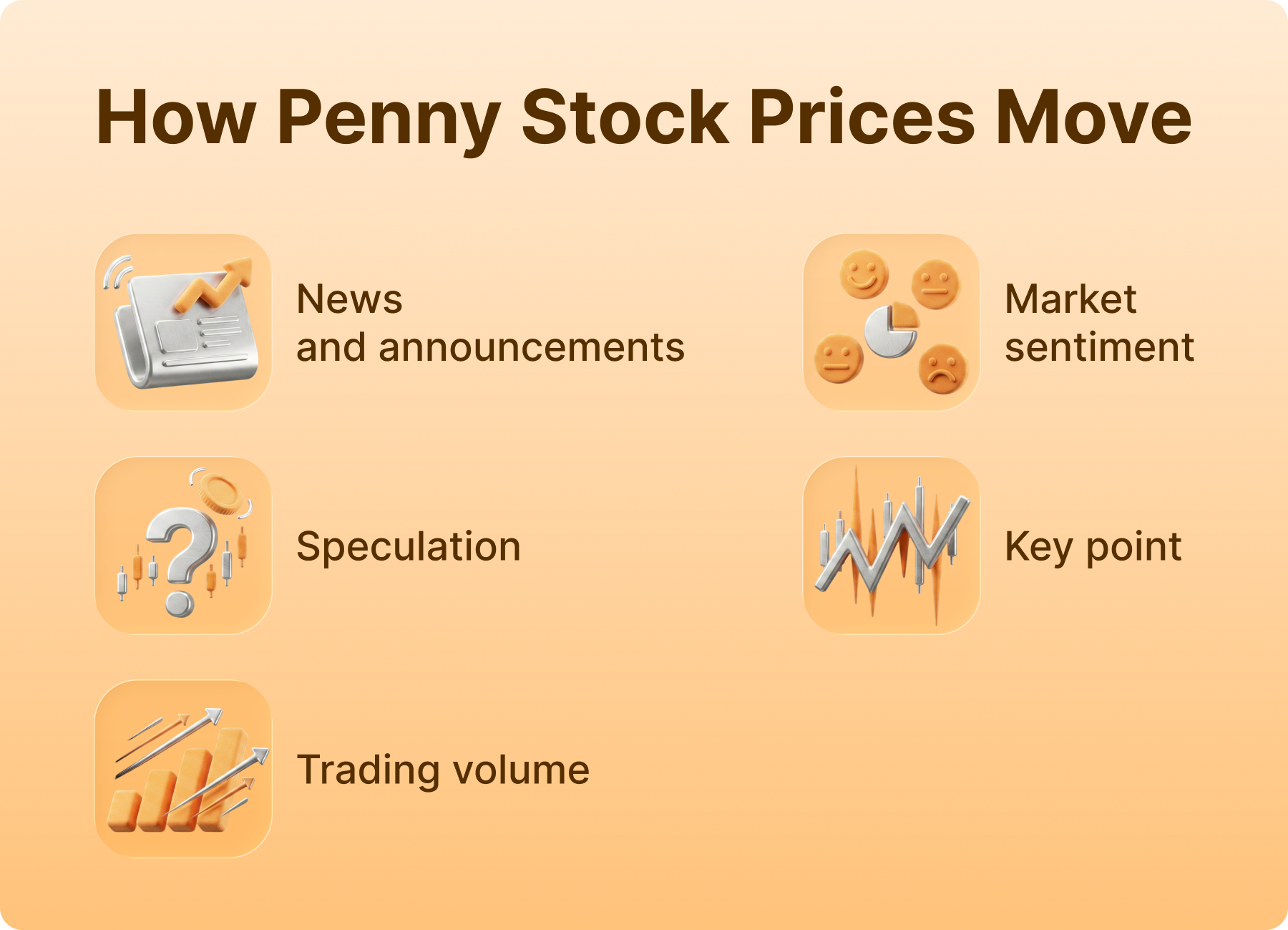
Penny stock prices can move for some of the same reasons as any other stock, but the balance is often different.
News and announcements
A company update, product headline, financing development, or regulatory event can move the price. Because penny stock companies are smaller and more fragile, even modest news can trigger exaggerated reactions.
Speculation
Speculation plays a major role in many penny stock moves. Some price action may be driven less by long-term business value and more by short-term attention, excitement, or narrative.
Trading volume
When a stock already has low liquidity, a jump in trading volume can send it sharply higher. When that attention fades, price may drop just as quickly.
Market sentiment
Penny stocks can be heavily influenced by mood. If traders become excited, price may rise much faster than fundamentals justify. If enthusiasm disappears, the move can reverse with similar speed.
Key point
In larger, well-followed companies, price tends to be more consistently tied to earnings, guidance, and business performance. In penny stocks, that connection can be weaker or less stable.
That is one reason how penny stocks work is different from how many beginners imagine the stock market works in general.
Common Penny Stock Scams
This section matters because many people first encounter penny stocks through promotion rather than through balanced research.
Pump-and-dump schemes
This is the classic example. A stock is hyped aggressively, the price rises as more people buy in, and then the people behind the hype sell, leaving late buyers exposed.
Social media promotion
Penny stocks are often promoted with:
- exaggerated upside claims
- fake urgency
- selective screenshots
- vague “big catalyst” language
- no serious discussion of risk
Cold outreach
Unsolicited stock tips through email, DMs, calls, or newsletters should be treated with caution. If an “opportunity” appears out of nowhere and pressures you to act fast, that is already a warning sign.
Red flags table
| Red Flag | Why It Matters |
| “Guaranteed” upside | Real markets do not offer certainty |
| Urgency to buy now | Pressure tactics are common in promotions |
| No discussion of risk | Promotional content often hides downside |
| Vague business story | Hard to verify what the company actually does |
| Hype without fundamentals | May signal speculation or manipulation |
Are Penny Stocks Suitable for Beginners?
For many beginners, penny stocks are not the best starting point.
That’s not because beginners should never research them. It’s because penny stocks often require more understanding of:
- volatility
- liquidity
- order execution
- market psychology
- company research
- hype and manipulation risk
They may be especially unsuitable for:
- risk-averse users
- people looking for stable long-term investing
- users who are new to reading company information
- traders who don’t yet understand market structure
So if someone asks are penny stocks safe, a practical answer is:
They are often less suitable for beginners than larger, more established stocks because the risks are harder to see and harder to manage.
That doesn’t mean every penny stock is automatically bad. It means beginners should not confuse affordability with simplicity.
How Traders Approach Penny Stocks
This section is explanatory, not promotional.
Some traders approach penny stocks as short-term speculative instruments, not as long-term investments. That usually means they focus on:
- momentum
- volume spikes
- short-term news flow
- market attention
Others may try to trade around sudden moves or rapid changes in sentiment.
The important point is that this approach is usually:
- fast-moving
- high-risk
- dependent on execution
- less tied to long-term fundamentals
This is why penny stocks are often discussed more in trading circles than in long-term investing discussions.
What to Understand Before Trading Penny Stocks
A useful article on penny stocks should give readers a practical checklist, not just definitions.
Before getting involved, understand these five things:
- Liquidity matters as much as price
A stock is not easy to trade just because it is cheap. - Research the company, not just the chart
What does the business actually do? Is the information clear and credible? - Expect volatility
Sharp percentage moves are common. - Treat hype carefully
Strong promotion is not the same as strong fundamentals. - Know that cheap can still get cheaper
A low share price does not create a floor.
Final Thoughts
If you wanted the clearest possible answer to what are penny stocks, here it is:
They are low-priced shares, usually linked to smaller companies, and they often come with more risk than their low price suggests.
That is the main idea users need to understand quickly.
The reason penny stocks attract so much attention is obvious: they look affordable and they are often surrounded by stories of big moves. But the low price is only the visible part. Behind it, there is often a riskier mix of lower liquidity, higher volatility, limited transparency, and stronger exposure to hype or manipulation.
That is why penny stocks should be understood before they are romanticized.
For beginners, the most useful mindset is simple: don’t judge a stock by price alone. Ask where it trades, how easy it is to sell, how much real information is available, and whether the company itself is understandable.
That shift — from “cheap stock” thinking to “market quality and risk” thinking — is what actually helps users make sense of penny stocks.