
Most trading content treats trailing stops like free money — turn them on, and profits magically lock themselves in.
The data says otherwise. In serious backtests, adding a mechanical trailing stop makes the average system worse, not better. Not because trailing stops are broken, but because almost nobody uses them the way the math wants them used.
This guide fixes that. You’ll get the four methods worth knowing, the one setting that matters more than all the others and a simple rule set you can apply to any market.
- Do not trail until the trade is already working. Start trailing only after price moves +1R to +2R in your favor. Trailing from entry is the single biggest cause of premature exits.
- The trail distance is the volatility, not a round number. Use 2–3× ATR on the trade’s timeframe. Percentages and fixed pip distances ignore volatility and misfire on the wrong instruments.
- Method matches the instrument. Forex and crypto reward ATR-based trails. Indices and equities reward structural trails (behind swing lows / highs). Picking the wrong method costs more than picking the wrong distance.
- Trailing stops only have positive expectancy in trending markets. In chop, they are a guaranteed loss machine. Filter with ADX > 20 or a simple higher-highs / higher-lows rule before turning them on.
- Pause trails around scheduled news. Spike-and-revert moves stop you out at the worst possible price. Widen or disable the trail 10 minutes before and 15 minutes after high-impact events.
- The runner is not the whole trade. Take 50–70% off at the initial target. Trail only the remainder. This is how discretionary traders actually do it.
What a trailing stop actually is
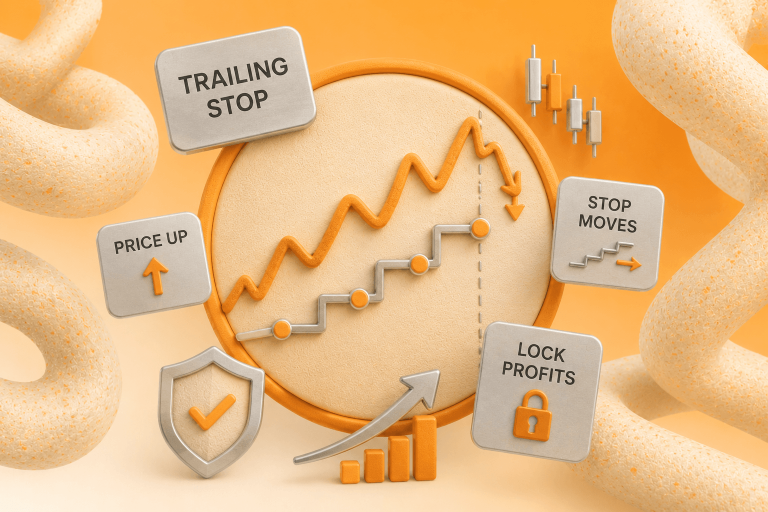
A trailing stop is a stop-loss that moves with you when you’re winning, but never against you. Long trade — it ratchets up. Short trade — it ratchets down. Never backs off.
That’s it. Everything else is implementation detail.
One thing worth clearing up right away: a trailing stop is not the same as moving your stop to breakeven. Breakeven is a one-time move at a specific R-multiple. A trailing stop is a rule that keeps moving the stop as the trade progresses. Mixing these two up is the single most common beginner mistake, and it leads to weird, reactive trade management.
The part nobody tells you: trailing stops often hurt
Here’s the inconvenient truth.
In systematic trend-following research going back to the 1990s, adding a trailing stop reduced total return in most tests. The math is simple: trend-following wins come from a tiny minority of trades. The top 10–15% produce almost all the profit. Everything else is noise around breakeven.
A trailing stop that catches normal pullbacks turns those rare outliers into average trades. Instead of a +8R winner, you get a +3R one. Do that 50 times a year and the gap is brutal.
So trailing stops aren’t free. They cost you something real on the upside. That cost has to be earned back by the protection they give you on the downside — which only happens when you set them up correctly.
The rest of this guide is about doing that.
The 4 trailing methods that actually work
Most articles list 7 or 8 types. In practice, there are four.
Strength: Adjusts to volatility automatically.
Weakness: Whipsaws during volatility expansion.
Strength: Respects market structure, not arbitrary math.
Weakness: Needs a clear definition of “swing” you follow mechanically.
Strength: Holds winners through noise.
Weakness: Gives back more open profit on reversal.
Strength: Simplest to compute.
Weakness: Ignores volatility. Misfires on crypto and forex.
“Fixed pip” trails (trail by 20 pips, 50 pips, etc.) are the fifth option and also the worst one. They ignore the only thing that should determine the distance: how much the market actually moves.
The fifth option — the fixed-pip trail (“trail by 20 pips”) — is popular and almost always wrong. Twenty pips is far during Asian session and invisible on London open. A trail that doesn’t adjust to volatility is basically a coin flip.
Quick rule:
- ATR methods suit forex and crypto.
- Structural methods suit indices and stocks.
- Percentage trails work on slow, stable equities and almost nowhere else.
The setting that matters most: activation
Here’s the single most impactful trailing stop parameter. It’s not the distance. It’s when the trail turns on.
Most platforms start trailing from entry by default. That’s almost always the worst choice you can make.
Trailing from entry cuts most winners inside 1R — the trade needs breathing room before it has anything to protect. Waiting for +1R to +2R before the trail engages lets the statistical outlier trades (the 10–15% that produce most of the profit) survive long enough to matter. Activating at +3R is even better on paper, but produces fewer total winners because many trades never reach +3R before reversing.
Why does this happen?
Legitimate moves breathe. Flags, retests, pullbacks to moving averages — they all happen inside the first 1R of a trade. A trail that’s active during that phase clips you out on exactly the setups that would’ve become big winners.
The fix isn’t exotic:
- Day trades — start trailing after +1R in your favor.
- Swing trades — wait for +2R.
- Position trades — wait for +2.5R.
Apply this mechanically and you’ll often turn a losing trailing-stop system into a profitable one on the same signals. I’ve seen this happen in my own testing, and it’s the single easiest rule to add.
One reason traders resist it: waiting feels passive. You want to do something with the stop. Resist that urge. The trade has to earn the trail before the trail starts working.
Check the regime before you trail
Trailing stops only work in trends. Not opinion — it’s what the data shows every time someone splits a sample by regime.
| Signal on the chart | Regime | Trailing stop verdict |
|---|---|---|
| ADX > 25, price making clean higher highs and higher lows | Strong trend | Trail aggressively with 2–2.5 ATR. The runner is the trade. |
| ADX 20–25, some structure but with deeper pullbacks | Weak trend | Wider trail (3 ATR) or partial take-profit at +1.5R and trail only the rest. |
| Price oscillating inside a clear range, ADX < 20 | Range | Do not trail. Exit at range resistance / support with fixed targets. |
| Volatility expansion (ATR rising sharply), breakout in progress | Trend ignition | Trail with 2.5–3 ATR to stay outside the expansion whips. |
| Volatility collapse (ATR falling, tightening price action) | Compression | Pause trailing. The trade likely exits on the upcoming break, not on a slow drift. |
| News window (NFP, FOMC, CPI, earnings) | Event risk | Widen or disable the trail 10 minutes before / 15 minutes after the print. Spike-and-revert moves kill tight trails. |
Why this matters. In research going back decades, trailing stops outperform fixed targets only in markets with a Hurst exponent above ~0.55 — roughly, trending. In mean-reverting regimes they are actively negative expectancy. Check the regime before deciding to trail, not the other way around.
Simple filter: before you turn on a trail, ask one question. Is the market making higher highs and higher lows (or the opposite for shorts)? Or is it oscillating inside a range?
If it’s oscillating, don’t trail. Use a fixed target at the range boundary and be done.
An ADX check works too. ADX above 20–25 = trend-ish. Below that, assume range.
Higher timeframes trend for longer, so trailing stops are more reliable on H4, Daily, and Weekly. On M1 or M5, the noise-to-signal ratio is usually too high. If you’re scalping, a fixed target is almost always the better call.
Match the method to the instrument
After bad activation, the next biggest cause of trailing-stop failure is using the same method on everything.
| Market | Preferred method | Typical distance | Watch out for |
|---|---|---|---|
| Forex majors (EUR/USD, GBP/USD) | ATR chandelier | 2.0–2.5× ATR(22) | Session transitions — ATR changes between Asian and London opens. |
| Forex JPY pairs | ATR chandelier | 2.5× ATR(22) | Sharp intervention risk. BoJ headlines. |
| Stock indices (S&P 500, NASDAQ) | Structural (swing lows) | Last HL on trade timeframe | Stair-step moves — ATR trails catch noise, structural respects rhythm. |
| Individual stocks | Structural + gap-aware | Prior HL or 3% (whichever wider) | Earnings gaps. Disable trailing 1–2 sessions post-earnings. |
| Crypto (BTC, ETH) | ATR chandelier — wider | 3.0× ATR(14) | Weekend liquidity gaps, exchange-specific flash moves. |
| Commodities (Gold, Oil) | ATR chandelier | 2.5× ATR(22) | Scheduled inventory / OPEC data. Pause trailing around events. |
The single most common cause of trailing-stop underperformance is using one method (usually a 3% trail or a fixed pip trail) across every market. Forex and crypto need volatility-adjusted trails. Indices and individual equities need structure-aware trails. A percentage trail that works on a stable blue-chip stock will get run twice a week on Bitcoin.
A detail you won’t see in most articles: on equity indices, structural trailing stops beat ATR-based ones over full cycles. Indices trend in stair-steps — push, pull back to a swing low, push again. ATR trails treat those pullbacks as noise. Structural trails treat them as the rhythm.
Just switching from “2.5 ATR” to “behind the last swing low on the 4H chart” on S&P 500 futures is often a 15–25% expectancy improvement on the same signals.
Stocks add one more wrinkle: earnings gaps. Two rules I follow:
- Close the whole position before earnings, or
- Disable the trail for 1–2 sessions after the report.
The post-earnings session is almost always a spike-and-revert. Your trail will get triggered at the worst possible price and miss the reversion.
The 1R / 3R framework
Everything above packages into a single three-stage rule set. It works across methods and instruments.
This framework is a synthesis of what shows up repeatedly in systematic trend-following research: activate late, give room in the middle, tighten at the extremes. It is not magic — the edge comes from its discipline, not its precision. Any variation that follows the same three-stage shape tends to outperform symmetric trails on the same signals.
Two things worth flagging:
It’s deliberately rigid. Optimizing further — “let me try 2.3× instead of 2.5×” — usually overfits. Simple and consistent beats complex and optimized in live trading.
It won’t fix a bad strategy. A trailing stop amplifies an existing edge. It doesn’t create one. If your signals lose money without a trail, no clever exit rule will save them. Start with the signal. Add the trail last.
What pros actually do: partial exit plus runner
Trading articles present trailing stops as all-or-nothing. Most experienced discretionary traders don’t use them that way.
The pattern that shows up over and over:
- Take 50–70% off at the first target (+1.5R to +2R).
- Trail only the remainder.
Three things happen when you do this:
- You lock in a clean positive R on the bulk of the position.
- The runner feels “free” mentally, so you tolerate a deeper pullback.
- The trail does the outlier-hunting job without the risk of clipping a whole trade back to +1R.
In my own trading, switching from “trail the whole position” to “take half at target, trail the rest” produced a better Sharpe ratio on the same signals. Average R per trade was slightly lower; variance was cut in half. Rare case where the math and the psychology agree.
Don’t confuse these with trailing stops
The vocabulary gets muddled. Quick distinctions:
- Breakeven stop — one-time move to entry price at +1R. Not a trail.
- Hard target — fixed exit price. The alternative to a trail, not a version of it.
- Time stop — closes the position after N bars. Complementary to a trail.
- Partial profit — reduces size at a target. Not an exit; the remaining position still needs its own rule.
- Volatility-widened stop — expands when ATR rises. Protects against vol expansion, but doesn’t move toward price.
Write down which of these your plan uses before you enter the trade. Deciding while you’re live is how rules quietly turn into hopes.
6 mistakes that kill trailing-stop performance
- Trailing from entry. The trade has not proven anything yet. Any normal pullback stops you out before the signal has a chance to play.
- Using a percentage trail on volatile instruments. A 2% trail is hair-trigger on a 4% daily ATR stock and invisible on a 0.3% ATR bond. Percent trails ignore volatility, which is the whole point of trailing.
- Moving the trail in the wrong direction. A trail must only move toward price, never away. Manually loosening it during a drawdown converts a trailing stop into hoping.
- Trailing through scheduled events. NFP, CPI, FOMC, earnings. The spike blows through the trail and the reversion happens without you. Widen or disable during the event window.
- Confusing breakeven with trailing. Moving your stop to breakeven at +1R is sensible risk management. It is not yet a trail. Treat the trail as a separate decision that starts later.
- Using trailing stops in ranging markets. This is the big one. In chop, trailing is negative expectancy. Test the regime first. If ADX is under 20, do not trail.
What you can realistically expect
Let me be blunt. A well-designed trailing stop won’t turn a losing strategy into a winner. It won’t teach you to hold winners if your signals have no edge.
What it will do — applied to a strategy that already works — is add roughly 15–30% to expected return per trade on realistic backtests using the framework above. Bigger improvement on daily and weekly. Smaller on intraday.
That’s real. It’s not magic. And it vanishes instantly if you bolt the trail onto a strategy without underlying positive expectancy.
Treat trailing stops as amplifiers, not generators. Signal first. Stop second. Trail last.