
The stock market has a language problem.
People do not usually lose interest because the ideas are impossible. They lose interest because every sentence seems to contain three words that assume you already know five other words.
“The stock is up on high volume, trading near resistance, with a wide bid-ask spread after earnings.”
That sentence is not advanced. It is normal market language. But for a beginner, it can feel like walking into a conversation halfway through.
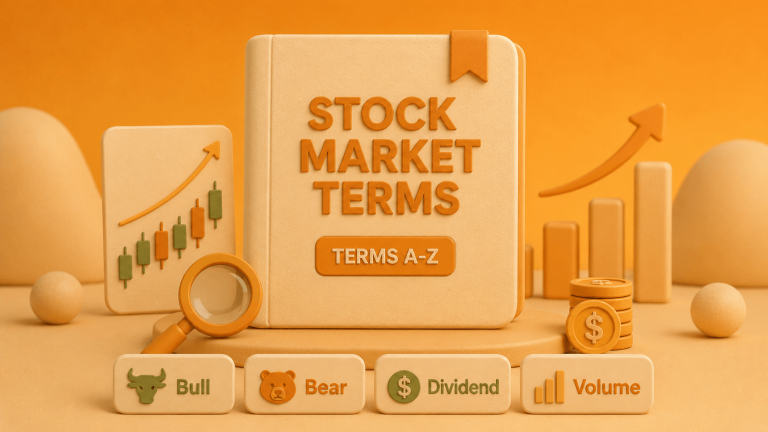
This guide is a starting point. Not a dictionary. Not a wall of jargon. Just the words that make a first trade easier to understand before money is involved.
Quick reference
10 stock market terms in plain English
Use this before reading charts, news, or an order ticket. Each term below answers one simple trading question.
Ownership exposure to a company.
One unit of stock ownership.
The short market code for a listed stock.
The highest current price a buyer is offering.
The lowest current price a seller is asking.
The difference between the bid and ask.
An order built to get filled quickly.
An order built around a chosen price.
The number of shares traded.
How much and how quickly price moves.
Imagine you are looking at a stock with the ticker XYZ. It trades near $50. The bid is $49.98, the ask is $50.02, and volume is higher than usual after company news. You want to buy 10 shares, but you are not sure whether to use a market order or a limit order. You also need to decide where the trade idea is wrong, so you can set a stop-loss.
That small situation already uses most of the vocabulary below. Learn the terms as decision words, not as flashcards.
1. Stock
A stock represents ownership in a company.
When you buy a stock, you are buying a small piece of that business. You are not buying the company’s products. You are not lending it money. You are buying an ownership share that can rise or fall in value.
If a company does well, investors may become more willing to own its stock. That demand can push the stock price higher. If the company disappoints, or if investors expect trouble ahead, the price can fall.
This is why people say “owning stock” rather than “betting on a ticker.” A ticker is just the short market code. The stock is a claim on part of a real company.
For example, if someone says:
“I bought Apple stock.”
They mean they bought shares in Apple Inc., not an Apple product or an Apple bond.
The practical beginner lesson is simple: before you buy a stock, know what company you are actually buying exposure to. What does it sell? How does it make money? Why might investors want to own it? Why might they avoid it?
Those questions matter more than the ticker symbol.
2. Share
A share is one unit of stock.
If stock is the ownership category, a share is the countable piece. You might own 1 share, 10 shares, 0.5 shares on platforms that support fractional shares, or 100 shares.
The number of shares matters because your profit or loss is connected to how many shares you hold.
Imagine a stock moves from $50 to $55.
- If you own 1 share, the gain is $5 before costs.
- If you own 10 shares, the gain is $50 before costs.
- If you own 100 shares, the gain is $500 before costs.
The stock made the same move. The position size changed the money result.
This is one of the first places beginners get confused. They focus on the price of one share, but the real question is exposure.
A $20 stock is not automatically “cheaper” than a $200 stock. If you buy $1,000 worth of either one, your market exposure is still about $1,000. The number of shares will be different, but the amount at risk depends on position size and price movement.
3. Ticker Symbol
A ticker symbol is the short code used to identify a stock on an exchange.
Apple trades under AAPL. Microsoft trades under MSFT. Tesla trades under TSLA.
Tickers make platforms faster to use, but they can also create mistakes. Some companies have similar names. Some tickers look like words. Some stocks trade on different exchanges or in different share classes.
Before placing a trade, check that the ticker matches the company you intended to research.
This sounds obvious until you see how quickly a trading screen can become crowded. A beginner might search a company name, click the first result, and not notice that it is a different listing, a fund, a foreign share, or a similarly named company.
Use the ticker, company name, exchange, and chart together. Do not rely on one tiny code if you are still learning.
4. Bid, Ask, and Spread
The bid is the highest price buyers are currently offering.
The ask is the lowest price sellers are currently willing to accept.
The spread is the gap between them.
If a stock shows:
- Bid: $100.00
- Ask: $100.05
The spread is $0.05.
That means if you want to buy immediately, you may pay around the ask. If you want to sell immediately, you may receive around the bid. The exact execution can vary, but the bid-ask spread gives you a quick view of trading friction.
Very liquid stocks often have tight spreads. Less liquid stocks can have wider spreads. A wide spread can make entering and exiting more expensive, especially for short-term traders.
The spread is easy to ignore because it does not look like a separate bill. But it can still affect your result.
If you buy at $100.05 and could only sell instantly at $100.00, the stock has to move in your favor just to overcome that gap.
Bid, ask, and spread in one example
If the buyer price is $100.00 and the seller price is $100.05, the spread is the $0.05 gap between them.
What immediate sellers may receive.
What immediate buyers may pay.
The trading friction between the two prices.
5. Market Order
A market order tells the platform to buy or sell as soon as possible at the best available price.
It is built for speed, not precision.
If you place a market buy order, you are saying: “I want in now.” If you place a market sell order, you are saying: “I want out now.”
That can be useful in very liquid markets, but it can be risky when prices are moving fast or when the spread is wide.
The beginner mistake is thinking a market order means “buy at the price I currently see.” It does not always mean that. It means “buy at the price available when the order reaches the market.”
Most of the time, the difference may be small. During fast moves, news, opening minutes, or illiquid stocks, the difference can be noticeable.
Market orders are simple, but they require respect. They solve the problem of execution speed. They do not solve the problem of price control.
6. Limit Order
A limit order sets the maximum price you are willing to pay when buying, or the minimum price you are willing to accept when selling.
If a stock is trading near $50 and you place a buy limit at $49, your order will only fill if the market can sell to you at $49 or better.
The benefit is control. You avoid paying more than your chosen price.
The trade-off is that the order may not fill.
This matters because many beginners want both certainty and control. Markets rarely give both at the same time. A market order gives you a better chance of getting filled quickly. A limit order gives you better control over price.
Neither is automatically better. They are tools for different jobs.
Use a market order when execution matters more than a small price difference. Use a limit order when price matters more than getting filled immediately.
Order types: speed, price, and risk
Order types solve different problems. The mistake is expecting one order to do every job at once.
Useful when getting filled quickly matters more than a small price difference. The final fill can differ from the price you saw.
Useful when you only want your chosen price or better. The trade-off is that the order may not fill.
Useful for defining where the trade idea is wrong. It helps set risk before the trade becomes emotional.
7. Volume
Volume shows how many shares traded during a period.
Daily volume shows how many shares changed hands that day. Chart volume bars show how active trading was during each candle or time interval.
Volume helps answer a basic question: how much participation is behind the move?
A price move on high volume may suggest stronger interest. A price move on low volume may be easier to question. That does not mean high volume always confirms a good trade, but it tells you the move attracted attention.
Volume also affects execution. A stock with very low volume may be harder to enter or exit without moving the price or accepting a worse fill.
For beginners, volume is useful in three simple ways:
- It helps you avoid extremely inactive stocks.
- It gives context to breakouts and sell-offs.
- It warns you when a chart may look clean but trading activity is thin.
Do not treat volume as a magic signal. Treat it as market participation.
8. Market Capitalization
Market capitalization, often called market cap, is the total market value of a company’s shares.
The formula is:
Market cap = share price x shares outstanding
If a company has 1 billion shares outstanding and the stock price is $50, the market cap is $50 billion.
Market cap is why share price alone can mislead you.
A company with a $20 share price can be much larger than a company with a $200 share price if it has many more shares outstanding.
Investors often group companies by market cap:
- Large-cap companies are generally bigger, more established businesses.
- Mid-cap companies sit in the middle.
- Small-cap companies are usually smaller and can be more volatile.
These categories are not perfect, and the exact thresholds can vary, but the idea is useful. Market cap tells you something about company size in a way share price does not.
Market cap example
Share price alone does not tell you company size. Market cap combines price with the number of shares outstanding.
9. Dividend
A dividend is a payment a company makes to shareholders.
Not all companies pay dividends. Some companies prefer to reinvest cash back into the business. Others return part of their profits to shareholders through regular dividend payments.
If you own a dividend-paying stock, you may receive payments based on how many shares you hold and the dividend amount declared by the company.
For example, if a company pays a $0.50 dividend per share and you own 20 shares, the dividend payment would be $10 before taxes and any platform-specific details.
Beginners often see dividends as “free money.” They are not quite that simple.
A dividend comes from company cash. On the ex-dividend date, the stock price may adjust to reflect the payment. A high dividend yield can be attractive, but it can also be a warning sign if the market thinks the dividend is not sustainable.
The useful beginner question is not only:
“How much does it pay?”
It is:
“Can the company realistically keep paying it?”
10. Volatility
Volatility describes how much and how quickly a price moves.
A highly volatile stock can rise or fall sharply in a short period. A less volatile stock may move more slowly.
Volatility is not the same as direction. A volatile stock is not automatically bullish or bearish. It simply means the ride may be rougher.
This matters because volatility affects risk.
If a stock often moves 5% in a day, a very tight stop may be hit by normal noise. If a stock usually moves 0.5% in a day, the same stop distance may mean something different.
Beginners sometimes choose volatile stocks because they look exciting. Big candles create the feeling that money can be made quickly. That can be true, but the same movement can work against you just as quickly.
Volatility is opportunity and danger in the same package.
The practical move is to size positions according to volatility. A calmer stock and a wild stock should not automatically get the same position size just because you like both charts.
Bonus term: Stop-loss
A stop-loss is an order or trading rule designed to limit a loss if the market moves against you.
It deserves a place in any beginner stock market terminology guide because it changes the way you think about trades.
Without a stop, a beginner often enters a position with only one plan: “I hope it goes up.”
With a stop, the plan becomes more complete:
- Where is the trade idea wrong?
- How much am I willing to lose?
- Does the possible reward justify the risk?
- Is the position size reasonable if the stop is hit?
A stop-loss does not guarantee a perfect exit price in every market condition. Gaps and fast moves can affect execution. But the discipline behind a stop is still important. It forces you to decide risk before the trade becomes emotional.
How these terms fit together in one trade
Imagine a beginner is watching a stock with ticker XYZ.
The stock is trading around $50. The bid is $49.98 and the ask is $50.02, so the spread is $0.04. Volume is higher than usual because the company just released news.
The trader decides they do not want to chase the price. Instead of a market order, they place a limit order at $49.80. If the stock pulls back, the order may fill. If it never comes back, the order may stay unfilled.
They buy 10 shares. Their exposure is about $498. They set a stop-loss below the level where their trade idea would be wrong.
Now the vocabulary is no longer abstract.
- Stock: the company ownership instrument.
- Ticker: XYZ.
- Shares: 10 units.
- Bid and ask: the current buyer/seller prices.
- Spread: the gap between bid and ask.
- Volume: how active trading is.
- Limit order: the chosen entry method.
- Stop-loss: the risk control.
- Volatility: how much price movement to expect.
- Market cap: context for company size.
That is how stock market terminology becomes useful. It lets you describe the trade clearly before money is on the line.
Beginner mistakes caused by misunderstood stock terms
The danger is not sounding inexperienced. The danger is making a real decision while using the wrong mental shortcut.
| Mistake | Term behind it | Better way to think |
|---|---|---|
| Buying a $5 stock because it “looks cheaper” than a $200 stock | Share price, market cap | Cheap price is not the same as good value or lower risk |
| Using a market order in a thin stock and getting a worse fill | Market order, volume, spread | Speed can cost money when liquidity is weak |
| Ignoring the bid-ask spread because it does not look like a fee | Bid, ask, spread | The spread is still trading friction, even if it is not charged as a separate bill |
| Treating high volume as automatically bullish | Volume | Volume shows participation, not direction by itself |
| Seeing dividends as free money | Dividend | Dividends come from company cash and depend on sustainability |
| Setting the same stop on every stock | Volatility, stop-loss | A normal daily move for one stock can be extreme for another |
This is where terminology becomes useful. The right word slows you down just enough to ask the right question.
A simple learning order
If you are new, do not try to memorize every term at once.
Learn in layers.
Start with what you are buying:
- Stock
- Share
- Ticker symbol
- Market cap
Then learn how prices work:
- Bid
- Ask
- Spread
- Volume
Then learn order and risk language:
- Market order
- Limit order
- Stop-loss
- Volatility
That order mirrors how a trade actually happens. First you identify the instrument. Then you understand the current market. Then you decide how to enter and how to control risk.
A beginner-friendly checklist before buying a stock
Before you place a stock trade or investment order, try answering these questions in plain English:
- What company does this stock represent?
- What is the ticker, and am I sure it is the right one?
- How many shares am I buying, and what is the total position size?
- What are the bid, ask, and spread?
- Is volume high enough for clean entry and exit?
- Am I using a market order or a limit order, and why?
- How volatile is this stock compared with what I can handle?
- Do I know the company’s approximate market cap?
- Does this stock pay a dividend, and if so, is that part of my reason for buying?
- Where will I exit if the idea is wrong?
If you cannot answer these questions yet, that is not a failure. It is exactly why learning terminology matters. The words are not decoration. They are handles for decisions.
Final thoughts
Stock market terminology feels boring until it starts saving you from mistakes.
Knowing the bid-ask spread can stop you from entering a thin stock carelessly. Knowing the difference between a market order and a limit order can prevent a bad fill. Knowing market cap can stop you from judging a company by share price alone. Knowing volatility can help you size a position with more humility.
You do not need to sound like a Wall Street analyst. You need enough vocabulary to understand what you are doing before you click buy or sell.
That is the real purpose of learning stock market terms: not to memorize jargon, but to make better decisions with less confusion.