

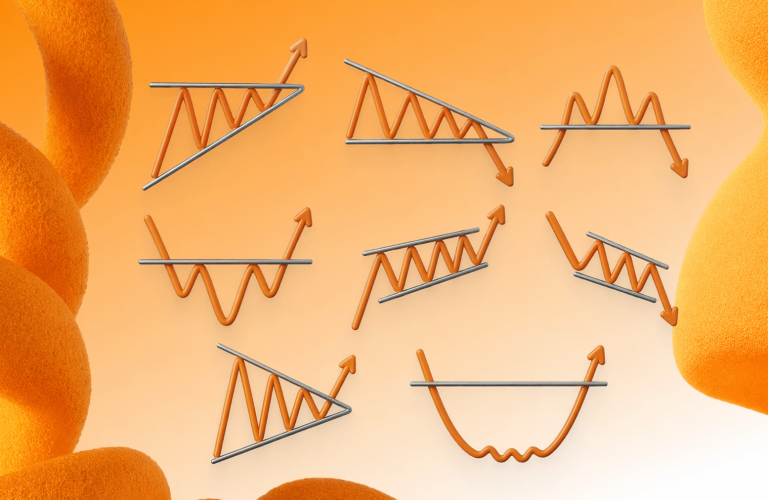
If you are new to trading, do not try to memorize 20 chart patterns. In practice, beginners do better when they follow five repeatable setups: double tops and bottoms, flags, triangles, rectangles, and head and shoulders. They appear often enough to practice, they teach the core logic of trend, pause, breakout, and reversal, and they are much easier to risk-manage than exotic patterns.
The mistake most new traders make is treating patterns like magic drawings. A pattern is not the signal. Context is the signal. The same triangle can be a high-quality continuation setup in a strong trend and a terrible trap in a choppy market.
What beginners actually want from chart patterns
Nobody searches for “chart patterns to follow” because they want a textbook definition. What most beginners actually want is this:
- A short list of patterns that are worth their screen time.
- A way to tell which setups are real and which are just random shapes.
- A repeatable entry and exit process they can use without overthinking.
- Fewer false breakouts and fewer impulsive trades.
The decisions they need to make are practical:
- Should I treat this as continuation or reversal?
- Is this pattern tradable on my timeframe, or is it too noisy?
- Do I enter before the breakout, on the breakout, or on the retest?
- Is the reward realistic compared with the risk?
The risks they are trying to avoid are even more important:
- Confusing every sideways move with a pattern.
- Trading patterns inside low-quality chop.
- Entering before confirmation and getting trapped by the first fake move.
- Placing stops too tight, then calling a good setup “bad” when the stop placement was the real problem.
The only 5 chart patterns beginners should follow first
Here is the opinionated version: most beginners should ignore diamonds, broadening formations, harmonics, and rare complex structures for now. They look advanced, but they are not the fastest way to build skill. The goal at the start is not to sound sophisticated. The goal is to recognize repeatable market behavior and execute it with discipline.
1. Double top and double bottom: the best first reversal pattern
Reversal pattern
Double Top
Bearish bias after neckline break
What to look for: price tests the same resistance zone twice, fails to continue higher, then confirms the setup only when it closes below the neckline.
Reversal pattern
Double Bottom
Bullish bias after neckline break
What to look for: two failed attempts to break support, then a close back above the neckline that shifts the structure from weak to constructive.
If I had to teach one reversal pattern first, it would be this one. It is visually simple, it shows failed breakout attempts clearly, and it forces beginners to think about support and resistance correctly.
What it tells you:
- Double top: buyers tried twice to push through resistance and failed.
- Double bottom: sellers tried twice to break support and failed.
Why it works for beginners:
- The invalidation point is obvious.
- The neckline gives a clear trigger.
- It appears across forex, stocks, crypto, and commodities.
In practice, the best double tops and bottoms usually have:
- A clear prior move before the pattern.
- Two obvious swing points, not five messy touches.
- A neckline that is easy to see without zooming in.
- Some sign of rejection near the second test: smaller candles, long wicks, or loss of momentum.
A common mistake is buying the second touch of a double bottom before the neckline breaks. What usually happens is price bounces a little, gives hope, and then rolls back into the range. For beginners, the neckline break is the part that proves the market is actually shifting.
Real-world scenario:
Imagine EUR/USD on the H1 chart drops from 1.0980 to 1.0890, bounces to 1.0925, then revisits 1.0892 during the London session. The second low leaves a long lower wick, but the better trade is not the wick itself. The better trade is the close back above 1.0925 or a retest of that level after the break.
2. Flags: the cleanest continuation pattern in strong trends
Continuation pattern
Bull Flag
Bullish continuation after breakout
What to look for: a strong directional move first, then a small controlled pullback inside a channel, then a breakout in the direction of the original trend.
Flags are one of the few continuation patterns that beginners can learn quickly and use well. They are basically controlled pauses after an aggressive move.
What a good flag looks like:
- A strong impulsive move first.
- A small pullback or sideways drift after it.
- A breakout in the original trend direction.
Why I rate it highly:
- It teaches patience better than almost any other pattern.
- The structure is compact, so the risk can be defined clearly.
- It tends to work best in strong trending conditions, which are easier to read than range-bound markets.
In most real cases, a flag that drags on too long stops being a flag. On H1 or H4, if the “pause” turns into a long, choppy sideways box with constant whipsaws, momentum has cooled and the edge drops. A clean flag usually resolves relatively quickly after the impulse leg.
What usually works:
- Trading with the higher-timeframe trend.
- Waiting for the breakout candle to close instead of jumping on the first spike.
- Using the low or high of the flag as the invalidation level.
What usually does not work:
- Calling every pullback a flag.
- Trading flags in dead markets with no momentum.
- Chasing after the breakout has already moved too far.
Practical benchmark:
If the pullback inside the flag retraces most of the original impulse, the setup quality usually drops. In practice, a shallow to moderate pullback is healthier than a deep one that erases the whole move.
3. Triangles: useful, but only when the build-up is clean
Compression pattern
Triangle Breakout
Wait for the actual break, not the shape alone
What to look for: the swings get smaller as price compresses inside the triangle, then the trade idea comes only when price leaves the structure with conviction.
Triangles are popular because they are easy to draw badly. That is exactly why beginners need rules.
The only triangles worth following at first are:
- Symmetrical triangles after a strong move.
- Ascending triangles below clear resistance in bullish conditions.
- Descending triangles above clear support in bearish conditions.
What makes a triangle tradable:
- The market is compressing, not randomly chopping.
- Each swing is smaller than the previous one.
- The breakout happens before the pattern becomes too mature.
What nobody tells beginners:
The longer price sits near the tip of the triangle, the less interesting the setup often becomes. In practice, the best breakouts usually happen before the pattern gets too squeezed. By the time price is crawling at the very end, momentum often fades and false breaks become more common.
A common mistake is assuming the breakout direction from the shape alone. Ascending triangles break upward often, but not always. Descending triangles break downward often, but not always. Price still has to confirm.
Real-world scenario:
A stock rallies 8% in three days, then spends two sessions building an ascending triangle under a clear swing high. Volume dries up during the compression. The next day, price closes above resistance with a wider-than-average candle. That is the kind of triangle worth attention. If the same stock spends nine sessions chopping around that level with overlapping candles, it is no longer a clean pressure build-up. It is indecision.
4. Rectangles: boring on the chart, very useful in real trading
Compression pattern
Triangle Breakout
Wait for the actual break, not the shape alone
What to look for: the swings get smaller as price compresses inside the triangle, then the trade idea comes only when price leaves the structure with conviction.
Rectangles are just ranges, and that is precisely why they matter. Most new traders do not lose money on elegant patterns. They lose money inside obvious ranges by forcing trades before the market has chosen a direction.
Why rectangles deserve respect:
- They show you where the market is balanced.
- They create very clear breakout or rejection levels.
- They teach beginners when not to trade.
In practice, rectangles are great because they give you two options:
- Range trade the edges if the market is respecting the box cleanly.
- Trade the breakout if price finally leaves the box with strength.
For beginners, the second option is safer. Range trading sounds easy, but it requires fast judgment and tighter execution. Breakout trading around a well-defined box is usually simpler.
A common mistake is treating the first wick outside the range as a breakout. A real breakout usually looks more committed:
- A candle close beyond the boundary.
- Little hesitation around the level.
- Ideally, a retest that holds.
Practical benchmark:
If a rectangle has fewer than two clean touches on each side, it is usually not established enough to trust. If it has too many messy touches with no clean reactions, it may already be losing its edge.
5. Head and shoulders: useful, but lower on the beginner priority list
Reversal pattern
Head and Shoulders
Pattern confirms only after neckline break
What to look for: three peaks with the middle one highest, plus a neckline break that proves the uptrend is no longer holding.
Yes, it is a classic. No, it should not be the first pattern you obsess over.
I still think beginners should learn head and shoulders because it teaches a critical concept: trend reversal through failed continuation. But compared with double tops and bottoms, it is easier to misread, especially when traders start forcing “shoulders” onto random peaks.
What makes it worth following:
- It often appears near meaningful trend exhaustion.
- The neckline gives a logical trigger.
- It can produce strong moves after confirmation.
Why it is not my first choice for beginners:
- The pattern often looks obvious only after the move is already underway.
- Many “head and shoulders” formations are just messy ranges.
- New traders love to anticipate it too early.
In most real cases, the neckline matters more than the head. If the neckline never breaks, the pattern is unfinished. Until then, it is just a possibility.
What usually works:
- Treating it as confirmed only after the neckline breaks.
- Checking whether volume or momentum weakens into the head.
- Using the right shoulder or neckline retest as a cleaner place for risk.
What usually does not work:
- Shorting the right shoulder just because it “looks right.”
- Trading a pattern that forms inside a larger, stronger uptrend without higher-timeframe resistance nearby.
Comparison table: which pattern is best for what?
| Pattern | Best market context | Best use for beginners | Biggest trap | My priority |
| Double top/bottom | Reversal near obvious support or resistance | Learning reversals and confirmation | Entering before neckline break | Very high |
| Flag | Strong trend with orderly pullback | Continuation trading | Calling any pullback a flag | Very high |
| Triangle | Compression after a real move | Breakout practice | Waiting too long and trading late pattern breaks | High |
| Rectangle | Clear range with repeated boundaries | Learning patience and breakout selection | Mistaking wicks for confirmed breaks | High |
| Head and shoulders | Mature trend near exhaustion | Understanding reversals | Seeing it everywhere | Medium |
The framework that matters more than the pattern itself
This is the part beginners usually skip, and it is the reason many chart-pattern articles do not help in live trading.
Before you take any pattern, run it through this five-part filter:
1. Context
Is the market trending, ranging, or just messy?
A flag inside a strong uptrend is one thing. The same shape inside sideways chop is just decoration.
2. Location
Is the pattern forming at a meaningful place?
The best patterns tend to form:
- At prior support or resistance.
- Around a recent swing high or swing low.
- After an extended move that actually needs a pause or reversal.
3. Structure
Is the shape clean enough that another trader would see it too?
If you have to explain the pattern for 30 seconds, it is probably not good enough.
4. Trigger
What exactly confirms the trade?
Examples:
- Neckline break on a double bottom.
- Breakout close from a flag or triangle.
- Confirmed close outside a rectangle.
5. Risk
Where is the trade wrong?
If you cannot mark the invalidation level in three seconds, skip the setup.
Practical rule:
For beginners, a minimum reward-to-risk idea of around 1.5:1 or 2:1 usually makes more sense than taking every pattern that appears. A mediocre pattern with poor room to move is still a poor trade.
What works in practice and what usually fails
What works more often:
- Higher timeframes like H1, H4, and Daily.
- Liquid assets with cleaner price behavior.
- Waiting for confirmation instead of predicting.
- Taking fewer patterns, but taking the obvious ones.
What fails more often:
- M1 and M5 pattern hunting without a plan.
- Trading right before major news and blaming the pattern.
- Entering late because of FOMO after the move is already extended.
- Ignoring the higher timeframe because the lower timeframe looks “exciting.”
This is the hard truth: the market does not reward pattern collectors. It rewards traders who are selective.
Mistakes beginners make with chart patterns
1. They learn too many patterns too early
Five well-practiced setups beat twenty half-understood ones.
2. They ignore market conditions
A continuation pattern needs a trend. A reversal pattern needs exhaustion or a real barrier. Without context, the pattern has very little meaning.
3. They trade before the market confirms
This is the most expensive beginner habit. Anticipation feels smart, but confirmation is what protects capital.
4. They use stops that are too tight
A pattern needs room to breathe. If your stop is sitting exactly where everyone else put theirs, a small sweep can remove you before the real move starts.
5. They confuse frequency with quality
Just because triangles appear five times a day on a 5-minute chart does not mean they are five tradable opportunities.
A simple practice plan for the next 30 days
If you are serious about improving, do this instead of scrolling through endless pattern lists.
Week 1: learn only two patterns
Pick:
- Double tops/bottoms
- Flags
Review 20 historical examples of each on H1 or H4 charts.
Week 2: add one continuation pattern
Pick:
- Triangle or rectangle
Do not trade it live yet. Just mark the setup, the trigger, and the invalidation.
Week 3: start a pattern journal
For every setup, record:
- Asset
- Timeframe
- Pattern type
- Market condition
- Entry trigger
- Stop location
- Result
- What you missed
After 20 to 30 logged setups, you will see a truth most beginners never write down: your losses are often coming from a specific mistake pattern, not from the chart pattern itself.
Week 4: narrow your watchlist
Choose one or two assets and one or two timeframes. Screen time compounds faster when you stop jumping around.
Which chart patterns should you ignore for now?
This is where I will be blunt.
For most beginners, these are not worth the effort yet:
- Diamond patterns
- Harmonic patterns
- Broadening formations
- Multi-leg complex wedges
- Any pattern you only recognize after someone else draws it for you
These patterns are not useless. They are just low priority. Early on, your edge comes from clarity and repetition, not sophistication.
Final take: the best chart patterns to follow are the ones you can actually execute well
If you are new to trading, the best chart patterns to follow are not the fanciest ones. They are the ones that show market behavior clearly and give you a clean decision point.
Start with:
- Double tops and double bottoms for reversals
- Flags for trend continuation
- Triangles and rectangles for breakout logic
- Head and shoulders as a secondary reversal pattern once your eye improves
That is enough. More than enough, actually.
In practice, traders improve faster when they stop asking, “What pattern is this?” and start asking, “What is price trying to do here, and where is the setup invalid if I am wrong?” That is the question that separates pattern memorization from actual chart reading.