
Most traders do not learn the truth about AI trading bots from a sales page. They learn it after testing one.
The first surprise is usually simple: the hard part is not turning the bot on. The hard part is understanding why it trades, whether the test results are realistic, what happens when market conditions change, and how quickly you can stop it when the logic starts failing.
An AI trading bot can help apply a clear process. It cannot turn an unclear process into a safe one.
This guide explains how AI trading bots work, what traders usually discover after testing them, why backtests can look better than live results, which warning signs matter, and how to use automation more carefully.
This article is for educational purposes only and is not financial advice. Trading involves risk, and past performance does not guarantee future results.
What Traders Usually Learn After Testing AI Trading Bots
After the first excitement fades, most bot testing comes down to a few practical lessons.
| Lesson | What it means in practice |
|---|---|
| The bot is only as good as the rule behind it | If the entry, exit, and risk logic are unclear, automation only hides the problem. |
| Backtests are easy to make look good | A test can ignore spreads, slippage, swaps, bad data, or future information. |
| Live trading feels different | Execution delays, wider spreads, news events, and emotions can change the result. |
| Risk settings matter more than the AI label | Position size, daily loss limits, and stop rules usually decide whether a mistake stays small. |
| The real skill is knowing when to stop | A bot can keep trading after the market conditions that made it work have disappeared. |
That is why the better question is not “Can AI trade for me?” The better question is: “Can this strategy be explained, tested, limited, and stopped before it causes serious losses?”
Safety check
Before using an AI trading bot, sort each answer into one of three columns
| Question | Continue | Pause | Walk away |
|---|---|---|---|
| Can you explain the strategy? | Entry, exit, and risk rules are clear. | The logic is vague but partly testable. | The answer is only “the AI decides.” |
| Was it tested realistically? | Costs, slippage, and out-of-sample data are included. | Only a short or unclear backtest is shown. | Only screenshots or profit claims are provided. |
| Are risk limits built in? | Risk per trade, daily loss, and max drawdown are capped. | Limits exist but are hard to verify. | The bot increases size after losses or has no stop rules. |
| Can you stay in control? | You can stop trading instantly and review every trade. | Manual override exists but is not simple. | The bot needs withdrawal access or full account control. |
| Are the claims realistic? | The seller discusses drawdowns and losing periods. | The marketing focuses mostly on high returns. | It promises guaranteed profit or no risk. |
One red answer is enough to stop. Automation should make a clear trading plan easier to follow, not hide risk behind technical language.
How AI Trading Bots Actually Work
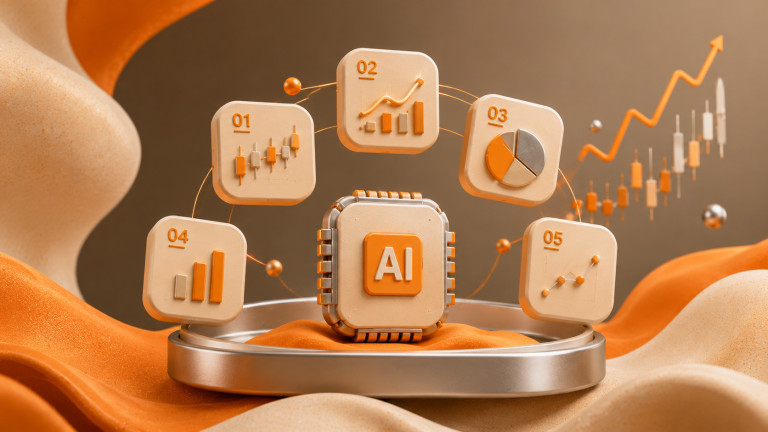
An AI trading bot is a software tool that uses market data, rules, models, or machine-learning methods to generate trading signals or automate parts of the trading process.
Some bots only send alerts. Others can open and close trades automatically. Some are simple rule-based systems, while others are marketed as AI-powered tools that adapt to market data.
The word “AI” can mean very different things. In some cases, it may refer to a real machine-learning model. In others, it may simply be marketing language for a basic rule-based system. That distinction matters because a trader should understand what the bot is actually doing before trusting it.
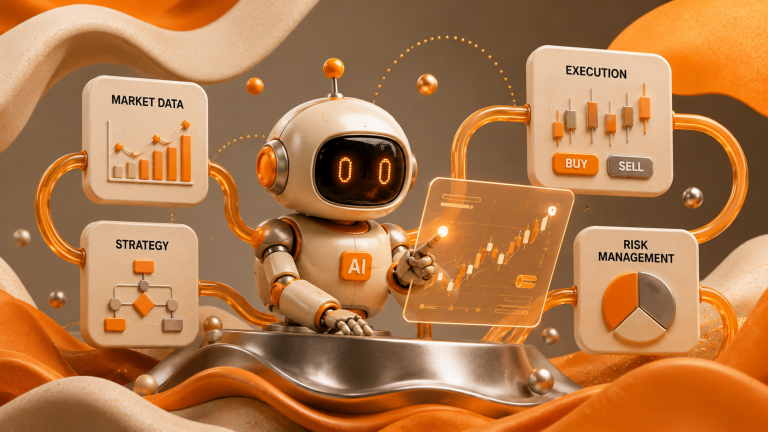
Most trading bots follow the same basic chain:
- Read data. Price, volume, indicators, news inputs, volatility, or other market signals.
- Generate a signal. The system decides whether conditions match its rules or model.
- Apply risk settings. Position size, stop-loss, take-profit, drawdown limit, or trade frequency.
- Alert or execute. The bot either sends a signal or places a trade automatically.
- Log the result. The trader reviews whether the trade matched the strategy and risk plan.
The more automatic the bot is, the more important the risk settings become.
| Type of tool | What it does | Main risk |
|---|---|---|
| Signal or alert tool | Sends a notification when conditions appear | The trader may overreact or ignore context |
| Rule-based bot | Executes fixed rules automatically | Rules may stop working when market conditions change |
| AI-assisted bot | Uses models to rank signals or adapt inputs | The logic may be difficult to verify |
| Fully automated bot | Places trades without manual confirmation | Losses can happen quickly if controls fail |
If a bot cannot explain its logic, risk limits, data source, or historical test method, that is a warning sign.
Can AI Trading Bots Make Money?
An automated strategy can be profitable for a period of time, but no AI trading bot can guarantee profit.
Markets change. A strategy that performed well during a strong trend may fail in a sideways market. A model trained on recent volatility may behave poorly during a news shock. A bot that looks impressive in a screenshot may be using unrealistic assumptions, such as perfect entry prices or zero transaction costs.
The important point is this: a bot is not a money-making machine. It is a tool for applying a trading process. If the process is weak, unclear, overfitted, or poorly controlled, automation can make the problem worse.
Before considering any bot, ask:
- What exact conditions does it use to enter and exit trades?
- Which assets and timeframes was it built for?
- Does it include spreads, fees, swaps, and slippage?
- What is the worst historical drawdown?
- How does it behave during news events or low liquidity?
- Can I stop it immediately?
- Do I understand the risk per trade?
If the only answer is “the AI handles it,” that is not enough.
The Biggest Risks of AI Trading Bots
AI trading bots can create technical, financial, psychological, and fraud-related risks. The most important ones are below.
| Risk | What goes wrong | What to check |
|---|---|---|
| Overfitting | The bot is tuned so closely to past data that it fails in live markets. | Was it tested on data not used to build the strategy? |
| Poor data quality | Missing candles, wrong timestamps, bad bid/ask prices, or ignored gaps distort the result. | Does the data match the trading environment? |
| Look-ahead bias | The test uses information that would not have been available at the time of the trade. | Are signals calculated only from past and current data? |
| Ignored costs | Spreads, swaps, slippage, and commissions turn a profitable test into a weak live result. | Are all realistic costs included? |
| Market regime change | A bot built for trends struggles in ranges, news shocks, or low liquidity. | Does it have rules for when not to trade? |
| Black-box logic | The user cannot explain why the bot opened or closed a trade. | Can the strategy be described in plain language? |
| Position sizing | Automation scales losses quickly, especially with martingale-style logic. | Are risk per trade, daily loss, and drawdown capped? |
| Account access | Some tools ask for unsafe permissions or store sensitive credentials. | Never give a bot withdrawal access. |
| AI misinformation | AI output may be inaccurate, incomplete, outdated, or made up. | Use AI as a research assistant, not the final decision-maker. |
| Fake performance claims | Scammers use the AI label to sell guaranteed-profit systems. | Treat “no risk” and “cannot lose” as major warning signs. |
FINRA has warned that AI systems can raise issues around accuracy, hallucinations, bias, governance, monitoring, and human oversight. FINRA, the SEC, and NASAA have also warned that bad actors use AI hype, deepfakes, fake websites, and unrealistic claims to target investors.
The SEC has taken action against firms for false or misleading statements about their use of artificial intelligence and machine learning. For traders, the lesson is simple: the label “AI-powered” does not prove that a trading system is reliable, regulated, profitable, or real.
How to Backtest an AI Trading Bot
Backtesting means testing a strategy on historical data to see how it would have performed in the past. It is useful, but only if done carefully.
A weak backtest can create false confidence. A strong backtest does not guarantee future results, but it can help you reject bad strategies before risking real money.
If you are new to the topic, start with this guide: How to Backtest a Trading Strategy.
Step 1: Write the strategy hypothesis
Before testing, explain the idea in plain language.
For example:
“This bot tries to enter after a breakout when volatility expands and exits when momentum slows.”
If you cannot describe the strategy without vague phrases like “the AI finds hidden opportunities,” it may be too unclear to evaluate.
Step 2: Define the market and timeframe
A bot should not be tested randomly across everything.
Define:
- Asset class
- Asset or market
- Timeframe
- Trading hours
- Entry rules
- Exit rules
- Risk per trade
- Maximum number of open trades
The more specific the test, the easier it is to understand what the result means.
Step 3: Include realistic costs
Add:
- Spread
- Commissions, if applicable
- Overnight fees or swaps, if relevant
- Slippage
- Missed trades
- Delayed execution
Short-term bots are especially sensitive to costs. A small difference per trade can change the entire result.
Step 4: Use out-of-sample testing
Do not only test on the data used to build the strategy.
A common approach is:
- Use one period to develop the strategy.
- Use a separate period to test it.
- Do not change the strategy after seeing the second result.
If the bot performs well only on the development data but fails on new data, it may be overfitted.
Step 5: Look beyond profit
Profit alone is not enough.
Review:
| Metric | Why it matters |
|---|---|
| Number of trades | Small samples can mislead |
| Win rate | High win rate can hide large losses |
| Average win/loss | Shows whether losses are larger than gains |
| Maximum drawdown | Shows worst historical account decline |
| Profit factor | Compares gross profit to gross loss |
| Consecutive losses | Helps set realistic expectations |
| Performance after costs | Shows whether the strategy survives real conditions |
A strategy that makes money but has extreme drawdowns may not be usable in practice.
Step 6: Stress test the result
A good strategy should not collapse after small changes.
Test what happens if:
- Spreads widen
- Entries are delayed
- Slippage increases
- Volatility changes
- One month of strong performance is removed
- Position size is reduced
- The market becomes less liquid
If a small change destroys the result, be careful.
Step 7: Forward test in demo mode
Before risking real money, run the strategy in a demo environment. Demo trading cannot perfectly reproduce live conditions, but it helps reveal practical problems:
- Does the bot execute as expected?
- Are there missed signals?
- Does it trade too often?
- Does it behave differently during news?
- Are risk limits working?
- Can you stop it instantly?
For beginners, a demo account is usually a safer place to observe automation before making any real-money decisions.
Rules Before Letting a Bot Trade Real Money
If a trader decides to test automation with real funds, strict rules should come first:
- Start in demo mode.
- Use the smallest possible position size at first.
- Set a maximum risk per trade.
- Set a daily loss limit.
- Set a weekly loss limit.
- Limit the number of trades per day.
- Avoid increasing position size after losses.
- Keep manual override enabled.
- Review trade logs regularly.
- Stop the bot during unusual market conditions.
- Do not use money you cannot afford to lose.
- Never give a bot withdrawal access.
The goal is not to make the bot aggressive. The goal is to make sure one mistake does not become a serious account problem.
For a broader framework, read: How to Master Risk Management in Trading and Risk/Reward Ratio in Trading.
How to Spot an AI Trading Bot Scam
Be especially careful with AI trading products promoted through social media ads, messaging apps, fake news articles, or celebrity-style endorsements.
Warning signs include:
- “Guaranteed profit”
- “No risk”
- “The bot cannot lose”
- “Secret AI algorithm”
- “Earn daily passive income”
- Pressure to deposit quickly
- Requests to send crypto to an unknown wallet
- Fake screenshots of profits
- No clear company ownership
- No explanation of drawdown or losing periods
- Refusal to explain fees or withdrawal rules
- Fake reviews or copied testimonials
- Deepfake videos or fake celebrity endorsements
FINRA, the SEC, and NASAA have warned that bad actors use the popularity and complexity of AI to lure investors into scams. They specifically warn about unrealistic claims, unregistered platforms, celebrity endorsements, deepfakes, fake websites, and AI-generated misinformation.
A useful rule: if the marketing focuses more on guaranteed results than on risk controls, walk away.
Safer Alternatives to Fully Automated Trading Bots
You do not need to jump directly into full automation. Many traders can use technology in a more controlled way.
1. Alerts instead of automatic execution
An alert can notify you when a condition appears, but you still make the final decision. This gives you time to check market context, news, spread, and risk.
This is usually safer than giving a bot full control.
2. Trading signals with manual confirmation
A trading signal can be useful as an input, but it should not replace your own analysis. Treat signals as ideas to evaluate, not instructions to follow blindly.
3. Demo testing
Use demo trading to test whether a rule-based idea behaves as expected. Keep notes on entries, exits, emotions, and mistakes.
The point is not to “win” in demo mode. The point is to learn whether the process is clear and repeatable.
4. A trading journal
A trading journal helps you identify patterns in your behavior and strategy. This can be more valuable than a bot, especially for beginners.
Track:
- Why you entered
- Why you exited
- Risk per trade
- Market condition
- Result
- Mistakes
- What you would do differently
5. Simple risk rules
Before automation, build basic risk discipline:
- Fixed risk per trade
- Stop-loss and take-profit rules
- Maximum daily loss
- No revenge trading
- No random position increases
These rules may sound simple, but they often matter more than complex AI models.
6. Indicator-based checklists
Instead of automating everything, create a checklist based on tools you understand.
For example:
- Trend direction
- Support and resistance
- Volatility
- Momentum
- Risk/reward ratio
- News conditions
If you use indicators, start with an educational overview such as Top Technical Analysis Indicators Every Trader Should Use.
When a Trading Bot Might Make Sense
A trading bot may be worth considering only when the trader already has a clear process.
It may make sense if:
- The strategy can be explained in simple terms.
- Entry and exit rules are written down.
- Risk per trade is limited.
- The strategy has been backtested realistically.
- It has been forward tested in demo mode.
- The trader understands when to stop it.
- The bot does not require unsafe account permissions.
- The trader accepts that losses can happen.
Automation is not a replacement for a trading plan. It is a way to apply a trading plan more consistently.
Conclusion
AI trading bots can be useful tools when they automate a clear, tested, and risk-controlled strategy. They become dangerous when they are treated as a replacement for judgment, risk management, or due diligence.
The safest way to approach automation is step by step: understand the strategy, backtest it realistically, forward test it in demo mode, set strict limits, and keep human oversight.
If a bot promises guaranteed profit, refuses to explain risk, pressures you to deposit, or asks for unsafe account access, the better choice is to walk away.
AI can support a trader. It should not be trusted blindly.