
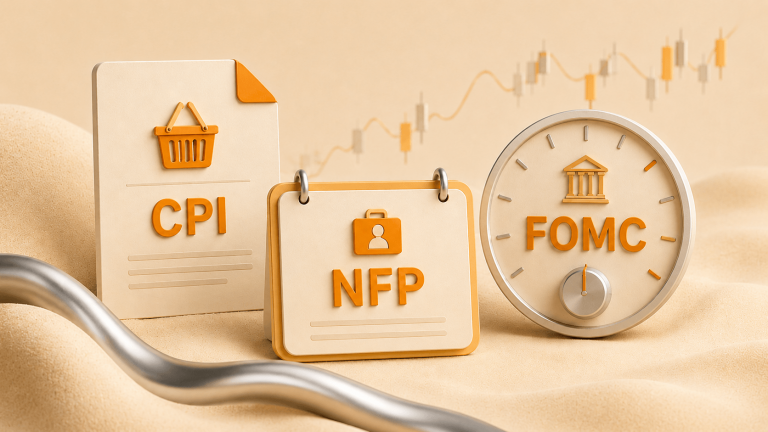
FOMC often produces the broadest repricing. CPI usually gives the cleanest first move. NFP causes the most false starts.
That is the useful ranking. It is not a permanent leaderboard.
The largest move comes from the release that changes the expected path of US interest rates by more than traders had priced in. Sometimes that is inflation. Sometimes it is employment. On other days, the Fed changes the outlook itself.
All three are US events. They matter to forex traders worldwide because the dollar sits on one side of EUR/USD, GBP/USD, USD/JPY and most other heavily traded currency pairs.
What to read first
Each release has a different trap. The useful comparison is how quickly the headline can be contradicted.
| Event | Read first | What can change the move | Practical read |
|---|---|---|---|
| CPI8:30 a.m. ET | Monthly core and headline inflation | Energy effects or a split between core and headline | Read the core figure before trusting the first move |
| NFP8:30 a.m. ET | Payrolls, unemployment, wages, and revisions | Several figures can point in different directions | Wait for one story across the full report |
| FOMC2:00 and 2:30 p.m. ET | Decision, statement, projections, then the press conference | The Chair can reframe the first market reading | Treat 2:00 and 2:30 as separate risk windows |
My working ranking: CPI usually gives the cleanest first read, NFP is the most internally mixed, and FOMC has the most room for a second move.
CPI, NFP and FOMC release times
CPI and the Employment Situation report, which contains NFP, are normally released at 8:30 a.m. Eastern Time. Both are monthly. The exact dates appear on the BLS release calendar.
The FOMC has eight scheduled meetings in 2026. The decision and statement are normally released at 2:00 p.m. ET on the second day. The Chair’s press conference starts at 2:30 p.m. ET. Meeting dates are published on the Federal Reserve calendar.
These are publication times. They are not entry signals.
The surprise moves forex, not the name of the report
A release does not move the dollar simply because a number is high or low. The market reacts to the gap between the result and what was expected.
Before a release, I write down three things:
- The consensus estimate.
- The previous figure and any number likely to be revised.
- The part of the report that could contradict the headline.
Then I watch the US two-year Treasury yield alongside the currency pair. The two-year yield is sensitive to expectations for Fed policy. If a hot CPI print pushes the yield higher and EUR/USD lower, the first reading is aligned. If the yield gives back the move, I become less confident in the initial forex reaction.
Positioning can still override a textbook result. If traders bought dollars for days before CPI, a mildly hot reading may not attract many new buyers. The number beat the forecast, but it did not beat the position already in the market.
CPI: usually the cleanest inflation reaction
The Consumer Price Index tracks changes in prices paid by consumers. Forex traders tend to focus on four numbers:
- Core CPI month over month.
- Headline CPI month over month.
- Core CPI year over year.
- Headline CPI year over year.
I look at the monthly figures first. They say more about the current pace of inflation. Annual figures move slowly because they still contain data from many months ago.
Core CPI excludes food and energy. That can make it a better read on persistent price pressure. Headline CPI still matters, especially when energy is driving household costs and inflation expectations.
The easiest CPI release to read is one where headline and core surprise in the same direction. A soft headline paired with firm core inflation is less clear. The first dollar move can reverse once traders notice that the apparent improvement came mainly from energy.
The Fed’s formal 2% inflation goal is based on the PCE price index, not CPI. CPI still matters because it arrives earlier and can change expectations for PCE and the next Fed decision.
A CPI reaction from 2026
On July 14, the June 2026 CPI report showed prices falling 0.4% month over month, compared with a forecast decline of 0.1%. Annual inflation was 3.5%, below the 3.8% consensus. Core CPI was also softer than expected.
The dollar index fell about 0.6% after the release. The two-year Treasury yield fell 7 basis points.
The reaction was fairly clean. Both the inflation data and the rate-sensitive yield pointed toward less pressure for higher rates. The important part was not that CPI had been published. It was that several parts of the release changed the policy outlook in the same direction.
NFP: one report with several competing stories
NFP is the monthly change in nonfarm payrolls. It sits inside the larger Employment Situation report.
Reading only the payroll headline is a common mistake. I use this order:
- Payrolls versus consensus. Did employers add more or fewer jobs than expected?
- Revisions. Did earlier months become stronger or weaker?
- Unemployment rate. Is the household survey telling the same story?
- Average hourly earnings. Is wage pressure rising or easing?
- Average workweek. Are employers changing hours before changing headcount?
A report can beat on payrolls while unemployment rises. Strong current hiring can sit next to large downward revisions. Wages can also change how traders read the jobs number because wage growth feeds the inflation debate.
That is why NFP often produces a fast move, a pause, and then a move in the other direction. Traders first react to payrolls. Seconds later, they absorb the rest of the report.
An NFP reaction from 2026
June 2026 payrolls increased by 57,000, against a consensus of 110,000. The unemployment rate was 4.2%, and April and May payroll growth was revised down by a combined 74,000 jobs.
The dollar index fell about 0.66%. In this case, the headline and revisions told a similar story: job growth was weaker than traders had expected.
I would still not reduce NFP to a simple rule that weak payrolls mean a weaker dollar. If payrolls miss but wages accelerate and unemployment falls, the rate outlook may not change much. The full report matters more than the first number on the screen.
FOMC: two reaction windows, not one announcement
FOMC days work differently because the Fed is not reporting one economic result. It is communicating policy.
At 2:00 p.m. ET, traders may receive:
- the rate decision;
- a new statement;
- vote details;
- economic and rate projections at the March, June, September and December meetings.
At 2:30 p.m. ET, the press conference begins.
I treat those times as separate events. A statement can push the dollar higher, then the Chair can describe the decision in a way that pulls it back. The reverse happens too.
My reading order is straightforward:
- Was the rate decision expected?
- What wording changed in the statement?
- Did the projected rate path move?
- Were there dissenting votes?
- Does the press conference confirm the 2:00 p.m. interpretation?
The rate can stay unchanged while forex moves sharply. Markets care about the next several meetings, not only the decision made that afternoon.
An FOMC reaction from 2026
On June 17, 2026, the Fed kept its benchmark rate unchanged. That part was expected. New projections, however, showed a more hawkish policy path.
At one post-release snapshot, the dollar index was up 0.9% and the two-year Treasury yield had risen 17 basis points. No current-rate surprise was needed. Traders changed their view of where rates were heading.
This is why FOMC can move forex more than CPI or NFP. It can alter the policy path directly, then alter the interpretation again during the press conference.
So which moved forex most in these 2026 examples?
The FOMC produced the largest quoted dollar-index move of the three:
- FOMC: about +0.9%.
- NFP: about -0.66%.
- CPI: about -0.6%.
That does not prove FOMC always wins. These were snapshots taken at different times after separate releases. They are not a controlled volatility study.
The comparison is still useful. The largest move came when the projected policy path changed. CPI and NFP also moved the dollar, but their effect travelled through the same question: what does this mean for the Fed?
How I decide whether the first move is credible
I do not judge a release from the size of the first candle alone. I run four checks:
- Do the details agree with the headline? A soft CPI report is clearer when core is also soft. Weak payrolls carry more weight when revisions and wages are weak too. On FOMC days, I want the statement, projections and press conference to point in the same direction.
- Does the two-year yield confirm it? The dollar and the yield do not have to match tick for tick. But if EUR/USD falls on a supposedly hawkish release while the two-year yield also falls, another driver may be controlling the pair.
- Does the move survive a second reading? NFP needs time for the full report to be read. FOMC has a scheduled second reaction during the press conference. CPI can reverse when traders move from headline inflation to the underlying components.
- Was the price actually tradable? A large candle does not show the spread or the quote available when an order reached the market. Around scheduled news, fills can occur away from the last displayed price.
One dollar position can hide across several trades
Long EUR/USD, long GBP/USD and long gold may look like three separate ideas. Around a US release, all three can behave like one short-dollar position.
I add up that exposure before the event. Otherwise, a normal position size on each chart can become an oversized bet on one data point.
The same logic applies to USD/JPY and US yields. A strong dollar response driven by higher yields may affect both positions at once, even if their chart setups looked unrelated before the release.
My pre-release workflow
What I write down before the release
The decision to trade, reduce, or stay flat is made before the first candle moves.
-
Official time
Check BLS or Federal Reserve, including the time zone.
-
Expected result
Record consensus, the previous figure, and the expected Fed decision.
-
Deciding detail
Choose the component that could confirm or contradict the headline.
-
Total USD exposure
Count correlated positions as one event risk, not separate ideas.
-
Position decision
Choose flat, reduced, or involved before the release.
-
Execution check
Wait until the spread and price structure are readable.
A release time is not an entry signal. It only tells you when new information becomes public.
Before the release, I decide whether I will be flat, reduced or involved. I do not make that choice after the first candle has already moved.
Once the data is out, I compare the headline with the details and watch the yield response. If the report is mixed or the spread makes the price hard to read, waiting is a valid decision.
Which release matters most right now?
Look at the question the market is already arguing about.
- Inflation is the main uncertainty: CPI is likely to matter most.
- The labor market may be turning: NFP can take control.
- Traders disagree about the policy path: FOMC has the greatest room to surprise.
- The result matches expectations: none of them has to produce a lasting move.
CPI is the cleanest inflation test. NFP contains the most ways for the headline to be contradicted. FOMC can create the broadest and longest repricing.
I rank the surprise, the internal details and the change in rate expectations. The acronym comes last.