

In 2022, private investors valued Shein at almost $100 billion. Four years later, the fast-fashion giant finally reached the stock market at roughly $26.5 billion — about three quarters below its private-market peak.
Shein sold 280 million shares at HK$48.56, raising around $1.74 billion in its Hong Kong IPO. But investors were cautious from day one: the stock fell around 9% on its debut and continued lower in the sessions that followed.
SHEIN’s post-IPO slide continued into mid-September, with the stock hitting a new low of HK$36.40. But on September 15, it joined the Hang Seng Composite Index — and shares bounced 3.63%.
SHEIN after the IPO
Daily closing price · HKDNow traders are watching one thing: can the rebound continue?
Why is Shein interesting to watch?
Short answer: because it helped change how clothes are designed, produced and discovered.
Three forces explain both its rise — and the questions now hanging over its stock.
- Fashion became data-driven
Shein effectively flipped the traditional fashion model. Instead of designing a large seasonal collection, producing it at scale and hoping customers want it, Shein can test large numbers of styles in small batches, track demand and scale the winners.
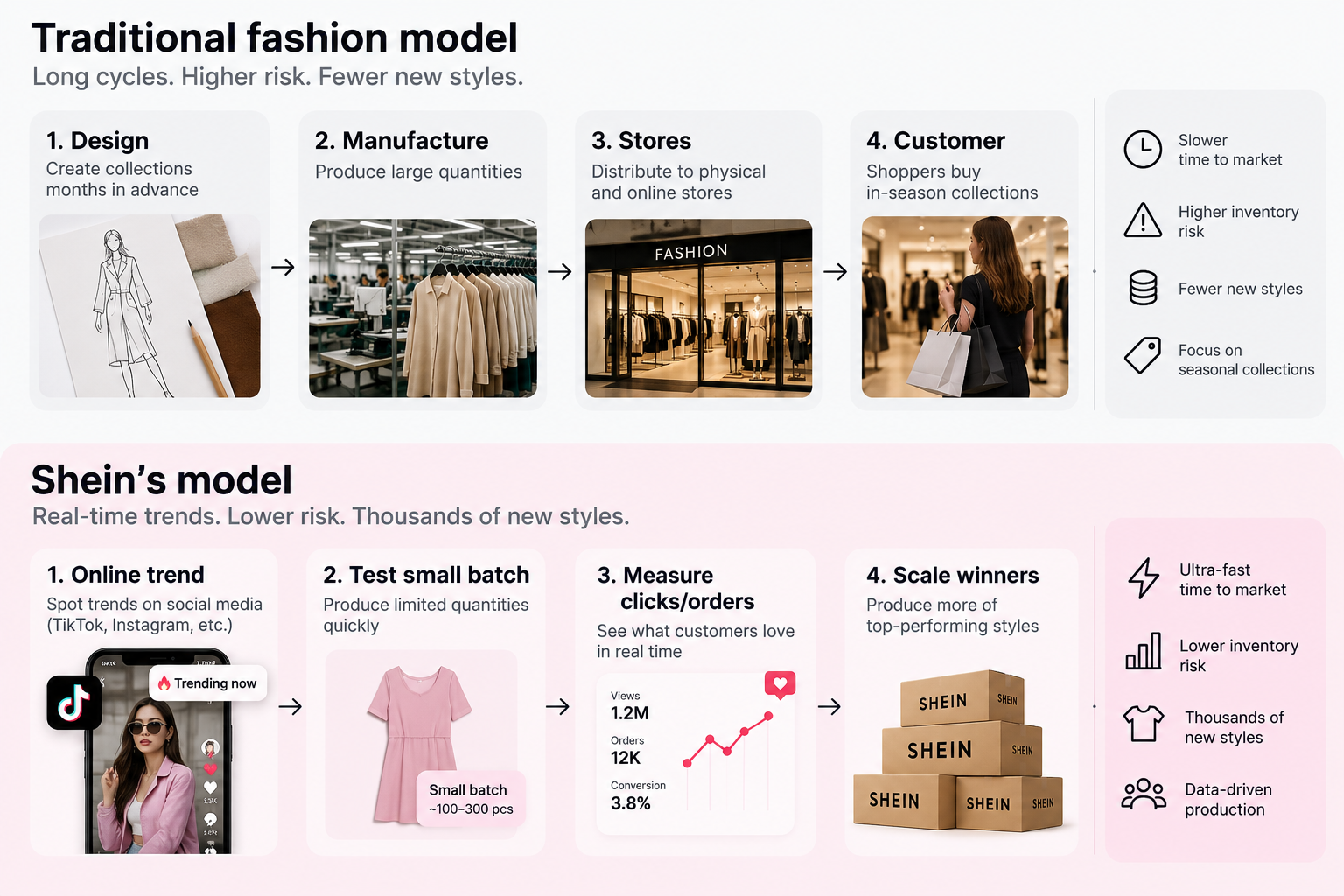
As of March 2026, the platform offered more than 2 million apparel styles, while customers discovered an average of around 4,700 new styles every day through Shein’s first-party model.
That changes the economics of fashion. A retailer no longer has to make one huge bet on what consumers will want six months from now. It can make thousands of smaller bets — and let real-time demand decide which ones deserve more inventory.
💡 For investors, this is the core Shein thesis: at its best, the company looks less like a traditional fashion house and more like a data-driven demand machine.
However, once competitors learn to become faster and more data-driven too, Shein has to prove that its model is difficult to copy — not merely quick.
2. TikTok changed the way we shop
Shein’s rise also coincided with a major shift in consumer behavior. In the past, if we needed a pair of jeans, we’d go to a store, browse the available options, and choose one. Today, Gen Z is more likely to discover first and shop second: scroll through a feed, spot something they like, find the product, and buy it.
For Gen Z, social media now plays an unusually large role in that process. McKinsey found that 34% of Gen Z consumers say social media plays a key role in purchase decisions, versus 16% of baby boomers.
Shein was built perfectly for this world: infinite feed, constant novelty,very low prices, thousands of new products, and rapidly changing microtrends.
In a sense, TikTok shortened the life cycle of trends — and Shein shortened the production cycle to match.
However, Gen Z is also becoming much more selective about money. McKinsey says roughly 70% of fashion consumers intend to spend less, while 80% show some form of value-seeking behavior. Younger consumers are simultaneously embracing resale, hunting for bargains and selectively spending more on products they consider special.
So the future consumer may want cheap here, premium there, secondhand somewhere else. That fragmentation makes Shein’s next phase harder than its first — and potentially more interesting for traders.
3. The world around Shein became more expensive
Shein’s original model was built for an unusually favorable era of global commerce. The era when manufacturing and cross-border shipping were cheap, import barriers were low, and social media were growing.
Now several of those conditions are reversing.
From July 1, the EU abolished the customs-duty exemption on low-value imports under €150 and introduced a temporary €3 customs duty per item.
The US has also tightened low-value import rules, hitting one of Shein’s most important markets. In Q1 2026, US revenue fell 14.3%, while Shein swung to a $99 million net loss, compared with a $395 million profit a year earlier. Part of that loss came from a one-off accounting charge, but the company itself acknowledged the impact of the US de minimis change on sales
Here, traders should ask themselves:
What happens to an ultra-low-cost fashion company when the world starts making ultra-low-cost commerce… expensive?
If Shein passes the costs to consumers, its price advantage narrows. If it absorbs them, margins suffer. That trade-off could become one of the most important drivers of SHEIN stock.
What Shein’s IPO changes for the fashion market
Shein’s listing gives traders something they didn’t have before: a publicly traded proxy for ultra-fast, algorithm-driven fashion.
And that means we can now compare several competing visions of how people will shop next.
| Shein | Zara / Inditex | H&M | Uniqlo / Fast Retailing | |
| The bet | More trends, faster | Fast fashion + strong brand | Fashion at accessible prices | Fewer, better basics |
| Superpower | Data + speed | Supply chain + stores | Scale + affordability | Quality + repeat purchases |
| Consumer says… | “I want what’s trending now” | “I want fashion without luxury prices” | “I want style on a budget” | “I want something I’ll keep wearing” |
| Wins when… | Microtrends + social shopping grow | Consumers value brand + experience | Shoppers become more price-sensitive | Consumers buy fewer, better items |
| Watch out for… | Tariffs + regulation | Slower consumer spending | Margin pressure + Shein competition | Fashion shifts back toward microtrends |
The trader takeaway
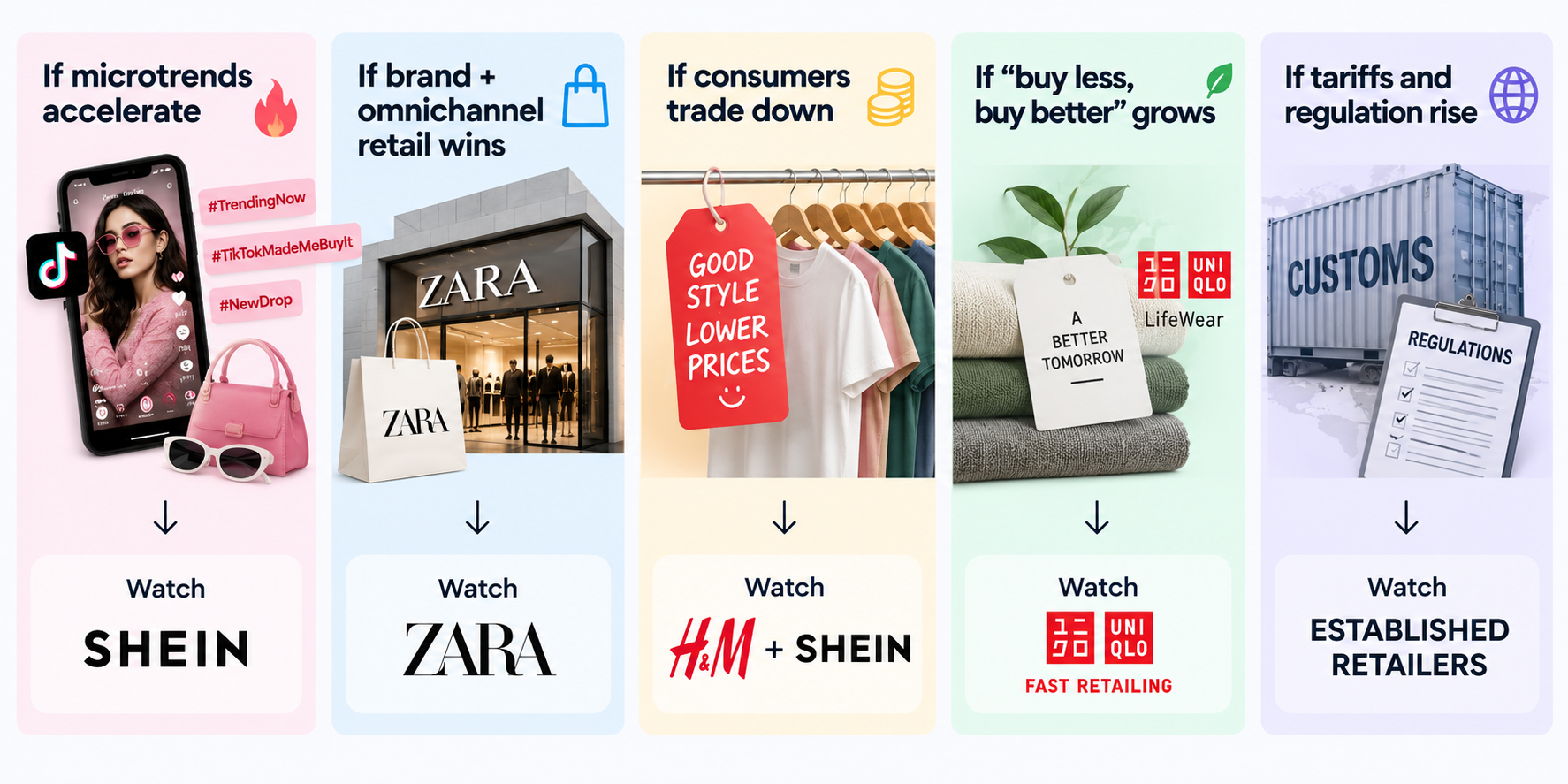
The point isn’t that one of these models has to destroy the others. The same person can buy a €5 viral top from Shein, a Zara jacket, a Uniqlo basic and a secondhand designer bag in the same month.
That means consumer behavior is fragmenting — and competitor results become useful trading signals.
- Strong Inditex margins could suggest brand and supply-chain control are winning.
- Strong H&M sales could point to consumers trading down.
- Fast Retailing strength could support the “buy less, buy better” theme.
- And if Shein grows despite tariffs and regulation, the market may conclude that its speed-and-data advantage is stronger than feared.
Analyst’s take: bull vs bear
Bull case: Shein proves the model still scales
The valuation reset becomes interesting if Shein can show that:
- the stock holds its post-index-inclusion rebound and starts recovering from its post-IPO lows;
- revenue growth reaccelerates;
- margins stabilize after the tariff shock;
- higher costs can be offset through pricing, sourcing or localization;
- its marketplace expands beyond first-party fashion;
- Gen Z keeps favoring discovery-led, value-focused shopping;
- regulatory costs remain manageable.
There is still a very large business underneath the controversy: Shein generated roughly $41.8 billion in 2025 revenue, although growth slowed to 8%. Its recent Hang Seng Composite inclusion and 3.63% bounce give traders an early signal to watch: can buyers keep stepping in?
Bear case: Shein’s biggest advantage becomes its biggest weakness
Shein’s model became huge partly because goods could move cheaply and frictionlessly around the world — and those economics are now changing. Watch for:
- the recent rebound fading and the stock falling below its HK$36.40 post-IPO low;
- more tariffs or customs costs;
- higher logistics expenses;
- persistently weak margins;
- slower customer growth;
- consumers shifting toward resale or longer-lasting products;
- tougher European regulation;
- stronger relative performance from Zara or H&M;
- difficulty converting Shein’s huge revenue base into durable profits.
Levels to watch
SHEIN now has a little more trading history — and its first major post-IPO support level has already failed.
Support: HK$36–36.5: SHEIN reached a new post-listing low of HK$36.40 on September 14. This is now the clearest short-term floor. A break below it would put the stock into fresh price-discovery territory.
Resistance: HK$40–40.5: This area has changed roles. Previously support, it could now act as the first important test for the recovery. A move back above HK$40 would suggest buyers are regaining some ground.
Major resistance: HK$48.56: The IPO price remains the big level. SHEIN would need to recover roughly a quarter from its Sep 14 low to get back there.
What traders should watch next
Stock Connect comes next — SHEIN could become eligible for Stock Connect in around seven months, potentially opening the stock to more mainland Chinese investors.
First earnings as a public company — focus especially on operating margin, profitability and guidance.
European regulation — Any expansion of ultra-fast-fashion rules or changes to e-commerce customs can immediately affect expectations for Shein’s economics.
US trade policy — Changes affecting China-origin parcels, tariffs or low-value imports can influence both costs and prices.
Zara and H&M earnings — Their results become useful read-throughs. Strong Zara sales alongside weak Shein numbers would strengthen the competitive bear case; broad strength across value fashion could suggest healthy consumer demand.
Localization — Watch whether Shein moves more inventory closer to customers. It could reduce trade risk and improve delivery—but potentially increase operating costs.
Pro tip on how to trade SHEIN
Shein trades in Hong Kong, so much of its market action happens overnight or early in the morning for European traders.
That makes risk management especially important. If you can’t watch the position live, consider setting Stop Loss and Take Profit levels in advance.
💡 Remember: a Stop Loss helps limit risk, but sharp price gaps can result in execution at a different price.
Final thoughts
Shein’s IPO puts one of the biggest experiments in modern retail onto the public market.
Can algorithms keep predicting what shoppers want? Can $5 fashion survive higher tariffs? Will Gen Z keep chasing microtrends—or shift toward resale, quality and fewer purchases?
From now on, investors can show up in SHEIN’s share price on IQ Option.