
Well, April 2026 has officially locked in a new reality for the global auto industry:
At the Beijing Auto Show, China’s CATL unveiled next-generation batteries, while the European brands we know so well displayed cars built on Chinese platforms and running Chinese software.
And this is no longer just about adapting to the market — it’s an acknowledgment that China has become the technology hub setting the standards for the entire industry.
But let’s take it from the top.
CATL introduced two breakthrough batteries:
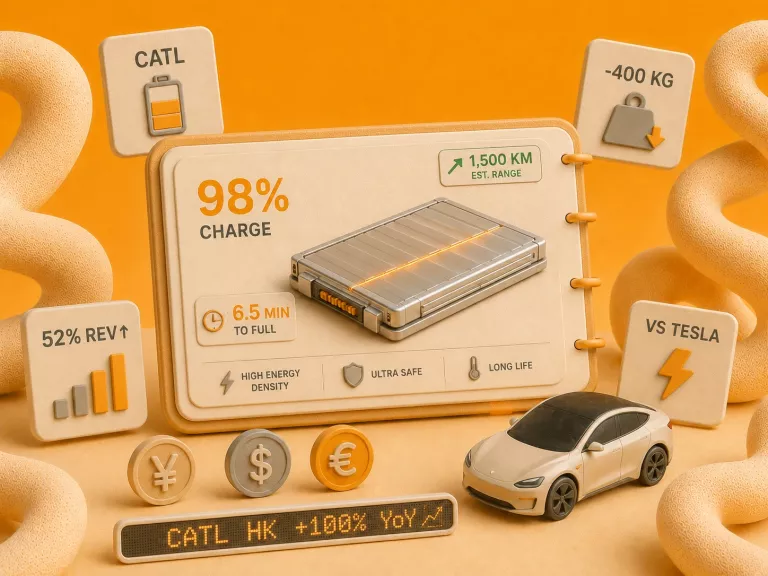
The first is the condensed Qilin, offering a range of 1,500 kilometers on a single charge — which, for context, is more than the distance from London to Barcelona.
Compared to a conventional LFP battery of equivalent capacity, it is 400 kg lighter and takes up 225 liters less space. The technology is semi-solid-state, with a peak discharge power of 3,000 kilowatts.
The second is the third-generation Shenxing, which charges from 10% to 98% in just 6.5 minutes.
The first 35% loads in one minute. 80% is reached in 3 minutes and 44 seconds. Even at -30°C, the battery recovers from 20% to 98% in under ten minutes. Safe to say your smartphone can’t do that.
Worth noting: CATL (alongside BYD) controls more than half of the global battery market and pours billions into R&D. The company’s founder, Robin Zeng, has stressed that the limits of electrochemistry are still far from being reached.
To back that up, the company is launching mass production of sodium-ion batteries this year — they are 30% cheaper than LFP and free from dependence on lithium, cobalt, and nickel.
CATL has also announced the rollout of 100,000 charging and battery-swap stations by the end of 2028.
The financials confirm just how strong their position is: in Q1, revenue grew 52% to 129 billion yuan, net profit rose 48.5%, and Hong Kong-listed shares have gained nearly 100% over the past year.
So What About Western Manufacturers?
According to Automobility data, their share of the Chinese market has collapsed — from 64% in 2020 to just 32% in 2026.
EVs and hybrids now account for more than half of all new car sales in China. That’s impossible to ignore, and Western companies are now choosing the path of deep integration with Chinese technology.
BMW Runs Huawei. Audi Dropped Its Logo. This Is What Adaptation Looks Like.
Volkswagen alone is launching 20 electrified models this year, with fifty planned by 2030 — all developed in China by Chinese engineers, with the best of them destined for export.
BMW unveiled the iX3 with a long wheelbase, already running Huawei’s HarmonyOS operating system, AI from Alibaba and DeepSeek, and driver assistance systems from Momenta.
Audi went even further, creating the sub-brand AUDI — without the four rings — on a SAIC platform. The first model is already on sale; the second, with Level 3 autonomous driving, is on its way.
The bottom line is straightforward: Chinese battery and software makers are no longer playing catch-up — they are setting the standards for the industry.
Western groups are holding onto their brands and design, but their technological platform is becoming increasingly Chinese. The global auto industry is entering an era where China is not just the factory floor — it is the primary source of technological innovation.
What Does This Mean for Tesla Stock?
Tesla occupies a strange position in all of this — it is simultaneously the company most threatened by CATL’s advances and the one least likely to be punished for it immediately by the market.
Here’s why: Tesla doesn’t trade like an automaker. It trades like a tech company with a cult following, and Elon Musk’s personal brand has historically acted as a buffer between bad fundamental news and stock price reaction. That buffer, however, is showing cracks — Tesla’s stock already dropped over 40% earlier in 2026 as Musk’s political entanglements damaged the brand in Europe and parts of the US, before partially recovering.
So what happens next?
The China problem is the most immediate pressure point. Tesla’s market share in China has been eroding steadily — BYD, NIO, and Li Auto have been undercutting on price for two years. Now CATL’s Shenxing battery, charging to 80% in under four minutes, will become standard equipment in Chinese-made EVs within 12–18 months. Tesla’s Supercharger network was a genuine competitive moat — a 6.5-minute charge makes that moat significantly narrower. Watch Q3 and Q4 2026 China delivery numbers closely: if they come in below 150,000 units per quarter, expect analyst downgrades to follow.
The range narrative is shifting. The Model S Long Range does roughly 650 km on a full charge — impressive by 2023 standards, unremarkable against a 1,500 km benchmark. Tesla’s 4680 battery cells, which were supposed to be the company’s next technological leap, are still ramping slowly and haven’t delivered the cost or energy density improvements originally promised. If CATL begins supplying its Qilin condensed battery to Tesla competitors at scale by late 2026 or early 2027, the spec-sheet gap widens further.
The software and AI angle cuts both ways. This is where Tesla’s bull case remains strongest — Full Self-Driving, the energy business, and the Optimus robot program give Tesla a story that has nothing to do with CATL. Morgan Stanley and Wedbush analysts have repeatedly argued that Tesla’s valuation should be read as an AI and robotics company that happens to sell cars. That narrative buys Tesla considerable time even as its pure EV competitiveness erodes.
So what’s a realistic forecast range?
Without a major positive catalyst — a breakthrough FSD regulatory approval, strong Q3 delivery numbers, or a credible Optimus production timeline — Tesla stock looks rangebound between $220 and $280 through the end of 2026, with the downside risk skewing toward the lower end if China numbers disappoint or if CATL’s battery announcements get picked up broadly by mainstream financial media.
A more bearish scenario — further China share loss combined with a broader tech selloff — could push the stock back toward the $170–190 range last seen in early 2026. That’s not a prediction, but it’s a range worth having in mind.
The bull case, where FSD achieves Level 4 approval in one or more major markets and Optimus enters limited commercial deployment, could push the stock back above $350 by mid-2027. But that scenario requires execution on timelines Tesla has repeatedly missed.
The honest one-liner: CATL’s announcements don’t kill Tesla — they just make the window for Tesla to reassert technological leadership narrower and the cost of missing that window higher.
What Does This Mean for Ordinary People?
Even if you’ve never planned to buy an EV or a share of CATL, a shift in technological leadership across a global industry will inevitably ripple through company valuations, commodity prices, pension funds, and currency rates.
The car you buy in three to five years will most likely have Chinese parts inside — and cost less than you think.
Don’t be surprised if American and European automakers start losing market capitalization while their Chinese counterparts keep gaining it.