

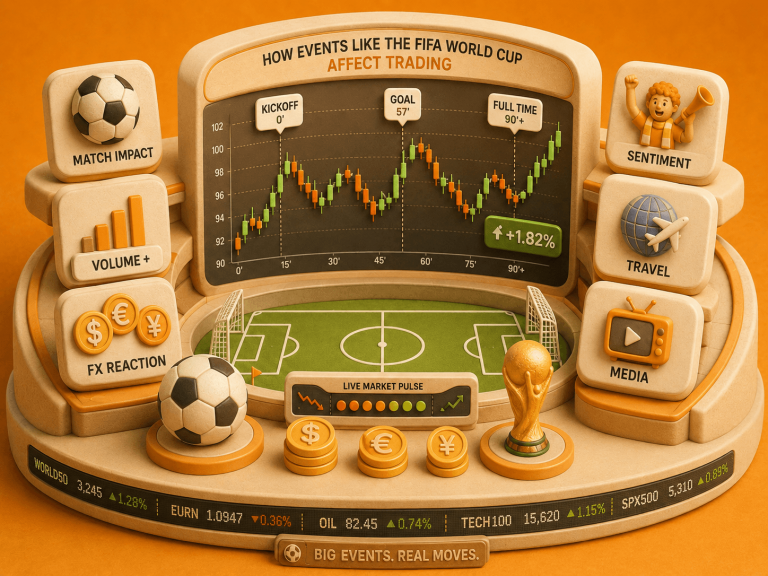
Markets do not trade football matches. They trade expectations.
That is the first thing to remember when people start asking whether the FIFA World Cup can move currencies, stocks or commodities. A World Cup can affect trading, but usually through indirect channels: attention, liquidity, sentiment, company exposure, travel demand, advertising spend and short-term risk appetite.
The mistake is turning that into a simple story like “the host currency should rise” or “a sponsor stock should go up.” In real trading, the useful question is narrower: which asset is affected, what exactly changes, and can you see that change in price, volume or expectations?
The 2026 FIFA World Cup runs from June 11 to July 19, 2026, according to FIFA. It will be hosted across the United States, Canada and Mexico with an expanded 48-team format. That makes it a good case study for traders because the tournament touches several real economic areas: flights, hotels, restaurants, payments, media rights, sponsorships, consumer brands and national attention.
But the honest answer is this: the World Cup is usually trading context, not a trading signal by itself. It can explain why some assets get attention, why a local market feels thinner during a national-team match, or why a certain sector appears on watchlists. It should not replace the chart, the economic calendar, risk management or common sense.
Start with the route from story to price
Before treating a World Cup headline as market news, trace how the story could actually reach the asset.
| Story | Possible market route | What would make it more tradeable |
|---|---|---|
| A national team plays during market hours | Trader attention drops, volume thins, spreads may widen | You see lower volume or poor execution in the local market |
| A major team loses a knockout match | National mood weakens, local sentiment may turn cautious | The local index or sentiment-sensitive stocks react the next session |
| Host cities see heavy travel demand | Hotels, airlines, restaurants and payment volumes benefit | Earnings comments or booking data beat expectations |
| A sponsor gets huge visibility | Brand attention improves, sales expectations change | The company updates guidance or analysts revise estimates |
| A host-country currency gets attention | Traders build a story around national sentiment | The move also fits macro data, rates and broader risk appetite |
If there is no clear route from the event to the asset, there is probably no trade. There may be a good story, but a good story and a good setup are not the same thing.
The most practical effect is attention
The most believable World Cup effect is not that a goal moves a market. It is that people stop watching the market.
During major matches, especially when a country’s national team is playing, a share of local traders and investors may be focused on the game rather than the order book. That sounds small, but in short-term trading it can matter. Lower attention can mean thinner volume, wider spreads in some instruments, slower reaction to unrelated news and awkward price action that cleans itself up after normal participation returns.
There is research behind this. Michael Ehrmann and David-Jan Jansen studied the 2010 and 2014 FIFA World Cups and found evidence of investor inattention during national-team matches. Their paper, published in the Journal of Money, Credit and Banking, reported that traded volumes declined by as much as 48% during some national-team matches.
For a retail trader, this is more useful than trying to predict whether a team will win. If your local market is open while the national team is playing a knockout match, the market may simply behave worse. You might see messy candles, less follow-through or a move that looks convincing only because there are fewer participants around.
In those conditions, the professional move is often boring: reduce size, widen expectations for spreads, or wait until normal liquidity returns. Not every event needs a trade.
Match results can affect mood, but mood is not a system
Football results can influence national mood. Sometimes mood leaks into markets.
A well-known Journal of Finance paper by Alex Edmans, Diego Garcia and Oyvind Norli looked at sports sentiment and stock returns. The authors found that national soccer losses were followed by negative stock market reactions, with larger effects after more important matches. In the paper, a World Cup elimination-stage loss was followed by an average next-day abnormal return of about -49 basis points.
That is a useful finding, but it is also easy to misuse.
It does not mean a loss automatically creates a short setup. It does not mean a win guarantees a rally. It does not mean the same effect will appear cleanly in 2026, after spreads, timing, other news and liquidity are considered.
The better takeaway is more practical: mood can become one input when a result is emotionally important, especially in local markets or smaller sentiment-sensitive stocks. But it is rarely strong enough to ignore inflation data, central-bank expectations, earnings, oil prices, risk sentiment or the broader trend.
If the market is already falling because of macro news, a football loss may become part of the explanation. It is not necessarily the cause.
Host-country spending is real, but markets care about surprises
A World Cup creates real spending. Fans travel, hotels fill rooms, restaurants get traffic, advertisers compete for attention and payment networks process more transactions. In 2026, that activity is spread across the United States, Canada and Mexico, which makes the tournament unusually broad.
That does not mean the U.S. dollar, Canadian dollar or Mexican peso should automatically rise because the event is happening.
Large economies are moved by larger forces: rates, inflation, labor data, growth, fiscal policy, commodity exposure, trade flows and global risk appetite. Tourism demand can be meaningful for certain companies and cities, but it is usually too small to overpower national macro drivers on its own.
This is where beginners often get trapped. They identify something true, then trade it as if the market has not already considered it.
Yes, the World Cup can help hotels and travel demand. But if everyone already expects that, the tradeable move usually comes from the surprise:
- Demand is much stronger than expected.
- Margins are weaker because costs rose faster than revenue.
- A company raises or cuts guidance.
- A broadcaster reports unusually strong or weak viewing numbers.
- A sponsor sees sales momentum that was not priced in.
The event creates the setting. The surprise moves the price.
The cleaner watchlist is company exposure
If you want to connect the World Cup to markets, company exposure is usually cleaner than broad macro storytelling.
A sportswear brand, broadcaster, hotel group, airline, food delivery company, payment provider or advertiser can have a more direct link to the tournament than a whole national currency. The question is still not “is this company connected to the World Cup?” The question is “can this connection change expectations?”
For example, a sportswear stock may already reflect tournament demand months before kick-off. Buying only because the brand is visible during matches is usually late. A better reason would be stronger-than-expected sales, a margin surprise, improved guidance, unusually high merchandise demand or a reaction in related sector names.
The same applies to media and advertising. A major tournament can lift attention, but the market may care more about viewership numbers, ad pricing, subscriber growth or whether the company paid too much for the rights.
In practice, the better trade often appears after the first clean data point, not after the first headline.
Forex is where bad World Cup stories spread fastest
Forex traders love simple narratives. That is why sports events can be dangerous in currency analysis.
The logic sounds reasonable at first: a country wins, national mood improves, investors feel better, the currency strengthens. Sometimes a short-term sentiment move is possible. But forex markets are deep, liquid and heavily macro-driven. Interest-rate expectations, inflation, central-bank commentary, bond yields, commodity prices and global risk appetite normally matter much more than a football result.
Take Mexico as an example during the 2026 tournament. A trader might look at heavy media attention around Mexico and assume MXN should strengthen. That is not enough. A better question is what is happening in USD/MXN before the match:
- Is the U.S. dollar broadly strong or weak?
- Are U.S. yields moving?
- Is there Mexican inflation or central-bank news?
- Are emerging-market currencies supported by risk appetite?
- Is USD/MXN near a major support or resistance zone?
- Is volume confirming the move, or is price just drifting?
If USD/MXN is moving because of rates or U.S. data, the match may be the least important variable on the chart. Football can be context. It should not be the whole trade idea.
Three World Cup situations worth watching
Some situations deserve more attention than others.
A national-team match during market hours
This is mostly a liquidity issue. The match does not have to predict direction. The problem is execution.
If many local traders are watching the game, volume may drop and price may become noisier. A breakout during that window may have less participation behind it. A move after the match may be more meaningful if normal volume returns.
For short-term traders, this is the most practical World Cup adjustment: check the schedule before assuming the market is behaving normally.
A major knockout loss
This is the type of result where sentiment research is most relevant. A group-stage draw and a painful elimination are not the same emotional event.
Even then, the setup needs confirmation. Look for the next-session reaction in the local index, sector behavior, volume and broader market backdrop. If a central-bank decision or inflation report lands at the same time, that probably matters more.
A company with direct tournament exposure reports numbers
This is often the cleanest setup because the link can be measured. Did bookings rise? Did advertising revenue beat expectations? Did costs hurt margins? Did management mention the tournament in guidance?
That is a better foundation than “the World Cup is popular.” Popularity is not enough. Repricing needs a surprise.
A simple pre-trade check
Before placing a trade around a major sports event, write one sentence:
“This event should affect [asset] because [channel], and I will know the market cares if [evidence].”
For example:
“This broadcaster stock may react because World Cup viewership was stronger than expected, and I will know the market cares if the stock breaks above resistance on higher volume while related media names also trade firm.”
That sentence forces discipline. If you cannot complete it, the idea is probably not ready.
This also stops emotional trading. If you support the team involved, be extra careful. The World Cup is designed to create emotion. Trading needs the opposite: distance, patience and a clear invalidation point.
What to watch during the 2026 World Cup
The 2026 tournament is hosted across three countries and 16 cities in North America, so the watchlist is wider than usual. The most relevant areas are:
- USD, CAD and MXN: not because football controls them, but because host-country attention may overlap with macro stories.
- Travel and hospitality: airlines, hotels, booking platforms, restaurants and local tourism demand.
- Consumer brands: sportswear, food, beverages, merchandise and sponsor campaigns.
- Media and advertising: broadcasters, streaming platforms, ad demand and audience numbers.
- Payment activity: card networks and payment companies if spending data becomes part of the market story.
- Local market liquidity: especially during national-team matches.
- The economic calendar: central banks, CPI, jobs data and earnings still outrank football.
The strongest traders will not ask “what should I buy because of the World Cup?” They will ask “what is already priced in, and what would genuinely surprise the market?”
Final thought
Events like the FIFA World Cup can affect trading, but not because football magically moves markets. They matter when they change attention, liquidity, sentiment or expectations.
If a World Cup story changes what investors expect from an asset, shows up in volume, breaks a meaningful level or affects company guidance, it may be worth watching. If it is only an exciting headline, it belongs in the news feed, not in the trade plan.