
Affiliate marketing has a lazy question: who pays the most?
It sounds rational. If one program offers a higher CPA or a bigger revenue share, why not send traffic there?
Because the headline rate is only one part of the business. Sometimes it is not even the most important part.
A high commission can still be a bad deal if the offer converts poorly, the audience does not trust the product, payouts are slow, tracking is unclear, or the affiliate is left alone to guess what works. A lower-looking offer can outperform it when the product fits the traffic and the feedback loop is fast.
That is the difference between a transactional affiliate program and an affiliate ecosystem.
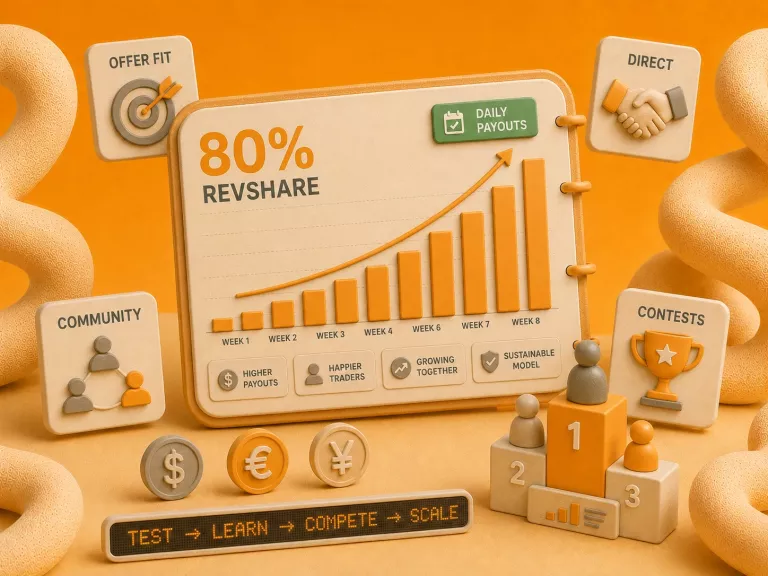
Most programs are transactional: send traffic, get paid, repeat. Affstore is built differently. It combines direct fintech and trading offers, up to 80% revenue share on selected offers, daily payout mechanics, regular affiliate contests, a competitive leaderboard culture, thousands of affiliates, personal managers, promo materials, and a social layer where people compare funnels, talk markets, test angles, and build audiences around trading.
You can see the difference in the contest ladder. Regular FTD challenges give growing affiliates a target. It is not just prizes; it is pace, status, benchmarks, and a public signal of what strong execution looks like.
Experienced affiliates learn this fast: the rate gets you interested, but the environment decides whether the campaign has room to grow.
Beyond the rate
What changes affiliate earnings
The headline commission is only the starting point. The operating environment decides how often an affiliate can repeat, improve, and scale the result.
Offer fit
01The product has to match the audience, GEO, and traffic source before the rate can do any work.
Direct economics
02Fewer layers mean cleaner terms, clearer feedback, and less margin lost before the affiliate is paid.
Payout rhythm
03Fast payouts let strong affiliates reinvest while the campaign angle is still fresh.
Feedback speed
04Clear campaign visibility turns optimization into decisions instead of guesswork.
Community
05Affiliates learn faster when they can compare tactics with people in the same vertical.
Competition
06Contests and leaderboards create benchmarks, pressure, and a reason to keep improving.
The commission rate trap
A commission rate is easy to compare. That is why everyone compares it.
But easy numbers can hide hard problems.
An offer can advertise a high CPA and still leave an affiliate with weak economics if the funnel does not convert. A revenue share can look generous but mean little if the users churn quickly. A program can promise attractive rates but sit behind several layers of intermediaries, each one taking a piece before the affiliate sees the final terms. A campaign can even look profitable for a week and then become hard to scale because payments lag behind media spend.
Experienced affiliates usually ask sharper questions:
- Does this offer match my audience and GEO?
- Do I get paid in a rhythm that lets me reinvest?
- Are there people around me testing the same vertical?
- Is the offer direct, or am I downstream from someone else’s margin?
- Can I keep earning if the trader stays active over time?
That last question matters a lot in trading and fintech.
In many verticals, the relationship ends after a single purchase. In trading, the relationship can be longer. A user may register, deposit, learn the product, return to trade, follow market events, react to education, and keep engaging if the platform fits them. That is why revenue share can be powerful when the product, traffic source, and retention quality line up.
The mistake is treating “80% RevShare” as a trophy number by itself. The real question is what sits behind it.
What Affstore adds beyond the payout
Affstore’s pitch is not just “send traffic and collect commission.”
It is closer to: pick direct trading offers, build around brands that already have demand, use ready promo materials, work with personal managers, watch your numbers, compete in affiliate contests, and grow around a community of people who understand the same vertical.
That matters because affiliate work is lonely when the program gives you nothing except a tracking link.
You can be a strong media buyer or creator and still waste weeks testing the wrong angle. You can have a promising audience and still promote an offer that does not fit the GEO. You can know how to generate clicks and still struggle to turn them into FTDs because the product story is weak.
Affstore gives affiliates a competitive environment: leaderboards, recurring competitions, public benchmarks, and a reason to keep improving when the first tests are messy.
That is not a soft benefit. It changes behavior.
Why contests matter even when you do not win
The obvious reason to join a contest is the prize.
The better reason is that contests force cleaner execution.
When a program runs regular affiliate challenges, affiliates start thinking in shorter feedback cycles. They look at FTD quality, not just clicks. They compare traffic sources. They pay closer attention to landing pages, pre-landers, creatives, payout model, and GEO fit. They notice whether a funnel is actually building intent or just producing curiosity clicks that never deposit.
A mid-tier FTD challenge can be useful because it gives growing affiliates a visible target. A flagship competition like A-List gives top performers a bigger stage. Both formats create the same basic effect: the affiliate is no longer operating in a vacuum.
Even if you do not finish on top, you learn faster when there is a scoreboard.
There is also a second-order effect: competition creates stories. Affiliates who trade themselves, publish market content, run Telegram channels, record short videos, or build educational funnels can talk about what they are testing, what markets are active, and why a specific trading offer fits their audience. That is stronger than another generic “sign up here” post.
The operating loop
How an ecosystem compounds
A flat rate pays for isolated results. A competitive environment helps affiliates improve the system that creates those results.
Choose a direct offer
Match the brand, payout model, GEO, and product story to the audience.
Test real traffic
Run creatives, pre-landers, content angles, and traffic sources against intent.
Read the feedback
Use campaign data and manager insight to separate clicks from real traders.
Benchmark with others
Community and leaderboards show what serious execution looks like.
Compete for momentum
Contests turn improvement into visible targets, pressure, and status.
Reinvest faster
Quicker payouts help strong affiliates put budget back into the next test.
Community is not a nice-to-have
A lot of affiliate programs use the word “community” when they really mean a chat with announcements.
For affiliates, a useful community does something more specific: it shortens the distance between question and answer.
Which GEO is reacting to a certain angle? Which creative format is getting attention without overpromising? Which audience understands binary options, CFDs, prop trading, or short-term market content? Those questions are hard to solve alone.
Affstore’s advantage is that many affiliates are not only traffic sellers. They are market-native. They trade, watch charts, follow assets, create trading content, and understand the emotions of the end user. That shared context is valuable because trading is not a random lead-gen vertical. It requires trust, timing, education, and product fit.
When affiliates compare strategies inside the same ecosystem, the learning curve gets shorter. A new affiliate can see what serious operators care about. A mid-level affiliate can benchmark against stronger performers. A top affiliate can build reputation, not just revenue.
Belonging sounds emotional. In performance marketing, it is practical. People stay sharper around others trying to win the same game.
Direct offers beat rate theater
There is another reason the highest-looking rate is not always the best offer: the affiliate chain can be messy.
When there are too many intermediaries, every layer needs a margin. That can affect rates, communication, flexibility, and speed. The affiliate may not know how close they are to the advertiser, how decisions are made, or why a rule changed.
Affstore is built around direct fintech and trading offers. That matters because fewer layers usually means cleaner economics and clearer communication. If an offer supports up to 80% revenue share, that number is more meaningful when the affiliate is not sitting at the end of a long chain where several players have already taken their share.
Directness also helps with practical work. Managers can explain offer rules. Promo materials are easier to align with the brand. Tracking and campaign feedback are easier to discuss. Affiliates can choose between offers such as IQ Option, Exnova, SabioTrade, IQ Broker and Quadcode B2B depending on audience, GEO, payout model, and promotional style.
That does not mean every affiliate should choose the same offer. It means serious affiliates get more room to choose intelligently.
Revenue share is a retention bet
CPA is simple: bring a qualified user, get a fixed payout. For some affiliates, especially those who need predictable cash flow, that is the right model. Revenue share is different. It is a bet that the user will keep engaging with the product.
That changes how an affiliate should think.
With a flat CPA mindset, the temptation is to optimize for the first conversion only. With a revenue share mindset, the affiliate has a reason to care about audience quality, education, expectations, and long-term product fit. Bad traffic may produce registrations but weak long-term value. Better traffic may scale slower at first but build a stronger base.
This is one of the reasons trading offers are interesting for affiliates who know how to create trust. The user journey is not only “click, deposit, done.” Traders often need education, confidence, product familiarity, and repeated reasons to return.
If your audience trusts you, and the offer fits them, revenue share can turn that trust into a longer earning curve.
That does not make RevShare automatically better than CPA. It makes the choice depend on traffic quality, user intent, and how much trust the affiliate can build before the click.
Payout rhythm changes growth speed
Payment terms are not a boring operational detail. They decide how quickly an affiliate can reinvest. If you run paid traffic, slow payouts can cap testing even when an angle is working. If you are moving between GEOs, payment reliability matters even more because tests stack up quickly.
Affstore’s daily payout mechanics and payment infrastructure matter here because affiliate growth is not only about earning money. It is about recycling money into the next test before the market mood changes.
Fast feedback plus faster payouts creates a cleaner loop:
test, read the numbers, adjust, reinvest, repeat.
That loop is where serious affiliates separate from people who only chase shiny rates.
This is where Affstore’s 10+ years of infrastructure matters. Reporting, promo materials, offer rules, manager support, and payment operations are not glamorous, but they protect affiliates from the small frictions that quietly kill scale.
Who benefits most from Affstore’s model?
Affstore is especially interesting for affiliates who want to build something larger than one-off traffic drops.
That includes:
- trading educators who already explain markets, strategies, assets, or platform tools;
- Telegram, YouTube, TikTok, and community builders with finance-curious audiences;
- media buyers who want direct offers and strong feedback from managers;
- affiliates who trade themselves and can create content with real market context;
- teams that want to compete, benchmark, and use contests as growth pressure;
- affiliates who understand that trust converts better than aggressive promises.
It is probably not the best fit for someone who only wants to paste a link, make a quick push, and disappear. The strongest upside comes when the affiliate treats the program as a place to build inside.
Transactional programs pay you for a result.
Affstore gives you a setting where better results become more likely over time.
Use this filter before choosing a program
Before choosing an affiliate program only because the rate looks high, ask:
- Is the offer direct, or are there several intermediaries?
- Does the product match my audience’s intent?
- Can I see campaign performance quickly enough to adjust?
- How fast can I get paid and reinvest?
- Are there contests or benchmarks that show what strong performance looks like?
- Is there a real community, not only a manager chat?
- Are promo materials available in formats I actually use?
- Are the offer rules clear enough before I send traffic?
If the answer is mostly no, the headline rate may not save the campaign.
If the answer is yes, the rate has a better chance of becoming real revenue.
Where Affstore fits
Affstore makes the most sense for affiliates who are not trying to squeeze one campaign and move on. It is for people who want direct trading offers, quick feedback, a payout rhythm they can plan around, and a competitive environment that keeps raising the bar.
That is a different promise from “we pay the highest rate.”
Rates can be copied. A real affiliate environment is harder to copy: active offers, managers who understand the vertical, contests people care about, a community that speaks the language of trading, and enough infrastructure to keep the work moving when campaigns start to scale.
That is the bet behind Affstore.
Not just better terms on paper. Better conditions for affiliates who want to keep getting sharper.