

Overtrading is the act of buying and selling financial assets too frequently, often driven by emotional impulses like boredom, greed or the desire to recoup losses rather than a logical strategy. In a business context, overtrading occurs when a company expands its operations faster than its working capital can support, leading to cash flow crises. To avoid overtrading, investors should stick to a predefined trading plan, set daily loss limits, and view cash as a strategic position rather than a missed opportunity.
In 2026, the rise of commission-free platforms and “vibe-driven” social media trading has made overtrading the #1 reason retail accounts fail within their first year. This guide breaks down the psychology of the “trading itch” and provides the structural boundaries needed to protect your capital.
What Exactly Is Overtrading?
At its core, overtrading isn’t just about a high number of trades. A high-frequency algorithm might execute 1,000 trades a day and not be overtrading because it is following a strict mathematical edge.
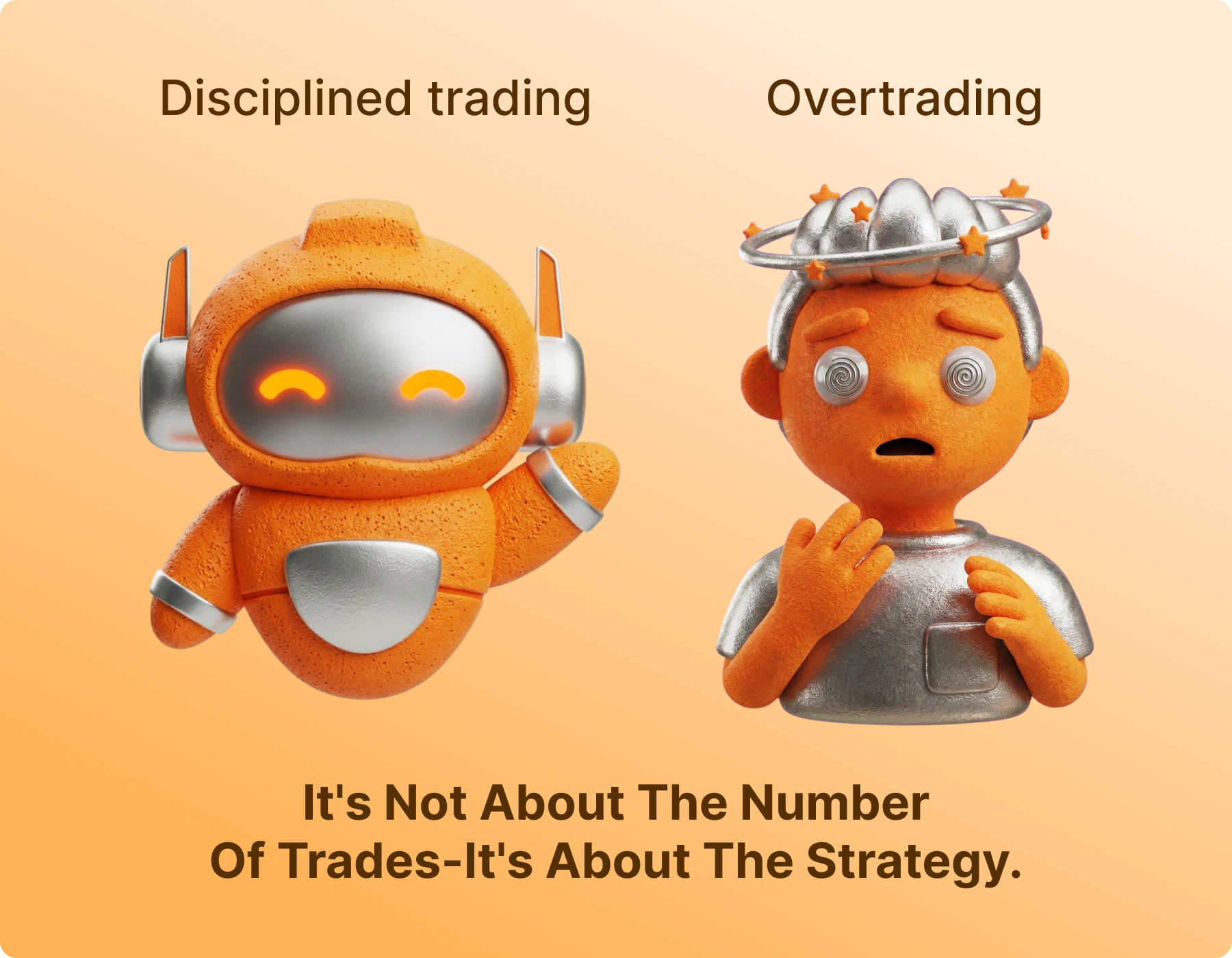
Overtrading is trading without an “edge.” It is the moment your activity outpaces your analysis. It usually falls into two categories:
- Discretionary Overtrading: You trade because you “feel” the market is about to move, ignoring your actual setup rules.
- Technical Overtrading: You add too many indicators to your chart until you can find a reason to enter a trade at any given time, effectively “forcing” a signal that isn’t there.
Trading vs. Business Overtrading
While most people think of the stock market, business owners face a different version. In business, overtrading is “growing yourself into bankruptcy”. You take on so many new orders that you run out of cash to pay your suppliers before your customers pay you.
| Feature | Trading Overtrading | Business Overtrading |
| Primary Driver | Emotions (FOMO, Revenge) | Rapid, Unplanned Growth |
| Immediate Result | Capital Depletion & Fees | Cash Flow Crisis |
| Warning Sign | High volume, low win rate | Increasing sales, decreasing cash |
Why Do We Overtrade? The Psychology of the “Itch”
Our brains are hardwired to fail at trading. In 2026, cognitive psychologists have identified a specific “dopamine loop” that keeps traders glued to their screens.
The Dopamine Trap
Every time you click “Buy” or “Sell,” your brain releases a small surge of dopamine—the same chemical released during gambling. Even if the trade is a loser, the uncertainty of the outcome provides a “thrill.” Over time, you stop trading for profit and start trading for the neurochemical hit.
The 4 Emotional Killers
- Revenge Trading: You lose $500. Your ego is hurt. You immediately jump back in with a larger position to “win it back.” This is the fastest way to blow an account.
- FOMO (Fear Of Missing Out): You see a stock like Nvidia or a meme coin pumping 10% on social media. You enter late, at the top, just because you can’t stand seeing others make money while you sit in cash.
- Boredom: The market is quiet. Nothing is happening. You place a “small” trade just to feel something. These “small” trades usually have the worst risk-reward ratios.
- Overconfidence: After a 5-trade winning streak, you feel invincible. You stop checking your criteria and start “guessing,” believing you have “decoded” the market.
The Hidden Costs of Overtrading
Many 2026 traders believe that if their platform has “$0 commissions,” overtrading doesn’t hurt them. This is a dangerous myth.
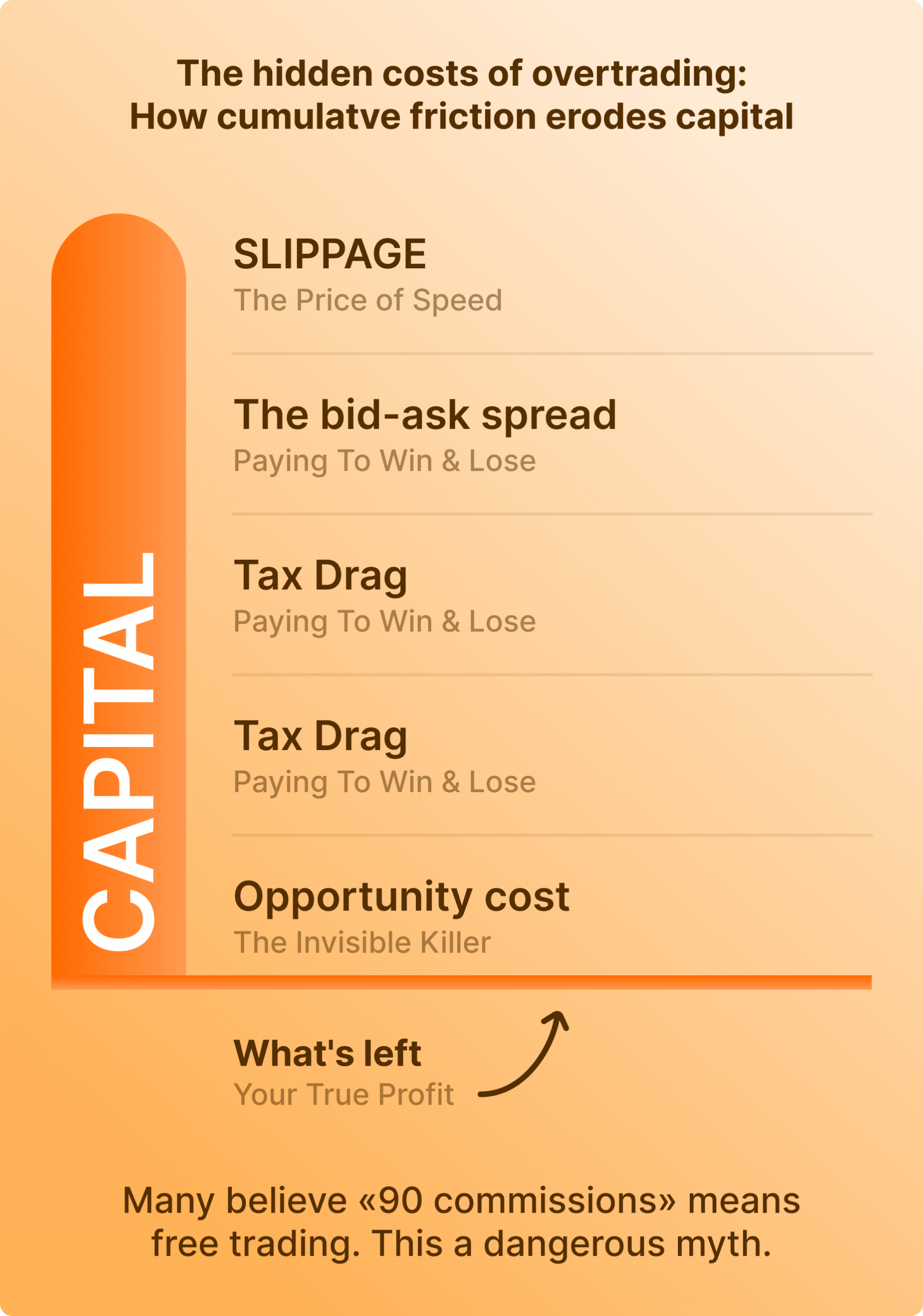
- The Bid-Ask Spread: Every time you enter a trade, you pay the “spread.” If you trade 50 times a day, those few cents add up to a massive percentage of your total capital.
- The Tax Drag: In many regions, short-term trades are taxed at much higher rates than long-term holds. By overtrading, you are essentially giving 20–40% of your potential profit to the government before you even see it.
- Opportunity Cost: While you are busy chasing 5-minute “noise” on a chart, you often miss the larger, high-probability trends that would have actually made you wealthy.
- Slippage: In fast-moving markets, your “Market Order” might execute at a price much worse than you intended. The more you trade, the more you get hit by these “hidden” losses.
How to Avoid Overtrading: 7 Actionable Strategies
If you find yourself constantly “tilting” or breaking your own rules, you need structural boundaries. Discipline isn’t about being “stronger”; it’s about making it harder to be “weak”.
1. The “Three and Out” Rule
Limit yourself to a maximum of 3 trades per day. Once you hit your third trade—win or lose—you must close your laptop and walk away. This forces you to be extremely picky about which setups you take.
2. Implement a Daily Loss Limit
Set a “Hard Stop” for your entire account. For example: “If I lose 2% of my account today, my platform locks me out”. Most professional 2026 trading platforms now have a “Kill Switch” feature that you can pre-program to prevent emotional spirals.
3. View Cash as a Position
One of the most powerful mindset shifts in 2026 is recognizing that sitting in cash is a strategic trade. You are choosing a “0% return” over a potential “-5% loss.” Patience is a form of active risk management.
4. Use a Pre-Trade Checklist
Never enter a trade based on a “feeling.” Create a physical checklist on your desk.
- Is the trend aligned?
- Is the RSI in my zone?
- Is my Stop-Loss placed?
- Am I revenge trading?
If you can’t check every box, you don’t take the trade.
5. Start a Trading Journal
Write down every trade, why you took it, and how you felt. Reviewing your journal at the end of the week will show you a clear pattern: “I lose money every time I trade after 2:00 PM” or “I overtrade when I haven’t slept enough”.
6. Limit Your Screen Time
The longer you stare at the charts, the more “ghost setups” you will see. Set specific windows (e.g., the first 2 hours of the market open) and then walk away.
7. Step Back After a Big Win
Ironically, big wins are more dangerous than losses. They trigger overconfidence. After a “home run” trade, take 24 hours off to reset your dopamine levels before returning to the market.
Risk Management: The Math of Longevity
Overtrading usually leads to poor Position Sizing. To survive 2026’s volatility, you must use a standard risk formula for every single trade.
The 1% Rule
Never risk more than 1% of your total account on a single trade.
Position Size = (Account Balance * Risk %) / (Entry Price – Stop-Loss Price)
If you have a $10,000 account and risk 1%, your maximum loss is $100. If your stop-loss is $2 away from your entry, you can only buy 50 shares. Overtrading often happens when traders ignore this math and “guess” their size based on how much they want to make.
The Risk-Reward Ratio (R:R)
Target trades where the potential reward is at least 2x the potential risk (a 1:2 ratio). If you only win 40% of the time but have a 1:2 R:R, you will still be profitable. Overtraders often take 1:1 or even 2:1 (risking $2 to make $1) trades, which is a mathematical death sentence.
Real-Life Case: The “Tariff Tantrum” of 2025
In early 2025, when global tariff announcements caused the S&P 500 to swing by 5% in a single day, retail trading volume surged by 2.5 times the yearly average.
One trader, “Alex,” had a successful $50,000 account. During the volatility, he moved from his usual 2 trades a day to 40 trades a day.
- The Result: Alex actually had a “green” day in terms of trade performance, but he was down $1,200 after commissions and slippage.
- The Lesson: Alex wasn’t trading the market; he was trading the volatility. He had become a “liquidity provider” for the big institutions, paying them in fees for the privilege of being emotional.
Final Takeaway
In 2026, the most successful traders aren’t the ones with the most activity; they are the ones who are the most bored. Trading should be a business, not a hobby. If it feels like a high-speed video game, you are likely overtrading.
True wealth is built by doing less, but doing it with higher conviction. Stop chasing the market, and start letting the market come to you.