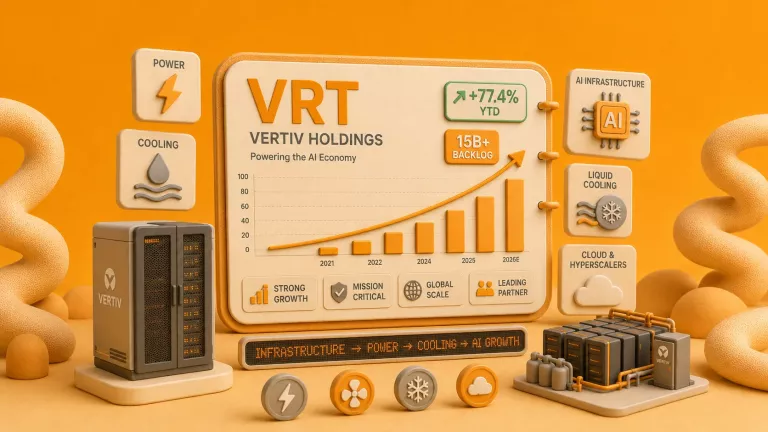
SmartRun digital-twin software co-developed with NVIDIA, backed by ThermoKey and Strategic Thermal Labs cooling acquisitions, puts Vertiv (VRT) at the center of AI data center build-outs that drive today’s stock analysis debate. The company has paired that technology push with record AI-driven orders, a backlog above $15 billion, and raised 2026 guidance, all while lifting margins above 20%. With the stock up sharply year-to-date and now included in the S&P 500, investors may focus on whether Vertiv can convert its swelling AI pipeline into sustained growth and profitability through 2027.
Summary
| Key Fact | Detail |
|---|---|
| Company | Vertiv (VRT) |
| Sector / industry | Data center power and cooling solutions |
| Market cap | $119.6B |
| YTD return | +77.4% |
| Revenue growth YoY | +27.7% |
| Primary risk | Slowdown in AI and cloud data center spending |
Data source: Yahoo Finance, as of July 2026.
Vertiv (VRT) at a Glance: Key Stats and Fundamentals
| Metric | Value |
|---|---|
| Current Price | $311.42 |
| Market Cap | $119.6B |
| P/E Ratio | 78.1 |
| Forward P/E | 35.2 |
| YTD Performance | +77.4% |
| Dividend Yield | 0.1% |
| 52-Week High | $379.94 |
| 52-Week Low | $110.06 |
| EPS | $3.99 |
What Does Vertiv Actually Do for AI Data Centers?
Vertiv focuses on the power, cooling, and infrastructure that keep AI and high-performance computing data centers running safely and efficiently. The company does not build servers or chips; instead, it supplies the hardware and services that manage electricity, remove heat, and protect equipment from failures. Its portfolio spans power systems, thermal management, racks and enclosures, and software that monitors and automates data center operations.
Vertiv’s core customers include cloud providers, AI hyperscalers, and large enterprises that are expanding data centers for AI training and other compute-heavy workloads. A key differentiator is its co-engineering work with major chip vendors and cloud platforms, where Vertiv teams design power and cooling setups alongside upcoming server generations. This approach turns Vertiv into an embedded design partner rather than a vendor that sells generic boxes after the fact.
Thermal solutions are a major growth focus. Vertiv has been expanding liquid-cooling and heat-rejection products through acquisitions such as ThermoKey and Strategic Thermal Labs, which bring additional thermal technology and European manufacturing capacity. These capabilities aim to handle the extreme heat produced by dense AI racks, especially in regions like Europe where data center construction is accelerating and energy-efficiency rules are tight.
Digital tools round out the model. Vertiv’s SmartRun digital twin software, which can integrate with NVIDIA Omniverse DSX, lets customers simulate and optimize new data center designs before they are built. Management has highlighted a record order backlog and rising AI-related demand, and according to available data the current strategy focuses on turning that pipeline into higher-margin revenue through execution on these power, cooling, and software platforms.
What Key Drivers Shape Vertiv (VRT) Stock Analysis in 2026?
Vertiv (VRT) stock analysis in 2026 mainly hinges on AI-driven data center demand, Vertiv’s cooling technology edge, and how quickly its record backlog turns into profitable revenue.
AI and high-performance computing data centers are the core engine. In Q1 2026, Vertiv’s operating profit rose 64% and free cash flow jumped 147%, helped by strong AI-related orders and growing liquid-cooling adoption. Management now guides 2026 net sales to $13.5–$14.0 billion, up from current annual revenue of $10.2 billion, with a backlog above $15 billion that could support growth into 2027.
Acquisitions and partnerships also move the stock. The June 2026 ThermoKey deal expands Vertiv’s liquid cooling and heat-rejection capacity in North America and Europe, directly targeting hyperscalers increasing their AI capex in those regions. Co-development with NVIDIA, including SmartRun digital twin integration with NVIDIA Omniverse DSX, helps make Vertiv part of the design phase for next-generation AI data centers rather than just a hardware supplier.
Index inclusion and sentiment are additional levers. Vertiv’s entry into the S&P 500 in March 2026 brings steady demand from index funds and raises its profile with large institutions. The stock’s +77.4% year-to-date return shows how quickly sentiment can swing on AI growth expectations, guidance changes, and bank price-target moves.
Key stock drivers to monitor:
- AI and liquid-cooling orders: pace of AI data center build-outs and adoption of Vertiv’s liquid-cooling and thermal solutions.
- Backlog conversion: how efficiently the $15B+ backlog translates into revenue and whether operating margins stay above the recent 20%+ level.
- NVIDIA and hyperscaler partnerships: depth of co-engineering work and whether Vertiv remains a preferred power and cooling partner in new AI designs.
- Capital markets signals: impact of S&P 500 index flows and any shifts in analyst targets or ratings on valuation and volatility.
What Gives Vertiv Its Competitive Edge in AI Data Centers?
Vertiv’s edge in AI data centers comes from deeply embedded engineering partnerships and thermal technology that is built directly into next-generation data center designs. These co-engineering relationships with hyperscalers and chip vendors mean Vertiv’s power and cooling systems are specified early, rather than chosen later as interchangeable hardware. That “designed-in” position lines up with the company’s reported 27.7% year-over-year revenue growth to $10.2 billion and $1.9 billion in free cash flow, suggesting that the engineering moat is already translating into scale and cash generation.
Vertiv’s global service and manufacturing network also supports its edge as AI data centers roll out across regions. A broad installed base and service footprint make it easier to support complex power and cooling setups over many years, which can be a deciding factor for large cloud and AI customers. The company’s recent move into the S&P 500 and a year-to-date return of 77.4% signal that investors are treating this network as a durable asset, not just a cost center.
Targeted acquisitions give Vertiv differentiated technology in liquid cooling and heat rejection just as AI power density rises. Buying ThermoKey and Strategic Thermal Labs adds specialized thermal designs and extra European manufacturing capacity while EMEA data center build-outs pick up speed. Management has raised its 2026 sales outlook to $13.5–$14.0 billion, which, if reached, would represent a sizable step up from current revenue and would underscore how these deals are feeding into growth.
Digital tools round out Vertiv’s advantage by helping customers design and run their data centers more efficiently. Co-development of the SmartRun digital twin integrated with NVIDIA Omniverse DSX allows clients to simulate and optimize layouts, cooling, and power before building. As more AI projects demand this type of planning, these software-driven workflows may make Vertiv harder to displace, supporting its current earnings per share of $3.99 and operating margin expansion noted in early 2026.
Vertiv (VRT) Stock Analysis: What Are the Biggest Risks Investors Should Watch?
Vertiv’s main risks cluster around three things: execution, hyperscaler spending, and rising competition in data center cooling. The company has raised its 2026 targets on the back of rapid AI-driven growth, which increases execution risk. To hit those goals, Vertiv must scale production, control costs, and deliver complex power and liquid-cooling projects on tight timelines. Any supply-chain disruption in specialized components or missteps in factory ramp-ups could squeeze margins and undermine the benefit of its backlog above $15 billion.
Vertiv is also tightly linked to hyperscaler and cloud data center capital spending. A slowdown in AI or cloud build-outs – whether from weaker macro conditions, past over-building, or a shift toward more efficient chip or cooling designs – could cut into new orders and delay converting existing backlog into revenue. Large cloud and AI customers may also choose to bring more power and cooling work in-house, or aggressively rebid projects, which could reduce Vertiv’s share of wallet and pressure pricing.
For readers who want exposure to the AI labs themselves rather than the data center infrastructure behind them, most are still private — but Anthropic is already tradeable pre-IPO. We break down what’s confirmed and what’s still rumor in our Anthropic IPO explainer.
Another major risk is competition and technology change in AI data center thermal management. Rivals are pushing alternative liquid-cooling and heat-rejection approaches, and a breakthrough solution or a pricing war could erode Vertiv’s pricing power. Its close co-engineering ties with NVIDIA and recent thermal acquisitions help its position, but they do not remove the risk that a new cooling architecture or a low-cost challenger could weaken its moat.
Finally, the stock’s recent 77.4% year-to-date return and trailing P/E near 78.1 mean the market has already priced in a lot of good news. If margins slip, AI demand grows slower than expected, or major projects get delayed, the share price could react hard to even modest disappointments, since so much future growth is already baked into the multiple.
What Should Investors Watch for Next in Vertiv Stock?
The key things to watch for in Vertiv stock revolve around whether AI-driven data center demand actually turns its record backlog into profitable revenue.
Investors may focus first on Vertiv’s ability to hit its raised 2026 outlook of $13.5–$14.0 billion in net sales and higher EPS. Each quarterly report will show how much of the $15+ billion backlog turns into revenue, whether operating margins stay above 20%, and if free cash flow continues to grow as it did in Q1 2026. Any slip in margins or order intake tied to AI data centers could signal that the recent guidance may be hard to sustain.
A second key watchpoint is AI data center capex from hyperscalers and cloud providers. Slower AI build-outs, large customers bringing cooling in-house, or aggressive pricing from rivals could weigh on Vertiv’s order growth and its current valuation. Lastly, product and execution milestones matter: progress integrating ThermoKey into Vertiv’s liquid-cooling lineup, customer uptake of SmartRun digital twin tools with NVIDIA Omniverse, and any supply-chain disruptions in advanced cooling components could all move expectations for how durable Vertiv’s AI cooling advantage will be into 2027 and beyond.
How Do Vertiv (VRT) Scenarios Compare for 2026 and Beyond?
Vertiv’s 2026 really turns on three things: how strong AI data-center demand stays, whether it keeps pricing power, and how cleanly it executes on that $15B+ backlog. The table below runs those through bear, base, and bull cases and links them to revenue growth and margins.
| Scenario | AI Data Center Demand | Vertiv Pricing Power | Supply Chain & Execution | Annual Revenue Growth Outlook | Operating Margin Trend |
|---|---|---|---|---|---|
| Bearish | AI capex slows as customers digest recent builds | Limited ability to raise prices on new orders | Component tightness and project delays resurface | Low single-digit growth driven mostly by backlog burn | Margins flat to slightly lower as pricing softens and volumes thin out |
| Base | AI and cloud spending grows at a steady pace | Selective price increases on higher-value systems | Operations broadly stable with normal hiccups | Mid-single-digit to high-single-digit growth from new wins plus backlog | Margins gradually improve as mix shifts to higher-margin solutions |
| Bullish | AI data-center build-outs stay very strong into 2026+ | Consistent price discipline on new AI-focused projects | Smooth execution, faster installation cycles, and cost efficiencies | Double-digit growth supported by both backlog and new AI projects | Margins step up as high-value liquid-cooling volume, mix, and pricing all move Vertiv’s way |
The grid isn’t a forecast — it just shows how much Vertiv’s 2026 could swing on two things it partly controls (execution and pricing) and one it doesn’t (the pace of AI spending).
Key Takeaways
- Vertiv is a fast-growing AI data center infrastructure player, with 27.7% year-over-year revenue growth and $1.9B in free cash flow supporting expansion.
- AI data center demand is a key driver, as Vertiv’s power and cooling systems are co-engineered with hyperscalers and chip vendors for next-generation high-density server racks.
- Strategic acquisitions of ThermoKey and Strategic Thermal Labs expand Vertiv’s thermal technology portfolio and EMEA manufacturing footprint just as European data center build-outs accelerate.
- Deep integration of Vertiv’s SmartRun digital twin with NVIDIA Omniverse DSX may help lock in Vertiv’s role as a design partner, not just a commodity hardware supplier.
- Vertiv’s elevated valuation multiples reflect optimism about AI-related growth but may be vulnerable if data center capital spending slows or customers insource cooling solutions.
- Rapid scaling to meet AI demand brings execution risks, including potential supply-chain issues in specialized liquid-cooling components that could delay projects and pressure margins.