



New to options trading? Master these 5 powerful IQ Option trading strategies for short-term trades — they don’t require complex tools or advanced mathematics. These beginner-friendly methods can help you build discipline, improve your win rate, make better decisions, and gain the confidence to trade in real market conditions.
These strategies act as a solid foundation — once you’ve mastered them, you’ll be better prepared to explore more advanced techniques with confidence and control.
What Is Options Trading?
Options trading allows you to speculate on the direction of an asset’s price — without owning the asset itself. You’re not buying the asset — you’re betting on its direction. If you’re right, you win a fixed payout. If you’re wrong, you lose the amount you risked. That’s why options trading is fast, flexible — and risky.
This often comes in the form of binary options or digital options, where you predict whether the price will be higher or lower after a set time.
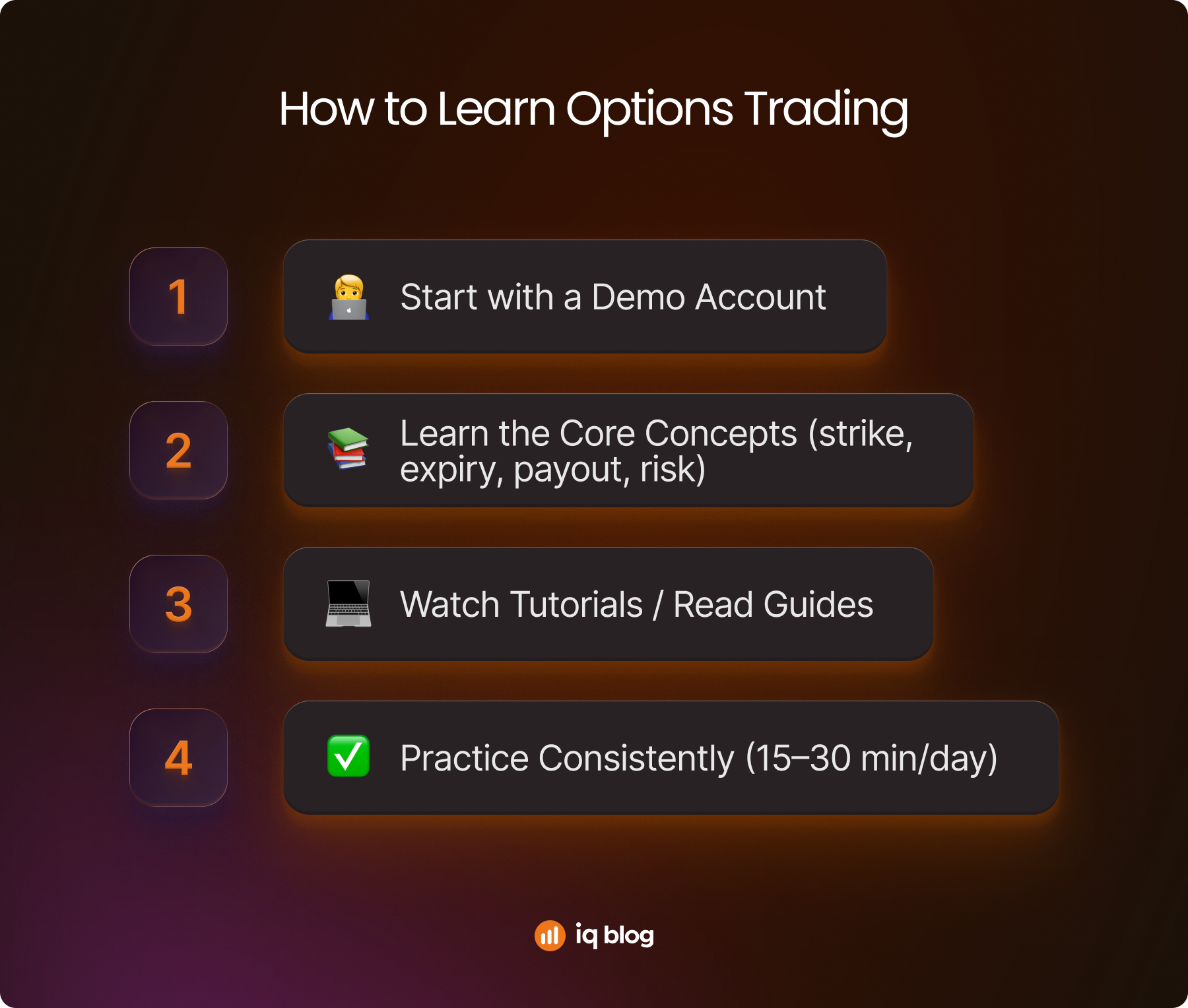
How to Learn Options Trading
If you’re new to trading, don’t rush into the real market right away — the fastest way to lose money is jumping in unprepared. Here’s how to get started:
✅ Start with a demo account — no risk, just practice.
✅ Study core concepts: strike price, expiration time, risk/reward, payout percentage.
✅ Watch beginner-friendly tutorials or read step-by-step guides like this one on on how to trade binary options.
Consistency is key — even just 15–30 focused minutes a day can build strong trading instincts over time.
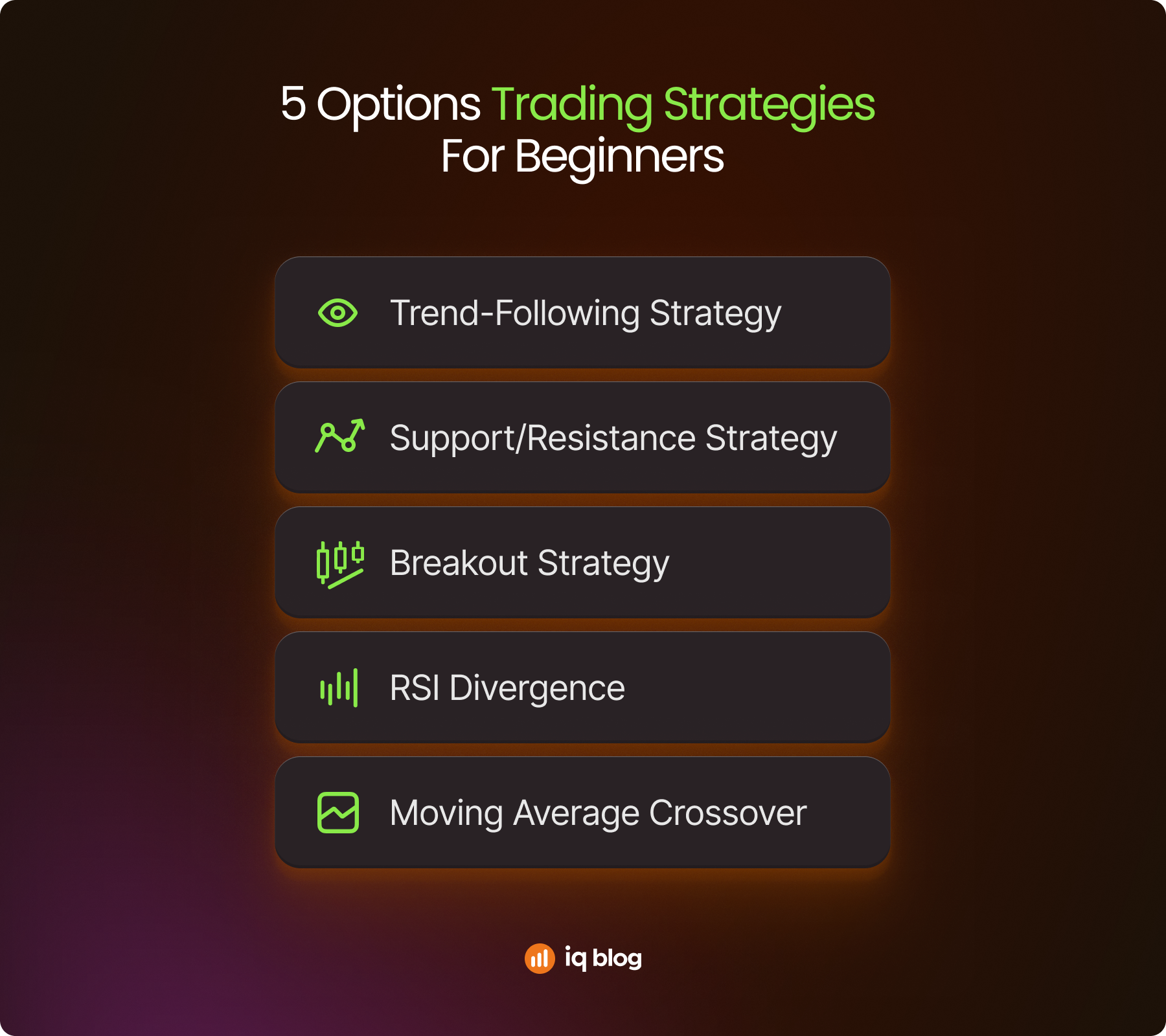
5 Options Trading Strategies For Beginners
1. Trend-Following Strategy
Best for: Identifying market direction and riding strong trends
Why it works: Markets often move in recognizable trends. The core idea of trend trading is that once a trend is established, it’s likely to continue — at least long enough to profit from a short-term option trade.
The best strategy combines using trend continuation candlestick patterns and indicators like Moving Averages (MA), MACD, or Bollinger Bands to confirm the direction and momentum.
Trend-following works especially well during major news releases or after a breakout, when volatility increases and price tends to follow through. Avoid trading during choppy, sideways markets — this strategy thrives in clear, directional environments.
💡 Pro Tip: Applying trend-following strategies on longer timeframes (15-min or above) with tools like EMA (Exponential Moving Average) can help smooth out noise.
2. Support and Resistance Levels
Best for: Reversal trades and price action analysis
Why it works: These horizontal price zones act as psychological barriers where traders consistently enter or exit positions. Identifying strong support and resistance levels helps you spot potential breakout or reversal opportunities. These zones often align with previous highs/lows, pivot points, or areas of high volume.
Draw these levels on a 1-hour or 4-hour chart and monitor price reaction with candlestick confirmation before placing a trade. Look for signs like pin bars, engulfing candles, or doji near these areas — they often signal a market turning point.
You can read more about the Support and Resistance levels in this article.
💡 Pro Tip: Combine this with RSI to confirm overbought or oversold conditions.
3. Breakout Strategy
Best for: Capturing early momentum after consolidation
Why it works: Markets spend a lot of time in consolidation. When price breaks out of a tight range or triangle pattern, it often leads to explosive moves that can offer high-reward, short-term trading opportunities.
Use charting tools to spot classic price patterns like rectangles, wedges, or triangles, and wait for high-volume breakouts to enter a trade. These patterns often appear during consolidation phases — when the market is “taking a breath” before making a strong directional move.
💡 Pro Tip: Use breakout strategies in volatile market sessions like London or New York open for higher impact moves. Breakouts are most reliable when accompanied by rising volume and strong momentum indicators like RSI or MACD confirming the shift.
Examples of Chart Patterns That May Signal a New Trend
- If the price breaks above a resistance level with a bullish engulfing candle, it may signal the start of an uptrend — especially when backed by rising volume.
- A descending wedge pattern followed by an upward breakout often suggests that selling pressure is fading. Look for confirmation from RSI divergence or a MACD crossover.
- When a symmetrical triangle forms after a bullish move, a breakout to the upside can indicate trend continuation, signaling a potential new leg higher.
- At the end of an uptrend, a head and shoulders pattern with a neckline breakdown and strong volume often marks the start of a new downtrend.
💡 Pro Tip: Use multi-timeframe analysis — confirm a pattern on a 15-minute or 1-hour chart before entering on a 5-minute chart to improve reliability.
4. The RSI Divergence Strategy
Best for: Spotting hidden reversals early
Why it works: Among all IQ Option trading strategies, RSI is considered one of the most popular. It’s very easy to read, and it works particularly well with options. It helps traders detect momentum shifts before they appear in price.
RSI divergence occurs when the price makes a new high or low, but the RSI indicator fails to confirm it — suggesting weakness in the move and a possible reversal ahead. This can signal exhaustion in the current trend.
Set your RSI period to 14 and look for divergence around key support/resistance areas. Use it with clean chart setups, especially after sharp moves. This strategy works best on higher timeframes to filter out noise and reduce false signals.
💡 Pro Tip: Perfect for combining with trendlines for added confirmation.
5. Moving Average Crossover Strategy
Best for: Spotting trend changes and confirming entry points
Why it works: This strategy uses the intersection of two moving averages — typically a short-term (e.g. 9- or 14-period EMA) and a long-term (e.g. 50-period EMA) — to detect momentum shifts and potential trend reversals.
- When the shorter moving average crosses above the longer one, it suggests a potential uptrend and acts as a bullish entry signal.
- A downward cross suggests the opposite and signals potential weakness. These crossovers often align with key breakout or reversal zones, making them useful for confirmation.
This strategy is especially powerful when combined with volume indicators, RSI, or price action around support/resistance zones.
💡 Pro Tip: Filter out false signals by avoiding low-volume markets and checking for trend alignment on higher timeframes.
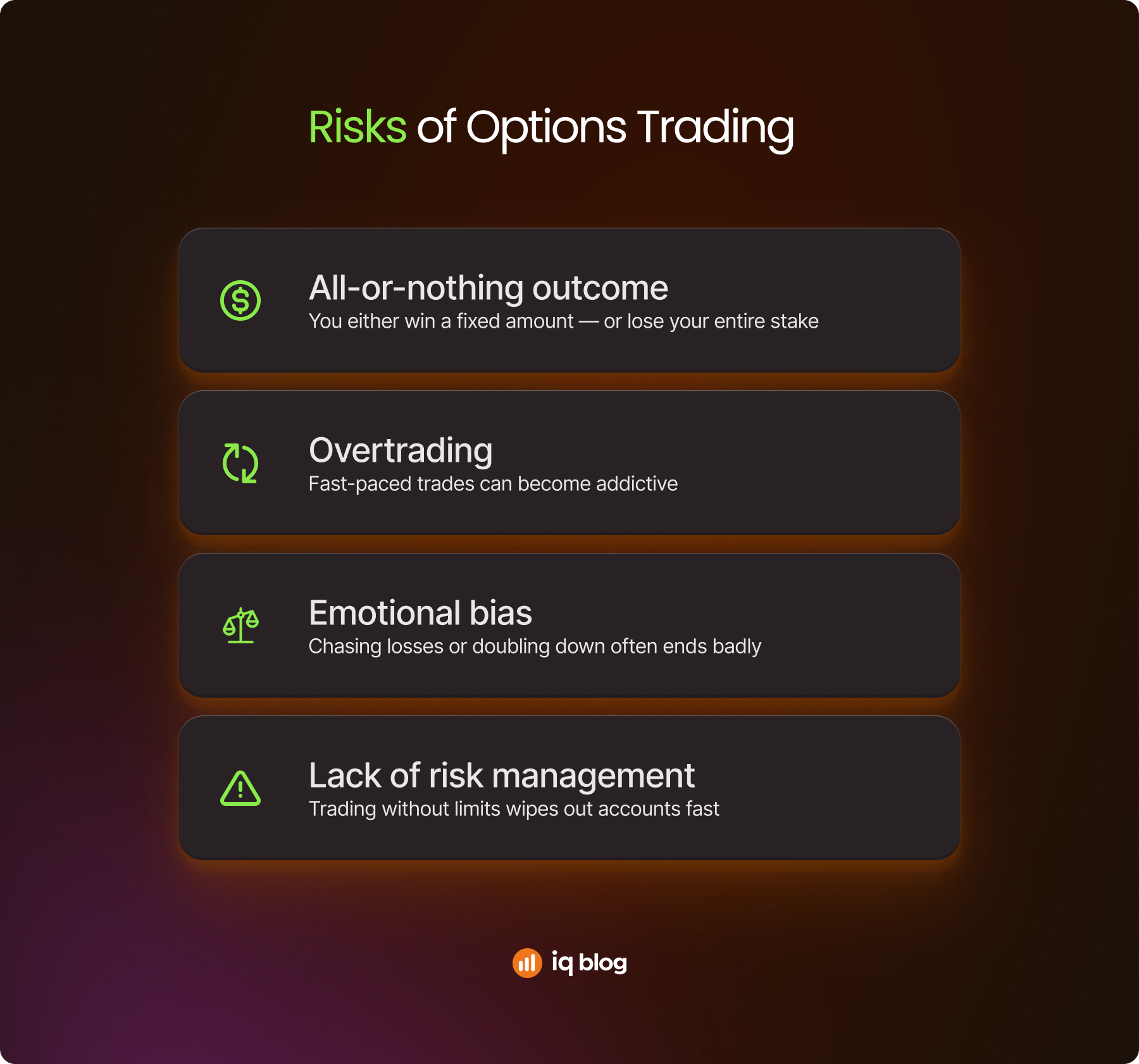
Risks of Options Trading
Options trading can be profitable, but it’s not a guaranteed path to easy money. Beginners often underestimate the risks:
⚠️ All-or-nothing outcome: You either win a fixed amount — or lose your entire stake.
⚠️ Overtrading: Fast-paced trades can become addictive.
⚠️ Emotional bias: Chasing losses or doubling down often ends badly.
⚠️ Lack of risk management: Trading without stop rules leads to account blowouts.
Risk management isn’t optional. Always cap your exposure (no more than 1–2% of your account per trade), avoid revenge trading, and take breaks when emotions run high.
Bonus Tips for Beginners
✅ Use the demo account to forward test strategies without risking real money — it’s the best place to make mistakes and learn from them.
✅ Stick to 1–2 strategies initially before exploring advanced ones. Focus builds mastery.
✅ Keep a trading journal to refine your methods — log entries, setups, outcomes, and your emotional state.
✅ Master risk management: never risk more than 1–2% of your capital on a single trade. Small losses protect you from big regrets.
✅ Backtest your strategy on past market data to see how it performs across different conditions — trends, ranges, and news events. This helps you build confidence and realistic expectations.
✅ Be cautious around major news events — volatility can create big opportunities, but it also increases the risk of fake breakouts and erratic price moves. If you trade during news, use tighter risk controls and wait for clear confirmation before jumping in.
✅ Set daily trading limits — know when to walk away after a win or loss. Discipline > impulse.
✅ (Optional) Use screen recording tools to review your decision-making in real-time. You’ll often catch patterns you missed in the moment.
✅ Review your trades weekly — even 15 minutes of reflection can prevent repeating costly mistakes.
Final Thoughts
These five best options strategies for IQ Option serve as a great foundation to build your skills. They’re simple enough for beginners yet flexible enough to grow with your experience.
Experiment with different IQ Option trading strategies one by one, mix them with other tools, and build your own go-to method when trading binary options. The key is to stay consistent, track your performance, and refine your process over time. With patience, practice, and smart risk management, even simple strategies can become powerful allies in trading.
Want to explore more? Check out:
🔗 5 Trading Strategies for 2025 – Which One Fits Your Personality?
🔗 Top 5 Indicators for Binary Option Strategies
🔗 5 Most Common Trading Strategies You Need to Know
🔗 3 High-Impact Trading Strategies for Binary Options