
SpaceX is no longer just one of the world’s most watched private companies. It is now a public stock.
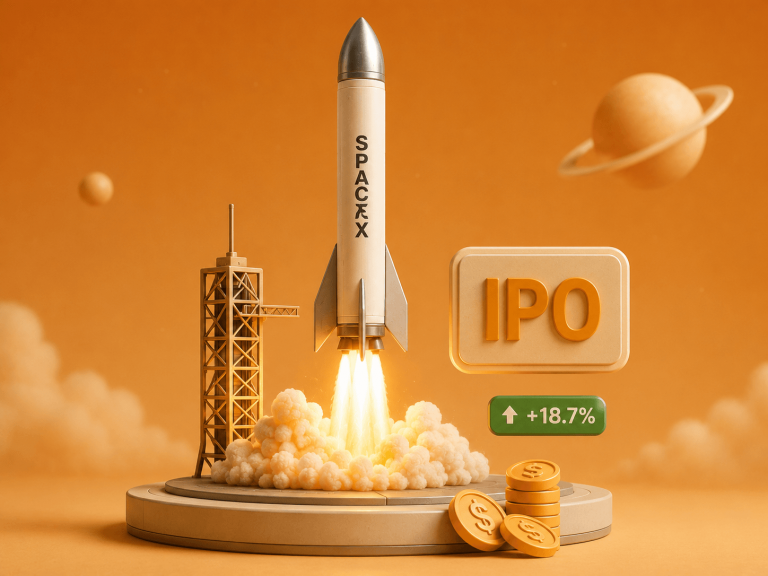
According to the final prospectus filed with the SEC, Space Exploration Technologies Corp. priced its IPO at $135 per share, offered 555,555,555 Class A shares, and listed on Nasdaq under the ticker SPCX. The gross raise was almost $75 billion, making the deal unusually large even by mega-cap IPO standards.
The first trading day was just as dramatic. NBC News reported that SPCX opened at $150 on June 12, 2026 and closed at $160.95, up about 19% from the IPO price.
For traders, the useful question is not whether SpaceX is an exciting company. It obviously is. The useful question is what is already priced into the stock, what can move it next, and where the risks are easy to underestimate.
SpaceX IPO facts
The numbers traders check first
The IPO price is only one reference point. Early traders also watch the opening trade, first close, volume, and post-listing supply.
Ticker
Nasdaq listing symbol for SpaceX Class A shares.
IPO price
Reference point from the final prospectus.
Gross raise
Before underwriting discounts and expenses.
Opening trade
Reported opening price on June 12, 2026.
First close
The stock finished its first session up about 19%.
Voting power
Expected Musk control after the offering.
Segments
Space, Connectivity, and AI in the prospectus.
Why the SpaceX IPO matters
SpaceX is not a normal IPO story. The company sits across several markets at once:
- reusable rocket launches;
- satellite internet through Starlink;
- government and defense contracts;
- commercial space infrastructure;
- AI and compute infrastructure after the xAI combination described in the prospectus.
That mix is why the stock attracted so much attention. A buyer is not only buying a rocket company. They are buying a public-market version of a business tied to space, connectivity, data, AI infrastructure, government demand, and Elon Musk’s execution record.
That also makes the stock harder to value. Traditional aerospace multiples do not fully explain it. Telecom comparisons do not fully explain Starlink. AI infrastructure comparisons may be too optimistic if losses and capital spending stay high. This is why the first weeks after the IPO matter: the market has to decide what kind of company SPCX should trade like.
What actually happened in the IPO
The final SpaceX prospectus, dated June 11, 2026, shows an IPO price of $135.00 per share. The company offered 555,555,555 shares of Class A common stock, with total gross proceeds of $74,999,999,925 before underwriting discounts and expenses.
The prospectus also says the shares were approved for listing under the ticker SPCX. Shares were ready for delivery on or about June 15, 2026.
There are two governance details traders should not skip:
- Class A shares have one vote per share.
- Class B shares have 10 votes per share.
After the IPO, Elon Musk was expected to hold about 82.4% of voting power. That means public shareholders can trade the stock and participate economically, but they do not control the company’s direction. SpaceX is a controlled company, and that matters for governance risk.
Why the stock jumped after listing
The first move in an IPO often reflects demand, scarcity, market mood, and positioning as much as it reflects fundamentals.
SPCX had several forces working in its favor:
- SpaceX is a rare asset that public investors had waited years to access.
- The IPO came with a large brand premium.
- Starlink gives the company a recurring-revenue story, not only a launch-services story.
- The xAI angle put the stock inside the wider AI infrastructure trade.
- Retail and institutional attention was unusually high.
That is a different mechanism from a short or gamma squeeze, where specific market participants are forced to buy. We break down the difference in our gamma squeeze vs short squeeze guide.
That does not make the stock cheap or expensive by itself. It means the first price move was not purely about one earnings report. It was about access to a company investors had been trying to own for a long time.
The valuation question
The hard part with SPCX is valuation.
CNBC reported that SpaceX had $18.7 billion in revenue in 2025 and lost nearly $5 billion that year. The SEC filing also shows how large and uneven the combined business had become by early 2026. For the three months ended March 31, 2026, SpaceX reported $4.694 billion in revenue across its Space, Connectivity, and AI segments, while loss before income taxes was $4.270 billion.
That is the tension in the stock:
- the company has scale;
- it has rare assets;
- it has a strong launch and Starlink story;
- it also has heavy spending, AI-related losses, and a valuation that already assumes a lot of future success.
That scale-versus-losses gap is at the center of the bubble debate — our analysis of the $2 trillion valuation breaks down the bull and bear cases, including Morningstar’s 43% bear-case probability.
When a stock opens far above its IPO price and keeps rising, the market is not just rewarding what the company is today. It is paying for what traders think it can become.
That can work for a while. It can also reverse quickly when expectations get too clean.
What traders should watch after the IPO
The first few weeks after a major IPO are usually noisy. Instead of trying to guess every headline, traders can focus on a short list of signals.
Post-IPO watchlist
What can move SPCX after the debut
The first sessions show demand. The next test is whether fundamentals, news, and share supply can support the higher price.
Early price levels
IPO price, opening trade, and first close become shared reference points for traders.
Watch $135, $150, and $160.95.
Volume
Post-IPO volume shows whether demand remains after the first wave of attention.
Strong dips matter more than loud green candles.
Starlink
Connectivity revenue and margins may anchor the long-term valuation story.
Watch subscribers, enterprise deals, pricing, and network costs.
Launch execution
Reusable rocket economics, Starship progress, and contract wins can move sentiment quickly.
Milestones help. Delays can reset the mood.
AI spending
The xAI exposure can add upside, but also adds capital intensity and loss risk.
Separate growth story from cash burn.
Share supply
More shares becoming available can change the balance between buyers and sellers.
Read lock-up and future-sale sections in the prospectus.
1. The IPO price, opening price, and first close
For early trading, three levels matter psychologically:
- $135: the IPO price;
- $150: the reported opening trade;
- $160.95: the first-day close.
If the stock stays above the first-day close with strong volume, momentum traders may keep treating the IPO as successful. If it falls back toward the opening price or IPO price, the tone can change fast.
These are not magic levels. They are reference points that many traders see at the same time.
2. Volume after the launch week
IPO volume is often huge at the start. The real test comes after the first wave of attention fades.
Watch whether volume stays active during pullbacks. If buyers appear only on green days, the move may be fragile. If buyers defend dips on heavy volume, the market may be building a stronger base.
3. Starlink growth and margins
Starlink is one of the cleaner parts of the SpaceX story because it looks more like a commercial network business than a one-off launch business.
Traders will watch subscriber growth, enterprise adoption, aviation and maritime deals, pricing, margins, and the cost of maintaining and expanding the satellite network.
If Starlink can show durable growth with improving margins, it helps the valuation argument. If growth slows or costs rise faster than expected, the market may question the premium.
4. Launch cadence and Starship milestones
SpaceX’s reputation is built on execution. Launch cadence, reusable rocket economics, Starship progress, NASA milestones, defense contracts, and commercial payload demand can all affect sentiment.
The stock may react sharply to successful milestones. It may also react sharply to launch failures, delays, regulatory issues, or higher development costs.
5. AI spending and xAI exposure
The IPO filing makes SpaceX more than a space-and-connectivity company. After the xAI merger, the business also carries AI infrastructure exposure.
That can increase upside if investors believe SpaceX can turn compute, data centers, satellite networks, and AI products into one platform. It can also increase risk because AI infrastructure is expensive, competitive, and capital intensive — especially as other AI labs like Anthropic and OpenAI race toward their own listings on the same wave.
For traders, this matters because SPCX may trade partly like a space stock and partly like an AI infrastructure stock.
6. Governance and key-person risk
Elon Musk’s voting control is not a footnote. It is a central feature of the stock.
Investors who buy Class A shares get exposure to the company, but they do not get much say in how the company is run. That can be acceptable when execution is strong. It can become a risk when controversy, capital allocation, acquisitions, political headlines, or related-party transactions move into focus.
7. Share supply after the IPO
Large IPOs can trade well at first and still face pressure later when additional shares become eligible for sale. Traders should watch the prospectus sections on shares eligible for future sale, lock-up arrangements, insider selling, employee liquidity, and any secondary offering plans.
More supply does not automatically mean the stock will fall. But it can change the balance between buyers and sellers.
How to trade a post-IPO stock without getting pulled into the hype
The first mistake is treating a famous company as a clean trade.
Fame creates liquidity and attention, but it does not remove risk. IPO stocks can move violently because early price discovery is messy. Some investors are building long-term positions. Others are flipping allocation. Funds may be forced to wait for liquidity or index eligibility. Retail traders may chase news after the biggest part of the move has already happened.
A cleaner approach is to define the setup before entering.
Momentum setup
Momentum traders usually want the stock to hold above key early levels, make higher lows, and break higher on volume. In SPCX, that means watching whether the stock can stay above its first-day close and whether pullbacks remain controlled.
The risk is buying after the move has already stretched too far. A stock can be a great company and still be a bad short-term entry if the chart is crowded.
Pullback setup
Some traders wait for the first serious pullback after the IPO excitement cools.
The goal is not to catch the exact bottom. The goal is to see whether buyers return near obvious reference levels, whether volume dries up on the decline, and whether the stock starts to stabilize.
The risk is assuming every dip is a bargain. In a newly listed stock, there is no long public price history to show where fair value is.
News-driven setup
SPCX will likely move on company-specific headlines: Starship tests, Starlink updates, AI infrastructure deals, government contracts, regulatory events, and Musk-related news.
News trades can be fast, but they are also messy. The headline is only one part of the move. The market also cares about valuation, positioning, and whether the news was already expected.
SpaceX IPO vs Tesla and other space stocks
SPCX will probably be compared with Tesla, Rocket Lab, traditional aerospace companies, satellite names, AI infrastructure stocks, and telecom businesses. None of those comparisons is perfect.
Tesla is the obvious comparison because of Musk and the market’s familiarity with a long-duration growth story. But SpaceX has different economics, different customers, different capital needs, and different government exposure.
Traditional aerospace companies are useful for launch and defense context, but SpaceX has a much larger technology premium.
Telecom companies can help investors think about Starlink, but Starlink is not a normal fiber or mobile network.
AI infrastructure stocks may capture the current market mood, but that part of the story can also make expectations more aggressive.
This is why SPCX may remain volatile. The market is still deciding which peer group matters most.
Main risks after the SpaceX IPO
The biggest risk is not that traders ignore SpaceX. The biggest risk is that they assume attention is the same as margin of safety.
Key risks include:
- Valuation risk: the stock may already price in years of successful growth.
- Execution risk: Starship, satellite deployment, launch cadence, and AI infrastructure all require heavy execution.
- Profitability risk: revenue scale does not guarantee consistent net income.
- Capital spending risk: rockets, satellites, launch sites, data centers, and compute capacity are expensive.
- Governance risk: public shareholders have limited voting influence.
- Headline risk: Musk-related news can affect sentiment even when the core business is unchanged.
- Supply risk: future share sales can pressure the stock if demand weakens.
- Regulatory risk: space launches, spectrum, defense work, AI, and global connectivity all involve regulators.
None of these risks means SPCX cannot rise. They simply mean the stock is not a simple “space is the future” trade.
What to remember
The SpaceX IPO gave public markets access to a company investors had watched for years. The offering was large, the debut was strong, and the early price action showed serious demand.
But after the first headline, the stock has to earn its valuation. Traders should watch Starlink growth, launch execution, AI spending, cash burn, governance, and post-IPO share supply.
SPCX may become one of the most important public growth stocks of this cycle. It may also stay extremely volatile while the market works out what it is worth.