


Price action trading focuses on reading raw price movement to make trading decisions. It removes unnecessary tools and relies on what the market is doing right now. Every shift in sentiment, buying pressure or selling pressure appears directly on the chart.
Traders use price action to understand market direction, key levels and potential turning points. Since it works across all markets and timeframes, both beginners and experienced traders widely use it.
What Is Price Action Trading?
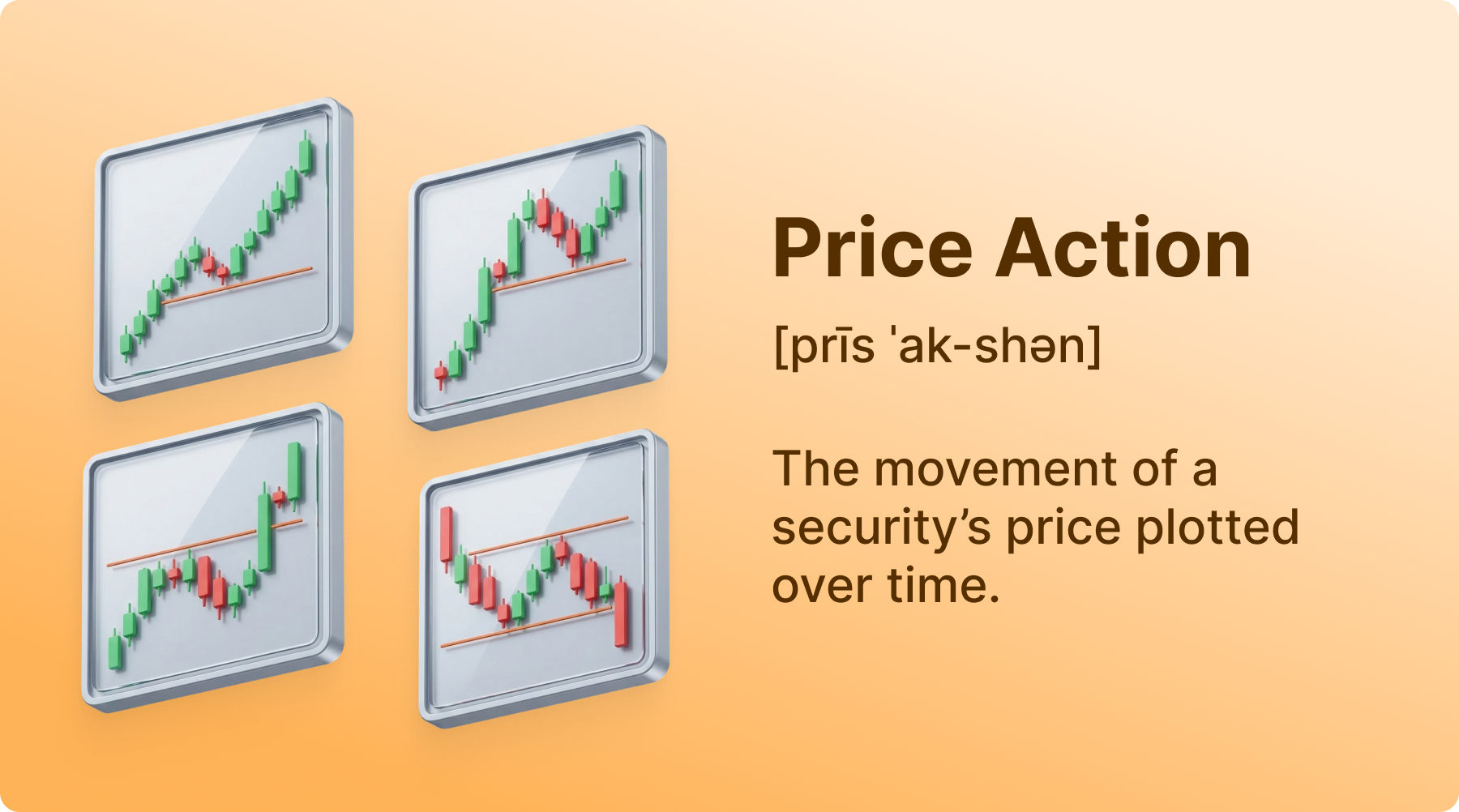
Price action trading is a method that looks at how prices move on a chart without using indicators. Traders pay attention to candlesticks, highs and lows, trends and key price levels to understand market behavior. The goal is to interpret how buyers and sellers interact and make decisions based on that information.
At its core, price action answers one question:, which is if buying pressure stronger than selling pressure or the other way around? When buyers are in control, price goes up. When sellers are in control, price goes down. By watching how price reacts at important levels, traders can predict possible continuations or reversals.
Price action is not just one strategy; it is a framework. Within this framework, traders use concepts like support and resistance, market structure and candlestick patterns. These elements work together to create trading setups based on logic instead of lagging signals.
How Price Action Trading Works
Price action trading works by observing how price behaves over time and how it reacts at important levels on the chart. Instead of waiting for indicators to generate signals, traders analyze live price movement to understand market intent. Every candle reflects a battle between buyers and sellers and the outcome of that battle shapes the next move.
Traders start by identifying the overall market context. This includes the trend direction, recent highs and lows and areas where price has previously reacted. These areas often act as decision zones where the market may pause, reverse or continue in the same direction. Once the context is clear, traders look for confirmation through price behavior.
This may include strong rejection candles, breakouts with momentum or signs of consolidation before a move. The focus remains on structure and reaction rather than prediction. The goal is to trade what price is showing, not what it might do.
Why Traders Use Price Action
Traders use price action because it provides a clear and logical way to read the market. Price is the most direct source of information. There are no formulas or calculations involved. This helps traders react faster and with more confidence.
Another key advantage is adaptability. Price action can be used in different market conditions and does not depend on specific settings or tools. The same principles apply whether the market is moving strongly or trading sideways.
Common reasons traders choose price action include:
- Clear chart structure with less visual noise
- Signals based on real market behavior
- No lag caused by indicators
- Applicability across all markets and timeframes
- Easier identification of entries, exits and risk levels
Because of this simplicity, price action often becomes a foundation skill. Many traders later add indicators, but price action remains the core of their analysis.
Price Action vs Indicator Based Trading
Price action and indicator based trading are built on different ideas. One focuses on direct observation. The other focuses on calculated signals. Understanding the difference helps traders choose the right approach.
How Price Action Trading Approaches the Market
Price action trading analyzes what price is doing in real time. Traders focus on structure, levels and reactions. Decisions are based on visible behavior, not signals generated after the move has started.
This approach helps traders:
- Read market intent earlier
- Adapt quickly to changing conditions
- Avoid signal delay
- Keep charts clean and focused
How Indicator Based Trading Works
Indicator based trading uses tools like moving averages, oscillators and momentum indicators. These tools are calculated from past price data. They can help with confirmation, but they react after price has already moved.
Indicators are often used to:
- Confirm trends
- Identify overbought or oversold areas
- Standardize entries for beginners
Which Approach Is Better
Neither approach is inherently better. It depends on the trader. Many traders start with indicators and later move toward price action. Over time, they realize indicators are derived from price itself. Learning price action first often builds a stronger foundation.
Core Price Action Concepts
Price action trading is built on a small number of core concepts. These concepts help traders understand market direction, strength and potential turning points. Without them, patterns and setups lose meaning.
Support and Resistance
Support and resistance are areas on the chart where price has reacted before. Support is a level where buying pressure has stopped price from falling further. Resistance is a level where selling pressure has stopped price from rising.
These levels matter because traders remember them. When price returns to these areas, reactions often occur again. Traders use support and resistance to plan entries, stop losses and profit targets.
Market Structure
Market structure describes how price moves over time. In an uptrend, price creates higher highs and higher lows. In a downtrend, it creates lower highs and lower lows. When neither is present, the market is ranging.
Reading structure helps traders stay aligned with the dominant direction. Trading with structure reduces the chance of entering against strong momentum.
Trends and Ranges
Markets do not move in one direction all the time. Trends and ranges alternate. In trends, price moves with clear direction and momentum. In ranges, price moves sideways between support and resistance.
Price Action Candlestick Patterns
Candlestick patterns are a key part of price action analysis. They show how price reacts within a specific period and reveal short term shifts in buying and selling pressure. Patterns are most effective when they appear at important levels or within clear market structure.
Pin Bar
A pin bar is a candle with a long wick and a small body. It shows strong rejection of a price level. When the wick points down, it suggests buyers stepped in. When it points up, it suggests sellers took control.
Pin bars are commonly used to spot potential reversals or trend continuation setups, especially near support or resistance.
Engulfing Pattern
An engulfing pattern forms when one candle fully covers the body of the previous candle. A bullish engulfing pattern shows strong buying pressure. A bearish engulfing pattern shows strong selling pressure.
These patterns often appear at key levels and signal a shift in control between buyers and sellers.
Inside Bar
An inside bar forms when a candle stays within the range of the previous candle. It reflects consolidation and indecision. Inside bars often appear before breakouts or continuation moves.
Price Action Trading Strategies
Price action strategies combine structure, levels and confirmation. A single pattern is never enough on its own. Traders look for alignment between market context and price behavior before entering a trade.
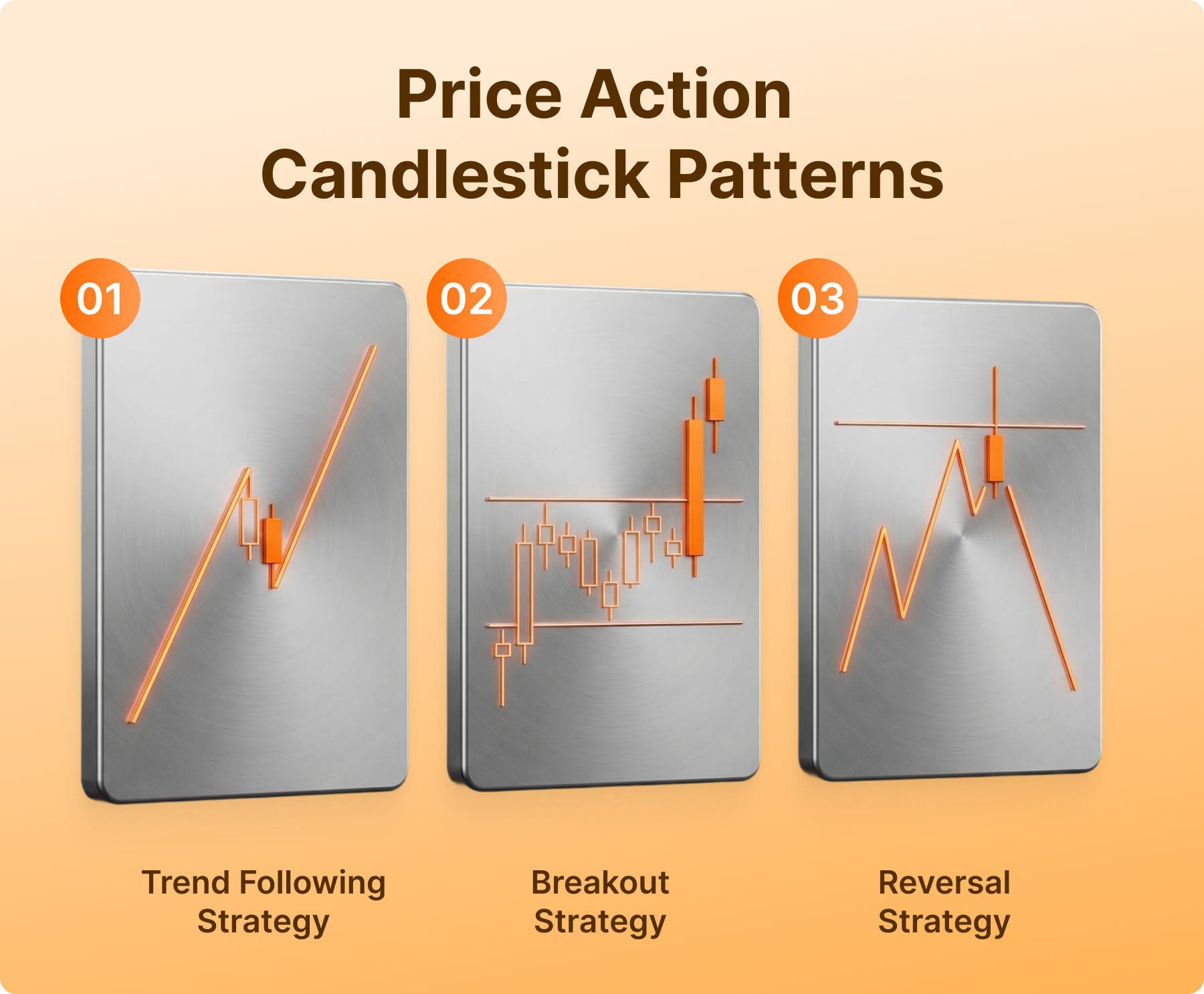
Trend Following Strategy
Trend following focuses on trading in the direction of the dominant market trend. Traders identify higher highs and higher lows in uptrends or lower highs and lower lows in downtrends. Entries are usually taken after pullbacks rather than during impulsive moves.
Typical elements of a trend following setup include:
- Clear market structure
- Pullback into support or resistance
- Confirmation candle such as a pin bar or engulfing pattern
Breakout Strategy
Breakout strategies target strong moves beyond key levels. These levels may be previous highs, lows or consolidation ranges. A valid breakout shows momentum and follow through, not just a brief price spike.
Traders often wait for a candle close beyond the level to avoid false breakouts. Retests of the broken level can also provide safer entries.
Reversal Strategy
Reversal strategies aim to catch potential turning points. These trades are higher risk and require strong confirmation. Traders look for exhaustion, failed breakouts or sharp rejection at major levels.
Reversals work best when combined with clear support or resistance and strong price rejection.
Risk Management in Price Action Trading
Risk management is essential in price action trading. Even the best setup can fail. Without proper risk control, a few bad trades can erase weeks of progress.
Price action makes risk management clearer because levels are visible on the chart. Stop losses are usually placed beyond structure or key levels. This keeps risk logical and consistent.
Core risk principles include:
- Risking a small percentage of capital per trade
- Using predefined stop loss levels
- Targeting a positive risk to reward ratio
- Avoiding overtrading during unclear conditions
Successful price action traders focus more on risk than on winning trades. Consistency comes from controlled losses, not frequent wins.
Common Price Action Mistakes
Many traders struggle with price action because they expect quick results. Price action requires patience and context. Patterns alone are not enough.
Common mistakes include:
- Trading every pattern without confirmation
- Ignoring market structure
- Forcing trades in choppy markets
- Entering without a clear stop loss
- Overanalyzing small timeframes
Most errors come from lack of discipline. Price action works best when traders wait for clear setups and avoid emotional decisions.
Is Price Action Good for Beginners
Price action is suitable for beginners, but only with the right expectations. It is simple in theory but takes time to master. There are no shortcuts or fixed signals.
Beginners benefit from price action because it teaches market logic. Instead of memorizing indicators, they learn how price behaves. This builds stronger long term skills.
New traders should focus on:
- Higher timeframes
- Basic structure and levels
- One or two patterns only
- Strict risk management
- Keeping things simple improves learning speed.
How to Start Trading With Price Action
Starting with price action does not require complex tools. A clean chart is enough. The focus should be on observation and practice.
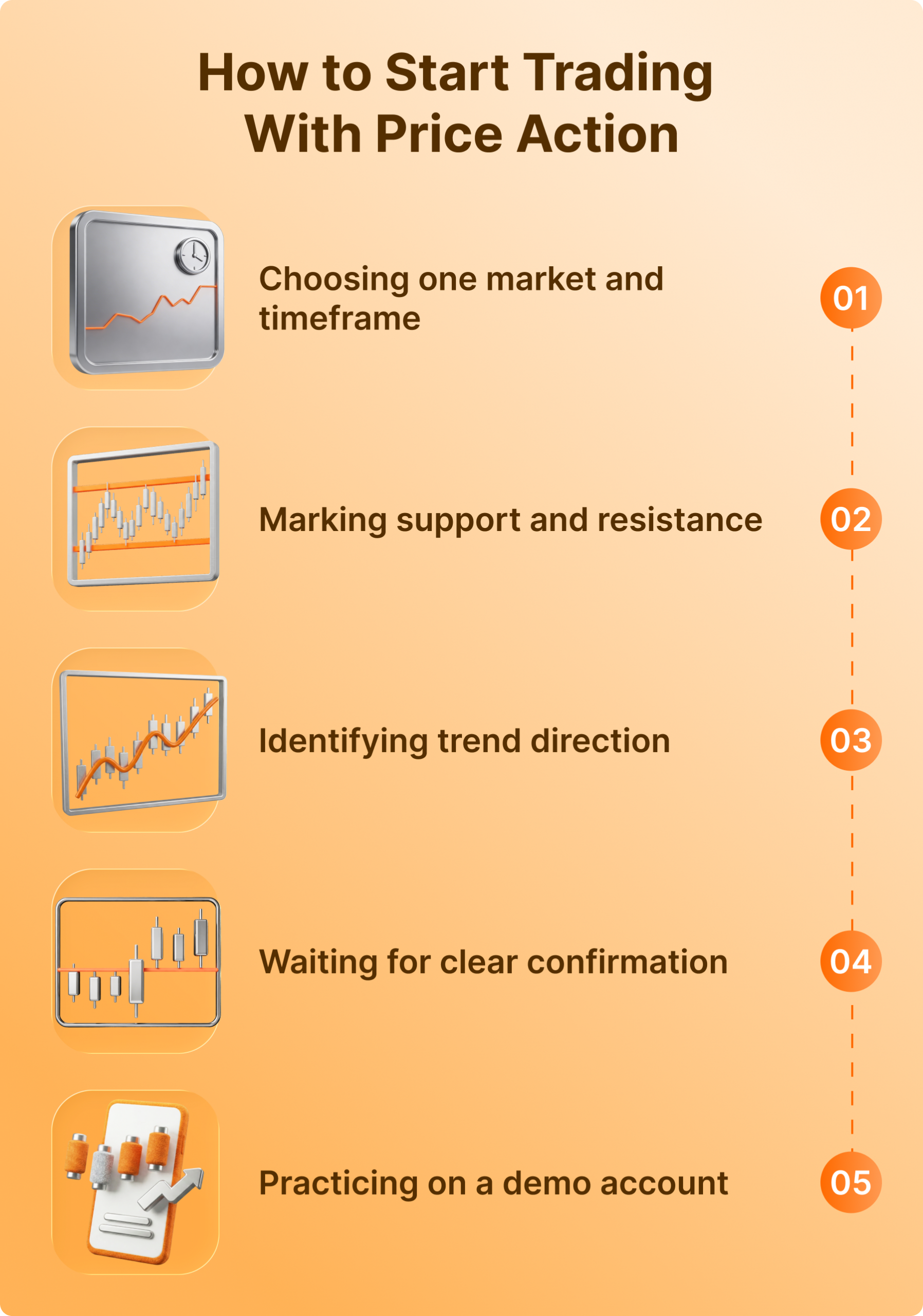
A practical starting process includes:
- Choosing one market and timeframe
- Marking support and resistance
- Identifying trend direction
- Waiting for clear confirmation
- Practicing on a demo account
Journaling trades helps speed up improvement. Reviewing both wins and losses builds confidence and discipline.
Final Thoughts
Price action trading focuses on understanding the market through price itself. It removes noise and highlights what truly matters. Buyer and seller behavior.
With patience, structure and risk control, price action can become a reliable trading framework. It rewards discipline more than speed.