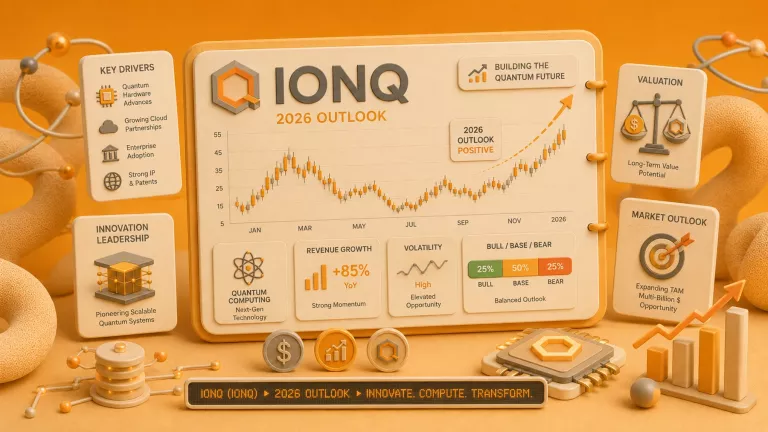
IonQ’s revenue is growing at a pace almost unheard of for a hardware company — up roughly 7x year over year in Q1 2026 — and that surge sits at the center of any 2026 stock analysis of this trapped-ion quantum pioneer. That jump pushed full-year 2026 guidance to $260–$270 million, backed by roughly $470 million in backlog and expanding commercial demand across more than 30 countries. With a planned $1.8 billion SkyWater acquisition aiming to bring chip manufacturing in-house and U.S. quantum funding initiatives accelerating, investors are weighing a fast-scaling, vertically integrated platform against heavy R&D spending, fierce Big Tech competition, and a still-unproven market path to profitability by 2026.
Summary
| Key Fact | Detail |
|---|---|
| Company | IonQ (IONQ) |
| Sector / industry | Quantum computing / hardware & software |
| Market cap | $19.2B |
| YTD return | +9.9% |
| Revenue and growth YoY | $130.0M revenue, +201.9% YoY |
| Primary risk | Early-stage quantum market and execution on hardware/manufacturing roadmap |
Data source: Yahoo Finance, as of July 2026.
IonQ (IONQ) at a Glance: Key Stats and Fundamentals
| Metric | Value |
|---|---|
| Current Price | $51.40 |
| Market Cap | $19.2B |
| P/E Ratio | 131.8 |
| Forward P/E | -48.8 |
| YTD Performance | +9.9% |
| 52-Week High | $84.64 |
| 52-Week Low | $25.89 |
| EPS | $0.39 |
What Does IonQ Actually Do in Quantum Computing?
IonQ is a quantum computing company that builds trapped-ion quantum computers and sells access to them through the cloud to governments, researchers, and businesses. The company focuses on a “full-stack” approach: it designs and operates the hardware, provides software tools to program it, and offers access through major cloud platforms. This setup lets customers run quantum algorithms without owning any physical quantum machines.
IonQ’s core technology is trapped-ion quantum computing. Instead of using tiny electrical circuits, its systems use charged atoms held in place by electromagnetic fields. These trapped ions act as qubits, which can hold more complex information than classical bits. IonQ highlights features such as 99.99% two-qubit gate fidelity, long coherence times (qubits stay stable for longer), and growing qubit counts, which together aim to support more reliable and larger-scale quantum calculations.
The business model centers on cloud access and contracts. Customers in government, education, and commercial sectors pay to run workloads on IonQ’s systems for tasks like optimization problems, drug discovery research, new materials design, and cybersecurity testing. Because these users build their software and workflows around IonQ’s stack and cloud integrations, switching to another quantum provider can be costly, which may create customer stickiness.
IonQ is also pushing into manufacturing and networking to control more of its supply chain. The planned acquisition of SkyWater Technology is aimed at bringing semiconductor fabrication in-house, while the Skyloom partnership targets quantum networking to link systems over distance. A new R&D and chip-testing lab in Boulder is meant to speed up hardware development and improve error correction. Together, these moves are intended to support a roadmap toward a 256-qubit system by late 2026 and, longer term, fault-tolerant machines with 10,000+ qubits that could handle real-world commercial workloads.
What Key Factors Move IonQ (IONQ) Stock Analysis in 2026?
IonQ (IONQ) stock analysis in 2026 mainly revolves around hyper-fast revenue growth, big contract visibility, and investor expectations for future quantum computing adoption.
IonQ’s revenue jumped about 202% year over year according to available data, and Q1 2026 alone delivered $64.7 million, roughly 7x the prior-year quarter. That kind of growth can quickly reset expectations, especially when management lifts its full-year 2026 outlook to $260–$270 million. When quarterly numbers beat guidance by about 30%, as they did in Q1, the stock often reacts sharply because the market recalculates how quickly the business might scale.
A second major driver is contract and backlog visibility. Remaining performance obligations of roughly $470 million (about 5x higher than a year earlier) suggest multi-year demand from government and commercial customers. As that backlog converts into revenue, each quarterly update on bookings and conversion rates may move the stock more than day-to-day news flow.
Key moving pieces investors often track include:
- SkyWater Technology acquisition progress: The $1.8 billion deal aims to pull semiconductor manufacturing in-house and deepen IonQ’s vertical integration. Any news on regulatory approvals, closing timing, or updated synergy targets can shift views on both growth potential and future cash needs.
- Hardware performance and roadmap milestones: IonQ targets a 256-qubit trapped-ion system by late 2026. Announcements on qubit counts, 99.99% gate fidelity, or new use-cases in areas like drug discovery or cybersecurity can influence how close the company appears to real “quantum advantage.”
- Quantum sector sentiment and valuation worries: The stock trades at a high trailing P/E of about 132 with negative free cash flow near -$300 million, so headlines about sector funding (like planned $2 billion U.S. quantum grants) can spark rallies, while any profit-timing disappointments or “too expensive” calls can trigger sharp pullbacks from its $84.64 52-week high.
What Gives IonQ Its Competitive Edge in Quantum Computing?
IonQ’s competitive edge in quantum computing centers on its vertically integrated, trapped-ion, full-stack platform that aims to control everything from chips to cloud access. The company does not just build quantum hardware; it also offers software tools and access through major cloud providers, so customers can develop and run applications on the same unified stack. This approach helps create switching costs for governments, universities, and enterprises that standardize on IonQ’s tools. Rapid revenue growth of about 202% year over year, with total revenue around $130 million according to available data, suggests that this integrated model is starting to gain commercial traction.
IonQ’s trapped-ion technology is a second key strength because it targets high performance rather than just qubit counts. Management highlights 99.99% two-qubit gate fidelity and long coherence times, which matter for running deeper and more accurate quantum circuits. Better system fidelity may let customers explore more complex problems before competitors with noisier machines can, and the company’s growing contract base with U.S. government and commercial clients supports that performance story in practice, not just in lab demos.
A third advantage comes from IonQ’s early push into vertical integration through strategic deals. Planned acquisitions such as SkyWater for semiconductor manufacturing and Skyloom for quantum networking, together with a new Boulder R&D and chip-testing lab, are intended to bring more of the supply chain in-house. This could lower long-term costs and reduce dependence on outside foundries, an important edge in a field where specialized chips and interconnects may be hard to source.
IonQ’s long-term roadmap also helps differentiate it from many smaller quantum peers that focus on short-term prototypes. Management is openly targeting a 256-qubit trapped-ion system by late 2026 and longer-term architectures with more than 10,000 qubits to reach fault-tolerant computing. Accepting negative free cash flow of about $300 million to fund this R&D shows a deliberate choice to prioritize future capability and potential quantum advantage over near-term profitability, which may appeal to investors who view quantum as a long-duration growth story.
IonQ (IONQ) Stock Analysis: What Are the Biggest Risks Investors Should Watch?
Several real risks could knock IonQ’s growth story off course if execution slips. The most direct threat is delivering on its ambitious hardware and manufacturing roadmap. IonQ is targeting systems with hundreds of qubits and longer term, fault-tolerant machines with 10,000+ qubits. Delays in hitting these milestones, or difficulties integrating newly acquired technologies like Skyloom, could slow how quickly the current $470 million-plus backlog turns into real revenue and profits.
The planned $1.8 billion acquisition of SkyWater Technology adds another layer of uncertainty. The deal still depends on regulatory approvals, and closing is only one hurdle. If IonQ struggles to merge operations, fails to reach the expected manufacturing cost savings, or discovers quality or culture mismatches, the push for vertical integration may drag on margins instead of helping them. Paying a high price for an asset that does not deliver the expected benefits could weigh on returns for years.
Competition and customer mix also pose specific challenges. Large technology companies such as IBM, Google, and Quantinuum continue to invest heavily in their own quantum platforms, while other approaches like D-Wave’s annealing systems may win certain use cases. If rival systems prove more scalable, more accurate, or easier to use, IonQ’s trapped-ion approach could lose share. On the demand side, a large portion of IonQ’s current deal value ties to U.S. government and education customers, so cuts in public research budgets, changes in national quantum policy, or tighter export rules could quickly hit bookings and limit international growth.
Finally, valuation and the early-stage nature of quantum computing create financial risk. IonQ’s market cap near $19.2 billion and trailing P/E above 130 sit on top of a business that still burns cash, with free cash flow around – $300 million. If the path to “practical” quantum advantage takes longer than expected, or if real-world applications scale more slowly, investors could reassess growth expectations. In that case, earnings misses or a shift away from high-growth tech could lead to sharp share-price drops and potential dilution if IonQ must raise more capital.
What Should Investors Watch for in IonQ Stock Through 2026?
The key things to watch for in IonQ stock through 2026 are progress on its 256-qubit roadmap, the SkyWater acquisition outcome, and how quickly its $470 million backlog turns into revenue.
Near term, investors may focus on whether IonQ can hit its raised 2026 revenue outlook of $260–$270 million and keep quarterly sales close to the Q1 2026 run rate of $64.7 million. Bookings and backlog growth matter just as much: if remaining performance obligations continue to climb from roughly $470 million, it would suggest demand is holding up, while a slowdown could signal pressure from competition or government budget shifts.
Two technical and strategic milestones could be especially important:
- 256-qubit system by late 2026: Hitting this target on time would support IonQ’s claims about scalability and keep it in the race with IBM, Google, and Quantinuum. Any delay or weaker-than-hoped performance could raise questions about the hardware roadmap.
- SkyWater Technology acquisition closing and integration: Investors will be watching for regulatory approval, deal closing in mid-2026, and early signs of manufacturing synergies. Smooth integration would back the vertical-integration story; cost overruns or delays could weigh on margins and raise dilution risk if more capital is needed.
Given the high valuation and volatility, quarterly EPS results and guidance changes may also move the stock sharply, especially if they hint at slower backlog conversion or higher spending than the market expects.
How Could Bull, Base, and Bear Scenarios Shape IonQ (IONQ) by 2026?
Because IonQ is still early-stage, its 2026 is better thought of as a range of outcomes than a single number. The table below sketches bull, base, and bear cases using plain assumptions on revenue, cash use, and how the market might value the story.
| 2026 Scenario for IonQ | Revenue Trend by 2026 vs. 2024 | Cash Burn and Runway View | Valuation Sentiment vs. Today | Key Drivers Behind the Scenario |
|---|---|---|---|---|
| Bull case | Revenue grows rapidly each year and meaningfully exceeds 2024 levels | Cash burn narrows as revenue scales; runway looks comfortable without urgent fundraising | Market is willing to pay a higher multiple for growth and leadership in quantum | Faster customer adoption, large cloud deals, and steady progress toward more powerful quantum systems |
| Base case | Revenue continues to rise but at a moderate, uneven pace | Cash use stays manageable; company may raise capital but from a position of reasonable strength | Valuation multiple stays near current levels, with swings around news and quarterly results | Gradual expansion of commercial use cases, controlled spending, and execution roughly in line with current plans |
| Bear case | Revenue growth slows or stalls relative to 2024 | Cash burn stays high; need to raise capital becomes a key concern | Market assigns a lower multiple because of execution risk and funding worries | Delays in hardware milestones, slower real-world adoption, or tougher competition from larger tech players |
None of these are calls on where the stock lands — they just show how differently IonQ’s quantum bet could play out depending on execution and adoption.
Key Takeaways
- IonQ is a fast-growing quantum hardware and software company, with revenue up about 202% year over year to roughly $130 million.
- IonQ’s trapped-ion systems target high gate fidelity and long coherence times, aiming to differentiate its full-stack quantum platform from superconducting and annealing-based competitors.
- The planned $1.8 billion SkyWater Technology acquisition could deepen vertical integration in manufacturing, but also adds regulatory and integration risk if approvals or synergies slip.
- Large U.S. government and education contracts support IonQ’s backlog, yet heavy exposure to public funding creates sensitivity to policy changes and budget shifts.
- A negative free cash flow near $300 million highlights ongoing cash burn, raising the chance of future capital raises if commercialization does not ramp as expected.
- IonQ trades at a high trailing P/E above 130 and shows sharp swings between its $25.89 low and $84.64 high, underscoring notable valuation and volatility risk.
If you liked this single-stock breakdown, see how quantum and AI names fit into a broader portfolio in our 5 AI stocks I keep in my portfolio.