


Investors love S&P 500 ETFs because they provide simple, diversified exposure to the largest and most influential companies in the US. But while the index is the same, the ETFs that track it are not. SPY, IVV and VOO all follow the S&P 500, yet they differ in cost, structure, liquidity, tax efficiency and ideal use cases.
And these differences matter, especially over long horizons, where even the smallest design variation can create measurable gaps in performance.
This guide breaks everything down in a clear, conversational way. Without assumptions, just a straightforward explanation of what makes SPY, IVV and VOO similar, what separates them and how to choose the right one based on your goals.
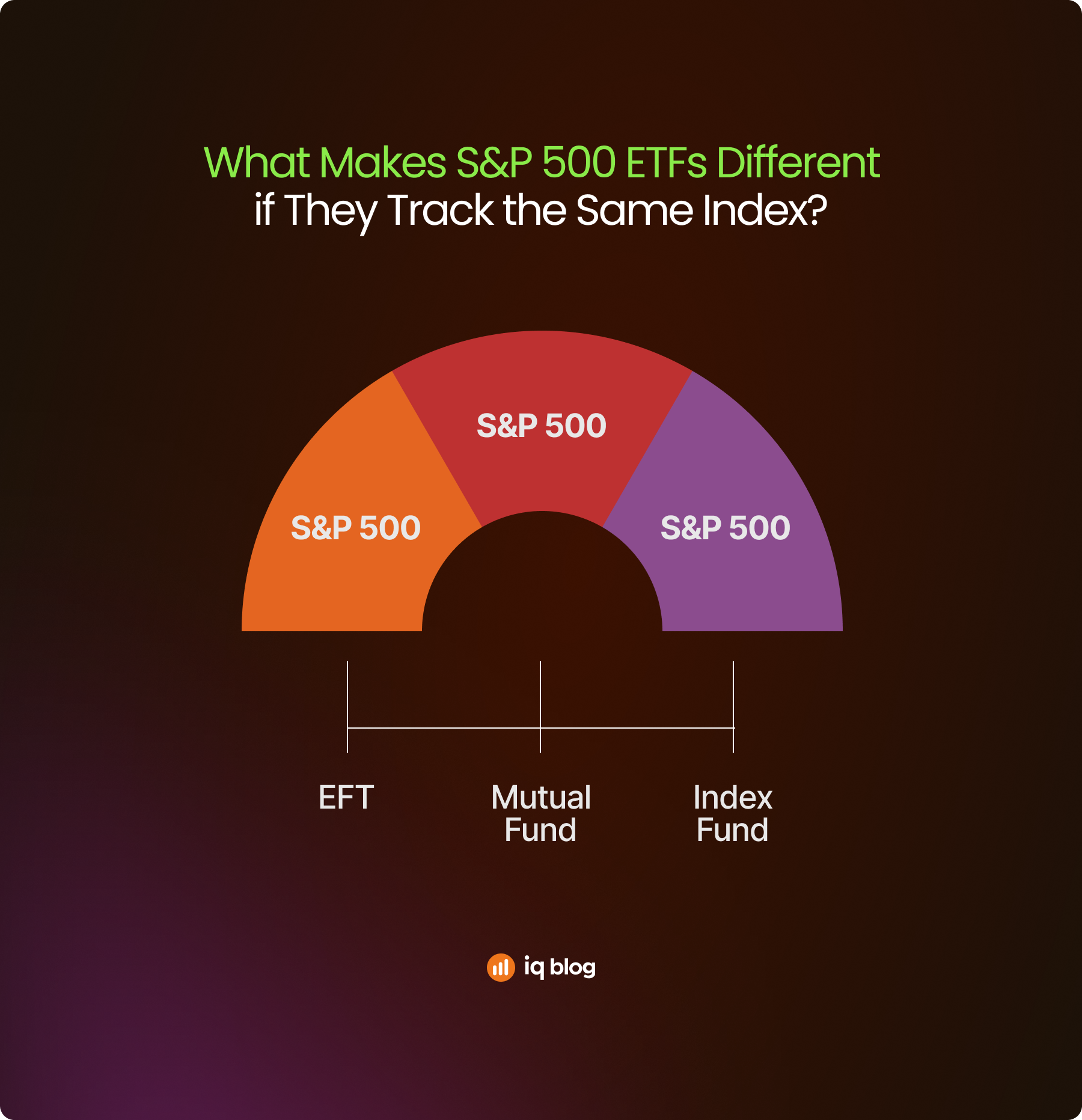
What Makes S&P 500 ETFs Different if They Track the Same Index?
At first glance, SPY, IVV and VOO look interchangeable.Same index, same companies and same exposure to the US market. But underneath the surface, ETFs can operate very differently:
- They can be structured differently (UIT vs mutual fund share class vs open-ended fund).
- They can handle dividends differently.
- They can reinvest cash flows differently.
- They can have huge variations in liquidity and trading volume.
- They can differ in cost, even by fractions of a percent, which compounds significantly over time.
SPY: The Most Liquid and Trader-Friendly ETF on the Market
SPY is the oldest and most famous ETF in the world. Launched in 1993, it essentially built the foundation for today’s ETF industry. Its reputation isn’t just historical, SPY remains the most actively traded ETF, with unmatched liquidity.
Why SPY Stands Out
- It has the deepest liquidity of any ETF globally.
- Spread tightness makes execution extremely efficient.
- Traders, institutions and hedge funds use SPY for short-term strategies.
- It has the most developed options market of any ETF.
SPY’s structure (Unit Investment Trust) is a bit old-fashioned by today’s standards, but that hasn’t impacted its popularity with traders. It’s optimized for speed, precision, and tactical exposure.
Strengths of SPY
- Best-in-class liquidity
- Tightest bid–ask spreads
- Massive options ecosystem
- Excellent for intraday traders
- Ideal for short-term hedging
Limitations of SPY
- Expense ratio is higher than competitors
- UIT structure restricts internal dividend reinvestment
- Slight long-term efficiency disadvantage compared to IVV/VOO
SPY isn’t designed for maximum tax efficiency, it’s designed for precision. If you are trading frequently, that benefit outweighs everything.
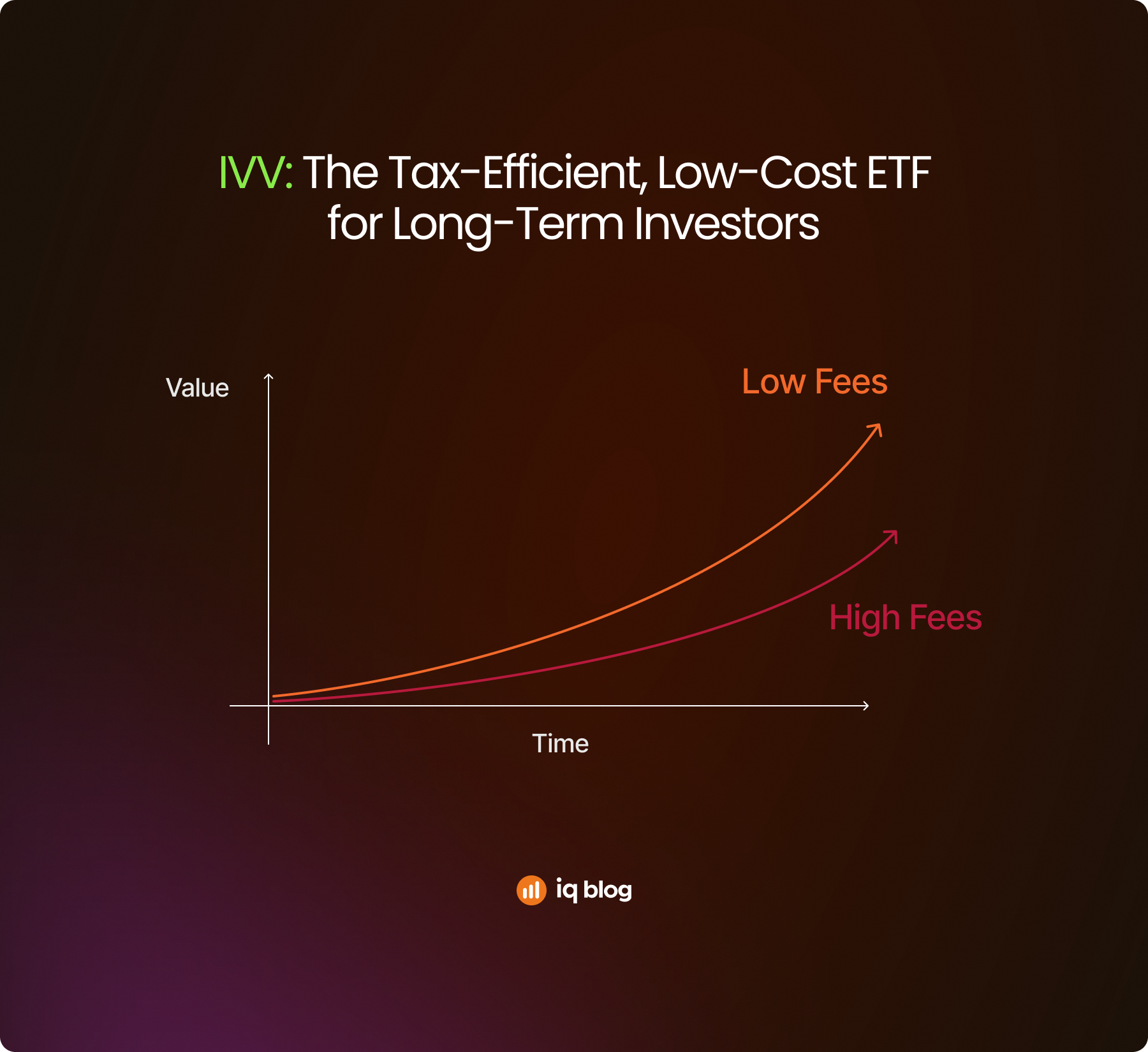
IVV: The Tax-Efficient, Low-Cost ETF for Long-Term Investors
Launched in 2000, IVV is part of BlackRock’s flagship iShares Core product line. It was built to solve several of SPY’s structural limitations and position itself as a long-term, low-cost, tax-efficient alternative.
Why IVV Attracts Long-Term Investors
- Open-ended structure allows for superior dividend reinvestment mechanics.
- Expense ratio is extremely low.
- Better tracking consistency thanks to internal reinvestment.
- Well-suited for institutional and retirement accounts.
IVV is the ETF that pension funds frequently choose because it is efficient, predictable and built for compounding.
Strengths of IVV
- Ultra-low expense ratio
- Efficient dividend handling
- Lower tracking error
- Excellent for long-term, passive portfolios
- Strong institutional adoption
Limitations of IVV
- Less trading volume compared to SPY (but still huge)
- Options market is not as deep
- Slightly lower intraday liquidity (irrelevant for long-term investors)
VOO: Vanguard’s Ultra-Low-Cost S&P 500 ETF for Buy-and-Hold Investors
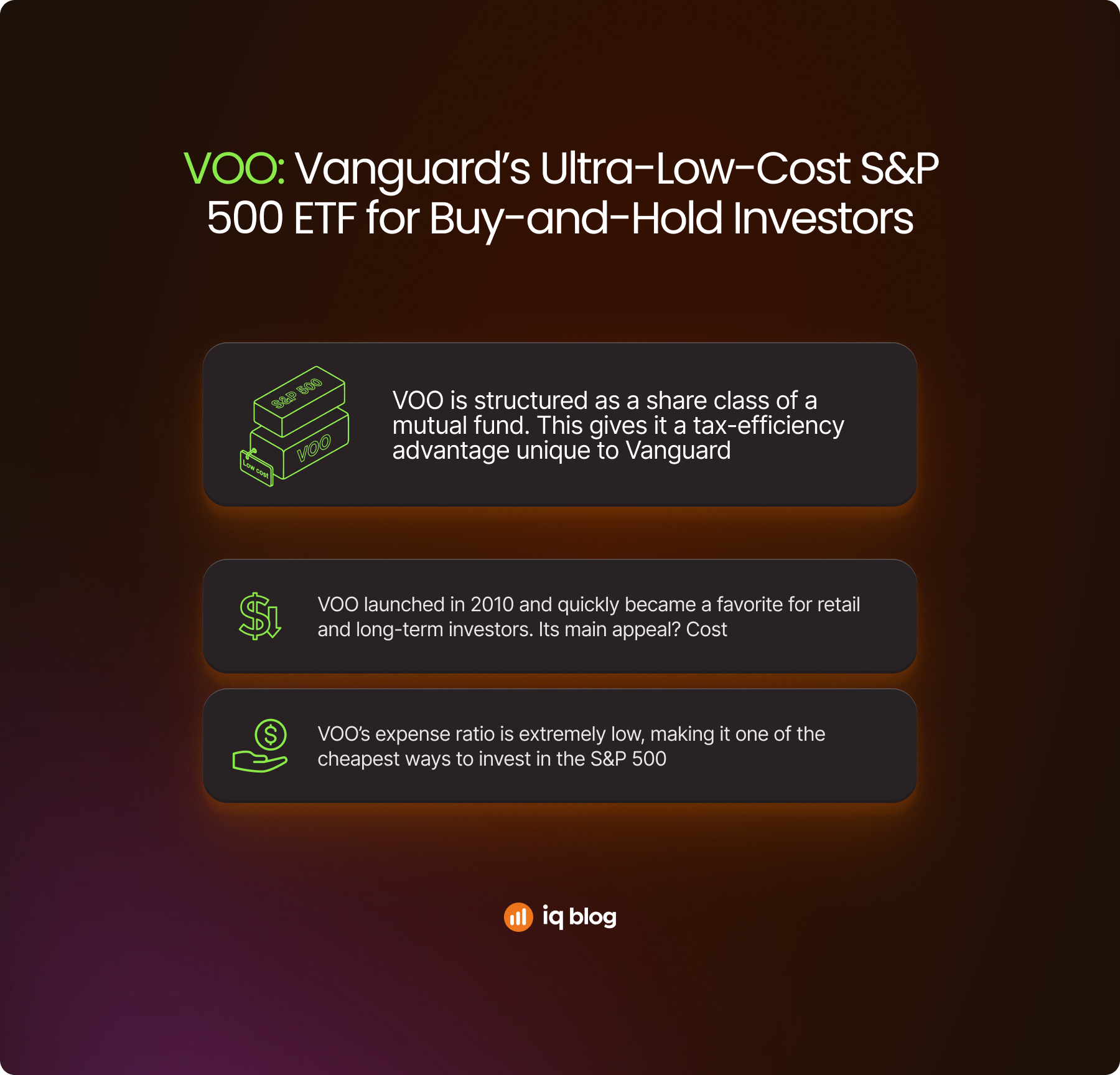
VOO launched in 2010 and quickly became a favorite for retail and long-term investors.
Its main appeal? Cost.
VOO’s expense ratio is extremely low, making it one of the cheapest ways to invest in the S&P 500.
Why Investors Love VOO
- Part of Vanguard’s cost-driven, investor-first philosophy
- Mutual fund share class structure means excellent tax efficiency
- Perfect for long-term, passive investing strategies
- Rapidly growing AUM due to strong inflows
Strengths of VOO
- One of the lowest-cost ETFs on earth
- Great for dollar-cost averaging
- Strong tracking efficiency
- Designed around long-term investor needs
Limitations of VOO
- Not ideal for active intraday trading
- Options market smaller than SPY
- Slightly lower liquidity compared to IVV
VOO is perfect for people who want simplicity and long-term exposure without overthinking it, especially investors who buy periodically and hold for 10, 20 or 30 years.
Structure Differences: Why They Matter More Than People Think
Even though the index is identical, the fund structure affects:
- how dividends are handled
- how cash flows are managed
- how tax-efficient the fund is
- how quickly it reflects index changes
- long-term compounding outcomes
Here’s the structural breakdown:
| SPY → Unit Investment Trust | IVV → Open-Ended ETF | VOO → Mutual Fund Share Class (Vanguard Exclusive) |
| Cannot reinvest dividends internallyHas stricter rules on holdingsSlight long-term dragBuilt for trading, not compounding | Fully reinvests dividendsAllows more flexibilityHigher tax efficiency | Excellent tax efficiencyStrong compounding mechanicsLower internal turnover |
Cost Comparison: Tiny Differences, Big Impact
While all three ETFs are inexpensive, SPY has noticeably higher annual fees than IVV and VOO. This difference may seem small in the short term, but over long periods, it compounds dramatically.
Why cost matters
- Long-term investors feel the impact most
- Fees compound like returns – but in reverse
- Lower costs = higher net performance over decades
If your strategy is:
- day trading → fees matter less
- long-term investing → fees matter more
For long-term holders, IVV and VOO typically win.
Liquidity: Where SPY Completely Dominates
Liquidity affects:
- bid–ask spreads
- slippage
- execution quality
- options pricing
SPY is the king of liquidity, full stop.
SPY Liquidity Advantages
- Perfect for scalpers
- Best ETF for options traders
- Widely used by hedge funds and institutions
- Extremely tight spreads
IVV and VOO are still very liquid, more than enough for 99% of investors, but they do not match SPY’s intraday efficiency.
Dividend Handling: The Hidden Factor That Affects Real Returns
SPY, IVV and VOO all distribute dividends to investors. But their internal mechanics differ:
SPY
- Cannot reinvest dividends internally
- Creates a slight efficiency loss
- Mostly relevant over long time frames
IVV & VOO
- Can reinvest dividends internally
- Improves tracking accuracy
- Enhances long-term compounding
This is why long-term total return charts often show IVV and VOO slightly edging out SPY.
Which ETF Should You Choose? Clear, Practical Recommendations
ETF choice depends not on which is “best,” but on which matches your goals.
| Choose SPY if you are: | Choose IVV if you are: | Choose VOO if you are: |
| A day traderAn options traderA high-frequency or tactical traderSomeone who needs fastest execution | A long-term investorA retirement account holderFocused on cost and tax efficiencySomeone who values tracking accuracy | A long-term, low-cost investorFocused on simplicity and passive growthDollar-cost averaging regularlyBuilding a portfolio for the next 10-30 years |
| SPY is built for speed and precision. | IVV is built for compounding and efficiency. | VOO is built for simplicity and long-term growth. |
Real-World Scenarios: Which ETF Works Best Depending on Your Strategy
S&P 500 ETFs are simple in theory, but investor needs are not.
Here are realistic examples of when each ETF makes the most sense.
Scenario 1: You trade frequently during the day
You scalp, swing trade, hedge portfolios using options, or often reposition intraday.
Best choice: SPY
Why?
- SPY has unmatched liquidity
- spreads are razor-thin even in volatile markets
- option chains are the deepest in the world
- execution slippage is minimal
If your success depends on split-second fills, SPY is the natural fit.
Scenario 2: You invest for retirement or a long-term portfolio
Your focus is slow, steady compounding with minimal fees.
Best choice: IVV or VOO
Why?
- both have ultra-low fees
- both handle dividends more efficiently than SPY
- both minimize tracking error
- both are optimized for compounding rather than quick trades
If your horizon is 10+ years, long-term efficiency beats short-term liquidity.
Scenario 3: You dollar-cost average (DCA) every month
You invest automatically without trying to time the market.
Best choice: VOO
Why?
- cost is extremely low
- structure fits long-term passive investors
- Vanguard funds attract sticky, long-term capital
- price behavior is stable without excessive daily volatility
Although IVV is also strong, VOO is the classic DCA pick for millions of investors.
Scenario 4: You want a single ETF that requires no oversight
Set-and-forget portfolios, robo-advisors, simple wealth-building plans.
Best choice: IVV or VOO
Both deliver:
- low costs
- minimal turnover
- reliable tracking
- strong compounding
SPY is simply not necessary for hands-off investors.
Scenario 5: You need the most liquid ETF for options strategies
You are selling covered calls, trading spreads, hedging positions.
Best choice: SPY – and not even close
SPY’s options market is enormous, offering:
- tight spreads
- deep liquidity even far from current price
- cleaner pricing for Greeks
- more flexibility for multi-leg options strategies
A Clear Comparison of SPY, IVV and VOO
ETF Purpose & Profile
| ETF | Ideal For | Strength | Structure Type |
| SPY | Active traders, option traders, hedge funds | Unmatched liquidity and tight spreads | Unit Investment Trust |
| IVV | Long-term investors, institutions, retirement use | Tax efficiency, internal dividend reinvestment | Open-Ended Fund |
| VOO | Passive investors, DCA users, cost-focused portfolios | Ultra-low costs, simplicity, Vanguard ecosystem | Mutual Fund Share Class |
Cost & Efficiency
| ETF | Fees | Dividend Handling | Tracking Efficiency |
| SPY | Higher | Cannot reinvest internally | Slightly lower long-term efficiency |
| IVV | Very low | Internal reinvestment | Strong |
| VOO | Very low | Internal reinvestment | Strong |
Liquidity & Options Trading
| ETF | Liquidity | Options Market | Intraday Trading |
| SPY | Highest | Deepest options chain | Best choice |
| IVV | High | Functional but smaller | Not optimal for day trading |
| VOO | High | Smaller | Suited for long-term |
Common Mistakes Beginners Make When Choosing Between SPY, IVV and VOO
Understanding the differences helps avoid investor mistakes. Here are the most common:
- Choosing SPY for long-term investing only because it’s popular – SPY is excellent, but for long-term portfolios, IVV/VOO are usually more efficient.
- Ignoring dividend mechanics – Internal reinvestment matters over decades.
IVV and VOO handle this better than SPY. - Believing the higher volume ETF is always “better” – Liquidity benefits traders, not necessarily investors.
- Overlooking cost differences – Even tiny fee differences add up over 20-30 years.
- Mixing ETFs without a purpose – Holding all three offers no extra diversification, they all track the same thing.
- Forgetting that fund structure affects taxes – VOO has a structural advantage many investors don’t even know about.