


Can You Really Start Trading With $100?
Technically, $100 is enough to open an account and place a trade. Many modern brokers allow for “micro” or “cent” accounts specifically designed for this purpose. But before you deposit, you must ground your expectations in reality.
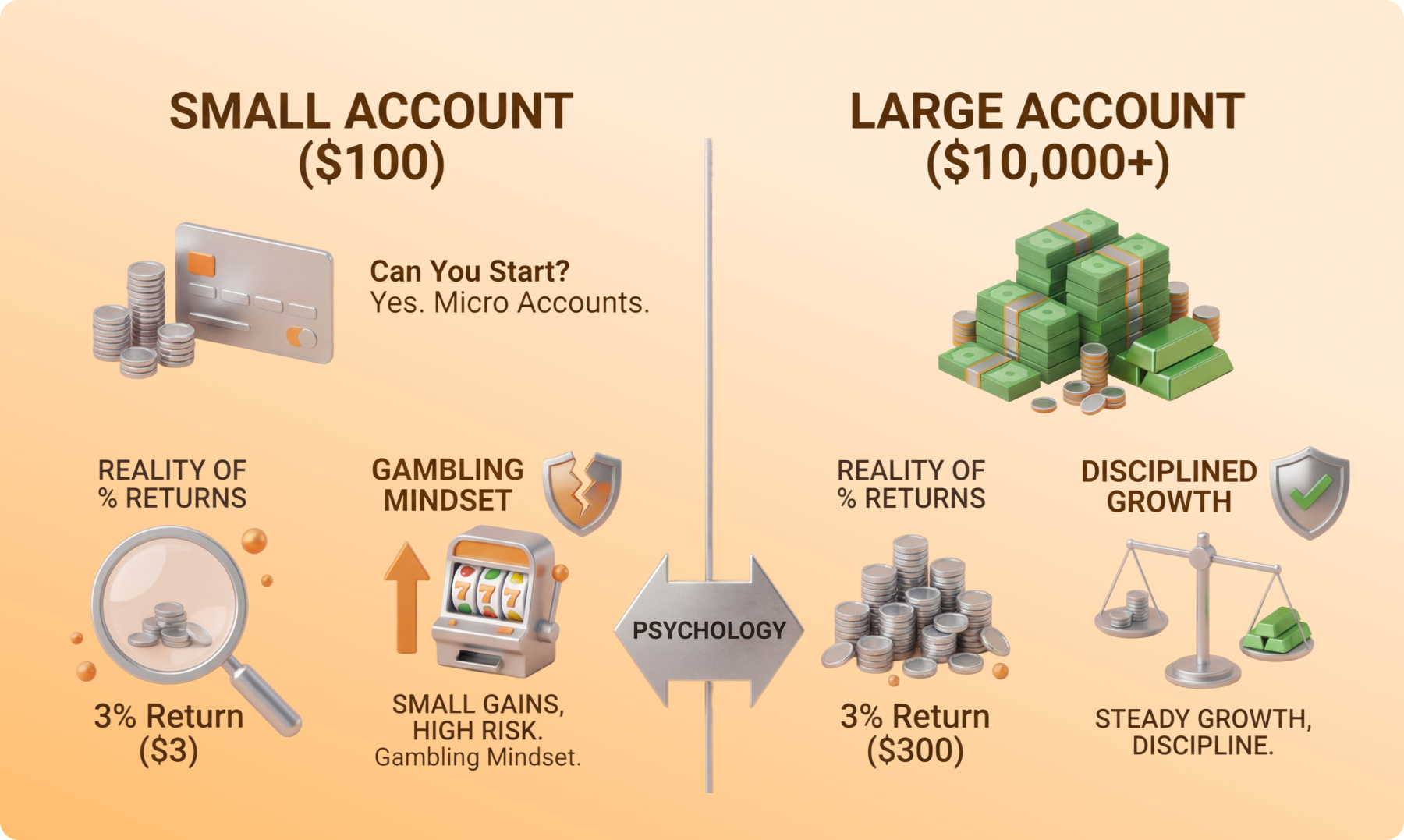
The Reality of % Returns
In a “good” month, a professional trader might return 3% to 5%. On a $100 account, that is only $3 to $5. If you expect to pay your rent using a $100 account, you will inevitably overleverage and lose the money.
Why Small Accounts are Harder
Psychologically, it is difficult to stay disciplined for a $2 gain. Beginners often feel that such small amounts aren’t “worth the effort,” leading them to take massive risks to make the numbers feel significant. This “gambling mindset” is the #1 killer of small accounts.
What Markets Can You Trade With $100?
Not all markets are created equal when you have limited capital. Some require thousands of dollars just to enter a single position, while others are perfectly suited for a $100 start.
Forex (Foreign Exchange)
Forex is arguably the most popular choice for small accounts. This is due to Micro Lots.
- Standard Lot: 100,000 units.
- Mini Lot: 10,000 units.
- Micro Lot: 1,000 units.
With a micro lot, a one-pip movement is worth approximately $0.10. This allows you to stay within safe risk limits even with only $100.
CFDs (Contracts for Difference)
CFDs allow you to speculate on the price of stocks, indices, or commodities without owning the asset. They are popular for small capital because they offer leverage. Leverage allows you to control a larger position with a small deposit. While this is a tool for small accounts, it is also a double-edged sword that amplifies losses just as much as gains.
Crypto (Cryptocurrencies)
Crypto is highly accessible because most exchanges support fractional buying. You don’t need $60,000 to buy Bitcoin; you can buy $10 worth of it. However, crypto volatility can be extreme, meaning your $100 could swing by 10% or more in a single hour.
The Biggest Mistake Small Accounts Make
The “Small Account Syndrome” is a real phenomenon. Because the capital is low, traders feel they must “go big or go home.”
The Scenario:
A trader has $100. They want to make $50 today. To do this, they use 50:1 leverage on a gold trade. If Gold moves just 1% against them, their entire $100 is wiped out in seconds.
Common Pitfalls:
- Overleveraging: Using too much “borrowed” power from the broker.
- Overtrading: Feeling the need to be in the market 24/7 to make the $100 “work harder.”
- Revenge Trading: Trying to “win back” a $5 loss by doubling the next position size.
Risk Management for a $100 Account
This is the most critical section of this guide. If you ignore this, you will lose your $100. Professional risk management for small accounts relies on the 1%–2% Rule.
The 2% Rule
You should never risk more than 2% of your total balance on a single trade.
- Total Balance: $100
- Max Risk per Trade: $2
If your trade hits your “Stop Loss” (the point where you automatically exit a losing trade), you should only lose $2. This gives you 50 “lives” before your account is empty.
How to Calculate Position Size
To trade responsibly, you must use a formula rather than guessing your trade size:
Position Size = Amount at Risk/Stop Loss Distance
Example:
- You want to risk $2.
- Your Stop Loss is 20 pips away.
- Your position size should be $0.10 per pip (one micro lot).
Best Trading Styles for Small Capital
When you’re starting with $100, your choice of trading style is the difference between giving your money a chance to grow and watching it disappear into broker fees. To succeed with limited funds, you need a style that maximizes profit potential while minimizing the “cost of doing business.”
In 2026, professional retail traders with small accounts focus on styles that allow for wide profit margins and low frequency. Here are the strategies that actually fit a $100 budget.
Swing Trading: The “Gold Standard” for Small Accounts
Swing trading is widely considered the best way to trade with $100. In this style, you hold positions for several days or even weeks. You are looking to catch a “swing” in the price—a significant move from one level to another.
- Fee Efficiency: Since you only place a few trades per month, you spend very little on spreads and commissions. This keeps more of your $100 working for you.
- Time Advantage: You don’t need to stare at charts all day. You can analyze the markets on the 4-hour or Daily timeframes after work or school.
- Noise Filtering: Larger timeframes are much more reliable. They filter out the random “price spikes” that often happen on 1-minute or 5-minute charts, which would otherwise hit the tight stop-losses required by a small account.
Position Trading: The “Investor” Approach
Position trading is the long-game version of swing trading. You identify a major trend—perhaps driven by a shift in interest rates or a massive tech breakthrough—and you hold that trade for months.
- Compounding Power: This style is perfect for “fractional” trading. You can buy a small amount of an asset and simply let it ride the macro trend.
- Maximum Resilience: Because your targets are so far away, small daily fluctuations don’t bother you. It is the most “hands-off” way to grow a small account.
- Cost Effective: This has the lowest transaction costs of any trading style. You pay the spread once and then let the trade mature.
Trend Following: Riding the Momentum
Trend following is a specific strategy that works exceptionally well with swing trading. The idea is simple: you find an asset that is clearly moving in one direction and you “hop on” until the trend ends.
- High Reward-to-Risk: Trends often move much further than people expect. This allows you to risk $2 (2% of your $100) to potentially make $10 or $15.
- Rule-Based: It is very easy to turn into a “checklist.” If the price is above a certain Moving Average and making higher highs, you stay in. If it breaks, you get out.
Summary Table: Why These Styles Work
| Style | Typical Hold Time | Best Timeframe | Why it fits $100 |
| Swing Trading | 2–6 Days | 4-Hour / Daily | Low fees; high-quality setups. |
| Position Trading | Weeks / Months | Daily / Weekly | Lowest fees; captures massive moves. |
| Trend Following | Variable | 4-Hour / Daily | Best math (Risk $2 to make $10). |
Step-by-Step Plan to Start With $100
Follow this practical checklist to transition from a beginner to a disciplined trader:
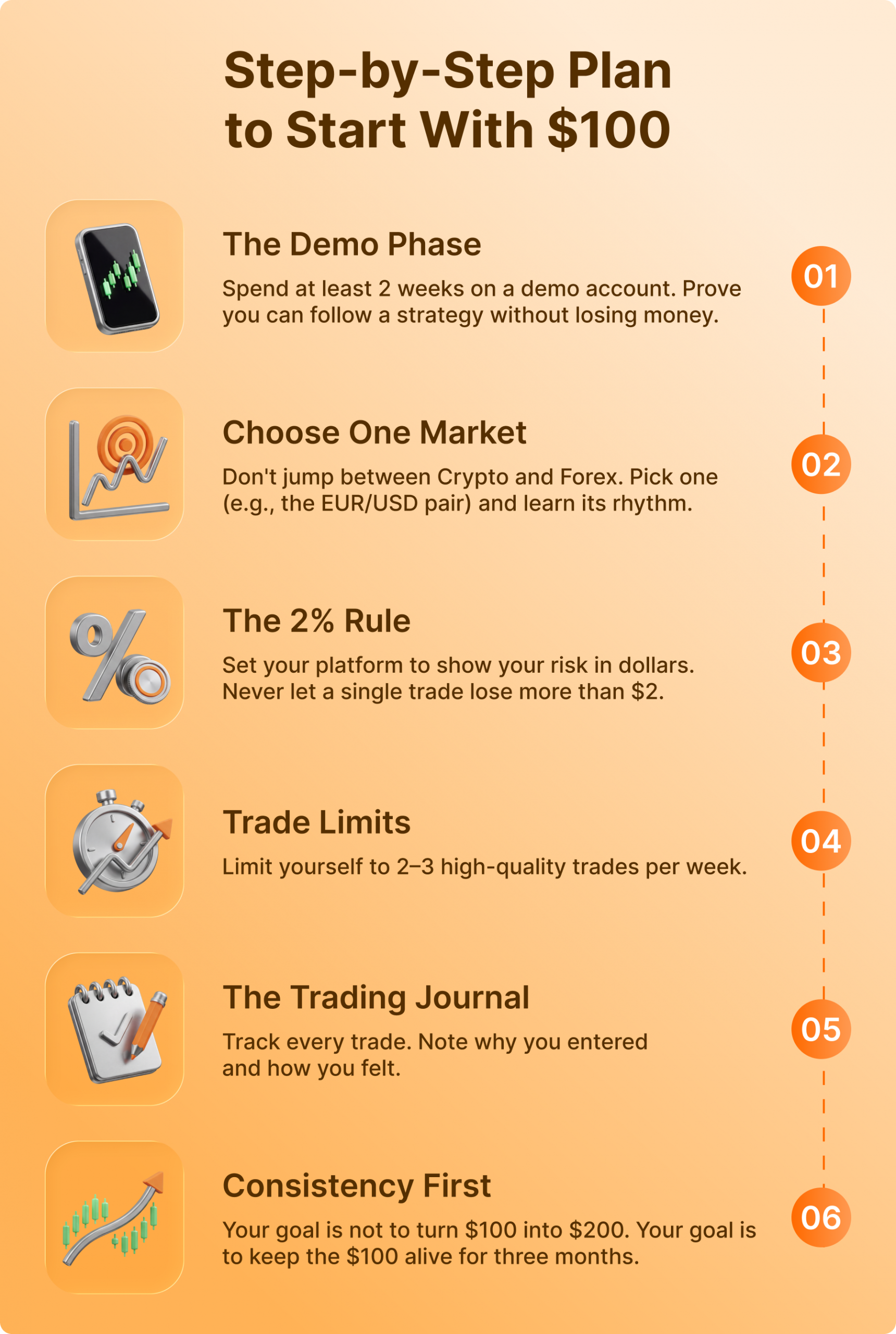
- The Demo Phase: Spend at least 2 weeks on a demo account. Prove you can follow a strategy without losing money.
- Choose One Market: Don’t jump between Crypto and Forex. Pick one (e.g., the EUR/USD pair) and learn its rhythm.
- The 2% Rule: Set your platform to show your risk in dollars. Never let a single trade lose more than $2.
- Trade Limits: Limit yourself to 2–3 high-quality trades per week.
- The Trading Journal: Track every trade. Note why you entered and how you felt.
- Consistency First: Your goal is not to turn $100 into $200. Your goal is to keep the $100 alive for three months.
Realistic Growth Expectations
Let’s look at what how to grow a small trading account actually looks like with compounding. We will assume a very successful (but conservative) 5% monthly return.
| Month | Balance |
| Month 1 | $105.00 |
| Month 3 | $115.76 |
| Month 6 | $134.01 |
| Month 12 | $179.59 |
After one year of disciplined, professional-level trading, your $100 has grown to nearly $180. While $80 profit in a year doesn’t seem like much, you have achieved something 90% of traders fail at: positive consistency. You have proven the system works. Now, if you had $10,000, that same skill would have made you $8,000.
When Should You Add More Capital?
You should only add more money to your account when you have proven consistency.
- Do NOT add money to “save” a losing account or to revenge trade.
- DO add money if you have traded your $100 for 3–6 months and your equity curve is trending upwards.
Adding capital is a reward for good behavior, not a solution for bad trading.
Is It Better to Save More First?
This is a balanced debate.
Pros of Starting with $100:
- Low-Risk Education: Losing $100 is a “cheap” tuition fee for the markets.
- Psychology Building: It is easier to learn discipline when the stakes are low.
Pros of Starting with $1,000+:
- Lower Relative Fees: Spreads have less impact on larger positions.
- Proper Sizing: You have more “room” to set wide stop losses on volatile assets.
The Bottom Line: If you cannot manage $100, you will lose $1,000 even faster. Starting small is a training phase that every successful trader should consider.
Conclusion
Starting your trading journey with $100 is entirely possible in 2026, but it requires a mindset shift. You aren’t “investing” $100; you are paying for a high-level course in discipline, math, and emotional control.
If you can protect your $100 and grow it slowly using a 1%–2% risk model, you are building the exact same skills used by hedge fund managers. Remember: discipline is more valuable than capital. Focus on the process, track your trades, and view this small account as the foundation for your future trading career.