


A diversified trading and investment approach can go a long way in minimizing risks and smoothening out trading performance by distributing trades across several markets and trading methodologies. Such an approach will prevent setbacks associated with trading and market volatility.
The aim of Diversification is not the generation of profits because, primarily, Diversification is a risk management technique that is useful for traders who want to remain active regardless of the changes that happen in the marketplace.
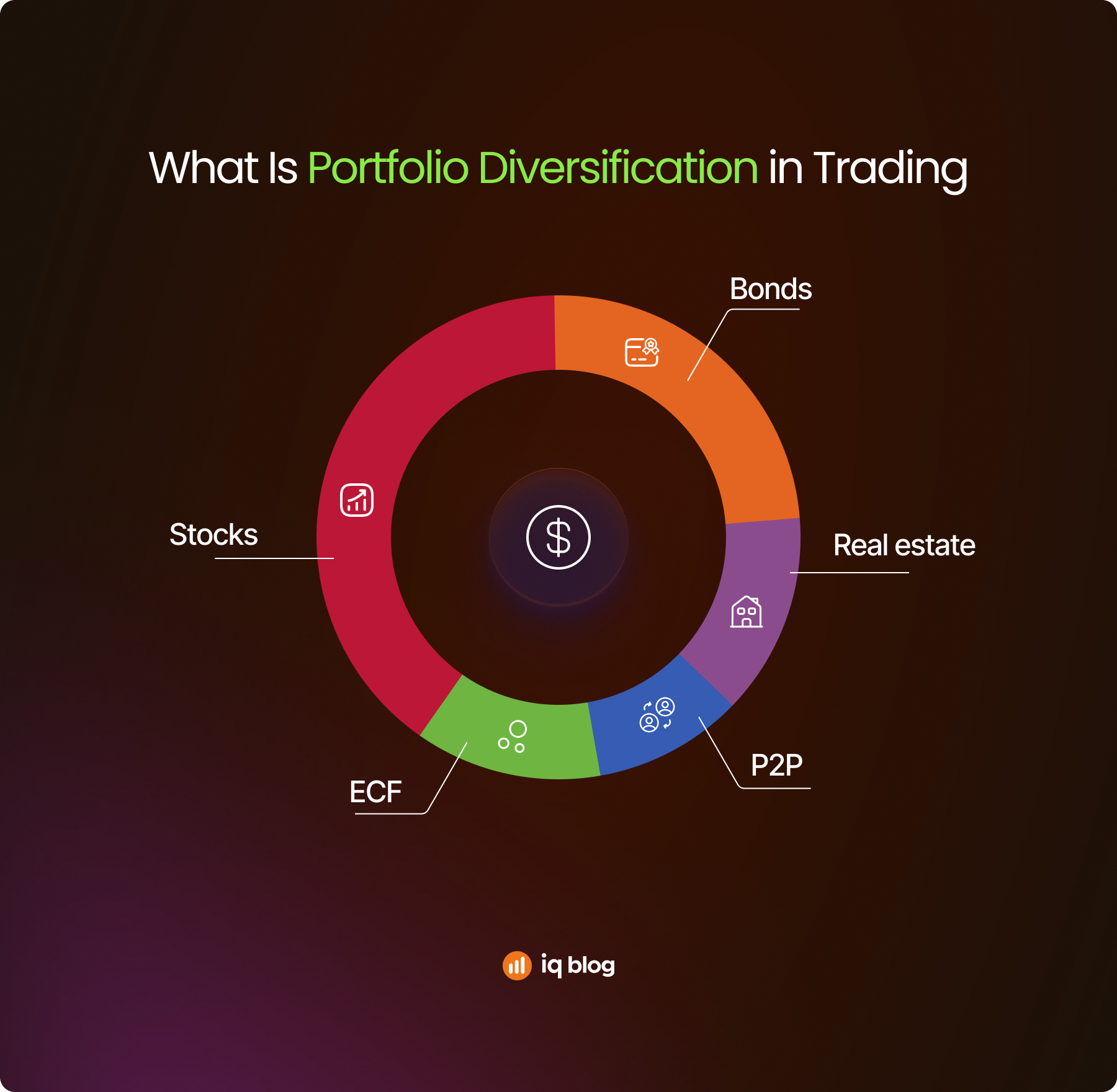
What Is Portfolio Diversification in Trading
Portfolio diversification in trading means spreading risk across different sources of market movement. Instead of relying on one asset or setup, traders allocate exposure to instruments that react differently to economic data, sentiment and volatility.
Unlike long term investing, trading diversification focuses on shorter holding periods and active risk management. Positions may last minutes, days or weeks, so diversification also includes timeframes and strategies, not just assets.
Why Diversification Is Critical for Traders
Market conditions change constantly. Periods of strong trends are often followed by ranges, low volatility phases or sudden news-driven moves. When a trader relies on a single market or strategy, these shifts can quickly lead to extended losing streaks.
Diversification reduces this dependency. By spreading exposure across different assets, timeframes and strategies, losses in one area may be balanced by stability or gains in another. This helps smooth overall performance and protects trading capital during difficult periods.
Key benefits of diversification for traders include:
- Reduced impact of sudden market reversals
- Lower drawdowns during unfavorable conditions
- More stable equity growth over time
- Improved emotional control and discipline
For active traders, diversification is not optional. It is a core tool for managing uncertainty and staying consistent across changing market environments.
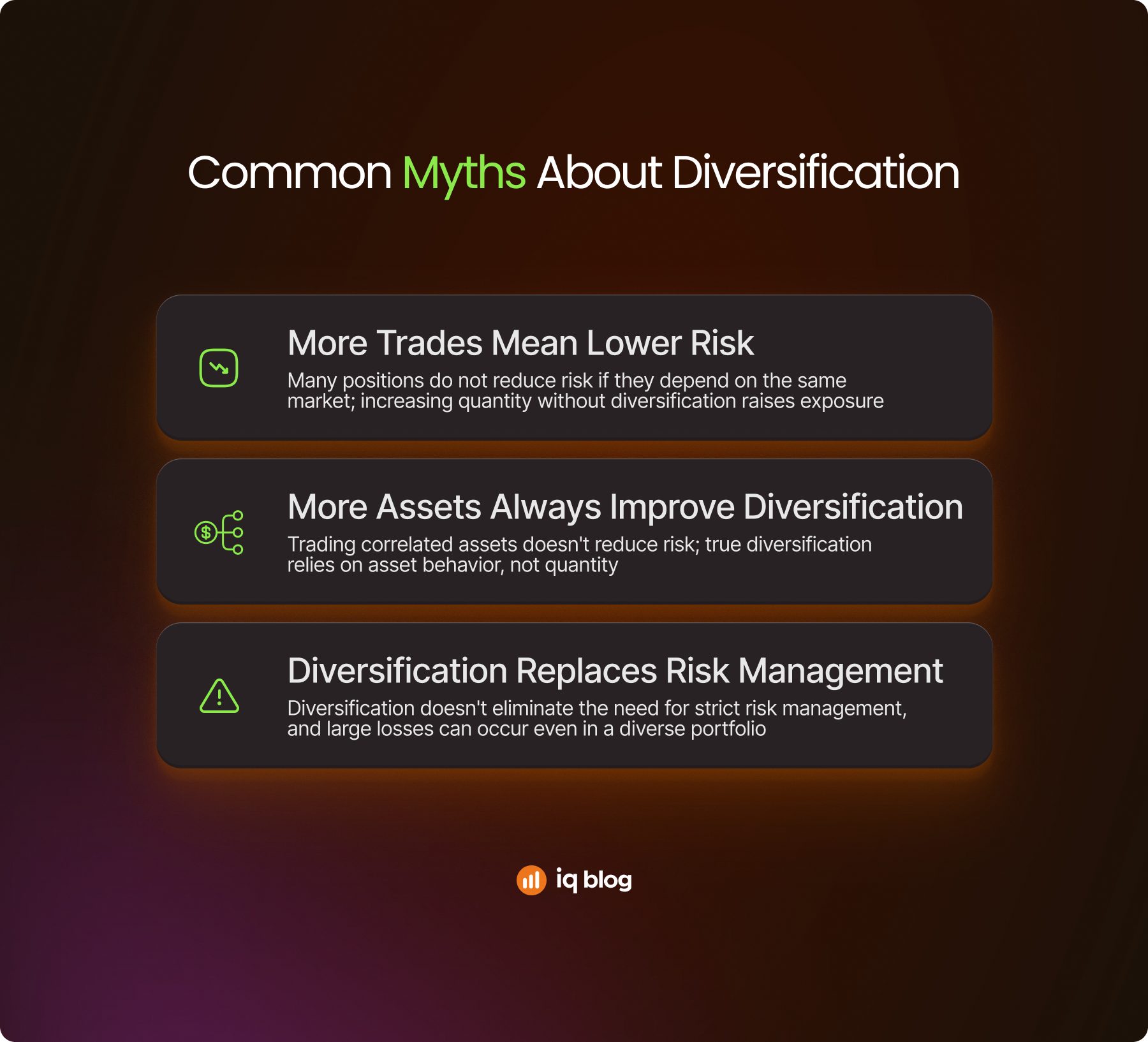
Common Myths About Diversification
Diversification is often discussed, but rarely applied correctly. Many traders follow simplified ideas that create a false sense of safety and lead to avoidable risk.
More Trades Mean Lower Risk
Opening many positions does not automatically reduce risk. If those trades depend on the same market movement, losses can occur at the same time. Quantity without differentiation increases exposure, not protection.
More Assets Always Improve Diversification
Trading multiple assets does not help if they move together. Highly correlated markets react similarly to news and sentiment. True diversification depends on how assets behave, not how many are traded.
Diversification Replaces Risk Management
A diversified portfolio won’t necessarily negate the need for tough risk management rules. A portfolio won’t necessarily go through a period with large losses even if it is diversified.
Key Asset Classes for a Trading Portfolio
A diversified trading portfolio may comprise more than one class of asset. Each class behaves in a unique manner based on economic data, monetary policies, and market sentiment.
Making decisions about which asset classes to trade has nothing to do with trading all of these assets. Making decisions about which asset classes to trade has nothing to do with trading all of these assets. The process has to do with picking well-liquided markets, and there has to be market behavior and enough volatility.
Forex Markets
Forex is one of the most liquid markets. Major currency pairs respond strongly to interest rates, inflation data and central bank decisions. Volatility varies by trading session, which allows both short term and swing trading strategies.
Stocks and Equity CFDs
Stocks are influenced by company earnings, sector trends and broader economic conditions. Trading individual stocks offers targeted exposure, while equity CFDs allow flexible positioning without owning the asset.
Indices
Indices represent groups of stocks and reduce single company risk. They reflect overall market sentiment and are often more stable than individual equities. Popular indices are widely traded and highly liquid.
Commodities
Commodities such as gold and oil react to supply, demand and geopolitical factors. They often behave differently from currencies and equities, making them useful for diversification during macro driven markets.
Cryptocurrencies
Cryptocurrencies are highly volatile and sensitive to risk sentiment. They require careful position sizing but can add diversification due to their unique market structure and independent drivers.
Understanding Correlation Between Assets
Correlation describes how different assets move in relation to each other. When two markets tend to move in the same direction, they are positively correlated. When one rises while the other falls, they are negatively correlated.
For traders, correlation is critical. Holding multiple positions that are strongly correlated increases hidden risk. Even if trades look different, they may react to the same economic news or sentiment shift.
Correlation is not static. Relationships between assets can change during high volatility or major economic events. Traders should review correlations regularly and avoid assuming that past behavior will always repeat.
Timeframe Diversification
Timeframe diversification means spreading trades across different holding periods. Instead of focusing only on short-term or long-term setups, traders balance exposure across multiple time horizons.
Short-term trades react quickly to intraday volatility and news. Swing trades focus on broader price movements and trends. Combining both can reduce dependence on a single market rhythm.
This approach also helps manage psychological pressure. Not every trade depends on immediate results, which supports patience and better decision-making during volatile sessions.
Strategy Diversification
Different strategies perform well under different market conditions. A single approach cannot adapt to every environment, especially when volatility and structure change.
Trend following strategies work best in strong directional markets. Range and mean reversion strategies perform better during consolidation. Breakout strategies are effective during volatility expansions. Combining these approaches helps reduce performance gaps.
Strategy diversification requires clear rules. Each strategy must have defined entries, exits and risk limits. Without structure, mixing strategies leads to inconsistency and poor execution.
Risk Management as the Core of Diversification
Diversification only works when risk is controlled at the portfolio level. Without clear risk rules, multiple positions can amplify losses instead of reducing them. Risk management defines how much damage one idea can cause.
Each trade should have a predefined risk limit. This is usually a small percentage of total capital. Portfolio exposure should also be capped so that several trades cannot fail at once.
Diversification manages where risk is placed. Risk management controls how much is allowed and both are required for long-term trading stability.
How to Allocate Capital Across Assets
Capital allocation determines how much risk is assigned to each market. A diversified portfolio spreads exposure without concentrating too much capital in one area. This prevents a single asset from dominating overall performance.
Some traders use a fixed percentage allocation for each asset class. Others adjust allocation based on volatility, assigning a smaller size to more volatile instruments. The goal is balanced risk, not equal position size.
Allocation should remain flexible. As market conditions change, exposure may need to be reduced or increased to maintain portfolio stability.
Example of a Diversified Trading Portfolio
A diversified trading portfolio combines multiple markets, strategies and timeframes with controlled risk. The exact structure depends on experience and risk tolerance, but the logic remains the same.
A hypothetical portfolio could include forex trades focused on major pairs, index positions aligned with broader trends and limited exposure to commodities during macro events. Each position risks a small portion of total capital, ensuring no single market dominates results.
This structure allows losses in one area to be balanced by stability or gains in another. The focus stays on consistency rather than aggressive concentration.
How Often to Rebalance a Trading Portfolio
Rebalancing ensures that a diversified portfolio stays on target within the tolerance level. Over the years, the successful sectors can become too prominent, or the bad sectors can skew the whole portfolio.
In reality, active managers tend to rebalance on the basis of actual performance and market developments rather than prearranged dates. For example, significant movements in volatility and correlation and drawdowns are known triggers for rebalancing.
A disciplined and rule-based approach should be followed in rebalancing. Frequent or emotional rebalancing can lead to overtrading and a lower consistency rate.
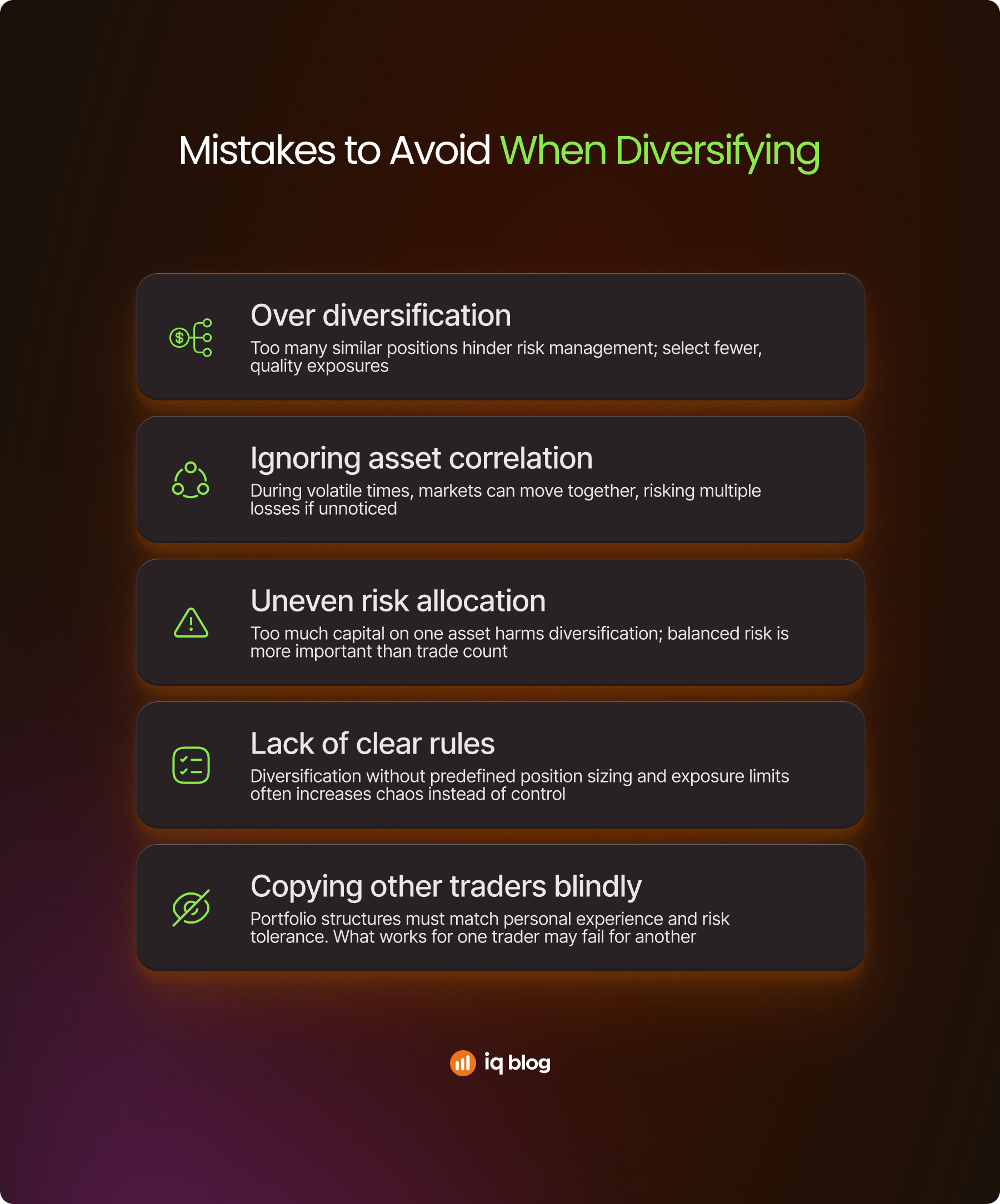
Mistakes to Avoid When Diversifying
Diversification can fail when it is applied without structure or understanding. The following mistakes are common among active traders and often lead to unnecessary risk.
- Over diversification – Managing too many positions across similar markets makes risk harder to track and execution less precise. Fewer, well-selected exposures are usually more effective.
- Ignoring asset correlation – Markets that once moved independently can become highly correlated during volatile periods. Failing to monitor this can cause multiple trades to lose at the same time.
- Uneven risk allocation – Assigning too much capital to one asset or strategy undermines diversification. Balanced risk matters more than the number of trades.
- Lack of clear rules – Diversification without predefined position sizing and exposure limits often increases chaos instead of control.
- Copying other traders blindly – Portfolio structures must match personal experience and risk tolerance. What works for one trader may fail for another.
The Role of Market Conditions in Diversification
Diversification should always reflect current market conditions. Markets behave differently during high volatility, low liquidity or strong macro trends. A portfolio that works well in calm conditions may become unbalanced during turbulent periods.
Traders should adjust exposure when volatility expands or contracts. This may involve reducing position size, limiting certain assets or focusing on more stable markets. Diversification is effective only when it adapts to the environment.
Psychological Benefits of a Diversified Portfolio
Diversification also supports better decision making. When results do not depend on a single trade or market, emotional pressure decreases. Traders are less likely to panic or force trades to recover losses.
A balanced portfolio helps maintain discipline. It encourages traders to follow rules instead of reacting emotionally to short term fluctuations. This psychological stability is often underestimated but critical for long term performance.
Building Diversification Gradually
A diversification process can be done gradually. A portfolio should not include too many markets or strategies to avoid confusion or inefficient execution of tasks. Every component has to be tested before being included in the portfolio.
A gradual approach enables traders to see what they consider to be adding value. It’s also easier to manage risk. Diversification that is sustainable takes experience over speed.
Tools That Help With Portfolio Diversification
Using the right tools makes diversification more accurate and easier to manage. They help traders identify hidden risk and maintain balanced exposure across markets.
- Correlation matrices – Show how assets move in relation to each other. They help avoid combining highly correlated markets in the same portfolio.
- Economic calendars – Highlight high-impact events that can affect multiple assets at once. They help reduce overlapping exposure during major announcements.
- Risk calculators – Assist with position sizing based on account size and stop loss distance. They ensure consistent risk across different instruments.
- Volatility indicators – Measure how much an asset typically moves. They help adjust position size for highly volatile markets.
- Trading journals – Reveal which assets and strategies dominate performance over time. They support informed rebalancing decisions.
Final Thoughts on Building a Diversified Trading Portfolio
A diversified trading portfolio takes time to build and is an ongoing process and not something that needs to be set up once and then forgotten. The key area of emphasis will always be to safeguard the money first and foremost. In order for diversification to be highly effective, it has to be blended with risks and trading rules that are strictly followed.
In this case, simplicity and discipline matter more compared to having a complex trading approach. Indeed, traders that focus on consistency as opposed to diversification are in a better position and thus can survive amidst market changes.