



What Is Swing Trading
Swing trading is a trading approach that targets price movements that unfold over several days. These movements are called swings. The goal is to buy when price pulls back and sell when it swings upward or sell when price rallies and buy back when it swings downward.
Swing traders look for clear setups instead of trying to trade constantly. They avoid the fast pace of day trading and focus on catching moves that develop over time. This style sits between short term and long term trading, offering a balance of activity and patience.
How Swing Trading Works
Swing trading works by taking advantage of the natural waves in the market. Price rarely moves in a straight line. It rises, pulls back, rises again or falls, retraces and continues lower. Swing traders aim to capture these moves.
They hold trades for several days while waiting for the swing to play out. This requires patience and clear rules. Swing traders do not enter every candle. They wait for setups with strong structure, such as pullbacks, breakouts or reversals.
The method focuses on timing. Traders look for moments when momentum shifts in their favor. Once the swing begins, they ride the movement and close the trade when the swing loses strength. Swing trading rewards clean analysis and disciplined execution.
Key Principles of Swing Trading
Swing trading is built on a few core principles. These principles guide when to enter, when to exit and how to evaluate the market.
- Trend Identification – Traders first check if the market is trending or moving sideways. Swing trades work best when the trend is clear. An uptrend offers buy swings. A downtrend offers sell swings.
- Support and Resistance – Swing traders rely heavily on key levels. Support acts as a buying zone during pullbacks. Resistance acts as a selling zone during rallies. These levels help time entries and exits.
- Market Structure – Markets move in patterns. Higher highs and higher lows show an uptrend. Lower highs and lower lows show a downtrend. Recognizing structure helps traders pick the most reliable swings.
- Patience and Timing – Swing trading is not about constant activity. Traders wait for clean setups, confirm momentum and then enter. Patience often leads to better trades and fewer mistakes.
Swing Trading Timeframes
Swing traders use timeframes that capture multi day movement without too much noise. These timeframes show the bigger picture while still giving enough detail for precise entries.
- Daily Chart – The daily chart is the main timeframe for swing trading. It shows the overall trend, key levels and strong patterns. Many traders use it to choose swing direction.
- Four Hour Chart – The four hour chart offers more detail. It helps traders refine entries, confirm pullbacks and spot early momentum shifts. It is a popular secondary timeframe.
- One Hour Chart – The one hour chart helps with timing. It shows the smaller waves inside the larger swing. Traders use it to enter at better prices or tighten stop losses.
Best Markets for Swing Trading
Swing trading works across many markets, but some assets suit this style better than others. Liquidity, volatility and market structure all play a role.
Forex
Forex pairs move in clear waves and respond strongly to economic news. This creates steady swings that traders can plan around. Major pairs are popular because they offer smoother movement.
Stocks
Stocks often create strong swings due to earnings, news and long term trends. Swing traders use support, resistance and pullbacks to catch multi day moves. Higher volume stocks generally work best.
Crypto
Crypto markets move quickly and can create large swings in short periods. This gives many opportunities but requires strong risk control. Medium timeframes help smooth volatility.
Commodities
Assets like gold and oil often follow strong trends. Swing traders use these trends to capture multi day momentum driven moves. Economic reports and supply changes influence swing opportunities.
Popular Swing Trading Strategies
Swing trading has many approaches, but most strategies fall into a few clear categories. These methods help traders catch the natural movements in price.
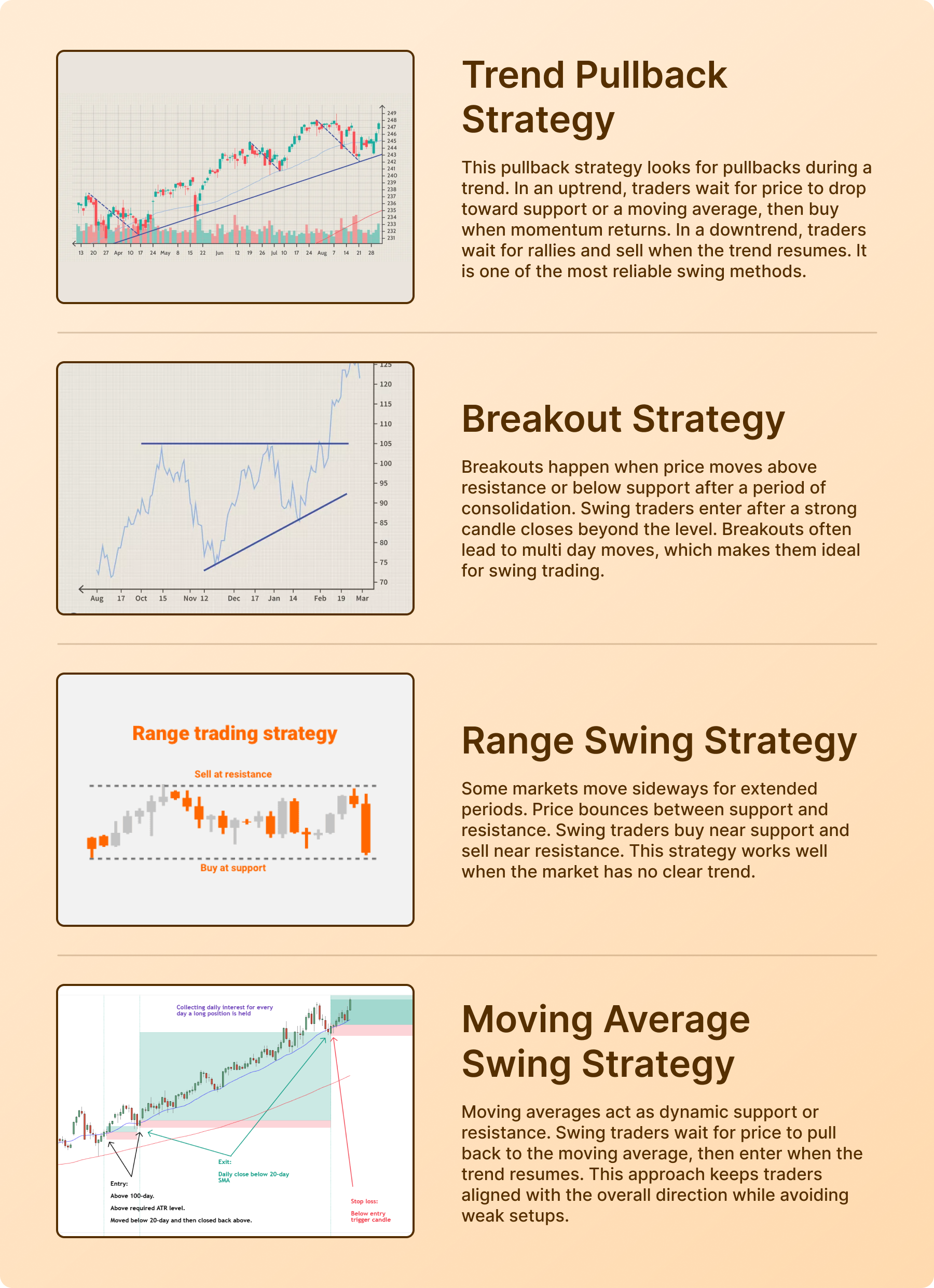
Trend Pullback Strategy
This pullback strategy looks for pullbacks during a trend. In an uptrend, traders wait for price to drop toward support or a moving average, then buy when momentum returns. In a downtrend, traders wait for rallies and sell when the trend resumes. It is one of the most reliable swing methods.
Breakout Strategy
Breakouts happen when price moves above resistance or below support after a period of consolidation. Swing traders enter after a strong candle closes beyond the level. Breakouts often lead to multi day moves, which makes them ideal for swing trading.
Range Swing Strategy
Some markets move sideways for extended periods. Price bounces between support and resistance. Swing traders buy near support and sell near resistance. This strategy works well when the market has no clear trend.
Moving Average Swing Strategy
Moving averages act as dynamic support or resistance. Swing traders wait for price to pull back to the moving average, then enter when the trend resumes. This approach keeps traders aligned with the overall direction while avoiding weak setups.
Best Indicators for Swing Trading
Swing traders use indicators to confirm setups, measure momentum and manage risk. Indicators do not replace price action, but they make decision making clearer.
- RSI – RSI helps identify when the market is overbought or oversold. During an uptrend, RSI pulling back into oversold levels can signal a buying opportunity. During a downtrend, overbought readings can signal a selling opportunity.
- MACD – MACD shows momentum changes. When the MACD line crosses above the signal line in an uptrend, it can confirm that momentum is returning. When it crosses below in a downtrend, it can support a sell setup.
- Moving Averages – Moving averages help define trend direction and key pullback zones. Swing traders use them to confirm that the market is trending and to spot areas where price may reverse back into the trend.
- ATR – ATR measures volatility. It helps traders set stop losses based on current market activity. Higher ATR means wider stops. Lower ATR means tighter stops.
- Stochastic – Stochastic helps spot turning points inside a swing. It works well in ranges, helping traders identify where price may reverse from support or resistance.
Risk Management in Swing Trading
Swing trading involves holding positions overnight, which adds extra risk. Proper risk management protects your capital and keeps your strategy stable over time.
- Stop Loss Placement – Swing traders place stop losses below support in an uptrend or above resistance in a downtrend. Stops should leave room for natural price movement without being too tight.
- Position Sizing – Small position sizes help control risk during volatile swings. Larger positions increase stress and make it harder to hold trades for several days.
- Overnight and Weekend Risk – Markets can gap when they reopen after news or global events. Swing traders plan for this by using proper stop losses and avoiding oversized trades before major announcements.
- Avoiding Large Gaps – Some assets have high gap risk. Stocks often gap after earnings. Crypto can move sharply on weekends. Being aware of these risks helps traders avoid unexpected losses.
Common Mistakes in Swing Trading
Many traders like swing trading, but some common errors can weaken results. Avoiding these mistakes helps improve consistency and confidence.
- Trading Every Candle – Swing traders wait for strong setups. Entering too often leads to weak trades and unnecessary losses. Patience is a key skill.
- Ignoring Trend Direction – Some traders try to catch reversals against the trend. This increases risk and lowers success. Swing trades work best when aligned with the main trend.
- Setting Stops Too Tight – Swing moves need space. Tight stops get triggered by normal pullbacks. Wider stops, paired with smaller positions, protect the trade more effectively.
- Using Too Many Indicators – Too many indicators create confusion and slow down decisions. Swing trading works best with a simple setup and a few confirming tools.
- Holding Trades Too Long – Swing trades focus on short to medium term moves. If the swing loses momentum, traders should exit instead of hoping the move continues.
Swing Trading on the IQ Option Platform
The IQ Option platform gives swing traders the tools they need to analyze trends, mark key levels and plan multi day trades. You can switch between several timeframes, including the daily, four hour and one hour charts. This makes it easy to combine the bigger picture with precise entry timing.
Indicators such as RSI, MACD, moving averages and ATR are available directly on the chart. Traders can add them with a few clicks and adjust their settings to match their strategy. Drawing tools help you mark support, resistance and trend lines, which are essential for swing setups.
The practice account allows you to test swing trading plans without risk. You can study how price behaves over several days, learn how swings form and understand how different assets move. This helps build confidence before switching to real trading.
The platform also updates prices in real time, so you can track how your swing trades develop and adjust levels when needed. This makes swing trading practical, clear and easy to manage.
Advantages and Disadvantages of Swing Trading
Swing trading has strengths and weaknesses. Understanding both helps traders decide if this style matches their goals and personality.
Advantages
- Less screen time – Swing traders do not need to watch every candle. They analyze the market, place trades and let the swing develop. This makes it suitable for people with full time jobs or limited time.
- Clear structure and predictable setups – Swings follow trends and levels. This creates logical entry and exit points. Traders focus on patterns that repeat across markets.
- Lower stress than day trading – Swing trading does not require split second decisions. Traders can plan calmly and avoid the pressure of fast intraday moves.
- Works on many assets – Forex, stocks, crypto and commodities all create multi day swings. This gives traders plenty of opportunities.
Disadvantages
- Overnight and weekend gaps – Price can jump while the market is closed. This creates risk that day traders do not face. Proper stop losses and smaller position sizes help manage this.
- Longer waiting periods – Some swings take time to develop. Traders need patience. Entering too early or too often leads to weak positions.
- Requires discipline – Holding trades for days means sticking to the plan even when the market moves slowly. Emotional decisions can weaken results.
- Not ideal for extremely volatile markets – Very fast markets can break swing structure and cause unexpected reversals. Traders may need to adjust or stay out during extreme volatility.
Conclusion
Swing trading is a flexible style that suits traders who want steady opportunities without watching the market all day. It focuses on capturing multi day moves, using trends, pullbacks and breakouts to find high quality setups. Swing traders rely on clear structure, good timing and strong discipline to stay consistent.
The approach works well across forex, stocks, crypto and commodities. When combined with smart risk management and simple indicators, swing trading becomes a practical and effective method. The IQ Option platform provides the tools needed to analyze swings, test ideas and trade with confidence.