



Quantitative easing (QE) is a monetary policy tool used by central banks to stimulate the economy when traditional interest rate cuts are no longer effective. Instead of adjusting short-term rates, the central bank buys large amounts of financial assets, typically government bonds, to inject liquidity into the system. By doing so, QE lowers borrowing costs, boosts lending and supports economic growth. Since the 2008 financial crisis, QE has been a central feature of global monetary policy and it continues to shape markets in 2025. This article explains what QE is, how it works and its benefits and risks.
What Is Quantitative Easing?
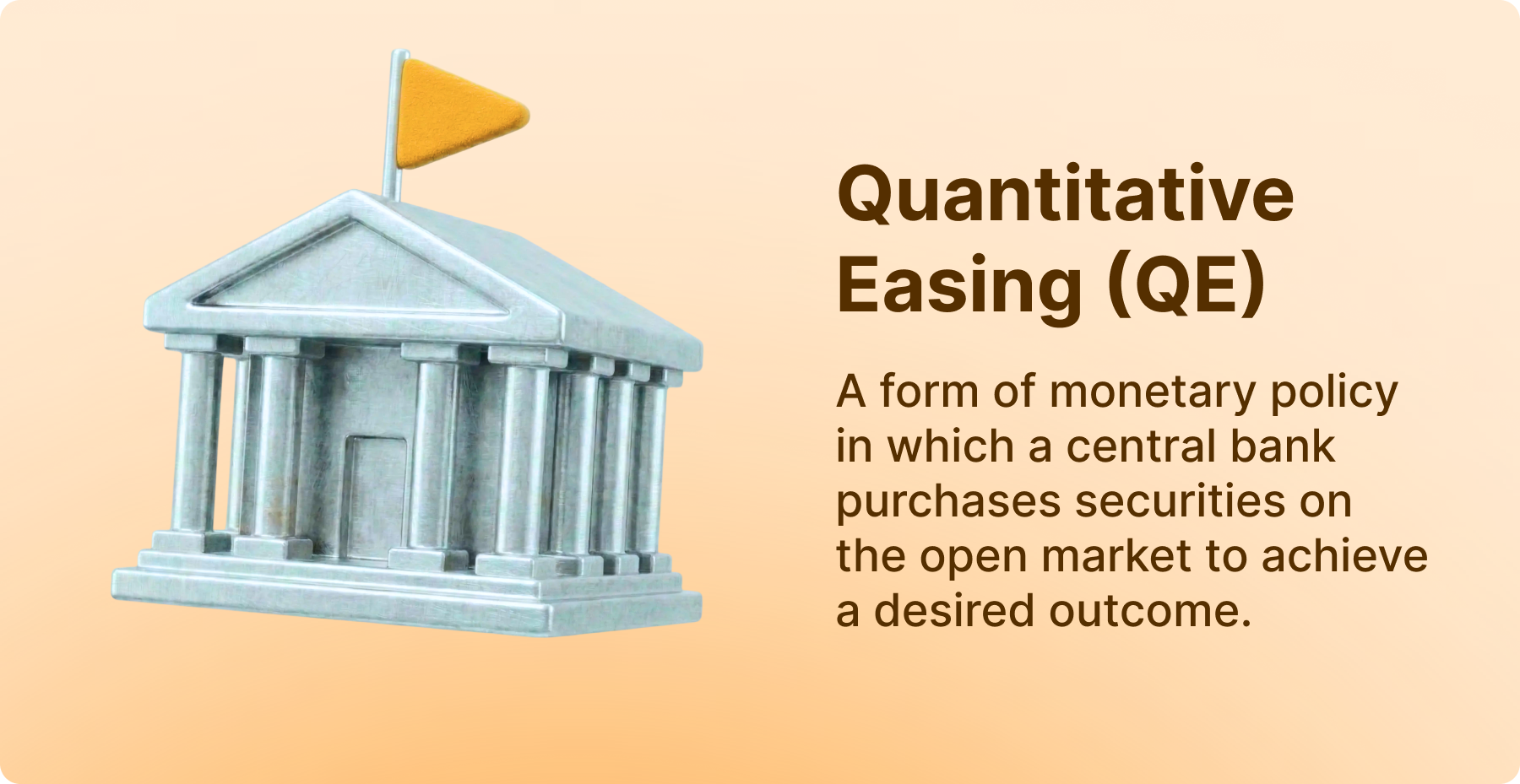
Quantitative easing is an unconventional monetary policy where a central bank purchases large amounts of financial assets to increase the money supply and encourage lending. The goal is to stimulate economic activity when interest rates are already near zero and cannot be lowered further.
In practice, QE usually involves buying long-term government bonds. Sometimes, it also includes mortgage-backed securities or corporate bonds. By making these purchases, the central bank pushes more money into the financial system. Banks that sell bonds receive cash, which they can use to provide more loans to businesses and households.
The impact is felt across the economy. Lower yields on government bonds usually lead investors to seek higher returns in riskier assets such as corporate debt or equities. This helps businesses raise capital more easily. At the same time, lower borrowing costs encourage households to spend more on housing, cars or other major purchases.
Quantitative easing is not the same as simply “printing money.” The central bank creates reserves digitally, which are exchanged for bonds. This increases the supply of money available for lending, but it does not automatically increase consumer spending unless banks and borrowers respond.
Since the global financial crisis of 2008, QE has been used by major central banks, including the U.S. Federal Reserve, the European Central Bank, the Bank of England and the Bank of Japan. During the COVID-19 pandemic, it became even more widespread, with trillions of dollars added to financial systems worldwide.
How Quantitative Easing Works
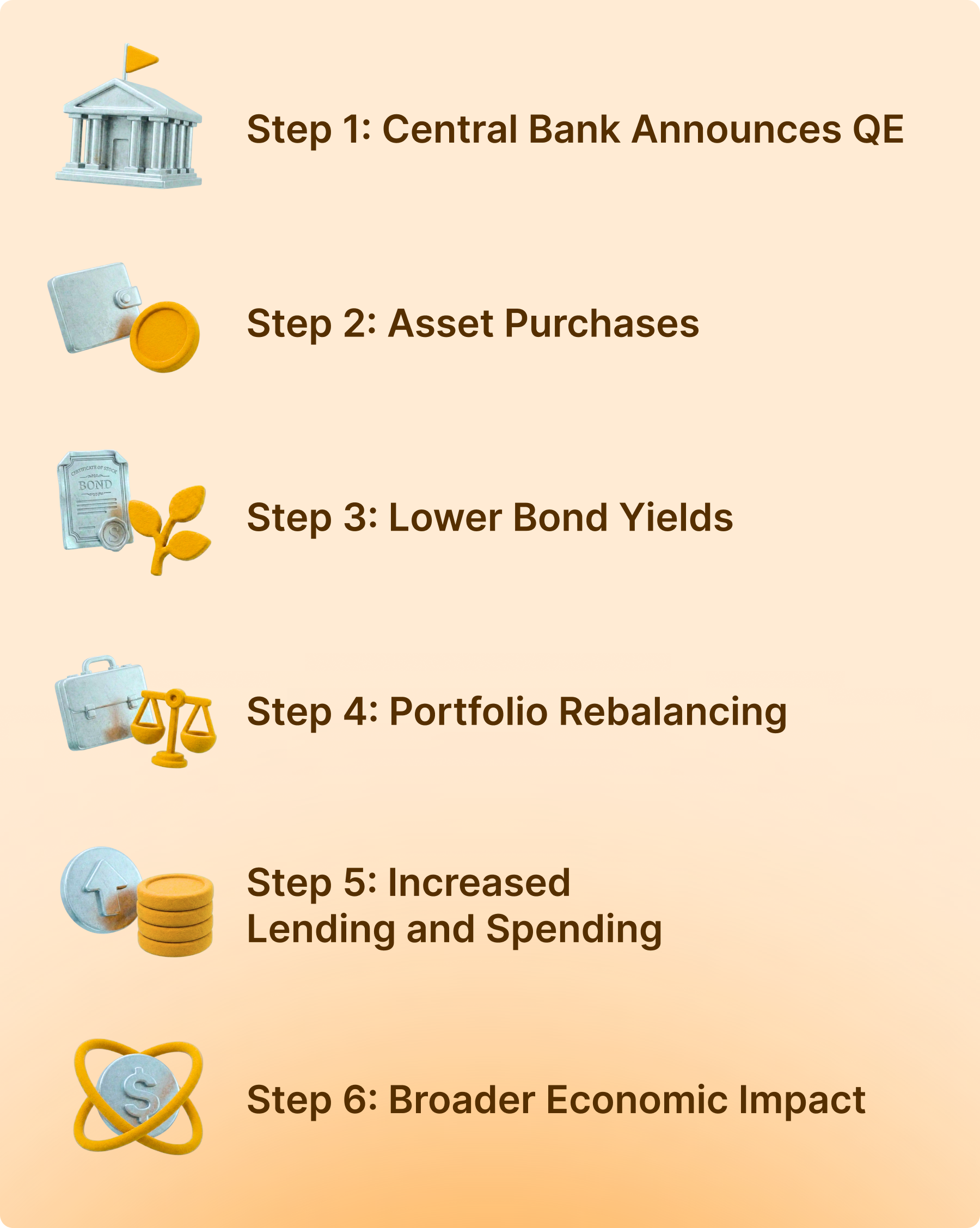
Quantitative easing follows a structured process that begins with a central bank decision and flows through to the wider economy. Each stage has specific effects that build on one another.
Step 1: Central Bank Announces QE
The first step is communication. A central bank announces its plan, including the size of the program, the timeline and the types of assets it will buy. These announcements shape market expectations even before purchases begin. Traders often react immediately by lowering long-term interest rates and adjusting portfolios in anticipation of easier financial conditions. For example, when the European Central Bank launched QE in 2015, bond yields across the eurozone began falling as soon as the plan was made public.
Step 2: Asset Purchases
Once the program starts, the central bank buys large quantities of financial assets, usually long-term government bonds, but sometimes also mortgage-backed securities or corporate debt. These purchases are made from commercial banks or other institutions. When the central bank pays for the bonds, it credits the banks’ reserve accounts. This increases liquidity in the financial system. A larger supply of reserves reduces the need for banks to borrow from each other, keeping short-term interest rates low.
Step 3: Lower Bond Yields
As central banks buy bonds, demand increases. Bond prices rise, which means yields fall. Yields represent borrowing costs, so lower yields make it cheaper for governments to finance deficits, for corporations to issue debt and for households to take out loans tied to long-term interest rates, such as mortgages. For example, after the Federal Reserve launched QE in 2008, U.S. mortgage rates dropped significantly, making home financing more affordable.
Step 4: Portfolio Rebalancing
Investors who sell bonds to the central bank now hold cash. To maintain returns, they often shift into assets with higher yields, such as corporate bonds, equities or real estate. This is known as the portfolio rebalancing effect. Rising demand for these assets drives up prices, which in turn lowers yields across markets. Higher equity prices support business investment and household wealth, while real estate gains encourage more construction and lending.
Step 5: Increased Lending and Spending
Banks that sold assets to the central bank now have larger reserves, giving them more capacity to extend loans. Combined with lower interest rates, this encourages businesses to borrow for expansion and consumers to finance big purchases. More credit flowing into the economy boosts spending and investment. During Japan’s QE programs in the 2000s, banks used their higher reserves to support corporate lending, which stabilized investment during periods of weak growth.
Step 6: Broader Economic Impact
The final step is the transmission into the real economy. More spending raises demand for goods and services, which encourages production and job creation. Higher employment lowers unemployment and supports wage growth. Ideally, inflation also rises closer to the central bank’s target, reducing the risk of deflation. QE is often seen as a last-resort tool, but when used effectively, it can stabilize economies during crises.
Benefits of Quantitative Easing
Quantitative easing has been one of the most influential policy tools in modern finance. When used correctly, it can stabilize markets and restore confidence during crises. Below are the main benefits.
- Lower Borrowing Costs – By purchasing long-term bonds, QE pushes down yields. This directly lowers the cost of mortgages, business loans and government financing. Cheaper credit encourages both households and firms to spend and invest, which supports growth.
- Stimulates Lending and Investment – With higher reserves and lower interest rates, banks are more willing to lend. Businesses use cheaper credit to expand operations, while consumers borrow for big-ticket items. This flow of money into the economy stimulates demand and creates jobs.
- Boosts Asset Prices – QE increases demand for riskier assets because investors shift away from low-yield bonds. Rising equity and real estate prices create a wealth effect. Households feel richer and spend more. For companies, higher share prices make it easier to raise capital for expansion.
- Prevents Deflation – Deflation, a general decline in prices, can paralyze an economy as consumers and businesses delay spending. By injecting liquidity and encouraging inflation to rise toward target levels, QE reduces this risk.
- Restores Market Confidence – Financial crises often trigger panic selling and credit freezes. QE signals that the central bank is committed to supporting markets. The announcement itself can calm investors, reduce volatility and reassure banks that liquidity will not dry up.
- Encourages Currency Weakness – QE often leads to a weaker domestic currency because lower interest rates reduce demand for that currency. A weaker exchange rate supports exports, as domestic goods become cheaper abroad. This can provide an additional boost to growth in export-driven economies.
Risks of Quantitative Easing
While quantitative easing can support economies during crises, it also comes with significant downsides. These risks often appear over the medium and long term, raising questions about whether QE creates more problems than it solves.
- Asset Bubbles – By lowering bond yields, QE pushes investors toward riskier assets like equities and real estate. This can inflate asset prices far beyond their fundamental values. If these bubbles burst, the resulting crashes may damage the economy more than the initial problem.
- Inequality Concerns – QE disproportionately benefits those who already own financial assets. Rising stock and housing prices make wealthy households richer, while low-income households see fewer direct gains. This widens wealth inequality, which can fuel social and political tensions.
- Diminished Bank Incentives – Although QE increases bank reserves, it does not guarantee higher lending. Banks may choose to hold excess reserves or invest in safer assets instead of providing credit to businesses and households. This limits the effectiveness of the policy.
- Currency Depreciation Risks – While a weaker currency can boost exports, it can also hurt consumers by raising the cost of imports. In economies reliant on imported goods, QE-driven currency depreciation may lead to higher inflation without improving domestic growth.
- Distorted Market Signals – Central banks become dominant buyers in bond markets during QE. This artificial demand distorts prices and yields, making it harder for investors to gauge true risk levels. Market functioning can become overly dependent on central bank intervention.
- Exit Challenges – Ending QE programs is difficult. When central banks eventually reduce asset purchases or raise rates, markets may react violently. Taper tantrums, where yields spike suddenly after hints of QE withdrawal, have occurred multiple times since 2013. Managing the exit without disrupting stability remains one of the hardest challenges.
- Inflation Risks – In the short run, QE often struggles to raise inflation. But in the long run, large-scale asset purchases and excess liquidity can fuel price growth beyond target levels. If inflation accelerates, central banks may be forced to tighten policy abruptly, risking recession.
- Diminishing Returns – Each round of QE may be less effective than the last. Once markets get used to the idea of central bank support, additional programs may not deliver the same boost. By 2025, many economists argue that QE has lost much of its initial power to surprise or stimulate.
Quantitative Easing in Practice: Historical Examples
Quantitative easing has been used by several major central banks over the last two decades. Each case offers insights into how QE works in practice and the challenges it creates.
United States: The Federal Reserve
The Federal Reserve first launched QE in late 2008 during the global financial crisis. With interest rates already near zero, the Fed began purchasing hundreds of billions of dollars in mortgage-backed securities and Treasury bonds.
- QE1 (2008–2010) – Focused on stabilizing housing and credit markets by buying $1.25 trillion in mortgage-backed securities.
- QE2 (2010–2011) – Added $600 billion in Treasury purchases to support recovery.
- QE3 (2012–2014) – A more open-ended program that continued until economic conditions improved.
QE lowered borrowing costs, revived credit markets and contributed to the recovery. But it also sparked debates about asset bubbles and wealth inequality as stock markets surged.
Japan: The Pioneer of QE
Japan was the first major economy to experiment with quantitative easing in the early 2000s. Faced with deflation and stagnation after its asset bubble burst in the 1990s, the Bank of Japan began purchasing long-term government bonds and other assets.
Despite these efforts, results were mixed. While QE stabilized financial institutions and prevented deeper deflation, it struggled to generate strong growth. Japan’s case shows that QE alone cannot fix structural economic problems such as an aging population and low productivity growth.
European Central Bank (ECB)
The ECB launched its own QE program in 2015, later than the U.S. and Japan. It was designed to address weak inflation, high unemployment and sluggish growth across the eurozone.
The program involved buying government and corporate bonds at a pace of €60 billion per month. At its peak, the ECB held trillions of euros in assets. QE pushed bond yields in countries like Italy, Spain and Greece to historic lows, easing borrowing pressures during the eurozone debt crisis.
However, critics argue that QE deepened financial imbalances between stronger and weaker economies within the union.
United Kingdom: Bank of England
The Bank of England launched QE in 2009 to counter the global financial crisis. Over several rounds, it purchased hundreds of billions of pounds in government bonds. QE helped stabilize credit markets and support recovery, but it also fueled concerns about inflated housing prices in London and widening inequality.
Pandemic-Era QE (2020–2021)
The COVID-19 pandemic triggered the largest wave of QE in history. Central banks across the globe acted quickly to prevent a financial meltdown.
- The Federal Reserve announced unlimited QE, buying Treasury securities and mortgage-backed securities without a fixed cap.
- The ECB launched the Pandemic Emergency Purchase Programme (PEPP), worth over €1.8 trillion.
- The Bank of England and Bank of Japan expanded their QE programs to record levels.
These measures stabilized markets, prevented credit freezes and supported governments’ massive fiscal spending programs. However, they also fueled sharp increases in stock markets and property prices, contributing to inequality and setting the stage for the inflation surge of 2021 – 2022.
Quantitative Easing in 2025: Current Role and Outlook
In 2025, quantitative easing is no longer the emergency lifeline it was during the financial crisis of 2008 or the COVID-19 pandemic. Instead, it has shifted into a phase of balance sheet management. The Federal Reserve and the European Central Bank have stopped expanding their programs and are now letting bonds mature without reinvestment, a process often called quantitative tightening. By contrast, the Bank of Japan remains committed to large-scale purchases, reflecting its different battle with low inflation and sluggish growth. This contrast highlights that while QE remains a tool in every central bank’s arsenal, its application depends heavily on domestic conditions.
The legacy of QE, however, continues to shape global markets. Trillions of dollars in bonds remain on central bank balance sheets, keeping yields suppressed and pushing investors toward equities, corporate debt and real estate. Housing prices in many countries still reflect years of cheap credit, while stock valuations remain elevated partly because investors have few alternatives in low-yield environments.
Key lasting impacts of QE include:
- Depressed bond yields encourage capital to flow into riskier assets
- Elevated equity valuations, supported by cheap financing and investor demand
- Higher housing costs in many regions, as mortgage rates stayed low for years
- Distortions in capital allocation, where weaker companies survived longer due to easy credit
- Greater reliance on central banks, with markets sensitive to even small policy shifts
These lasting effects have fueled heated debate. Supporters argue that QE prevented deeper recessions, stabilized markets during crises and gave governments breathing room to manage shocks. Critics, however, point to its role in driving wealth inequality, fueling asset bubbles and creating reliance on central bank intervention. The inflation surge of 2021 – 2022, though caused by multiple factors, is often cited as evidence that prolonged QE carries risks. The political dimension is also growing, as some governments may come to expect central bank support when fiscal deficits widen.
Looking forward, QE is unlikely to vanish. Instead, it will become more targeted and deliberate. Central banks may design programs around specific goals, such as supporting green bonds or ensuring stability in corporate credit markets, rather than broad government bond purchases. Technology could also change the way QE is executed, with AI-driven analysis and potential links to digital currencies, allowing more precision and transparency. For investors, this means QE remains a force to watch. Policy shifts, even subtle ones, ripple across bonds, stocks and currencies, making central bank communication a critical driver of market sentiment.
Final Thoughts
Quantitative easing has transformed modern monetary policy. Once seen as an emergency response to crises, it is now a standard part of the central bank toolkit. By buying financial assets and injecting liquidity, QE has influenced everything from government borrowing costs to stock market valuations and housing prices. Its reach extends far beyond the bond market, shaping the financial landscape in ways both intended and unintended.
The benefits of QE cannot be ignored. It stabilized markets during some of the most turbulent times in history, from the 2008 global financial crisis to the COVID-19 pandemic. Without it, borrowing costs for governments and businesses would likely have soared, unemployment would have climbed higher and recessions would have been deeper. Supporters argue that QE gave economies breathing room when traditional policy tools reached their limits.
Yet, the risks are equally real. Prolonged asset purchases have contributed to higher inequality, as those who own assets have gained disproportionately. Easy credit has sometimes allowed unproductive companies to survive, creating inefficiencies in capital allocation. The sharp inflationary surge of 2021–2022 also raised questions about whether central banks waited too long to reverse QE.
Looking ahead, QE will not disappear. Instead, it will evolve. Central banks are likely to use it more selectively, focusing on targeted goals such as climate-related financing or stabilizing corporate bond markets. For traders and investors, QE remains a critical force to monitor. Policy signals from central banks can move markets in an instant, making awareness of QE dynamics an essential part of modern investing.