



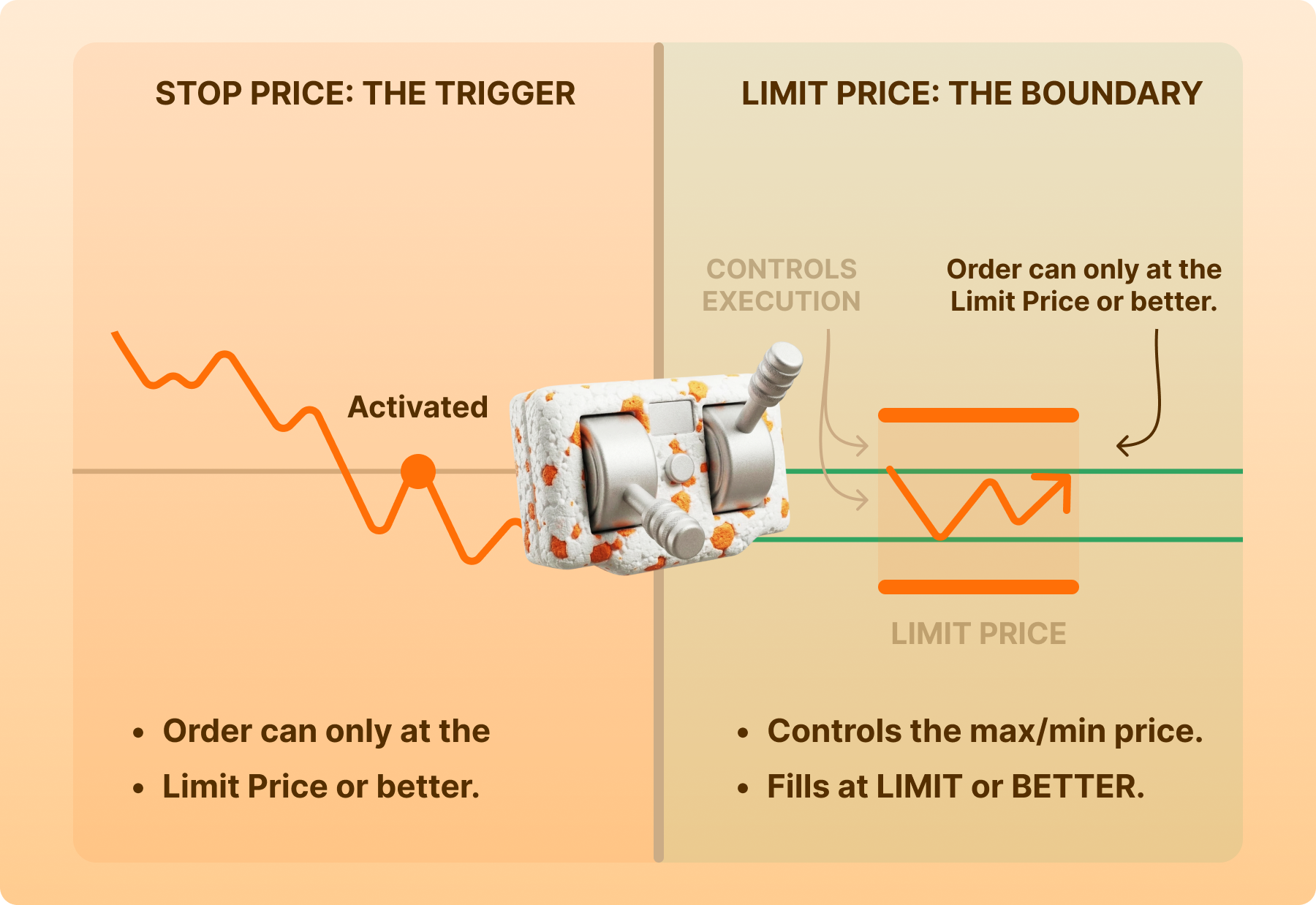
A stop-limit order is a risk management tool and a trading instruction that combines two price points, that is, a stop price and a limit price. When the asset reaches the stop price, the order is automatically triggered and converted into a limit order. This limit order then ensures that the trade will only be executed at the specified limit price or better. This provides more control over the execution price but does not guarantee the trade will be filled.
In this guide, we will thoroughly look at what stop-limit orders are, how they work, why traders use them, and the risks to keep in mind. We’ll also walk through an easy example and compare it with stop-loss orders so you can clearly see the difference.
How Stop-Limit Orders Work
As mentioned before, a stop-limit order begins with two prices you set, the stop price and the limit price. The stop price acts as the trigger that activates your order once the market reaches it. As soon as the stop level is touched, your order automatically becomes a limit order and moves into the order book.
From there, the limit price takes over. The trade will only execute if the market can match your limit price or offer something better. If the price moves normally toward your limit, your order fills. But if the market moves too quickly and skips your limit level, the trade simply won’t execute.
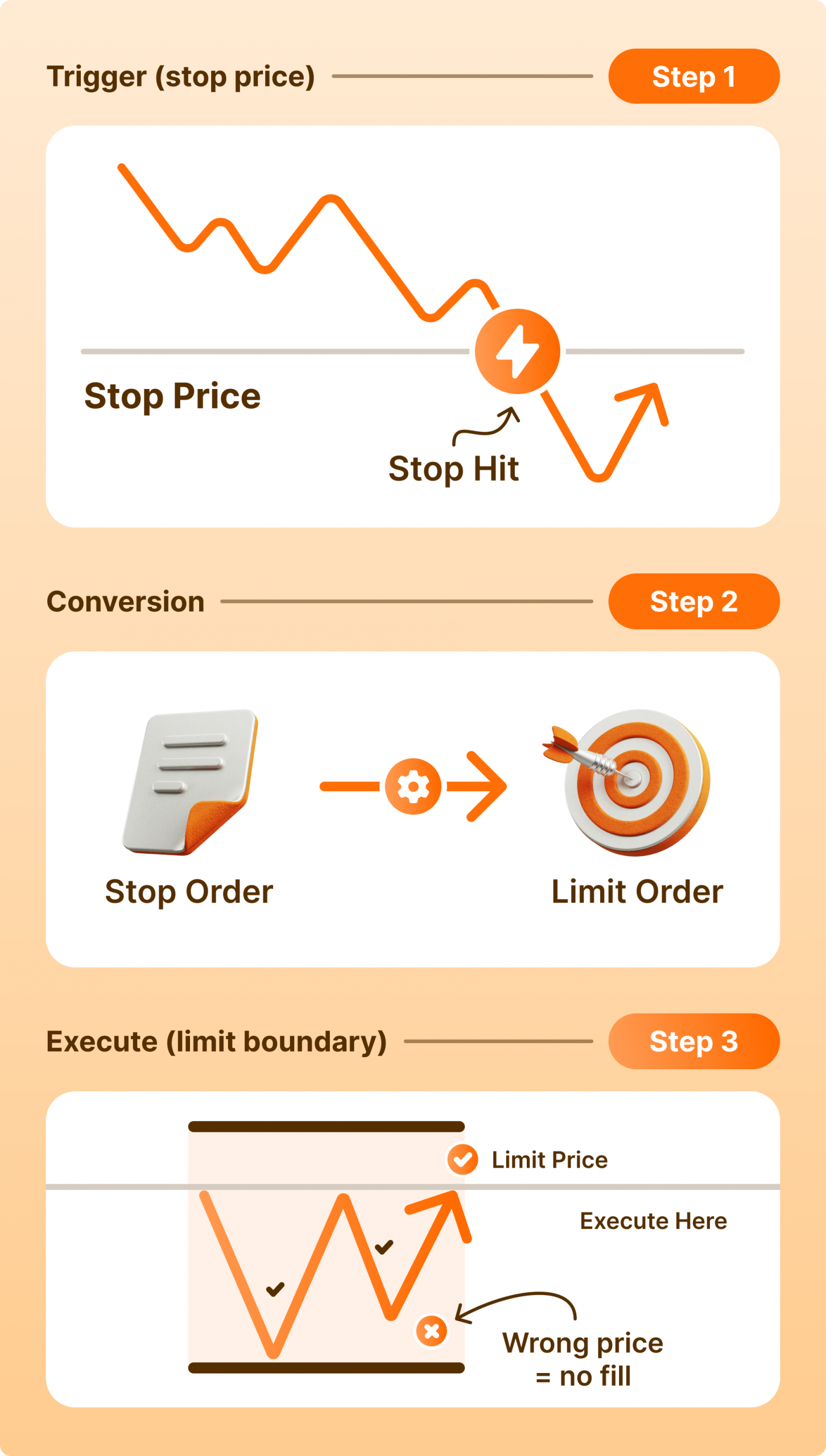
This design gives you strong price control, but no guaranteed execution. A stop-limit order protects you from unwanted prices during fast or volatile conditions, but it also carries the risk of remaining unfilled. In essence, the stop price decides when the order activates, while the limit price decides how it executes.
Features of Stop and Limit Orders
Stop-limit orders combine key features from both stop orders and limit orders. Understanding these features helps you use the tool effectively.
Precise Price Control
Stop-limit orders give you the ability to define exactly where your trade should begin and how it should execute. This level of precision helps you avoid entering or exiting at random prices during fast market movements. It ensures your trades follow a structure you set, not the market’s sudden swings. Precise price control also supports a disciplined trading approach.
Protection Against Slippage
Slippage occurs when your order fills at a worse price than expected, usually during fast or volatile market movements. This can happen when the market jumps suddenly, and your order is forced to accept the next available price. Stop-limit orders help reduce this problem by enforcing a minimum or maximum price you choose.
With a limit price in place, the platform will not execute your trade below or above your specified level. This way, you’d not get caught in the sharp price gaps that often occur during news releases or sudden market reactions.
Automated Execution
Stop-limit orders are pending orders that are automatically executed once the price reaches the set stop. As such, you don’t need to frequently monitor your charts, as it allows you to stay focused without emotionally reacting to sudden price movements.
Moreover, stop-limit orders can be used to take a long or short trade or exit an already active trade with a controlled price. Hence, it offers traders good flexibility in different market conditions. This also makes them suitable for various trading styles and strategies, maintains consistency, and supports long-term trading discipline.
Strategic Entries and Exits
Stop-limit orders help traders position themselves more strategically in the market. They allow you to enter only when specific conditions are met, reducing the risk of entering too early. This is especially useful when waiting for confirmation during potential breakouts or trend reversals.
These orders also strengthen your exit strategy. By setting your stop-limit levels, you can lock in profits or minimize potential losses with controlled pricing. They help you stay aligned with your setup and follow your plan without constant chart monitoring. This approach gives you more confidence and consistency in your overall trading process.
No Guarantee to Execute
One of the main limitations of stop-limit orders is that they do not guarantee execution. The order activates when the stop price is reached, but it will only fill if the market also touches your limit price. If the price moves too quickly and skips your limit, the order remains open.
This lack of guaranteed execution can be risky if you are trying to protect profits or limit losses. An unfilled order may leave you exposed while the market continues to move against you. For this reason, traders must set stop and limit levels carefully and consider market volatility before choosing this order type.
Why Traders Use Stop-Limit Orders
Now that you know what stop-limit orders do, let’s talk about why traders use them.
To Enter the Market at the Right Time
Many traders watch for breakouts, but entering too early can lead to unnecessary losses. Markets often test resistance levels before moving strongly. A stop-limit order helps you wait for clearer confirmation.
Once the price reaches your stop level, the order activates only if the market offers your chosen limit price. This prevents you from chasing sudden moves without structure. It also ensures your entry aligns with your planned strategy.
To Exit with Price Control
Stop-limit orders give traders the ability to choose precisely how and when their exit should happen. This prevents selling at random prices during sudden moves. It also helps protect profits more effectively in fast-changing markets.
When your stop level is reached, the limit price ensures you exit only within your preferred range. This means you avoid accepting prices that fall far below your expectations. It offers a structured approach that simple market orders cannot provide. This level of control supports smarter, more confident decision-making during active trades.
To Avoid Emotional Decisions
Trading often becomes emotional when prices move quickly or unpredictably. Fear and excitement can push traders into rushed choices. A stop-limit order helps remove that pressure by defining your actions in advance.
Once your stop and limit levels are set, the platform handles the execution automatically. This prevents impulsive reactions during sudden price swings. It also keeps your decisions grounded in your original plan rather than in momentary emotions.
To Trade Strategically During Volatile Conditions
Volatile markets can move sharply within seconds, creating sudden spikes and rapid drops. These unpredictable swings often make manual entries and exits difficult. A stop-limit order adds structure by defining clear conditions before the chaos begins.
When the market reaches your stop level, your limit price ensures controlled participation. You avoid entering or exiting at extreme levels caused by fast movements. This helps you stay protected while still taking advantage of strong market activity.
To Stick to Risk-Management Plans
Risk management is a core part of successful trading, and stop-limit orders help support that discipline. For most emotional traders, it is not easy to stick to their risk management plans. However, you can conquer this with the use of pending orders, including stop-limit orders. This works because you don’t need to adjust orders under pressure or second-guess your moves with emotions that often lead to increased risk.
Risks of Stop-Limit Orders
Like any tool, stop-limit orders have downsides you need to understand before using them. Being aware of the risks helps you avoid frustration and surprises.
No Execution Guarantee
One of the biggest risks with stop-limit orders is that they offer no guaranteed execution. The order activates when the stop price is reached, but it will only fill at your chosen limit price. If the market moves too quickly, it may never trade within your limit range.
This situation often occurs during sudden volatility or sharp drops. Prices can fall rapidly and skip several levels before stabilizing again. When this happens, your order remains in the book without being executed.
The lack of guaranteed execution also means you may stay in a position longer than planned. This can expose you to unexpected losses if the market continues moving against you. Traders must understand this limitation clearly before relying on stop-limit orders.
Market Gaps Can Skip Your Order
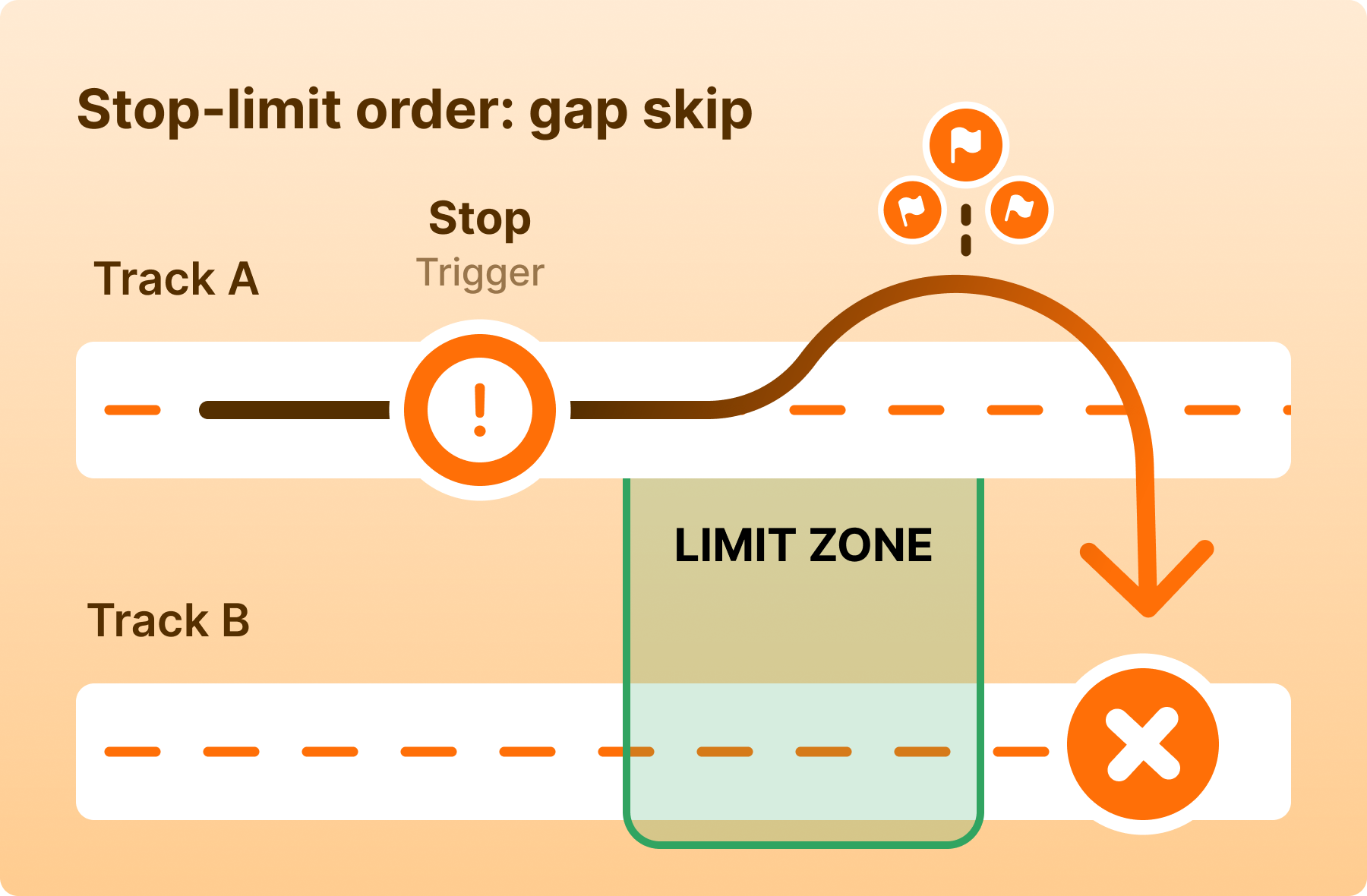
Market gaps occur when the price jumps from one level to another without trading in between. These gaps often appear after major news or sudden overnight events. When this happens, the market may altogether skip past your limit price.
If the new price is worse than your limit, your order will not execute. Gaps reduce the reliability of stop-limit orders during sensitive market periods. Traders must be aware of this risk, especially when holding positions overnight or around scheduled announcements.
Requires Thoughtful Setting of Prices
Stop-limit orders demand careful planning because both prices must work well together. Placing the stop too close to the limit can reduce the chance of execution. A small distance leaves little room for normal price movement during volatility.
Traders must consider market behavior before choosing these levels. Different assets move with different intensity, and some react sharply to small triggers. Ignoring volatility can lead to poorly placed orders that rarely fill. By understanding typical price ranges and market speed, traders can set realistic levels. This reduces frustration and improves the likelihood of smooth execution.
Not Ideal During Extremely Fast Markets
Stop-limit orders become less effective when markets move at extreme speed. Prices can jump several levels within seconds during major announcements or unexpected events. This rapid movement often skips past both the stop and limit levels entirely.
When the market moves too fast, your order may activate but never execute. The limit price acts as protection, but it also restricts the trade from filling at worse levels. This leaves you exposed in conditions where quick reactions matter most.
Fast markets require tools that prioritize execution over price control. Stop-limit orders, with their strict limits, cannot always keep up during high volatility. Traders must evaluate when these orders fit the situation and when simpler orders may work better.
What is an Example of a Stop-Limit Order?
Let’s make this clearer with a simple example.
Imagine you bought a cryptocurrency at $100, and the price has now risen to $120. You want to secure some profit, but you also want to avoid selling too cheaply if the market suddenly drops. To manage this, you decide to place a stop-limit order. You set your stop price at $115 and your limit price at $113, giving the market a small range to execute your sell order once the decline begins.
If the price falls to $115, your stop level is triggered, and a limit order to sell at $113 or better enters the order book. When the decline is gradual, the market usually trades through your limit range, and your order fills somewhere between $113 and $115. However, if the price drops sharply and falls below $113, your order will not execute because it can no longer match your limit price. In this situation, you still hold the asset even though the stop was triggered, simply because the limit price protected you from selling at a level you consider too low.
Differences Between Stop-Limit and Stop-Loss Orders
Some traders often mix stop-limit and stop-loss orders. The table below shows their differences.
| Stop-Limit Order | Stop-Loss Order |
| Converts into a limit order | Converts into a market order |
| No guarantee, as it only fills at the limit price or even better | Guaranteed to execute once triggered |
| Complete control over the minimum or maximum acceptable price | No control over the final execution price |
| Strong protection because the limit prevents bad fills | No protection; may fill at worse prices in fast markets |
| Risk of not executing at all | Risk of being filled at an unfavorable price |
| Strategic entries/exits where price precision matters | Risk management exists where execution is more important |
| May fail to execute if the price jumps past the limit | Executes immediately, often with slippage |
Conclusion
Understanding how stop-limit orders work gives you control, structure, and the ability to plan your trades with precision. Whether you’re trying to catch a breakout or protect profits with a controlled exit, stop-limit orders offer the balance between automation and price discipline.
However, like all trading tools, they come with risks, especially the possibility of not being filled. That’s why it’s essential to understand market conditions, volatility, and price behavior before relying too heavily on them.
The key is to use stop-limit orders thoughtfully and integrate them into a broader risk-management strategy. When used correctly, they help you stay disciplined, reduce emotional decisions, and trade more confidently.