



If you have spent even five minutes looking at a currency chart, you have likely heard the word “pip.” It is the most common term used in the currency markets, yet for many newcomers, it remains a source of deep confusion.
A pip in forex is the standard unit of measurement used to quantify the change in value between two currencies.
Think of a pip as the “atom” of a forex trade. Everything — from the spread your broker charges to the profit you take home and the risk you manage — is measured in pips. If you don’t understand pips, you are essentially trying to build a house without knowing how to use a tape measure.
In this comprehensive guide, we are going to strip away the jargon and break down exactly what a pip is, how the math works in the real world, and why this tiny decimal point is the most important number on your screen.
What Is a Pip?
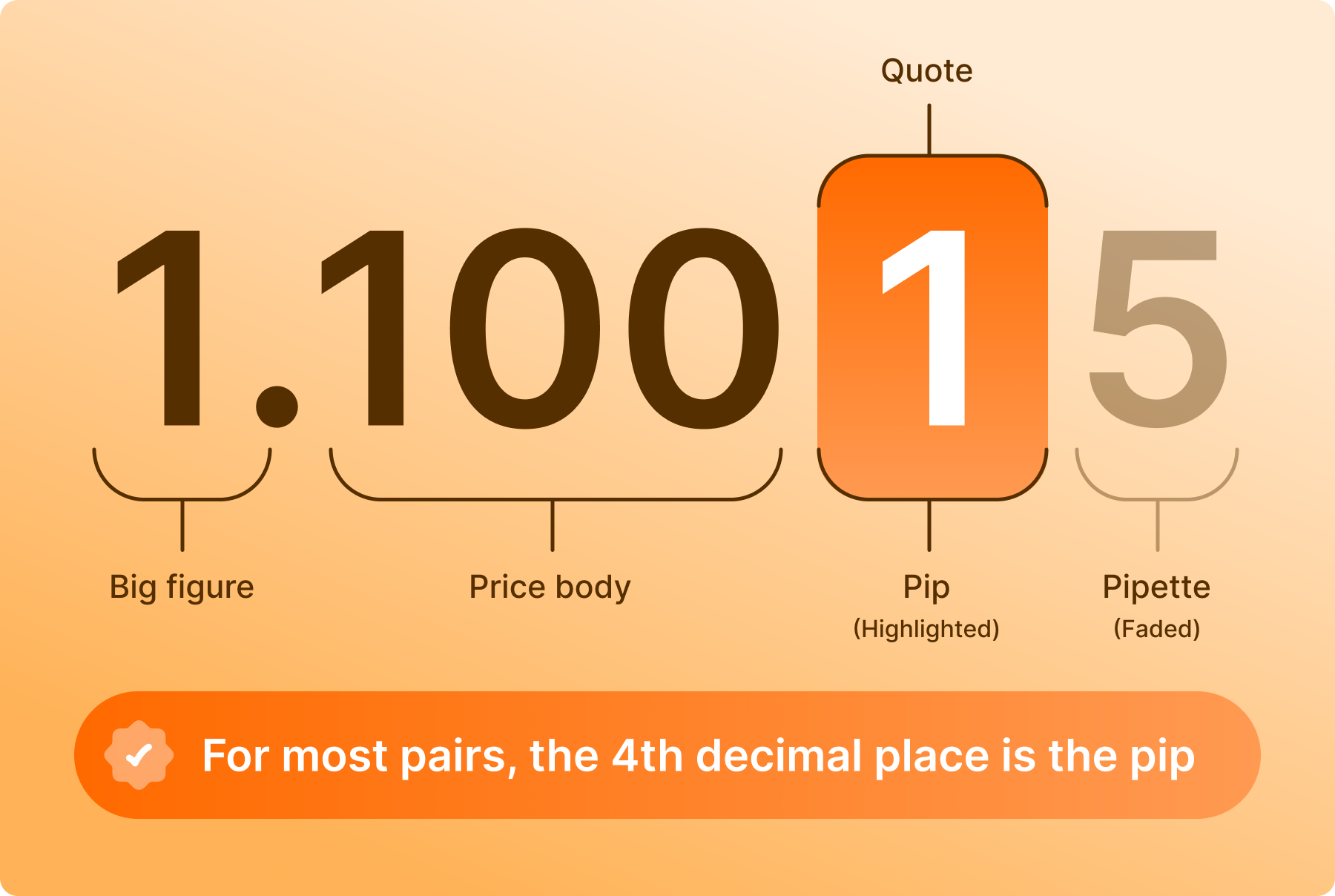
The term pip stands for “Percentage in Point” or “Price Interest Point.” It represents the smallest standard price move that a currency exchange rate can make.For most major currency pairs, such as the EUR/USD, GBP/USD, or AUD/USD, a pip is represented by the fourth decimal place ($0.0001$).
A Simple Breakdown with EUR/USD
Imagine you are looking at the EUR/USD exchange rate, and it is currently trading at 1.1000.
- A 1-pip move: If the price moves from 1.1000 to 1.1001, it has increased by 1 pip.
- A 10-pip move: If the price moves from 1.1000 to 1.1010, it has increased by 10 pips.
- A 100-pip move: If the price moves from 1.1000 to 1.1100, it has increased by 100 pips (also known as a “Big Figure”).
While it might seem like a tiny change, when you are trading thousands of units of currency, these fourth-decimal shifts add up to significant sums of money.
Why Do Forex Traders Use Pips Instead of Dollars?
You might wonder why we don’t just say, “The Euro went up by half a cent.” While that makes sense in a grocery store, the global forex market moves trillions of dollars every day, and it needs a much more precise and universal way to measure value.
1. Standardization Across the Globe
Forex is a global market. Traders in London, Tokyo, and New York need to speak the same language. Currency pairs involve different values — some are worth $1.10$, while others are worth $150.00$. Measuring moves in pips provides a universal metric that works regardless of the specific exchange rate.
2. Extreme Precision
In the world of international finance, a move of half a cent is actually quite large. Most of the action happens in much smaller increments. Dollars and cents are simply too “clunky” for the level of accuracy required. By using the fourth decimal place, traders can pinpoint exact entry and exit levels.
3. Measuring Volatility
It is much more efficient to say, “The GBP/USD moved 80 pips today,” than to say, “The exchange rate changed by $0.0080$.” It gives you an instant, intuitive sense of how active the market is. If a pair usually moves 100 pips a day and it has only moved 10, you know the market is quiet.
Enter the “Pipette”: The Fractional Pip
As technology improved and trading became more electronic, brokers wanted to offer even more competitive pricing. This led to the introduction of the pipette, which is essentially a “fractional pip.”
A pipette is the fifth decimal place ($0.00001$) in a currency quote. It represents $1/10$th of a pip. If you see five digits after the decimal point on your trading platform (MT4, MT5, or cTrader), that last, smaller digit is the pipette.
- Example: If EUR/USD moves from 1.10005 to 1.10006, that is a move of 1 pipette.
- The Ratio: It takes 10 pipettes to make a single pip.
Most traders still focus on the fourth digit (the pip) for their strategy, but pipettes allow for “tighter spreads,” meaning it’s slightly cheaper for you to enter and exit trades.
How Much Is 1 Pip Worth?
This is where the theory actually hits your bank account. The “value” of a pip — the actual cash you make or lose — isn’t a fixed number. If you make 10 pips, it doesn’t always mean you made $10.
The value of a pip changes based on three critical factors:
- Lot Size: How much currency you are actually “buying” or “selling.”
- The Currency Pair: Whether the USD is the “base” or “quote” currency.
- The Exchange Rate: The current price of the pair.
Pip Value Based on Lot Size
In forex, we don’t trade “one dollar” at a time; we trade in “lots.” Here is a breakdown of what 1 pip is worth for the EUR/USD (and most pairs where the USD is the second currency listed):
| Lot Size | Units of Currency | Pip Value (USD) |
| Standard Lot | 100,000 | $10.00 |
| Mini Lot | 10,000 | $1.00 |
| Micro Lot | 1,000 | $0.10 |
This is the most important table for a beginner to memorize. If you are trading 1 Micro Lot, every pip is worth 10 cents. If you make 50 pips, you’ve made $5. If you are trading 1 Standard Lot, those same 50 pips are worth $500.
How to Calculate Pip Value Step-by-Step
When the USD is the second currency in a pair (like EUR/USD or GBP/USD), the math is easy because the pip value is “fixed” at $10, $1, or $0.10.
However, when you trade pairs like USD/CHF or USD/CAD, the pip value fluctuates slightly along with the exchange rate. You can use this simple formula to figure it out:
Pip Value = (One Pip/Exchange Rate) * Lot Size
A Real-World Calculation Example
Let’s say you are trading USD/CHF at an exchange rate of 0.9000 using a Mini Lot (10,000 units).
- Identify the Pip: $0.0001$
- Divide by Exchange Rate: $0.0001 / 0.9000 = 0.00011111$
- Multiply by Lot Size: $0.00011111 * 10,000 = $1.11$
In this specific trade, every pip move is worth $1.11. While your trading platform will do this math for you instantly, knowing the “why” prevents you from being surprised when a “volatile” pair has a higher pip value than you expected.
The JPY Exception: Why Yen Pairs Are Different
The Japanese Yen (JPY) is the “odd one out” in the major currency world. Because a single Yen is worth so much less than a Dollar or a Euro, the fourth-decimal rule doesn’t work. For JPY pairs, a pip is located at the second decimal place ($0.01$).
- Standard Pair (EUR/USD): 1.1001 (4th decimal)
- Yen Pair (USD/JPY): 150.01 (2nd decimal)
Example of a JPY Move:
If USD/JPY is trading at 150.00 and moves up to 150.01, that is a 1-pip move. If it moves to 151.00, that is a 100-pip move.
The pipette in JPY pairs is the third decimal place ($0.001$).
How Pips Determine Your Profit and Loss
Let’s look at how pips play out in a real trade. This is exactly how you should be thinking before you ever hit “Buy” or “Sell.”
The Setup:
- Action: You believe the British Pound is going to get stronger against the US Dollar.
- Trade: You buy GBP/USD at 1.2500.
- Position Size: 3 Micro Lots (3,000 units).
- Pip Value: $0.30$ ($0.10 * 3$).
The Two Outcomes:
- The Win: The price rallies to 1.2560. You have made 60 pips.
- Math: $60 pips * $0.30 = $18.00 Profit.
- The Loss: The price drops to 1.2470. You have lost 30 pips.
- Math: $30 * $0.30 = $9.00 Loss.
By knowing your pip value and your “stop loss” distance in pips, you can calculate your exact dollar risk before the trade even starts.
Why Understanding Pips Is the Key to Risk Management
Professional trading isn’t about “guessing” which way the price will go; it’s about managing risk. The most successful traders in the world use pips to calculate their “Position Size.”
Most pros follow the 1% Rule: never risk more than 1% of your total account on a single trade.
The Math of Professional Risk Management:
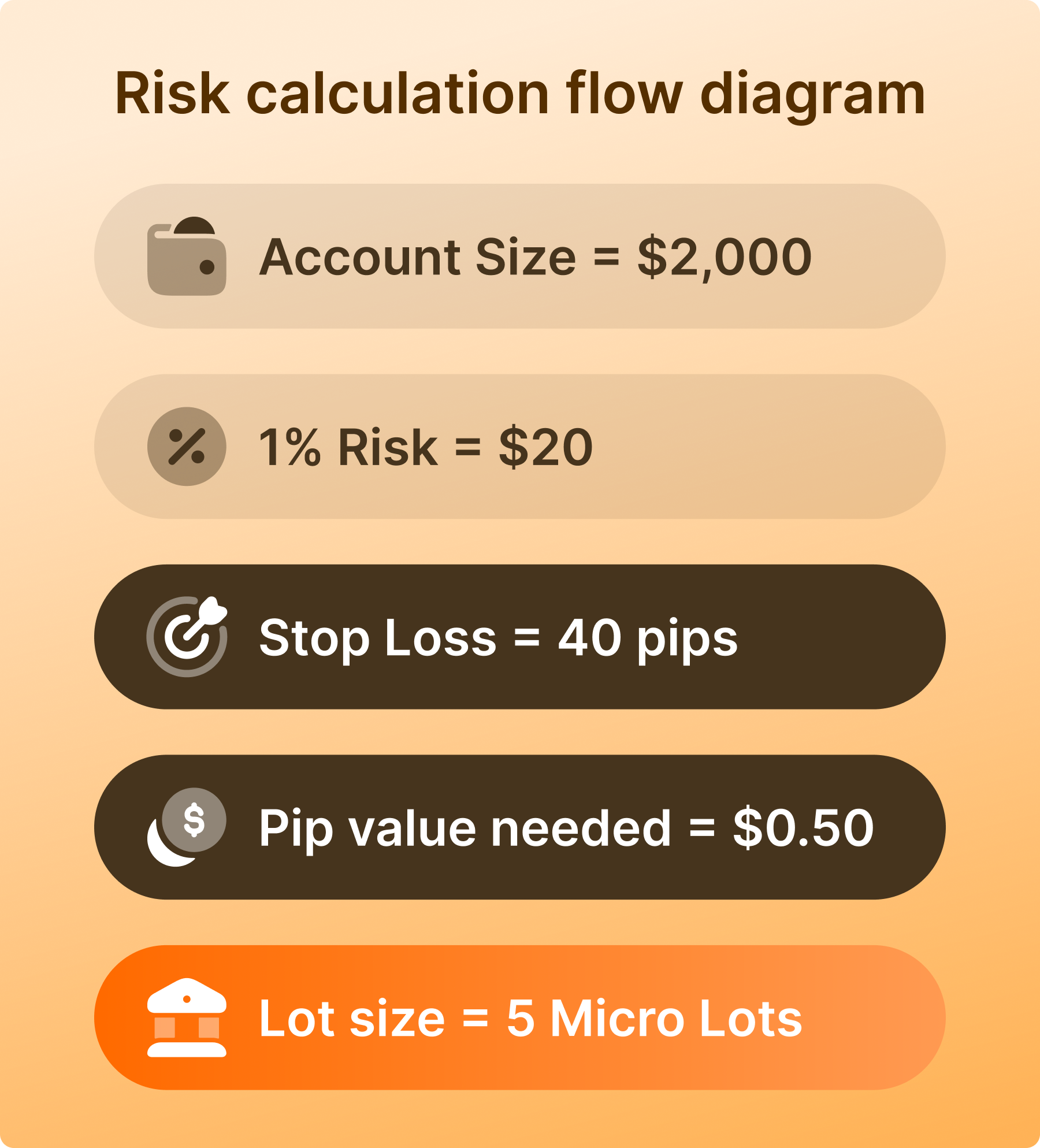
- Your Account Balance: $2,000
- Your Risk (1%): $20
- Your Strategy: You see a setup where your “Stop Loss” needs to be 40 pips away to be safe.
If you are only allowed to lose $20, and the distance is 40 pips, you need a pip value of $0.50 ($20 / 40$). This tells you exactly what lot size to use: 5 Micro Lots.
If you didn’t understand pips, you might have just guessed and opened a Standard Lot. In that case, a 40-pip move would have cost you $400 — wiping out 20% of your account instead of the 1% you intended. Pips turn gambling into math.
Avoiding the Traps: Common Beginner Blunders
When you are new to the charts, it is incredibly easy to make a mistake that feels small but costs you a lot of money. Here are the most frequent ways new traders mess up their pips:
1. The “Pip vs. Pipette” Confusion
Most brokers show five decimals. A new trader sees the price move from 1.10000 to 1.10050 and thinks, “Wow, I just banked 50 pips!” Wait. That last digit is a pipette. You actually only made 5 pips. If you base your risk on thinking you’re moving 50 pips when you’re only moving 5, your entire strategy will be backwards.
The Pro Rule: Mentally “blur out” the tiny 5th digit. The 4th digit is the only one that truly matters for your pip count.
2. Generalizing Pip Value
A dangerous trap is assuming 10 pips always equals the same dollar amount.
10 pips on a Standard Lot is $100.
10 pips on a Micro Lot is $1.
If you accidentally open a Standard Lot because you didn’t check your platform settings, a tiny 10-pip “market wiggle” that should have cost you a dollar will suddenly wipe out $100. This is how accounts are “blown” in seconds.
3. Entering a Trade “Blind”
Never, ever enter a trade until you know exactly how much each pip is going to cost you in your local currency.
Before you enter, ask yourself: “If my Stop Loss is 25 pips away, how many Dollars am I actually losing?” If you can’t answer that in two seconds, you haven’t done your risk management. You are just rolling the dice.
Pip vs. Point: Don’t Get Confused
If you start trading other things — like Gold, Oil, or the S&P 500 — you will hear the word “Point.” Beginners often use these terms interchangeably, but they are different.
- Pip (Forex): Specifically for currency pairs ($0.0001$ or $0.01$).
- Point (Indices/Stocks): Used for things like the US30 or Nasdaq. A point is the smallest price change on the left side of the decimal ($1.00$).
Note: Some brokers call “pipettes” (the 5th decimal) “points.” This is why it is vital to read your broker’s “contract specifications.” If they say the spread is “10 points,” they usually mean 1 pip.
A Full Trade Walkthrough: Putting It All Together
Let’s walk through a complete, professional-style trade setup so you can see pips in action.
- The Opportunity: You notice that the GBP/USD has hit a strong support level at 1.2500.
- The Plan: You decide to “Buy” at 1.2510 because you think the price will go up.
- The Safety Net: You place your “Stop Loss” at 1.2480.
- Distance: $1.2510 – 1.2480 = 30 pips.
- The Budget: You have a $1,000 account and only want to risk $10 (1%).
- The Size: Since $10 / 30 pips = $0.33$ per pip, you open 3 Micro Lots (Value: 0.30/pip).
- The Target: You set your “Take Profit” at 1.2570 (+60 pips).
- The Execution: The market rallies as you expected. It hits your target.
- The Win: $60 * $0.30 = $18.00 Profit.
In this scenario, you risked $9 to make $18. That is a professional, calculated trade, all made possible because you understood pips.
Understanding pips is like learning the alphabet. It might feel a bit tedious at first, but once you know it, you’ll never have to think about it again — you’ll just “read” the market.
Every successful trader started where you are right now. By taking the time to master the math of pips, you have already put yourself ahead of the 90% of beginners who dive into trading without a plan.