



Exotic options are extremely specialized financial contracts that differ from standard options, like plain vanilla options, in terms of agreements, features, or payoff structures. They are mostly traded over-the-counter (OTC) between financial institutions and made for specific, complex investment or hedging strategies. Even though they give players more flexibility to speculate, they present greater risks and may yield greater rewards.
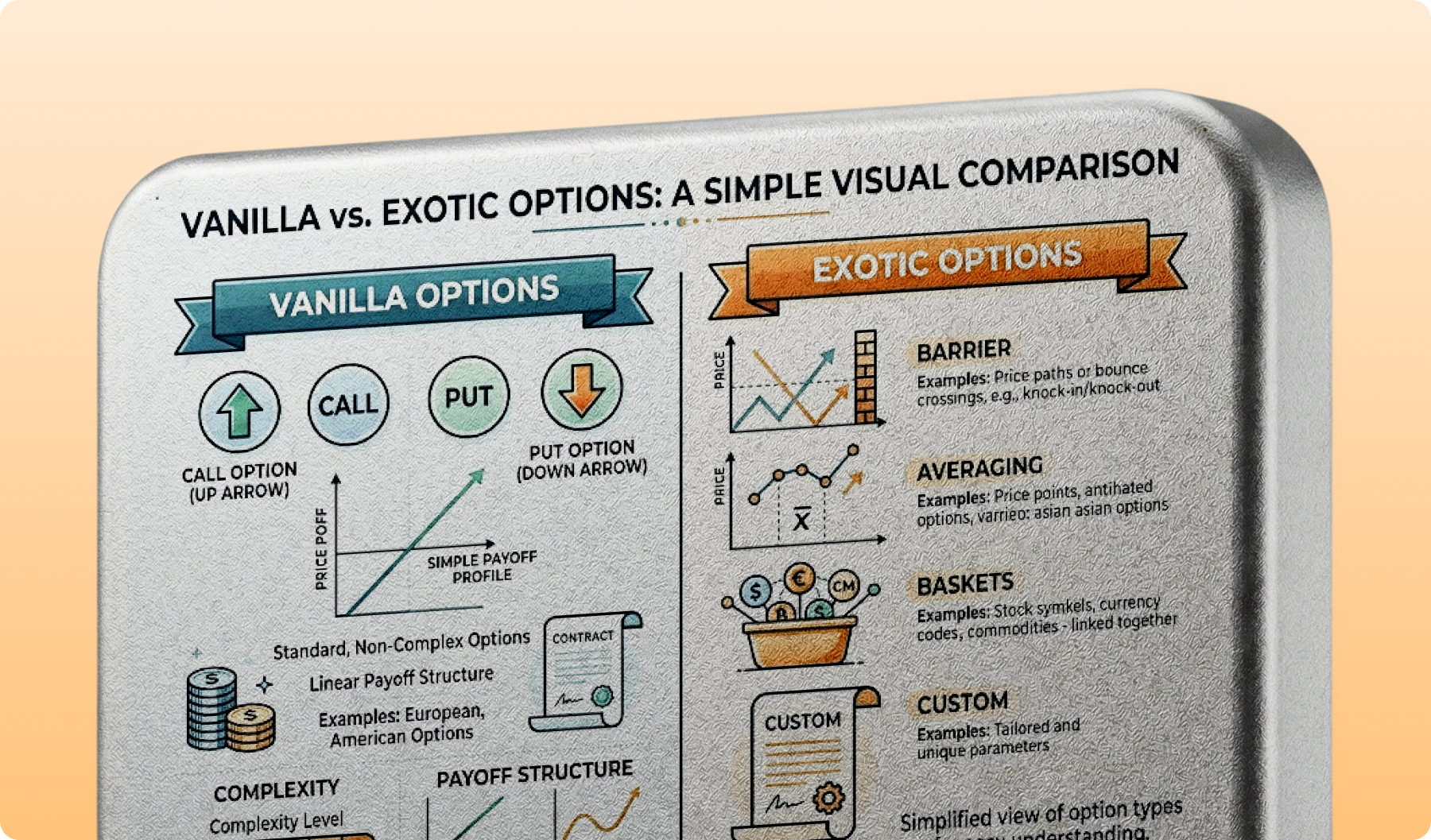
It is, therefore, essential to understand the concept of exotic options and develop a profitable system before investing large sums of money. This article defines exotic options, explains how they differ from traditional options, and examines the different types of exotic options that are traded. Regardless of your level of trading experience, you will also learn about the characteristics, operation, and potential benefits of exotic options.
Key Features of Exotic Options
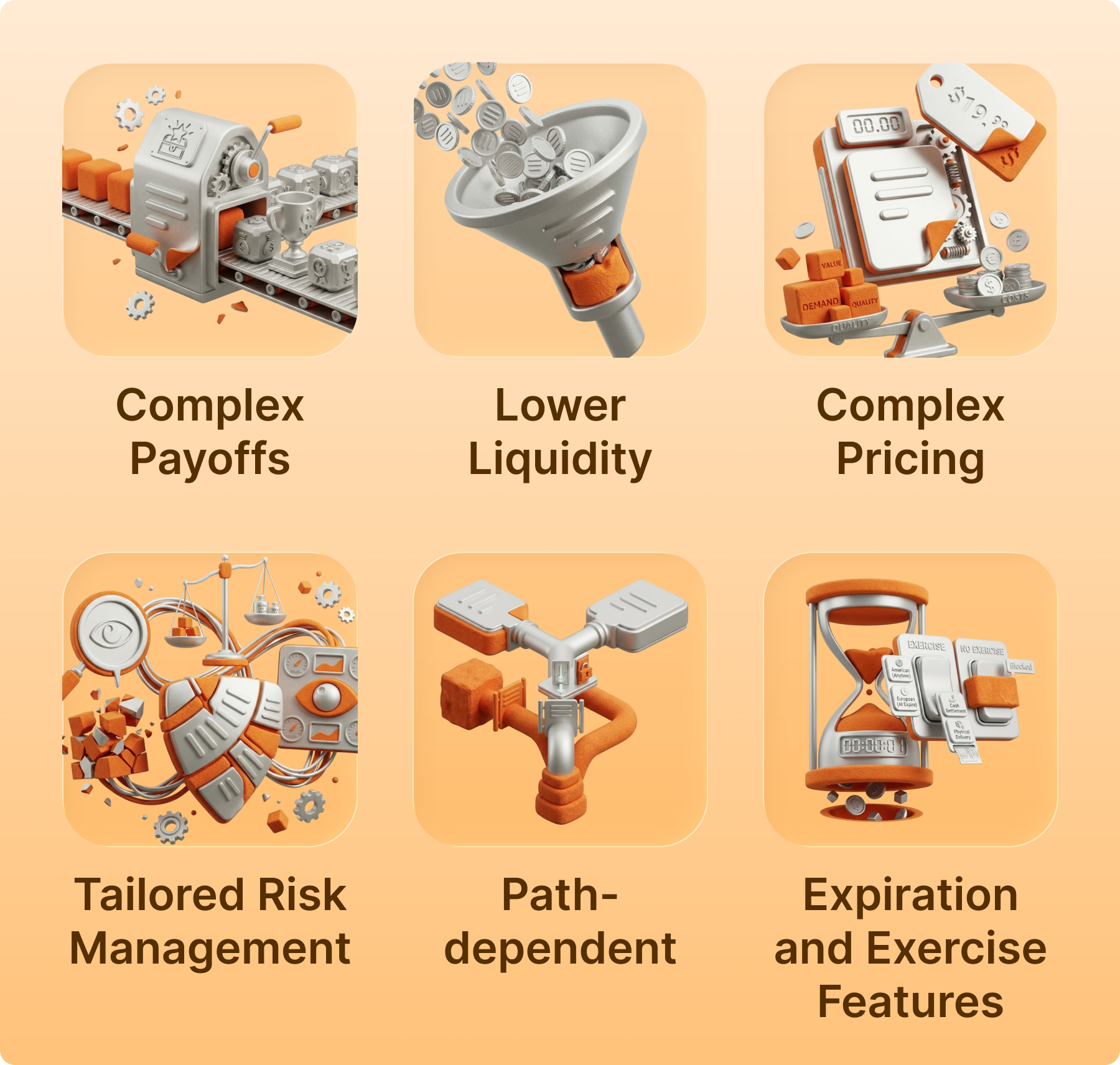
As previously mentioned, exotic options are more complicated with customizable features than vanilla options. Highlighted below are the key features that set exotic options apart:
Complex Payoffs
The payoff structures of exotic options are usually not simple. For instance, the payout might be dependent on a number of variables, such as the underlying asset’s price hitting specific thresholds or the option’s performance being averaged over time. Therefore, the payout mechanisms can be based on average prices (Asian options), price barriers (barrier options), or the performance of multiple assets (basket options).
Lower Liquidity
Since most exotic options are customized and traded over the counter (OTC), they are less traded. Hence, lower liquidity as compared to standard options. As a result of this, they have wider bid-ask spreads, making them more challenging to trade.
Complex Pricing
Exotic options require advanced mathematical models for valuation due to their non-standard nature. Such advanced models include Numerical techniques, finite difference methods, or Monte Carlo simulations, and can lead to model risk, where pricing uncertainty arises from their complexity.
Tailored Risk Management
Traders who require highly specialized risk-management tools are drawn to exotic options. This is because these options can protect against certain market conditions, atypical volatility patterns, or specific price movements due to their distinctive features. To put it briefly, exotic options enable investors to customize their approach to match their level of risk tolerance or market outlook precisely.
Path-dependent
Because exotic options are path-dependent, the historical path of the underlying asset dictates the option’s value. For instance, a lookback option takes into account the asset’s highest or lowest price over a specific time frame. Compared to standard options, these path-dependent features add another level of complexity.
Expiration and Exercise Features
Exotic options frequently have unusual exercise regulations or non-standard expiration dates. Some have a European style with special requirements for early exercise, while others have a Bermudan style, which means you can only work out at predetermined intervals before they expire. Although these new features increase traders’ flexibility, they also necessitate thorough research before using them.
How Do Exotic Options Work?
Understanding how exotic option works before committing any capital is quite important. This is to ensure that you familiarize yourself with the risks involved and build a profitable system around it.
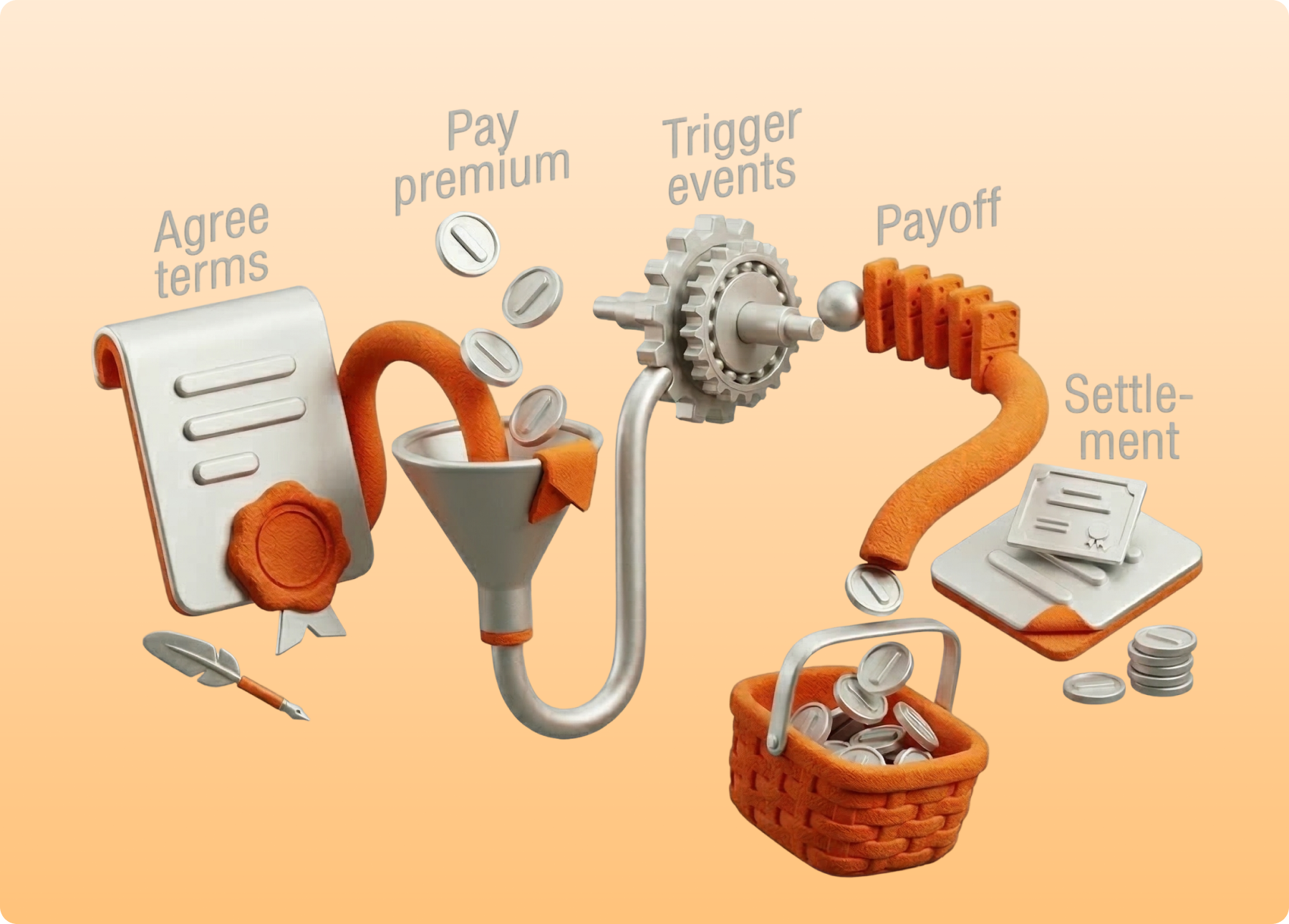
To trade an exotic option, you must agree with a second party on the terms, just like a regular option. The underlying asset, strike price, expiration, and any other special conditions or triggers that might apply are what you agree on. The buyer then pays a premium to the seller for the right to exercise the option under those agreed conditions.
However, certain events, like the price of the underlying asset hitting a predetermined level, may be triggered by the conditions during the option’s life. This implies that variables such as the price at expiration, average price over time, or even the direction of the price can affect the payout.
At expiration, or earlier in some cases, the payoff is calculated based on whether the option’s terms were met. For instance, the payoff might depend on whether a barrier was breached or if the asset’s average price exceeded the strike price. After that, depending on the terms of the agreement, the buyer can either accept the payout or exercise the option. The settlement may involve a cash settlement or a physical delivery of the asset, depending on the kind of exotic option.
What are the Differences Between Exotic and Traditional Options?
To really understand how exotic options differ from traditional options, it helps to compare them side by side. Here’s a quick breakdown of the key differences:
| Traditional Options | Exotic Options |
| Traditional options are simple and standardized with fixed strike prices, expirations, and contract sizes. | Exotic options are customizable with unique features such as barriers, averaging, adjustable quantities, or special triggers. |
| Payoff depends mainly on whether the asset price is above or below the strike at expiration. | The primary determinant of payout is whether the asset price is above or below the strike at expiration. |
| High liquidity, as they are widely traded on major exchanges. | Lower liquidity as they are often traded over-the-counter (OTC). |
| They are simple to price and comprehend, therefore, beginner-friendly. | They have more complex pricing models that are better suited for advanced or professional traders. |
| Exercise is typically American or European style. | Exercise rules can be Bermudan or include specially designed early-exercise conditions. |
| Ideal for simple speculative and hedging techniques. | Ideal for targeted risk management, customized hedging, or taking advantage of specific market scenarios. |
Types of Exotic Options Explained
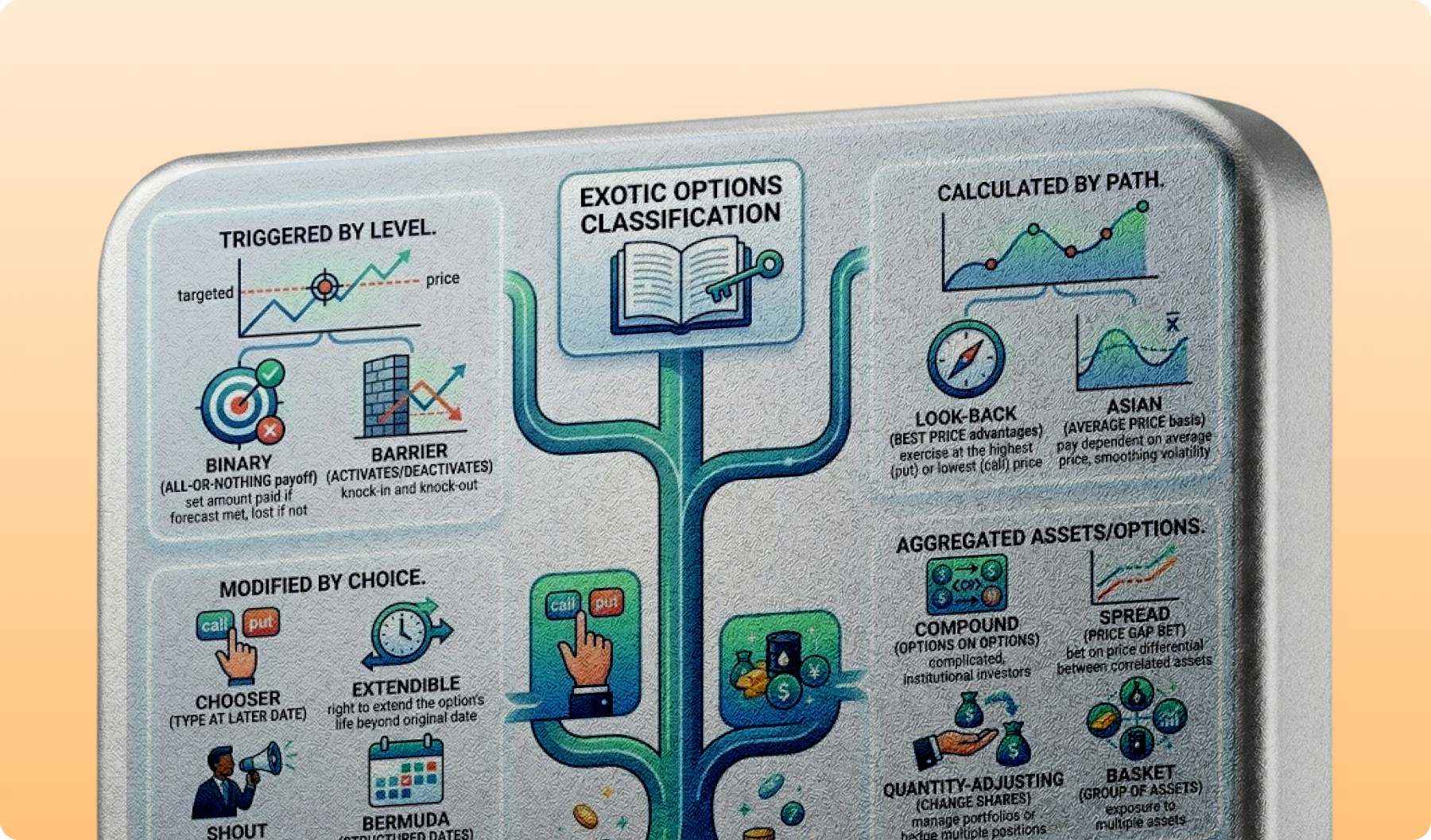
There are many different types of exotic options, and each has special qualities that suit different traders and trading styles. Some of the most popular categories of exotic options are listed below:
Binary Options
Binary options are a type of exotic option with a simple all-or-nothing payoff. The trader predicts whether an asset will reach a specific price level by a certain time.
For instance, a trader may forecast that at 3 PM, the price of gold will surpass $2,000. The trader is paid a set amount if the price is, in fact, higher than that threshold. The trader loses the entire investment, though, if the price does not match the forecast. Because of this, binary options are very speculative and have simple possible outcomes.
If how binary options trading works appeals to you, go through these Hacks That Will Save Your Time And Money before investing your hard-earned money.
Bermuda Options
The hybrid structure of Bermuda options offers a balance between the flexibility of American options and the fixed exercise dates of European options. This gives the holder more control than European options but more restrictions than American options.
Specifically, a Bermuda option may allow the holder to exercise the option on the first day of each month leading up to the expiration date. This provides some flexibility, but within a structured timeframe.
Quantity-Adjusting Options
These give traders the ability to change the amount of the underlying asset after the option is exercised. They are typically used to manage large portfolios or hedge multiple positions.
If you purchase a quantity-adjusting option, the number of shares you are entitled to may change based on changes in the asset’s price over the course of the option. Because of its adaptability, traders can modify their exposure to the asset in response to shifting market conditions. Therefore, it is a valuable tool for dynamic risk management.
Look-Back Options
Instead of exercising at a set strike price, look-back options let you take advantage of the best price during the option’s life. This implies that you will profit from the best price available for the duration of the option. They are invaluable for speculating or hedging in volatile markets, allowing you to lock in the best market conditions.
If the price of the underlying asset changes over the course of the option’s life, for instance, you may decide to exercise the option when the price is at its highest (for a put option) or lowest (for a call option).
Chooser Options
You can choose whether to exercise a call or put option at a later time with a chooser option. The buyer typically selects the option type at a predefined point in time before expiration, providing flexibility in response to changes in the market.
Depending on the state of the market, a trader may be able to use a chooser option to determine whether to purchase or sell the underlying asset. But whether it’s a put or a call, the strike price and the expiration are typically the same.
Compound Options
Compound options are options on options. You are purchasing the right to buy or sell another option at a particular price at a later time. Institutional investors frequently use these, and they are more complicated. Call on call, call on put, put on put, and put on call are the four main categories.
Barrier Options
Options known as “barrier options” only activate (or “knock in“) when the price of the underlying asset hits a specific threshold. Some barrier options, on the other hand, “knock out” when the asset price hits a specific threshold.
A knock-in barrier option, for instance, only activates when the asset price rises above a predetermined level. In contrast, a knock-out option loses all of its value if the price rises above a predetermined threshold. The four types of barrier options include up-and-out, down-and-out, up-and-in, and down-and-in.
Asian Options
Asian options are a good option in volatile markets because they are based on the average price of the underlying asset over a given period of time rather than the price at a single point in time.
For instance, the payoff of an Asian option is determined by the average price of the asset during its life, which helps smooth out any extreme volatility or short-term price spikes.
Spread Options
Spread options allow you to place a bet on the price differential between two related assets, like stocks, commodities, or other financial instruments. Instead of placing bets on the direction of the price of a single asset, traders can use these options to profit from relative price movements between correlated assets.
How the price differential between the two assets evolves will determine the payout. The trader can profit from the change in the spread if the expected widening or narrowing of the price gap between the stocks occurs.
Shout Options
If you are a holder of a shout option, you can lock in profit at any time during the option’s duration. The trader can “shout” to lock in the best price they’ve seen thus far at any point before expiration, making sure they don’t lose out on advantageous market conditions.
Basket Options
Basket options derive their value from a collection of different assets, rather than a single underlying asset. This enables traders to speculate on the combined performance of several assets or hedge against them.
For instance, they might be based on an index or sector of stocks, with the payout dependent on the group’s overall performance rather than any one asset. Because they offer exposure to a variety of assets, these options are frequently used in diversified strategies to spread risk and lessen the impact of changes in the prices of individual assets.
Extendible Options
Extendible options give the buyer the right to extend the option’s life beyond its original expiration date. This allows the trader to wait for more favorable market conditions before exercising the option.
The trader can decide to extend the option’s expiration date, for instance, if the price of the underlying asset hasn’t reached a favorable level by the date of expiration. This will give the asset price more time to move in a favorable direction.
Range Options
Range options provide a payoff if the price of the underlying asset remains within a specified range during the life of the option. Traders who expect the asset to remain within specific bounds and speculate on price stability use these options.
A range option might pay out if the asset’s price remains between $100 and $120 over the following three months. The option loses all of its value if the price moves outside of this range.
Why Should You Trade Exotic Options?
Exotic options are not for everyone, but they can offer several advantages to seasoned traders. Below are some of the reasons you should consider trading exotic options:
- Greater Flexibility: Because they are customizable, exotic options allow you to tailor your positions to specific market views or risk profiles. Moreover, they offer varied payoff options and triggers that will enable you to match your specific market view or risk tolerance.
- Higher Reward Potential: Because of their complexity, exotic options can provide higher returns compared to traditional options. However, you must first attain an expert skill level to reap such high rewards.
- Hedging Opportunities: Exotic options allow you to hedge your positions by offsetting the loss on one asset with a correlating one. Moreover, when dealing with large portfolios or an uncertain market, they can be a perfect tool to manage your risk. For instance, if your business is exposed to multiple currencies, you can effectively hedge your total foreign exchange risk by using a basket option.
- Diversification: With exotic options, you can diversify your trading strategies by using instruments that have unique payoff structures. The underlying assets for exotic options can extend beyond traditional stocks and indices to include commodities (oil, corn), foreign currencies, bonds, and even non-financial metrics like weather patterns.
However, the complexity and higher risk associated with exotic options mean they should only be used by traders with a deep understanding of financial markets.
Conclusion
Experienced traders can benefit significantly from exotic options’ special flexibility and customized risk management techniques. This is because they give them the ability to target particular market conditions and protect themselves against a variety of risks. Through path-dependency, variable strike prices, or diversified asset baskets, they also present opportunities for higher profits.
However, they have complicated pricing models and lower liquidity, which makes them extremely risky. Therefore, it is advisable that, as a trader, you conduct thorough research and build a profitable system around it. Start with a small capital, then scale later to avoid being frustrated while trying to figure things out.