


How to Use AI in Trading (Step-by-Step Guide)
AI becomes truly useful when applied with a clear, structured approach. Here are the most practical ways traders use AI today and how you can start immediately:
- Choose a platform that supports AI tools – Select a trading environment compatible with AI bots, automation and integrations (MetaTrader, AlgoTrader, Trade Ideas, Kavout and others). Many modern platforms now include built-in pattern recognition, volatility forecasting or macro-sentiment modules.
- Start with simple AI tools (signals, sentiment, scanners) – Before you try automation, begin with low-risk AI assistants such as pattern detectors, news sentiment scores, correlation analysis, volatility heatmaps or trend scanners. They help you understand how AI interprets the market.
- Test everything on a demo first – Use demo mode for 2–4 weeks to observe how signals behave in different market conditions. Track accuracy, false alerts, reaction time and performance during high-volatility events.
- Set your strategy and risk rules before automation – AI needs clear instructions about risk per trade,position sizing, entry/exit logic and stop-loss / take-profit.
- Use AI for research and analysis – AI can process chart data, read news, analyse volatility, detect correlations and evaluate macroeconomic releases or earnings transcripts. Advanced systems even incorporate alternative datasets like social sentiment or order-book microstructure.
- Automate repetitive tasks – Let AI handle the setups that require strict discipline such as breakouts or grid-based systems. Leave discretionary, creative or intuition-based trades to yourself.
- Monitor, evaluate and adjust continuously – Review hit rate, average win/loss, drawdown, slippage.
- Avoid black-box tools you don’t understand – Do not trust systems that promise guaranteed accuracy or hide their strategy. A safe tool must offer: full transparency, editable settings, demo mode and execution logs.
Recommended AI Trading Tools (Practical List)
Here are popular and beginner-friendly AI tools traders actually use:
| Stock Market Analysis & Signals | No-Code & Multi-Asset Trading | AI Bots & Automation | Quantitative & Developer Platforms |
| Trade Ideas | Capitalise.ai | 3Commas AI Bot Framework | QuantConnect |
| TrendSpider AI Pattern Recognition | Composer | Pionex Built-In AI Grid Bot | MetaTrader 5 (MT5) |
| Kavout Kai Score | Tickeron | Coinrule | Alpaca API |
What AI in Trading Actually Means
AI in trading is the use of advanced computational models that can analyze data, learn from patterns and assist in making trading decisions. These models do not rely on simple rules. They learn by observing historical information, testing outcomes and adjusting themselves as new data appears.
The most important thing to understand is that AI does not guess and it does not rely on emotion. It processes numbers, patterns, language and probabilities. A trader can only look at a few charts at once. AI can scan hundreds of markets in seconds.
AI in trading usually involves these core components:
- Machine learning – Machine learning models discover patterns in historical price movements and try to understand how those movements behave in future scenarios. They adjust and improve based on new data.
- Natural language processing – NLP tools read and analyze news, speeches, financial reports and even social media sentiment. They extract meaning from text and convert it into signals that show how the market might react.
- Reinforcement learning – These AI systems learn through trial and error. They simulate many market situations, observe what works and optimize their strategy.
- Automated action – AI tools can execute trades automatically under specific conditions. They follow rules that the trader sets and react faster than any human.
In essence, AI is a decision support and execution technology. It helps traders avoid emotional mistakes and gives brokers an advanced system for analyzing client activity, managing liquidity and maintaining smarter risk tools.
Types of AI Used in Trading
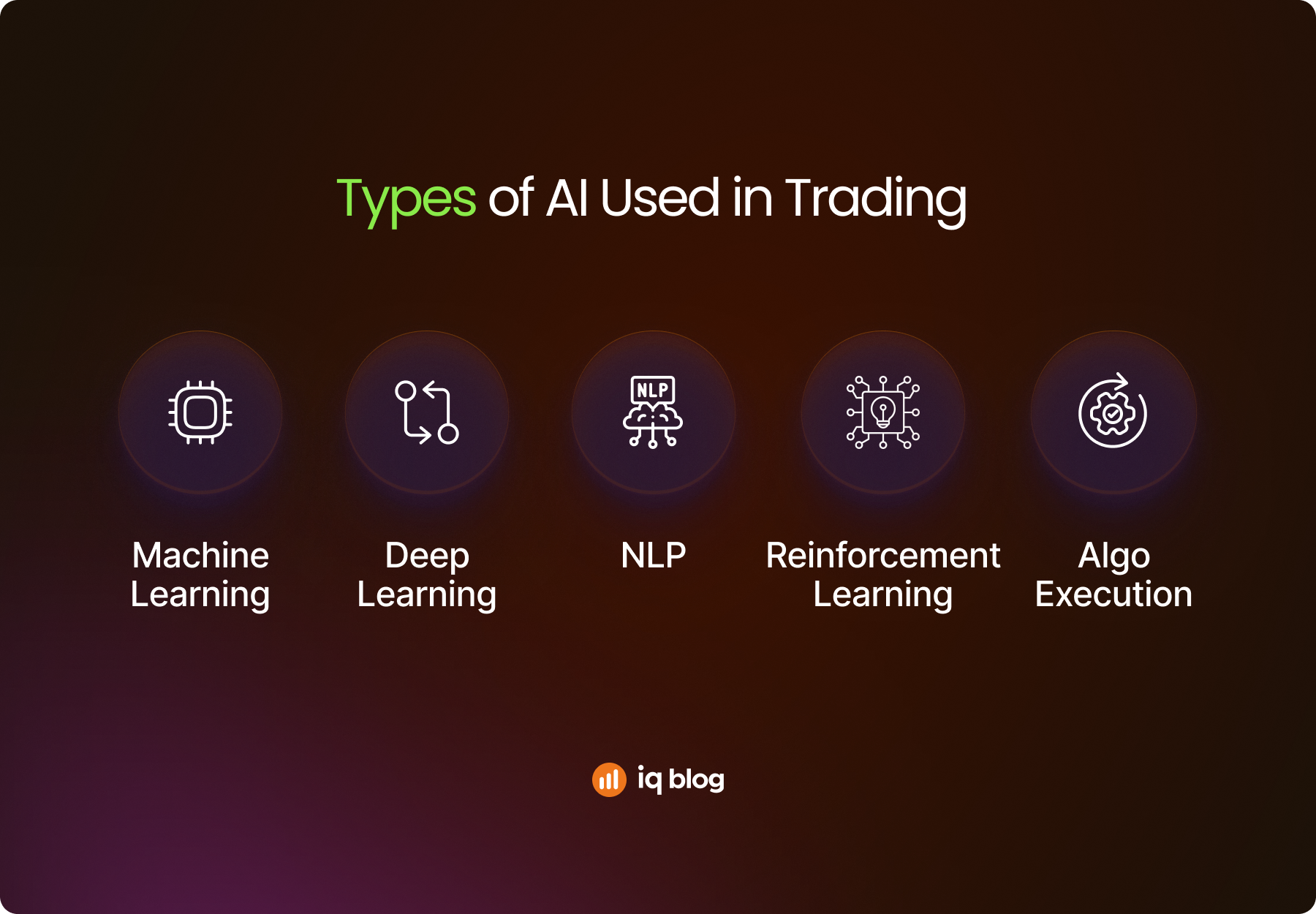
Automated trading bots combine several of these AI components into a single system. They analyse markets, evaluate signals and place trades according to the rules you set. You create the logic, the bot handles the repetitive work.
- Machine Learning: Detects repetitive behaviour
- Deep Learning: Recognises complex and hidden patterns
- NLP: Measures sentiment and interprets language
- Reinforcement Learning: Learns from feedback and improves over time
- Algo Execution: Optimises order placement
- Automation Bots: Apply rules automatically and consistently
Benefits of AI Trading
AI brings several advantages that directly improve trading performance and execution. These benefits are practical, measurable and felt immediately once traders start using AI tools.
- Higher accuracy – Models learn from large datasets and refine themselves over time, often spotting signals traditional analysis would miss.
- Speed that captures opportunities – AI reacts in milliseconds which helps traders enter or exit positions before short-lived setups disappear.
- Scalability – One system can support a single account or thousands without losing consistency or speed.
- Powerful backtesting – AI can run strategies across decades of historical data within minutes. This helps traders refine their edge before putting money at risk.
- Emotion-free decision making
AI follows logic, not fear or excitement. This reduces the emotional mistakes that cause most trading losses.
Independent research, including studies from the CFA Institute, shows that machine learning improves investment decision making when applied with proper risk controls and real-world context.
Common Mistakes Beginners Make with AI Trading
Even though AI makes trading faster and more consistent, beginners often make predictable mistakes. Avoiding these early on will save time, money and frustration.
- Relying entirely on AI bots – AI is a tool, not a strategy. Traders who let bots run without supervision usually face unexpected losses.
- Believing in “100% accurate” systems –
- No AI model can predict markets perfectly. Any platform offering guaranteed returns is either misleading or outright fraudulent.
- Not understanding the rules behind the bot – Black-box systems give signals without explaining why. This makes risk management very difficult.
- Skipping demo testing – Running AI directly on live capital without demo testing is one of the most common reasons beginners lose money.
- Ignoring risk controls – AI can execute trades quickly, but if risk limits are not set properly, the system may overtrade or compound losses during volatile conditions.
- Updating nothing – AI models require regular adjustments because market conditions change. What worked last month may fail today.
- Emotional dependence on the tool – Some traders trust the bot more than their strategy. AI should support decisions, not replace judgment.
How to Evaluate an AI Trading Tool (Checklist)
| Transparency | Control & Flexibility | Data Quality | Performance & Testing | Security | Support & Documentation |
| Does the tool clearly explain its strategy? | Can you adjust risk settings (SL/TP, lot size, max drawdown)? | Does the tool use real-time data? | Can you run it on a demo for several weeks? | Is the platform reputable? | Does the platform offer tutorials or support? |
| Are the indicators or signals understandable? | Can you pause or override the bot manually? | Does it include multiple market regimes (bullish, bearish, sideways)? | Does it show performance metrics (accuracy, win rate, drawdown, slippage)? | Does it have 2FA and account protection? | Are updates released regularly? |
| Are there backtests available? | Does it allow customization? | Are alternative datasets available (news, sentiment, order flow)? | Is there a track record of past performance? | Does it avoid asking for unnecessary permissions (API withdrawal access etc.)? | Is the developer active? |
Red flags include any AI trading tool that promises guaranteed accuracy, offers no transparency about its strategy, lacks a demo mode, operates without a clear stop-loss framework or relies on unverified user reviews.
Real-World Use Cases of AI in Trading
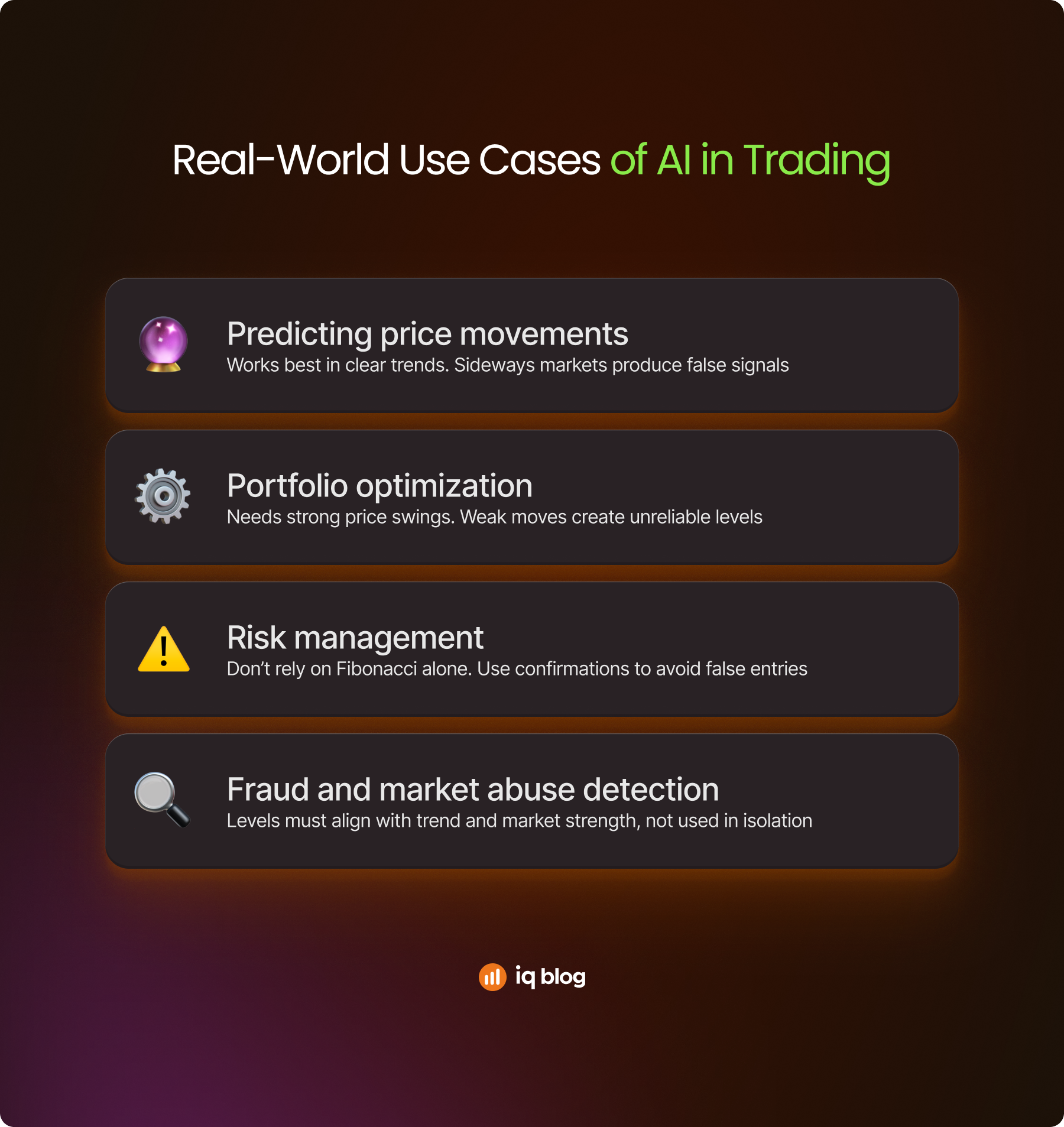
AI shows its value in real markets every single day. Traders, institutions and brokerages rely on it because it reacts fast, processes more data than any human and helps avoid emotional mistakes. Here’s where it’s used most:
- Predicting price movements – AI models analyse volume, volatility and macro signals to forecast short-term direction. Hedge funds use these insights to capture fast alpha opportunities.
- Portfolio optimization – AI evaluates correlations and risk levels, then reallocates assets dynamically so portfolios stay balanced even during unstable market conditions.
- Risk management – Machine learning powered Value at Risk models detect potential drawdowns earlier than static rule based systems.
- Fraud and market abuse detection – Banks and exchanges use AI to flag suspicious activity, unusual order flow or patterns that resemble pump and dump behaviour.
If you want a deeper look into how modern trading platforms integrate AI in their infrastructure, you can check our articles about trading platform development.
Limitations and Risks
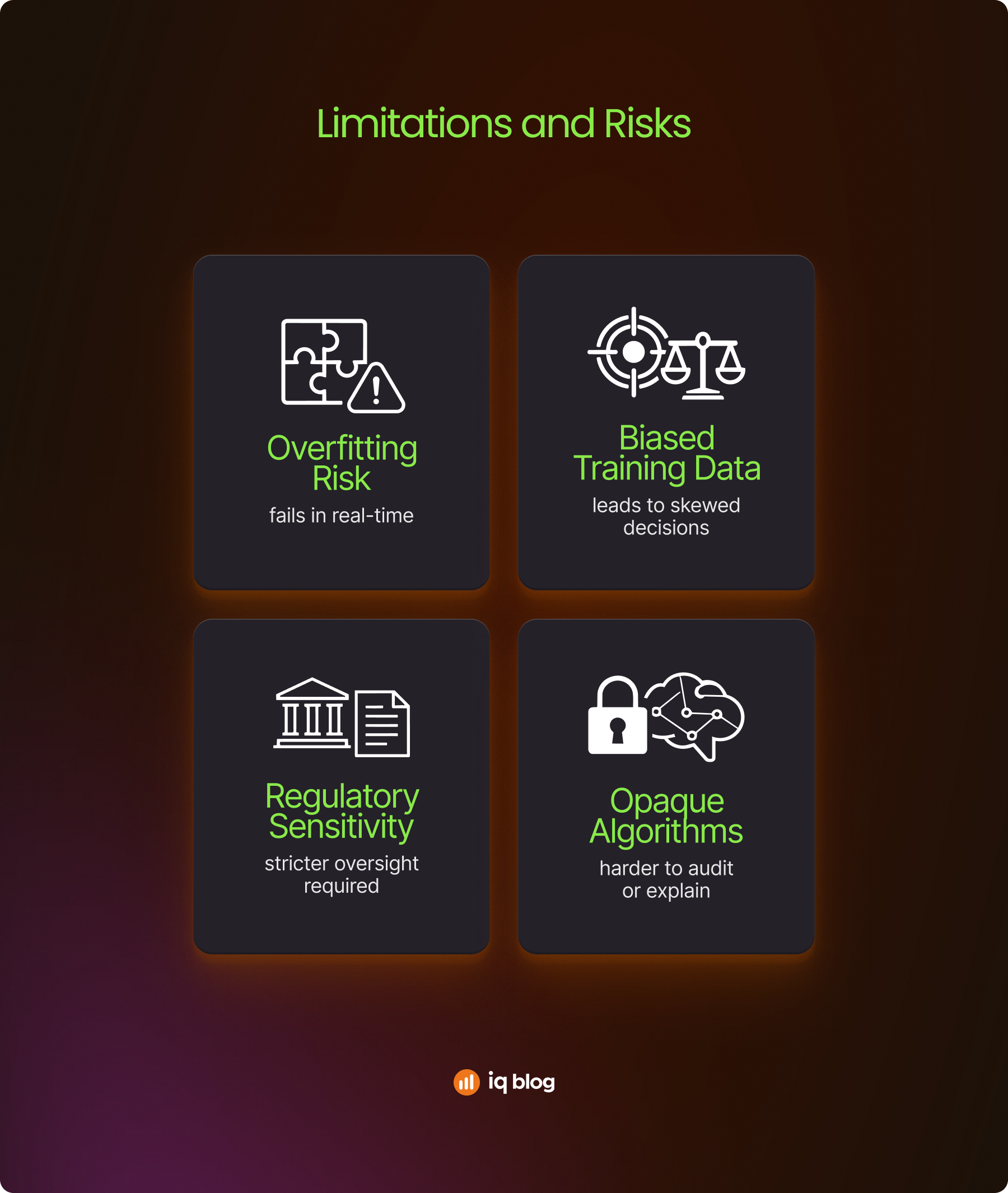
AI brings a lot of value, but it is not flawless. Models can overfit by memorizing past data without adapting to new market conditions which often leads to poor real-time performance. Bias can also appear if the training data is unbalanced, for example if it includes mostly bullish environments, which makes the system behave unpredictably when the market shifts. When the input data is weak or inconsistent the output becomes unreliable, which is why the phrase “garbage in, garbage out” is especially true in trading.
There are also broader concerns. Regulators are increasingly paying attention to AI behaviour because some rapid execution algorithms can amplify volatility, as highlighted in the Bank for International Settlements’ report on FX execution systems. Some models operate as black boxes which makes them difficult to explain to compliance teams or even to traders themselves. AI works best when it supports human decision making, not when it replaces it, so clear oversight is always necessary.
How to Start Using AI in Trading
The easiest way to begin is to use a trading platform that already includes basic AI tools like sentiment scores or simple predictive signals. Try them first in a demo or with a very small amount of capital so you can see how the system behaves. If you want more control, you can experiment with pre built bots or no code AI tools, but always rely on your own judgment rather than following every signal blindly. Start small, learn how it reacts in different market conditions and scale only when you feel confident.
Future of AI in Trading
The future of AI in trading is shaping up to be far more advanced than what we see today. AI driven portfolios may eventually adjust themselves automatically to match each trader’s goals and risk levels. Blockchain could merge with AI to create smart contracts that execute trades securely on decentralized exchanges with almost zero counterparty risk. Sentiment systems will likely move beyond text and start reading tone, facial cues or video patterns to understand market mood more accurately.
A few developments stand out already:
- Explainable AI will make complex models easier to understand, which means more trust and transparency for traders and regulators
- Quantum enhanced models could generate faster and sharper predictions by processing enormous datasets instantly
- Ethical AI standards will become a competitive advantage as highlighted by the CFA Institute, since responsible integration will separate serious platforms from the rest
AI will not replace traders, but traders who understand AI will have a clear advantage as these technologies evolve.