


Market makers are the unsung workhorses of the contemporary financial markets, ensuring that you are able to buy and sell securities when you want to. They provide liquidity by continuously quoting both buy and sell prices of financial instruments, thereby enabling trading for anyone, ranging from day traders to institutional investors.
Understanding how market makers function makes you a superior trader. You will know why there is a spread, how your order is completed, and what happens in the background when you click “buy” or “sell.”
Who is a Market Maker?
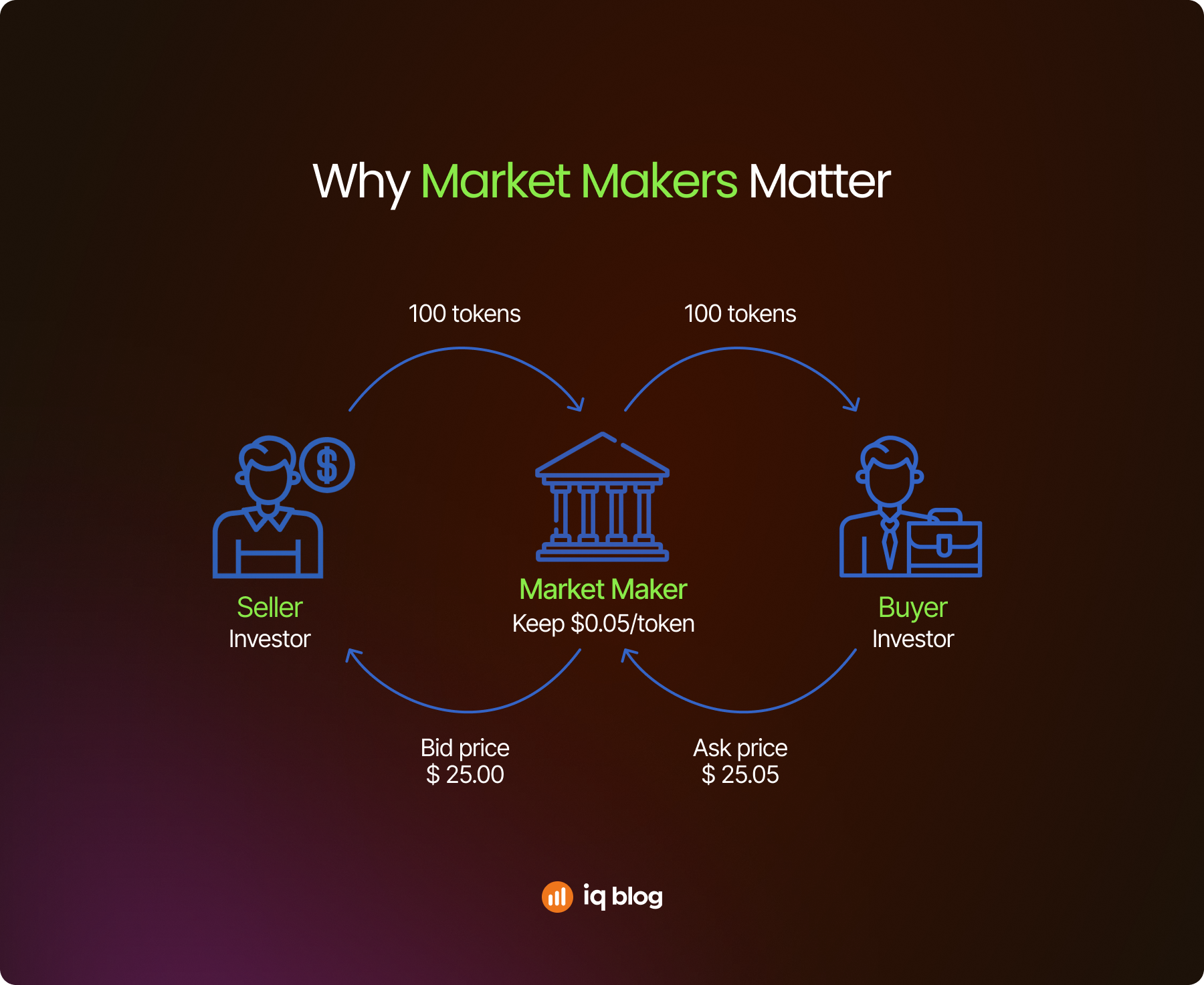
A market maker is an entity or individual who makes a buy and sell quotation for a security and is willing to deal at such quotes. They profit from the difference between what they will buy (bid) and what they will sell (ask).
Think of market makers as financial middlemen. If you need to sell Apple shares worth $100, a market maker steps in as the buyer. Similarly, if someone else needs to buy Apple shares, a market maker steps in as the seller.
This system brings liquidity even in the absence of natural buyers and sellers at a point in time. Without market makers, you can wait hours or days to find someone who will take the other leg of your trade.
Primary Responsibilities of Market Makers
Market makers have several primary duties that assist the entire trading community:
- Continuous Quoting: They are obligated to quote ask and bid prices continuously during the market session so that there is continuous trading.
- Liquidity Provision: They are willing to sell or buy securities even if there is no counterparty available in the immediate instant.
- Price Discovery: Their quotes help determine fair market prices based on supply and demand behavior.
- Risk Management: They have to maintain control of their inventory and hedge positions to avoid significant losses.
Two-Sided Quote System of Market Makers
Market makers post two prices every moment: the bid (how much they will pay) and the ask (how much they will sell for). This creates the bid-ask spread that is their profit margin. For example, if a market maker posts Apple at $150.00 bid and $150.05 ask, they will sell shares at $150.00 and repurchase them at $150.05. The $0.05 spread is their gross profit per share.
How Do Market Makers Work?
The process of market making includes sophisticated strategies and systems, which most of the traders never get to see. Knowing the mechanics makes you a better trader.
The Quote Process
Market makers employ complicated algorithms to determine their ask and bid prices. These systems take into account several variables:
- Order Flow: Buy and sell orders coming in affect how they price things.
- Inventory Levels: If they have too much inventory, they may reduce ask prices to induce selling.
- Market Volatility: Spreads that are wider with more volatility to hedge against more risk.
- Competition: Prices move as quotes of other market makers force them to remain competitive.

Inventory Management
Market makers must manage their inventory closely to avoid too much risk. When they buy too much of a specific stock, they face declining prices.
They use several strategies to limit this risk:
- Hedging: They can buy put options to hedge against declining risk in their stocks.
- Dynamic Pricing: They adjust bid and offer prices according to prevailing inventory positions.
- Cross-Trading: They cross-trade buy and sell orders internally where possible.
Risk Management Techniques
Market making involves significant risks that have to be carefully managed:
- Position Limits: Firms set position size limits to prevent overexposure.
- Stop-Loss Orders: They automatically close positions that move against them.
- Diversification: They make a market in a number of securities in order to diversify risk.
- Real-Time Monitoring: Sophisticated systems track positions and risk indicators in real time.
For more, you can check out our post on “Risk Management Tips for Traders”.
Example Trading Scenario: Imagine that you want to buy 1,000 shares of Microsoft. A market maker sees your order and sells to you at $250.05 a share. They now have a short position of 1,000 shares. Another trader later wants to sell 1,000 shares of Microsoft. The market maker buys them from him at $250.00, covering their short position and earning $50 in profit ($0.05 × 1,000 shares).
What are the Types of Market Makers?
Different kinds of market makers have different roles in the financial world. They all have different characteristics and operating procedures.
Traditional Market Makers
They are typically huge investment banks and financial institutions that offer market-making services across a range of asset classes. They have enormous amounts of capital and sophisticated infrastructure. Some of the traditional market makers are Goldman Sachs, Morgan Stanley, and Citadel Securities. They are also the designated market makers for some securities on the exchanges.
Electronic Market Makers
They rely extensively on computers and algorithms to provide liquidity. They execute thousands of trades each second using automatic systems. Virtu Financial and KCG Holdings (owned by Virtu) are major electronic market makers. They prioritize speed and efficiency over human discretion.
Designated Market Makers
Some exchanges designate particular firms to make a market in particular securities. The designated market makers have special privileges and responsibilities. On the New York Stock Exchange, the designated market makers have to maintain an orderly market and provide price continuity in their assigned stocks.
Retail Market Makers
These firms have the specialty of rendering retail order flow liquid. They usually remunerate retail brokers for order flow. Two Sigma Securities and Wolverine Trading are two market makers with a retail orientation. They typically provide superior prices for more modest, retail-sized orders.
How Do Market Makers Earn Money
Although market makers earn through several mechanisms, with the majority of their revenue originating in the bid-ask spread, as previously explained.
Spread Capture Strategy
The simplest source of profit for market makers is the bid-ask spread. They earn the spread whenever they purchase at the bid and sell at the ask. But this is not guaranteed profit. Market makers incur inventory risk in the event that prices move against their positions before they get to close them.
Volume-Based Profits
Market makers generate more from high-volume trading than from wide spreads. They prefer generating small profits on numerous trades to generating large profits on a few trades. A market maker might earn as little as $0.01 per share but sell millions of shares daily, which amounts to big money.
Inventory Management Gains
Successful market makers are able to generate profits from their inventory management. They will take positions where they anticipate prices increasing or reduce their inventory before anticipated declines. This requires sophisticated analysis and risk control systems to implement successfully.
Rebates and Fees
Most exchanges normally pay rebates to market makers for the liquidity that they provide. The rebates help in minimizing the cost of market-making operations. Fees are also levied by some market makers for their services, particularly in over-the-counter markets.
Revenue Stream Example: An Apple market maker might:
- Earn $0.02 per share in spread on 100,000 shares = $2,000
- Earn $0.001 per share in exchange rebates = $100
- Earn $0.005 per share in payment for order flow = $500
- Total revenue daily: $2,600
Payment for Order Flow: Retail brokers often route customer orders to market makers who pay the broker for this order flow. The market maker provides price improvement to retail consumers while making a small profit per transaction.

Market Maker vs. Market Taker
Understanding the distinction between market makers and takers helps to explain market dynamics and trading expenses.
Roles
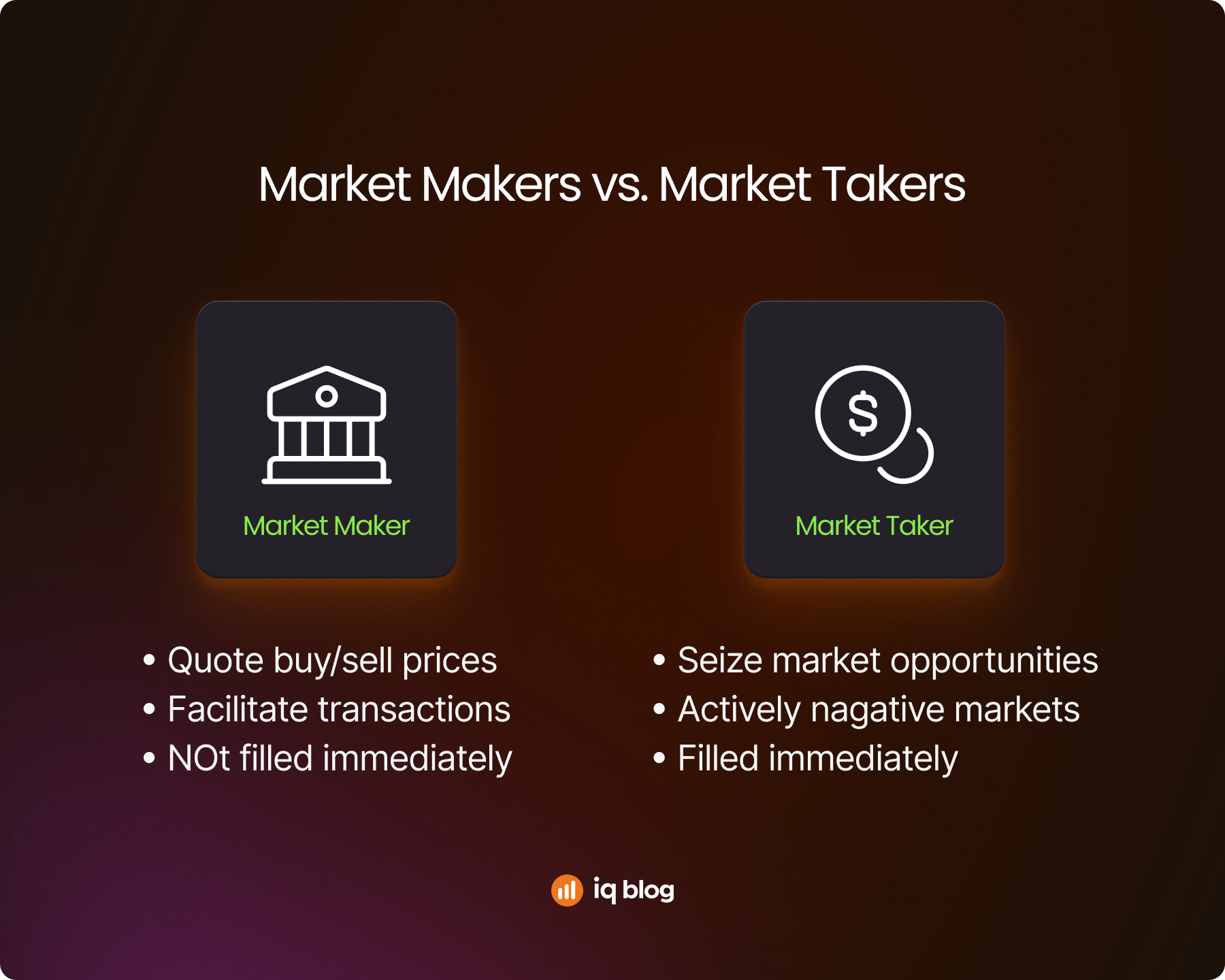
- Market Makers provide liquidity by entering limit orders that others can trade with. They’re willing to wait for someone to trade with them.
- Market Takers take out liquidity by using market orders to trade immediately against limit orders entered. They pay for the convenience of immediate execution.
Differences in Trading Behavior
Market makers typically:
- Enter limit orders away from the current market price
- Wait for others to trade
- Earn rebates from exchanges
- Make money from bid-ask spreads
Market takers typically:
- Take market orders for quick execution
- Pay slightly more to have it in a hurry
- Pay exchange fees
- Care about the timing and direction of the market
Market Impact Comparison
- Market makers will typically have a low market impact because they provide liquidity rather than absorbing it. Their trades will be price-stabilizing.
- Market takers will create more acute market impact, especially on large trades. Their activity generates price discovery and market efficiency.
Risk Profiles:
- Market makers bear inventory risk but are rewarded with spreads
- Market takers bear timing risk but are rewarded with immediate execution
Profit Mechanisms:
- Market makers gain profit by providing liquidity services
- Market takers gain profit by predicting prices
Impact of Market Makers on Trading and Markets
Market makers are significant players in modern financial markets, shaping everything from transaction costs to market stability.
Liquidity Enhancement
Market makers significantly enhance market liquidity by providing ongoing availability for trading. Without them, you could spend hours waiting for a natural counterparty for your trade. This increase in liquidity benefits everyone participating in the market by lowering transaction costs and enhancing price discovery efficiency.
Price Discovery Efficiency
Market makers assist in effective price discovery by constantly adjusting their quotes in accordance with current information. Their competition aids in ensuring prices are at a fair value. When there is news about a company, market makers immediately change their quotes, directing prices to new levels of balance.
Market Stability Contribution
During periods of volatility, market makers help stabilize markets by providing continuous liquidity. They prevent excessive price gaps from occurring that would otherwise happen in their absence. But market makers are also able to leave markets during extreme stress, which might contribute to added volatility.
Advantages to Individual Traders:
- Reducing trading costs through narrower bid-ask spreads
- Having the availability of instant execution
- Enhanced price discovery
- Less market effect on typical trade sizes
Benefits to Overall Markets:
- More trading activity and volume
- More efficient capital allocation
- Reduced system-wide transaction costs
- Increased normal-case market resilience
Market Maker Regulatory Framework
Market makers face a comprehensive regulatory framework aimed at ensuring fair and orderly markets.
Regulatory Framework
The SEC oversees market maker activities in the United States. FINRA provides day-to-day supervision and enforcement of most market makers.
Regulations are specific to:
- Reg NMS: Regulates order handling and execution
- Rule 15c3-3: Requires segregation of customer funds
- Anti-manipulation rules: Refrain from artificial price manipulation
Compliance Requirements
Market makers must satisfy strict capital requirements in order to ensure their capacity to meet their obligations in trading. Market makers must also submit to position limits and reporting. Regular audits ensure adherence to regulations and risk management standards.
Market Surveillance
Advanced surveillance systems track market maker activity for suspected violations. The systems identify abnormal trading patterns that could reflect manipulation or other abuse.
Registration Requirements:
- SEC registration as a broker-dealer
- FINRA membership for most activities
- Exchange-specific market maker registrations
- Ongoing compliance training and testing
Capital Adequacy Rules:
- Minimum net capital requirements
- Risk-based capital calculations
- Stress testing requirements
- Regular capital reporting
Conclusion
Market makers provide the liquidity and price stability that allow millions of investors worldwide to trade efficiently, making them the vital backbone of contemporary financial markets. Even though they mainly work in the background, their constant presence guarantees that there is always someone willing to take over your business when you decide to buy or sell a security.