


Futures trading is a way to speculate on a price movement without owning the asset itself. Futures trading is used globally to manage risk and speculate on asset prices.
Futures trading and spot trading can be distinguished in that futures trading involves contracts with standard terms and conditions. This brings about opportunity and responsibility at the same time. It is important to understand futures before venturing into futures trading with real money.
What Is Futures Trading
Futures trading is an agreement between two or more persons where one party agrees to sell an asset at an agreed price in the future. The process of futures trading is not an agreement between two persons; it is an exchange traded in an exchange.
The traders in the futures market do not aim to own or deliver the underlying asset. The majority of futures trading is opened and closed before the futures contract expires. The gain or loss is realized from the change in the futures contract price itself.
Futures markets are used as a hedge by market players seeking to reduce risk and as a way of generating income by market players seeking to make money.
How Futures Contracts Work
Futures contracts follow strict specifications set by the exchange. This standardization allows transparent pricing and efficient execution across global markets.
Standardized Contract Specifications
Each futures contract defines the asset, contract size, tick size and expiration date. Contract size determines how much exposure one contract represents. Tick size defines the minimum price movement and its monetary value.
These specifications mean that futures contracts can be significantly larger than retail traders expect. Understanding contract value is critical before placing trades.
Futures Expiration and Settlement
All futures contracts have an expiration date. At expiration, contracts are either cash settled or physically settled depending on the asset.
Most retail traders close or roll positions before expiration. Holding contracts too close to expiry can expose traders to unexpected volatility or settlement obligations. Managing expiration dates is a key part of futures trading discipline.
What Assets Are Traded as Futures
Futures markets trade a variety of assets. This enables traders to take positions on the global economy using a single market framework.
- Commodity Futures – Commodity futures trade assets such as oil, gold, gas and agricultural commodities. The value of such assets is influenced by factors such as supply and demand, as well as seasonality and geopolitical events.
- Index Futures – Index futures trade contracts on major stock market indices such as the S&P 500 and the Nasdaq. They enable traders to take positions on the overall performance of the stock market, as opposed to specific stocks.
- Currency Futures – Currency futures enable traders to trade currencies on exchanges. The price and volume of currency futures are fully transparent since they are traded on exchanges.
- Interest Rate Futures – Interest rate futures are tied to government bonds and interest rate forecasts. They are widely used by traders to hedge against changes in monetary policy.
Who Trades Futures and Why
Futures markets bring together participants with different goals. Their combined activity creates liquidity and continuous price movement. Understanding these roles helps traders read market behavior more clearly.
Hedgers
Hedgers use futures to reduce risk. Producers, manufacturers and large companies lock in prices to protect against unfavorable market moves. An airline may hedge fuel costs. A farmer may hedge crop prices.
Their goal is stability, not profit. Hedging activity often increases around key production or reporting periods. This can affect volatility and volume.
Speculators
Speculators trade futures to profit from price movement. They do not need the underlying asset. They focus on direction, timing and risk.
Speculators add liquidity to the market. Their activity tightens spreads and improves execution. Most retail traders fall into this group.
Institutions and Professionals
Banks, funds and proprietary firms trade futures at scale. They provide liquidity and help with price discovery. Their positions often influence trends.
Institutional activity is driven by macro views, portfolio allocation and arbitrage. Retail traders often react to moves initiated at this level.
Leverage and Margin in Futures Trading
Leverage is one of the defining features of futures markets. A single contract controls a large amount of underlying value. This allows traders to gain meaningful exposure with limited capital, but it also increases responsibility.
Margin in futures trading works differently than in other markets. It is a security deposit, not borrowed money. The exchange requires margin to ensure that traders can cover daily price fluctuations. This system keeps the market stable, but it leaves little room for error if risk is mismanaged.
How Margin Works in Practice
To open a futures position, a trader must post initial margin. This amount depends on the contract and current market volatility. More volatile contracts require higher margin.
Once the position is open, the account must stay above the maintenance margin level. If losses reduce the balance below this level, a margin call is triggered. The trader must add funds or reduce exposure. Otherwise, the broker may close the position automatically.
Why Leverage Is Risky for Beginners
Futures leverage reacts fast. Even small price moves can produce large gains or losses. This makes poor position sizing extremely costly.
Many beginners choose contracts that are too large for their account size. Normal market noise then becomes financially and emotionally overwhelming. Consistent futures trading requires using the smallest viable contract and prioritizing survival over opportunity.
Futures Trading Costs
Futures trading has a clear and transparent cost structure. Costs are fixed and known in advance. This makes planning and risk control easier compared to some other markets.
Traders must understand how costs affect profitability. Small mistakes become expensive when contracts are large. Cost awareness is part of discipline.
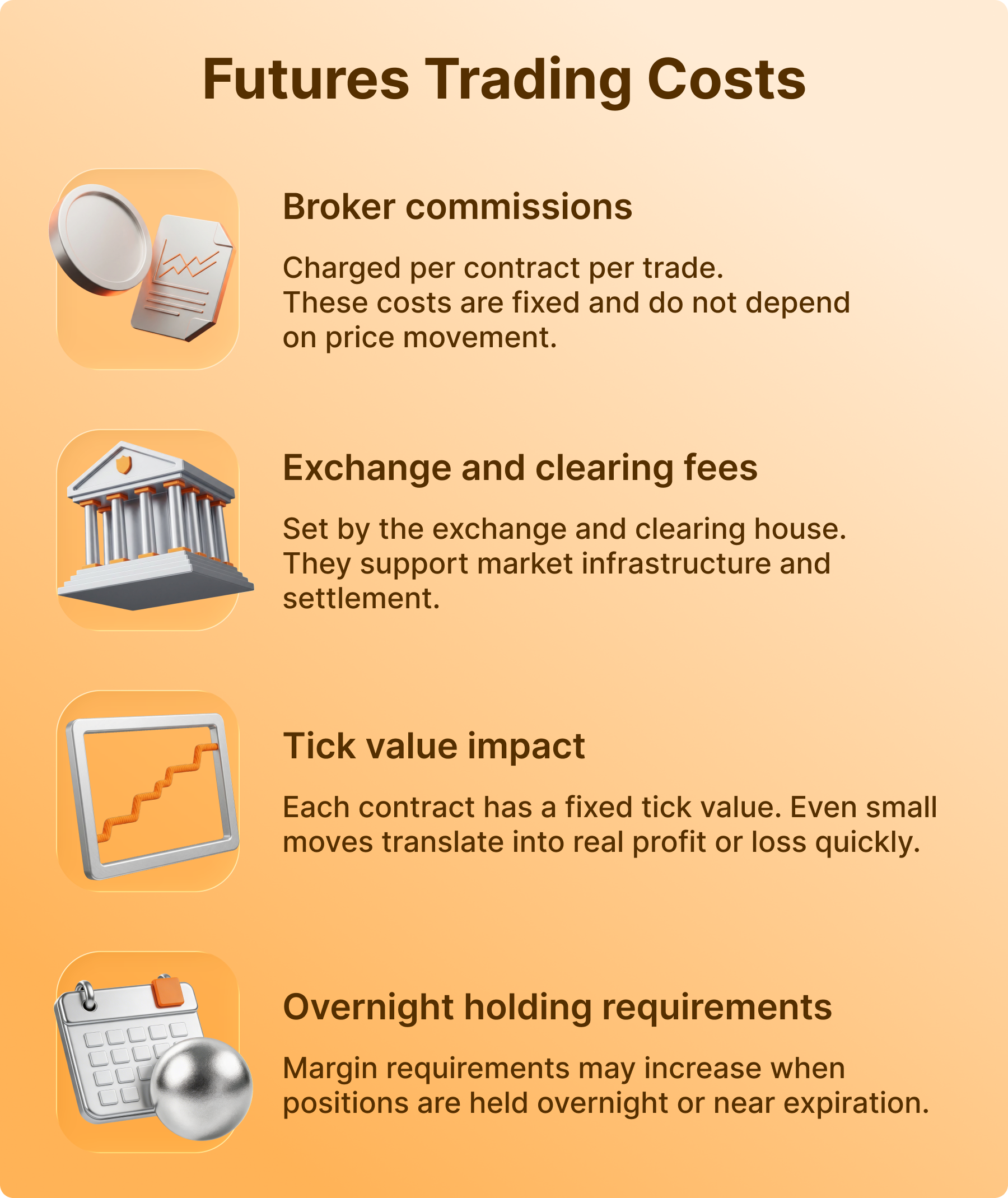
Main futures trading costs include:
- Broker commissions – Charged per contract per trade. These costs are fixed and do not depend on price movement.
- Exchange and clearing fees – Set by the exchange and clearing house. They support market infrastructure and settlement.
- Tick value impact – Each contract has a fixed tick value. Even small moves translate into real profit or loss quickly.
- Overnight holding requirements – Margin requirements may increase when positions are held overnight or near expiration.
Futures costs are predictable. Risk comes from position size, not hidden fees. Choosing the right contract size keeps costs manageable.
Futures Order Types and Execution
Execution in futures trading is precise and rule driven. Orders are matched on regulated exchanges with transparent pricing. Because contract values are large, the way an order is placed matters as much as the analysis behind it.
Good execution reduces slippage and emotional interference. Poor execution can turn a valid idea into a bad trade.
Market Orders
Market orders are used when execution speed is the priority. The trade is filled at the best available price at that moment.
They are common during strong momentum or news driven moves. The downside is slippage, especially in fast markets. Market orders should be paired with smaller position size.
Limit Orders
Limit orders are placed at a specific price. They only execute if the market reaches that level.
This order type improves price control and is often used for pullbacks or range trading. The main risk is missing the trade if price does not reach the limit.
Stop and Stop Limit Orders
Stop orders activate when price reaches a predefined level. They are widely used for breakouts and stop losses.
Stop limit orders add price control but may fail to execute during sharp moves. They are useful in calmer conditions but risky in high volatility.
Execution Timing and Liquidity
Futures markets are most liquid during active sessions. Trading during peak hours improves fills and reduces unexpected price gaps.
Low liquidity periods increase execution risk. Spreads widen and price can jump. Timing execution is part of risk management
Risk Management in Futures Trading
Risk management is more important in futures than in most other markets. Contract size and leverage amplify mistakes quickly. Survival depends on strict control, not prediction.
Position Sizing and Contract Selection
Each futures contract represents a fixed exposure. Some contracts are too large for small accounts. Choosing the smallest suitable contract is the first risk decision.
Position size should be based on maximum acceptable loss per trade. Many disciplined traders risk a small fixed percentage of capital. This keeps losses predictable and emotions manageable.
Stop Loss Discipline
Stop losses define risk before entry. They should be placed at logical technical levels, not random distances. Futures markets move fast, so hesitation increases damage.
Moving or removing stops breaks discipline. A predefined stop turns uncertainty into a controlled outcome and protects capital during unexpected moves.
Managing Drawdowns
Drawdowns are unavoidable. What matters is response. Continuing to trade during emotional stress increases risk.
After a series of losses, reducing size or pausing helps restore objectivity. Capital protection always comes before opportunity.
Common Beginner Mistakes in Futures Trading
Futures trading punishes small mistakes quickly. Most beginner losses come from misunderstanding contract size, leverage and expiration mechanics rather than poor market analysis.
One frequent error is trading contracts that are too large for the account. A single contract can represent substantial exposure. Normal price movement then creates outsized gains or losses, which leads to emotional decisions and rapid drawdowns.
Another mistake is treating margin like available capital. Margin is only a performance deposit. Losses are settled daily. When volatility increases, margin calls arrive fast and force exits at poor prices.
Beginners also overlook contract expiration. Holding a position too close to expiry can cause unexpected volatility, liquidity drops or settlement issues. Active traders usually roll or close positions well before expiration.
Finally, many new traders overtrade during fast markets. Futures reward patience and planning. Selective trading with clear rules is far more effective than constant activity.
Futures Trading vs Other Markets
Futures trading offers a different structure compared to other popular markets. These differences affect cost, transparency and risk, which makes comparison important before choosing where to trade.
Futures vs Stock Trading
Futures trading provides built in leverage and extended trading hours. Markets are open almost around the clock, which allows reaction to global events outside regular stock exchange hours.
Stock trading usually requires more capital for similar exposure. It is also limited by exchange hours and, in some cases, restrictions on short selling. Futures offer more flexibility, but mistakes are amplified faster due to contract size.
Futures vs Forex Trading
Futures markets are centralized and exchange traded. Prices, volume and order flow are transparent. This reduces counterparty risk and improves execution clarity.
Forex trading is decentralized and broker dependent. While it offers flexibility and smaller position sizing, pricing and liquidity vary by provider. Futures favor structure and transparency. Forex favors accessibility and micro sizing.
Both markets require discipline. The choice depends on experience, account size and risk tolerance.
Is Futures Trading Suitable for Beginners
Futures trading is accessible but demanding. It offers transparency, regulation and deep liquidity. These features are attractive to serious traders.
At the same time, futures contracts are large. Leverage is built in. Losses can grow fast without strict control. This makes the learning curve steeper than in some other markets.
Futures may suit beginners who are disciplined and patient. A beginner should start with education, simulation and the smallest available contracts. Anyone seeking fast profits or casual trading should avoid futures early on.
How to Start Trading Futures Safely
Starting futures trading requires structure and patience. A step by step approach reduces risk and builds skill before capital is exposed.
- Learn contract specifications first – Study contract size, tick value, margin requirements and expiration dates. Never trade a contract without knowing how much one tick is worth.
- Focus on one market only – Choose a single liquid futures market and learn its behavior. This improves pattern recognition and reduces mistakes.
- Use simulated trading seriously – Practice in a demo environment with realistic size and strict rules. Treat simulation as real trading, not experimentation.
- Start with the smallest contract available – Use micro or mini contracts if available. Smaller size gives more room for error and emotional control.
- Define strict risk limits – Set maximum loss per trade and per day. These limits protect the account during volatile periods.
- Scale slowly and deliberately – Increase position size only after a stable period of disciplined execution. Scaling without consistency usually leads to losses.
Final Thoughts on Futures Trading
Futures trading provides transparency, liquidity and access to the world market; however, it is not an forgiving market. The size of the contract and the leverage involved mean that skill and error are magnified.
Skilled futures traders think in terms of structure, risk and consistency. They think in terms of the contract before they think in terms of opportunity. The key to successful futures trading is to make it a controlled process, not a gamble.