



If you’re just starting out, the world of trading can feel like a blur. Charts jump around, prices flash constantly, and the advice you find online often sounds like a bunch of riddles. It’s easy to feel like you need to jump in right away, but doing that usually leads to a quick loss of both money and confidence.
That’s where demo trading comes in. Think of it as a flight simulator: you get to fly the plane in real weather, but if you crash, nobody gets hurt. It’s a safe way to practice, explore the platform, and build your “market muscles” without touching your savings.
What Exactly is a Demo Account?
A demo account is a simulated trading environment offered by most brokers. It’s a practice version of their real platform. It looks the same, uses the same live prices, and has all the same tools. The only difference? The money isn’t real.
In a demo account, you can:
- Open and close trades on live charts: Experience the speed of price action in real-time.
- Experiment with various assets: Trade stocks, currencies, or crypto to see how they differ and understand how different markets behave.
- Play with technical indicators: Master tools like RSI, MACD, and Bollinger Bands.
- Master the Platform “Plumbing”: Learn how to set stop-losses, take-profits, and trailing stops.
For most people, this is the only way to learn the mechanics of a trading platform without paying for every “fat-finger” mistake.
Demo trading helps beginners learn the platform and test strategies without risk. Traders who practice on demo accounts often make fewer mistakes at the start. However, real trading involves emotional pressure, and long-term success depends on discipline and risk management.
How it Works in the Real World
When you sign up, the broker usually gives you a big pile of virtual cash—often $10,000 or even $100,000. While that sounds great, it’s actually a bit of a trap. Since it’s “Monopoly money,” it’s very easy to become a reckless trader.
Many people take huge risks on demo because they know they can just hit a “reset” button if things go south. The problem is, you’re training your brain to be careless. To actually get value from this, you have to treat that virtual balance as if it were your last $500.
On platforms like IQ Option, you can start with a $10,000 demo balance. A key benefit here is that this balance is refreshable. If you blow the account while learning a difficult strategy, you can reset it to $10,000 and try again. This allows for infinite practice until your win rate stabilizes.
Why Success on Demo Doesn’t Always Lead to Real Profits
You’ll often hear stories of people who were “demo stars” but lost everything the week they went live. There are two big reasons for this: emotions and market execution.
The Stress Factor
On a demo account, a losing trade is just a number on a screen. In real life, that loss might be your car payment. That pressure changes how you think. You’ll find yourself hesitating when you should buy or panicking and selling too early.
The Technical Gap (Execution Reality)
In a demo environment, orders usually fill instantly at the exact price you see. In the real market, prices can “slip” or jump over your orders during busy news events.
*Understanding the difference between demo and live trading is critical before risking real money.
Demo vs Live Trading: Key Differences
| Feature | Demo Trading | Live Trading |
| The Money | Virtual / Unlimited | Real / Limited |
| Heart Rate | Calm and relaxed | Often high stress |
| Order Fills | Nearly perfect | Can be delayed (slippage) |
| Spreads | Usually stable | Can widen during big news |
How to Practice the Right Way
If you want to move from “playing” to “training,” you need a structured approach. Here is how to make your demo time actually count:
Use a Realistic Balance
If you only plan to deposit $500 of your own money later, don’t practice with $50,000. A huge balance hides your mistakes. If you lose $2,000 on a $50k account, you barely notice. If you lose $2,000 on a $5k account, you’re in trouble. Match your demo balance to your future reality.
Pick One Corner of the Market
Don’t try to be everywhere. Choose one thing—maybe just a couple of major currency pairs and learn how the forex market works. Every asset has its own “personality” and rhythm.Specializing helps you learn those patterns much faster than jumping around.
Stick to One Simple Strategy
Find a strategy that makes sense to you and repeat it. Over and over. The goal isn’t to find a “perfect” system; it’s to learn how to execute one system consistently. You want to reach a point where taking the trade feels like a boring routine, not a gamble.
Why You Need a Trading Plan
A trading plan is what separates a professional from a gambler. Without one, you’re just guessing. On a demo account, you have the luxury of testing your plan without it costing you a cent.
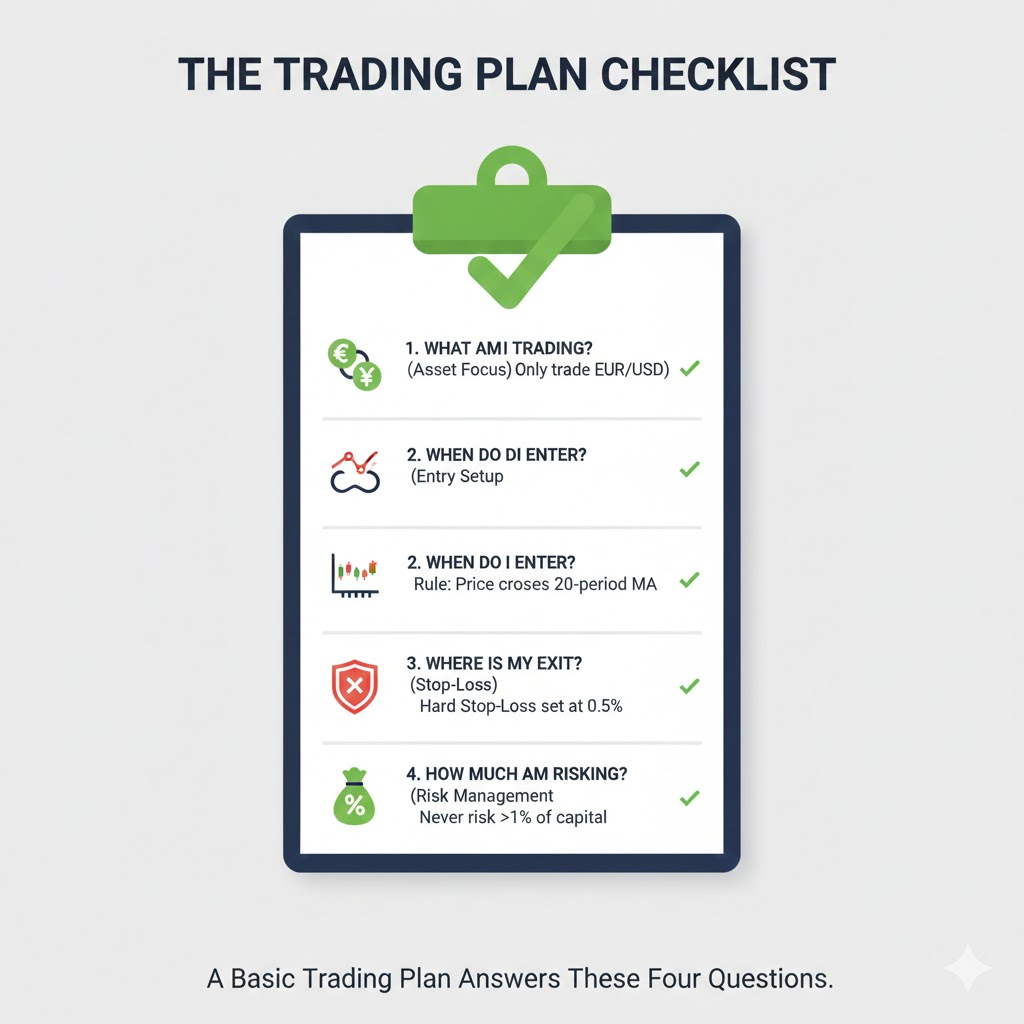
A basic plan must answer:
- What am I trading? Focus on specific assets (e.g., EUR/USD).
- When do I enter? Define the technical setup (e.g., “Price crosses the 20-period Moving Average”).
- Where is my “get out” point? Set a hard Stop-Loss to prevent a single bad trade from wiping you out.
How much am I risking? Use the 1% Rule—never lose more than 1% of your total balance on one trade.
Mastering Risk Management (The Math)
The biggest mistake demo traders make is ignoring Position Sizing. They just pick a random number of shares or lots. To prepare for the real world, you must use the 1% risk formula.
The Calculation
If your account has $1,000 and you risk 1%, your maximum loss is $10.
If you buy a stock at $100 and set your stop-loss at $95, your “risk per share” is $5.
To stay within your $10 limit, you can only buy 2 shares ($10 / $5).
Practicing this math on a demo account is the only way to ensure you don’t over-leverage yourself when using real money.
The Psychology of the “Fake” Loss
To make a demo account feel real, you need to impose consequences. If you break your rules or blow your demo account, punish yourself in the real world. For example:
- If you take a “boredom trade,” you can’t eat out for a week.
- If you remove a stop-loss, you have to do 50 pushups.
Building these neural pathways now will save you thousands of dollars later. You need to train your brain to feel a “sting” even when the money isn’t real.
Building the Journaling Habit
If you don’t write down your trades, you’re destined to repeat the same mistakes. A trading journal is where the real learning happens. After every trade, take thirty seconds to jot down:
- The Setup: Why did I get in? (e.g., “Bullish engulfing on the 4-hour chart”).
- The Feeling: Was I nervous? Bored? Greedy? (This identifies psychological triggers).
- The Result: Did I follow my plan?
- The Lesson: What would I do differently next time?
Reviewing this at the end of the month will show you patterns you never knew you had. For example, you might find you always lose money when trading on Friday afternoons.
How to Transition from Demo to Live Trading (The Bridge)
Don’t jump from a demo account straight into a $50,000 live account. The emotional shock is too great. Use the “Micro-Account” bridge.
- Stage 1: Demo Account (3 Months). Prove you can be profitable for 90 days straight.
- Stage 2: Micro Account. Deposit a small amount ($100–$500). Trade the smallest possible size. The goal here is to feel the emotional sting of losing real money, even if it’s only $1.
- Stage 3: Full Account. Only once you can follow your rules with $500 should you move up to larger sums.
How Long Should You Stay on Demo?
There’s no prize for switching to live trading quickly. Most successful traders suggest staying on demo for at least three months of consistent profit.
- Month 1: The Mechanic. Focus on the buttons. Learn the software so you never make a technical mistake.
- Month 2: The Strategist. Focus on the strategy. See if your plan actually works over 20 or 30 trades.
- Month 3: The Psychologist. Focus on yourself. Can you stay disciplined even when you’re on a losing streak?
Only move to real money when following your rules feels like second nature.
Final Summary: The Discipline of Practice
A demo account is not a place to get rich — it’s a training ground. It helps you build the discipline, patience, and technical skills needed to survive in real markets. Treat every virtual dollar as if it were real, and you’ll be better prepared when the stakes truly matter.