


What Is Currency Trading
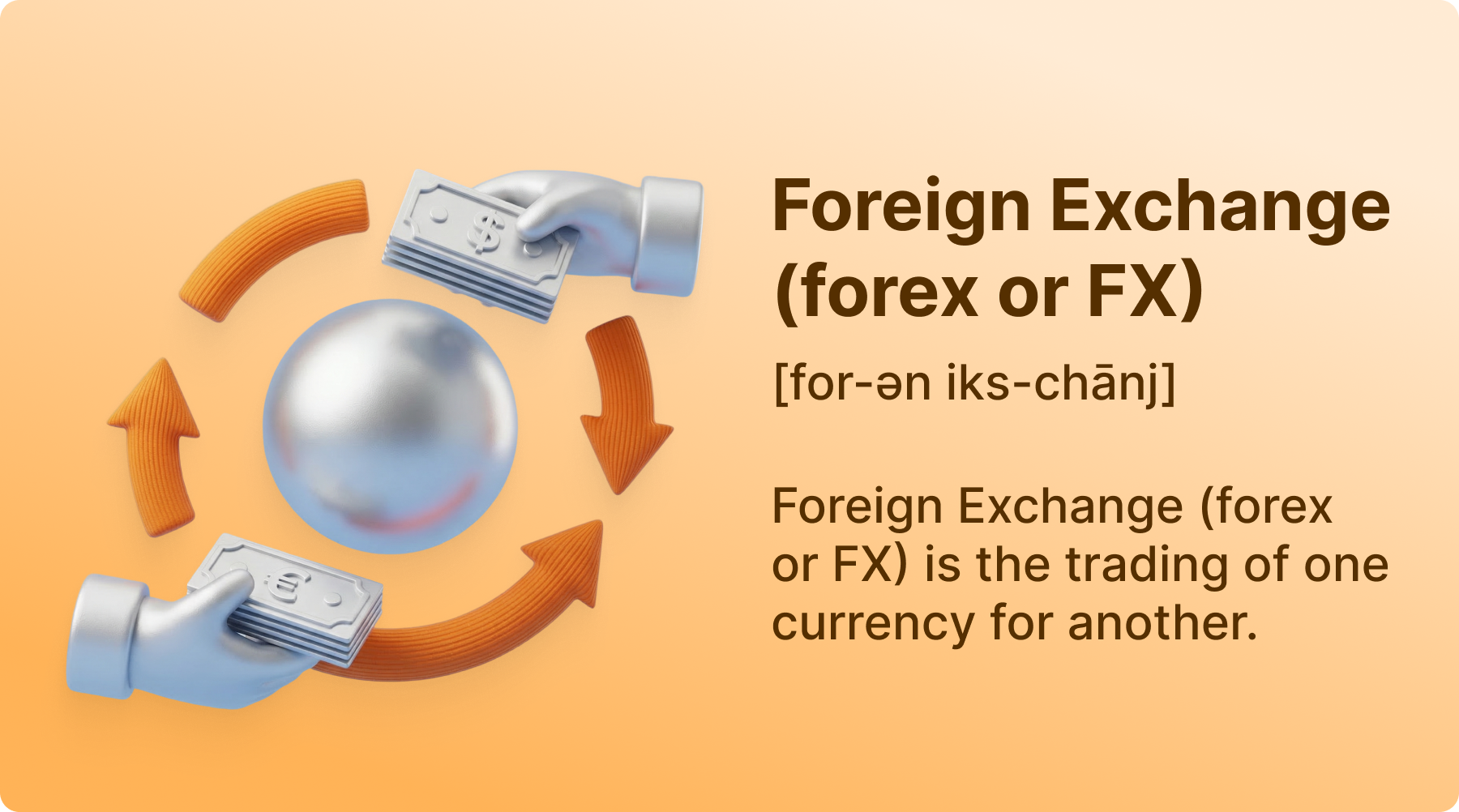
Currency trading is the simultaneous purchase of one currency and the sale of another. All trades involve an exchange pair; the value of one currency is measured against the value of the other. People trade as they can make money off of exchange rate differentials based on economic and political happenings.
Unlike shares and commodities, the foreign currency market is an online global market and is decentralized. There is no central market. Market prices are generated through incessant transactions by banks, institutions, and brokers across the world.
Currency markets remain operational throughout all hours during a trading week. While opportunities exist around the clock and every day, discipline and risk management are necessary for achievement in such markets.
How Currency Trading Works in Practice
Currency trading is based on relative value. One currency is always compared to another. Profit comes from changes in that relationship over time.
Prices move constantly due to supply and demand. Traders do not buy physical currencies. They trade price movements through contracts offered by brokers.
Understanding Currency Pairs
Every forex trade uses a currency pair. The first currency is the base currency. The second is the quote currency.
The price shows how much of the quote currency is needed to buy one unit of the base currency. If the price rises, the base currency is strengthening. If it falls, it is weakening.
Buying and Selling Currencies
Buying a currency pair means expecting the base currency to rise in value. This is called going long. Selling a currency pair means expecting the base currency to fall. This is called going short.
Both directions are equally accessible. Traders can profit in rising or falling markets. This is one reason forex trading is flexible.
Pips, Lots, and Trade Size
A pip is the standard unit of price movement in forex. It represents a small change in exchange rate. Profit and loss are measured in pips.
Trade size is measured in lots. A standard lot is large. Mini and micro lots are smaller. Smaller lot sizes allow better risk control, especially for beginners.
Types of Currency Pairs
Currency pairs are grouped by how actively they are traded and how stable their price behavior is. Each group has different costs, volatility levels, and risk characteristics. Choosing the right type of pair is an important part of risk management, especially for beginners.
Major Currency Pairs
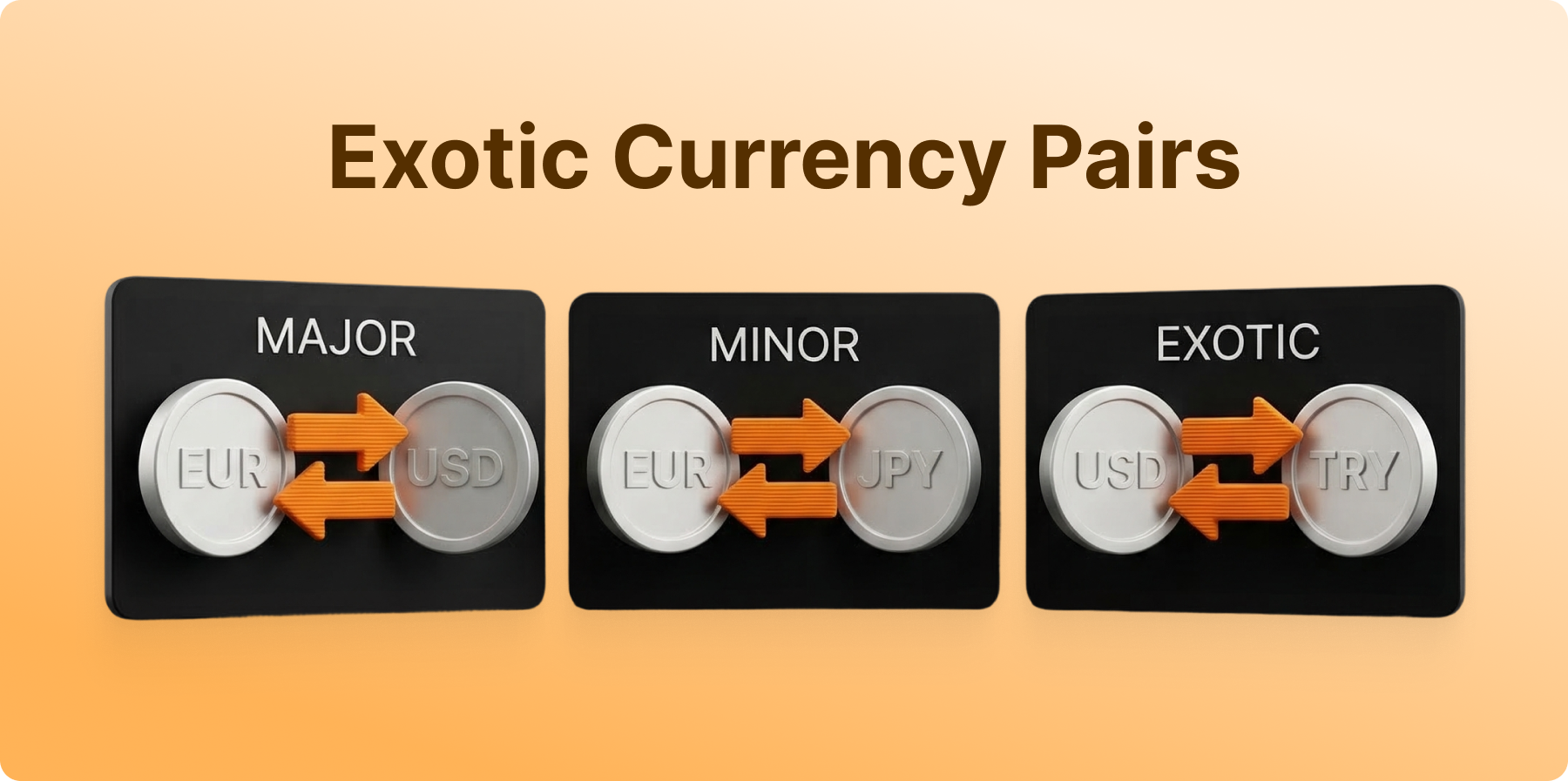
Major currency pairs include the most traded currencies in the world and always involve the US dollar. Common examples are EUR/USD, GBP/USD, and USD/JPY. These pairs account for the majority of global forex volume.
High liquidity means orders are filled quickly and spreads are usually very tight. Price movement tends to respect technical levels more clearly. Economic data, central bank decisions, and interest rate expectations strongly influence these pairs. Because of lower costs and more stable behavior, major pairs are often the best starting point for new traders.
Minor Currency Pairs
Minor currency pairs combine major currencies without the US dollar. Examples include EUR/GBP, EUR/JPY, and AUD/JPY. These pairs are traded less than majors but still offer sufficient liquidity during active sessions.
Price behavior can be more volatile, especially when regional news is released. Spreads are wider and moves can be sharper during low volume periods. Minor pairs often reflect relative strength between two economies, which makes them useful for traders who understand fundamentals and session timing.
Exotic Currency Pairs
Exotic currency pairs include one major currency and one from an emerging or smaller economy. Examples include USD/TRY, USD/MXN, and EUR/ZAR. These pairs have low liquidity and significantly higher trading costs.
Price movement can be erratic and heavily influenced by political risk, capital controls, and local economic instability. Spreads are wide and slippage is common. Exotic pairs require advanced risk management and are generally unsuitable for beginners due to their unpredictable behavior.
What Drives Forex Prices
Currency prices move because of changes in economic expectations. Forex is a relative market. One currency strengthens while another weakens. Price reflects which economy is expected to perform better.
Several core factors influence these movements. Traders who understand them can better anticipate volatility and risk.
- Interest Rates and Central Banks. Interest rates are one of the strongest drivers of currency value. Higher rates attract capital. Lower rates reduce demand. Central banks control these rates through monetary policy. Statements, decisions, and guidance from central banks often cause sharp price moves. Traders closely watch policy meetings and forward guidance.
- Economic Data and Indicators. Economic reports measure the health of an economy. Key data includes inflation, employment, and economic growth. Strong data usually supports a currency. Weak data pressures it. Scheduled releases often increase short term volatility and trading volume.
- Market Sentiment and Risk Appetite. Forex prices also react to global risk sentiment. In risk on conditions, traders favor higher yielding or growth currencies. In risk off periods, they seek safety. Currencies like the US dollar and Japanese yen often strengthen during uncertainty. This behavior repeats across market cycles.
- Geopolitical and Global Events. Political instability, conflicts, and unexpected global events affect currency flows. These events increase uncertainty and reduce risk appetite. Price reactions can be sudden and difficult to predict. During such periods, spreads widen and volatility rises. Risk control becomes more important than opportunity.
Key Participants in the Forex Market
The forex market is made up of different participants with different objectives. Their combined activity creates liquidity, volatility, and price movement. Understanding who is active helps traders interpret market behavior.
- Central Banks. Central banks influence currency value through monetary policy. They set interest rates, control liquidity, and manage inflation. Their decisions affect long term currency trends. Central banks can also intervene directly in the market. These actions are rare but powerful. When they happen, price moves can be sharp and fast.
- Commercial Banks and Financial Institutions. Large banks are the main liquidity providers in forex. They trade currencies for clients and for their own operations. Most interbank trading happens at this level. Institutional activity shapes major trends. Retail traders often follow moves that start with institutional positioning.
- Corporations and Hedgers. Companies use the forex market to manage currency risk. They hedge exposure created by international trade and operations. These participants are not speculators. Their trades are based on business needs. Large hedging flows can still affect price, especially in less liquid pairs.
- Retail Traders. Retail traders participate through online brokers. They trade smaller volumes and focus on short to medium term price movement. Retail traders do not move the market on their own. Their role is to react to existing liquidity and trends. Discipline and risk control are essential at this level.
Forex Trading Sessions and Market Timing
The forex market follows a global cycle as major financial centers open and close. Each session has distinct behavior, liquidity, and volatility. Knowing when markets are active helps traders choose suitable strategies and avoid low quality conditions.
Asian Trading Session
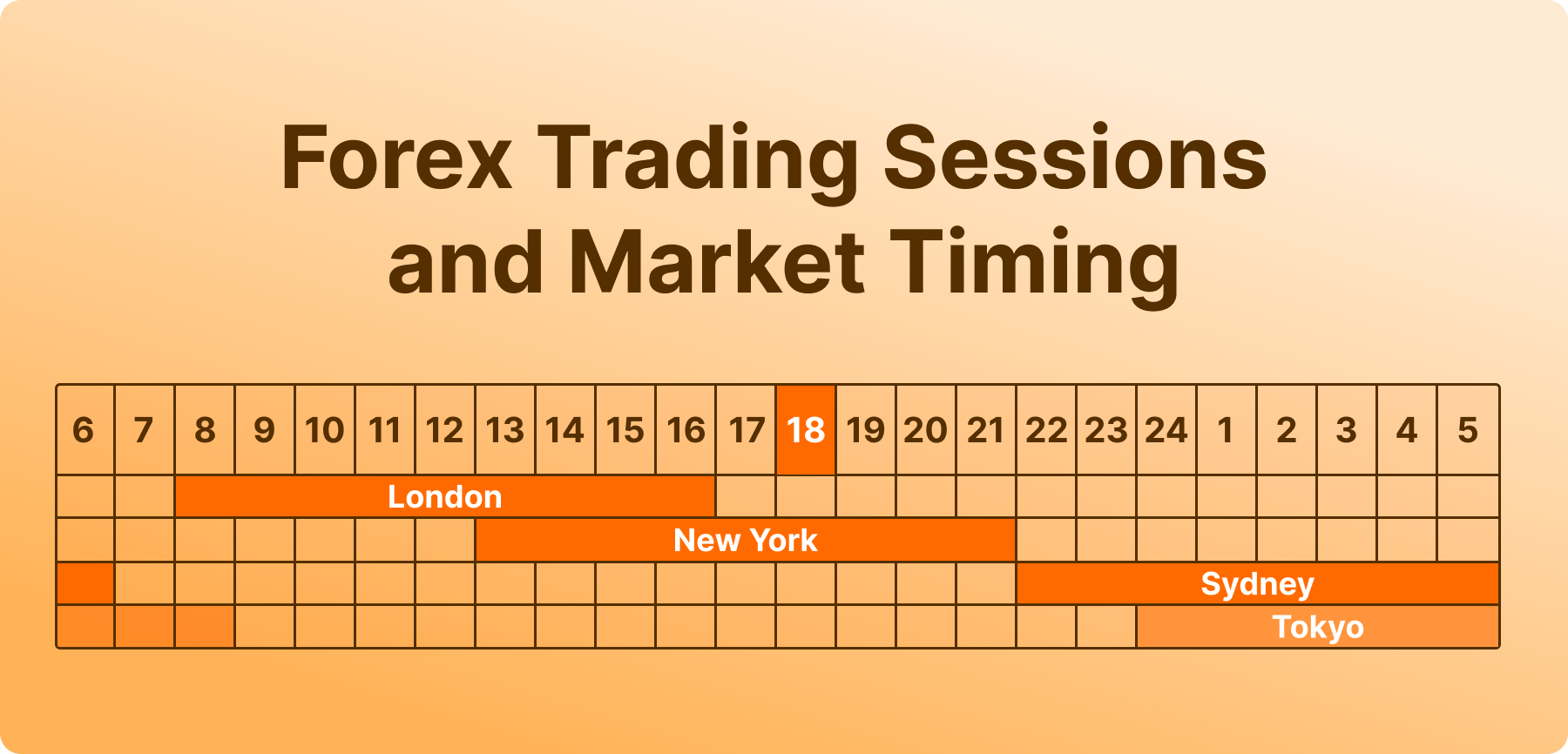
The Asian session typically runs from 00:00 to 09:00 UTC. It is led by Tokyo, with participation from Sydney, Hong Kong, and Singapore. Volatility is usually lower, and price action is often range bound.
Currency pairs involving the Japanese yen and Australian dollar are most active. Examples include USD/JPY, AUD/USD, and AUD/JPY. Traders often use this session for range trading, managing open positions, or waiting for clearer direction later in the day.
European Trading Session
The European session runs from 07:00 to 16:00 UTC, with London as the main center. This is one of the most liquid and active sessions in the forex market.
Pairs such as EUR/USD, GBP/USD, and EUR/GBP often show strong directional moves. Many key economic reports are released during this time. Trend formation is common, which makes this session suitable for breakout and trend following strategies.
US Trading Session
The US session runs from 13:00 to 22:00 UTC, led by New York. Volatility remains high, especially during the early hours when major US economic data is released.
USD based pairs like EUR/USD, USD/JPY, and GBP/USD are very active. Price moves can be fast and decisive. This session suits momentum and news driven trading but requires strict risk control.
Session Overlaps
Session overlaps create the highest trading volume. The European and US overlap from 13:00 to 16:00 UTC is the most active period of the day.
Liquidity is high and spreads are tight, but volatility increases. For example, EUR/USD often sees its largest daily moves during this overlap. Traders should reduce position size if needed and expect faster price action.
Leverage, Margin, and Trading Costs
Leverage is one of the main features that attracts traders to the forex market. It allows control of a large position with a relatively small amount of capital. At the same time, it significantly increases risk and requires strict discipline.
How Leverage Works in Forex
Leverage lets traders open positions that are larger than their account balance. For example, with leverage of 1:100, a trader can control a position one hundred times larger than their capital. This amplifies both gains and losses.
Margin is the amount of capital required to open and maintain a leveraged position. If losses reduce available margin too much, positions may be closed automatically. Understanding this mechanism is essential to avoid unexpected liquidations.
Risks of High Leverage
High leverage increases emotional pressure and magnifies mistakes. Small price movements can cause large losses when position size is too big. Many beginner accounts fail due to excessive leverage rather than poor analysis.
Lower leverage provides more room for price fluctuation and better risk control. Experienced traders often use less leverage than beginners because it supports consistency and capital preservation.
Spreads and Other Trading Costs
Forex trades involve a bid and ask price. The difference between them is called the spread. This is the primary trading cost for most retail traders.
Spreads vary by currency pair, session, and market conditions. Major pairs usually have tighter spreads, while exotic pairs are more expensive to trade. Some brokers may also charge commissions or overnight holding fees.
Orders and Execution in Forex Trading
Orders control how and when trades are executed. Using the right order type improves precision and risk control. Execution quality also depends on market conditions and liquidity.
- Market Orders. Market orders execute immediately at the best available price. They are used when speed matters more than price precision. During high volatility, execution may differ slightly from the expected price. Market orders are common during breakouts and news events. Slippage can occur, so position size should be adjusted to risk tolerance.
- Pending Orders. Pending orders are placed in advance at specific price levels. Limit orders aim to enter at a better price. Stop orders trigger entries when price breaks a level. These orders help remove emotion from execution. They are useful for pullbacks, breakouts, and structured trade plans.
- Stop Loss and Take Profit Orders. Stop loss orders limit downside risk. Take profit orders lock in gains at predefined levels. Both should be set based on structure and volatility. Using these orders consistently protects capital and enforces discipline. They are essential tools for long term survival in forex trading.
Common Beginner Mistakes in Forex Trading
Most beginner losses come from avoidable mistakes rather than market complexity. These errors are usually linked to psychology, risk misuse, and lack of structure.
- Over Leveraging. Using high leverage is the fastest way to damage an account. Beginners often open positions that are too large relative to their balance. Small price moves then cause large losses. High leverage increases emotional pressure. Fear and panic replace logic. Lower leverage gives trades room to develop and supports better decision making.
- Overtrading. Overtrading happens when traders open too many positions without clear setups. This is often driven by boredom, fear of missing out, or the desire to recover losses. More trades increase costs and mistakes. Quality matters more than quantity. Fewer, well planned trades lead to better consistency.
- Ignoring Fundamentals. Many beginners focus only on charts and ignore economic context. Major news events and central bank decisions can override technical setups.
How to Start Trading Forex Safely
Starting forex trading without preparation increases risk. A structured approach helps beginners build skills while protecting capital.
- Choosing a Broker. A broker, like IQ Option provides access to the forex market. Regulation, execution quality, and transparency are critical. A regulated broker offers better protection and clearer trading conditions. Traders should review spreads, leverage limits, platform stability, and customer support. Choosing a reliable broker reduces operational risk and execution issues.
- Using Demo Accounts. Demo accounts allow traders to practice without real money. They help test platforms, strategies, and order execution in live market conditions. Beginners should treat demo trading seriously. Following the same rules as live trading builds discipline and realistic expectations.
- Transitioning to Live Trading. Live trading should start with small position sizes. The goal is to adjust to real emotional pressure while keeping risk low. Scaling should be gradual and rule based. Consistent execution matters more than early profits. Capital protection comes first.
Final Thoughts on Currency Trading
Currency markets provide flexibility, liquidity, and global accessibility. However, currency markets require discipline, endurance, and continuous learning. It’s not a question of anticipating all the actions. A successful forex trader should have skills that revolve around risk management and education. With this mindset and preparation, trading in the foreign exchange market becomes a skill as opposed to gambling.