


Quick Comparison: Spot vs. CFD Trading
| Feature | Spot Trading | CFD Trading |
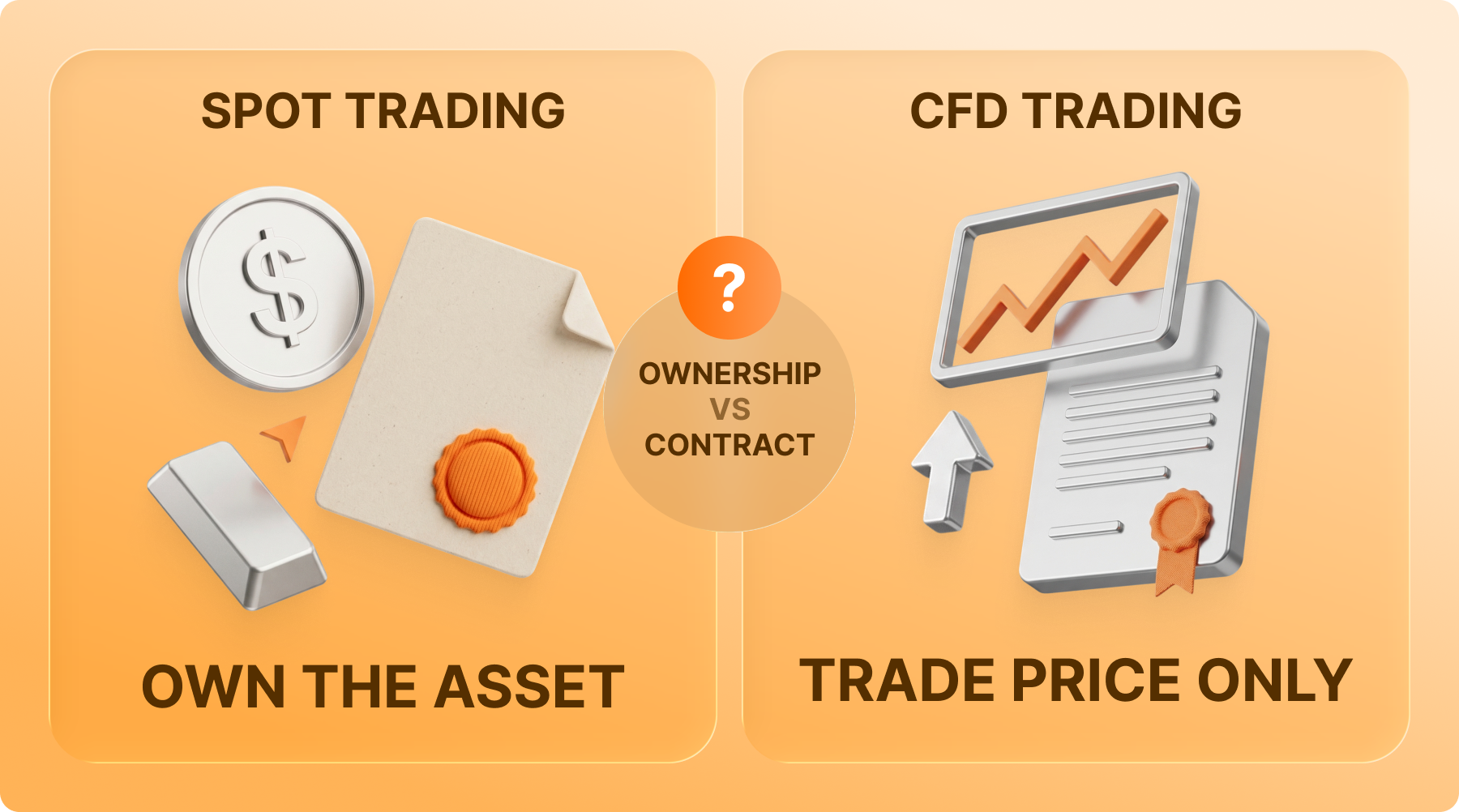
| Ownership | You own the actual asset | You own a price contract |
| Capital Needed | 100% of asset value | 5% to 20% (Margin) |
| Leverage | Not available (1:1) | High (up to 20:1) |
| Direction | Profit only when price rises | Profit on rise or fall (Shorting) |
| Holding Term | Best for years (Investing) | Best for days (Trading) |
| Risk | Asset value could drop | Entire deposit could be lost |
What is Spot Trading?
Spot trading is the traditional way to build wealth. It is the “cash and carry” method. When you execute a spot trade, you are purchasing the asset for immediate delivery. Whether it is a stock, a cryptocurrency, or a physical metal, the transaction is settled “on the spot.” You pay the full market price, and the asset is transferred to your account, your digital wallet, or your physical safe.
In 2026, spot trading is the primary choice for investors who value security and long-term ownership. If you buy Bitcoin on the spot market, you can move it to a private hardware wallet, where it exists independently of any broker. If you buy gold on the spot market, you can take physical delivery of coins or bars. You have full legal title to the asset. Your only real risk is the price of the asset dropping—but even then, you still own the asset and can wait decades for it to recover.
What is CFD Trading?
A Contract for Difference (CFD) is a derivative product. When you trade a CFD, you aren’t buying the asset itself; instead, you are entering into a legal agreement with a broker to exchange the difference in the price of an asset from the time the contract is opened to the time it is closed. It is effectively a “side bet” on the market.
CFD trading is designed for short-term speculation and flexibility. Its biggest draw is leverage, which allows you to put down a small percentage of the total trade value (the margin) to control a much larger position. It also allows for “short selling,” a process where you can profit if the price of an asset like gold or Bitcoin falls. However, because you never actually own the underlying asset, you usually pay “swap” fees or daily interest to the broker to keep that contract open overnight.
The Core Differences and Comparison Trading
To understand which method fits your strategy, you have to look at the “plumbing” of the trade. Spot trading is a “one-to-one” transaction: if you have $1,000, you buy $1,000 worth of Bitcoin. Your exposure is exactly what you paid. In CFD trading, that same $1,000 could act as a margin to control $10,000 or even $20,000 worth of Bitcoin. While this can amplify your profits by 10x or 20x, it also amplifies your losses by the same amount.
The comparison also extends to how you exit the market. In spot trading, you are an “owner.” If the market becomes incredibly volatile, you can simply stop looking at the charts and wait. In CFD trading, you are a “contract holder.” If the market moves against your position too far, the broker will issue a Margin Call, demanding more money. If you cannot provide it, the broker will close your trade instantly, and your initial deposit will be gone. This makes CFD trading a high-speed game of precision, whereas spot trading is a marathon of patience.
| Cost Category | Spot Trading (Bitcoin/Gold) | CFD Trading (Bitcoin/Gold) |
| Entry Costs | 0.1% to 0.5% Commission | Spread (Built into the price) |
| Leverage Cost | Zero | Daily Swap Fees (Interest) |
| Storage Fees | $0 for BTC / ~0.5% for Gold | Zero (No asset to store) |
| 1-Month Cost | Low (One-time fee) | High (30 days of interest) |
| 1-Year Cost | Best Value | Very Expensive |
What Beginner Should Choose
For almost every beginner entering the 2026 market, spot trading is the safer and more educational starting point. Spot trading allows you to learn the rhythm of the markets without the constant stress of a “liquidation” event. If the market drops 10%, your asset is worth 10% less on paper, but you still have the same amount of Bitcoin or Gold. This “safety net” allows beginners to develop the emotional discipline needed to handle market swings.
CFDs are tempting because they promise large profits from small amounts of money, but this is a double-edged sword. Most beginners who start with CFDs end up losing their entire account within the first 90 days because they use too much leverage. If you are new, start by building a core portfolio in spot assets. Once you have a handle on how prices move, you can use a tiny portion of your capital—say 5%—to experiment with CFDs for short-term trading. Treat your spot account as your “savings” and your CFD account as your “laboratory.”
Do Professional Traders Use CFDs?
Professional traders and institutional hedge funds use CFDs extensively, but almost never for “gambling.” For a pro, CFDs are a tool for hedging and capital efficiency.
For example, a professional gold miner who expects to dig up 5,000 ounces of gold next month might be worried that the price will drop before the gold is refined. Instead of selling their physical operations, they open a Short CFD on gold. If the price drops, their physical business loses money, but their CFD trade makes a profit, canceling out the loss. This is called a “perfect hedge.” Pros also use CFDs because they don’t want to tie up all their cash. They use leverage to get the market exposure they want while keeping the rest of their millions in higher-interest savings accounts or other investments.
Is CFD Trading Legal?
The legality of CFD trading in 2026 is a complex map that depends heavily on your local regulations. Because CFDs are “over-the-counter” products (meaning they aren’t traded on a central exchange like the New York Stock Exchange), governments often place strict limits on them to protect retail investors.
- United Kingdom and Europe: CFD trading is perfectly legal and very well-regulated by the FCA (UK) and ESMA (EU). However, since 2021, the FCA has banned the sale of Crypto CFDs to retail traders. This means in the UK, you can trade Gold CFDs, but you must buy “Spot” Bitcoin. European regulators also impose strict leverage caps (usually 30:1 for major currencies and 5:1 for stocks) to prevent massive losses.
- United States: CFDs are generally illegal for retail citizens in the U.S. American regulators prefer that residents trade “Futures” or “Options” on regulated exchanges like the CME. U.S. law requires that most retail trades result in the actual exchange of an asset or occur on a transparent, centralized exchange.
- Australia and Asia: Australia (ASIC) remains one of the largest hubs for legal CFD trading, though they have recently matched European standards by limiting leverage and enforcing Negative Balance Protection. In Hong Kong and Singapore, CFDs are legal but typically reserved for “Sophisticated” or “Accredited” investors who can prove they have a certain level of wealth and experience.
Before you sign up with a broker, always check that they hold a valid license from a reputable regulator. Many “offshore” brokers will offer you 500:1 leverage, but these are often unregulated and offer you no legal protection if the broker decides to disappear with your funds.
Summary: The Strategy for 2026
The choice between spot and CFD depends on your timeframe. If you are building a nest egg for the next five years, buy spot. If you want to trade the daily news cycles of the volatile 2026 economy, use CFDs. The most successful investors today use a “hybrid” approach: they keep their core wealth in spot assets (the shield) and use a small CFD account to take advantage of market movements (the spear).