


Imagine being able to double your money in just 60 seconds or lose it just as fast. That’s the high-stakes world of binary options trading.
Binary options are investments that allow you to predict whether the value of an asset will rise or fall within a specified period. You receive a fixed payout if you win, but lose your entire investment if you lose. The yes-or-no nature makes binary options easy enough for beginners, but it also consists of fast trading in stocks, currencies, commodities, and cryptocurrencies.
Understanding Binary Options
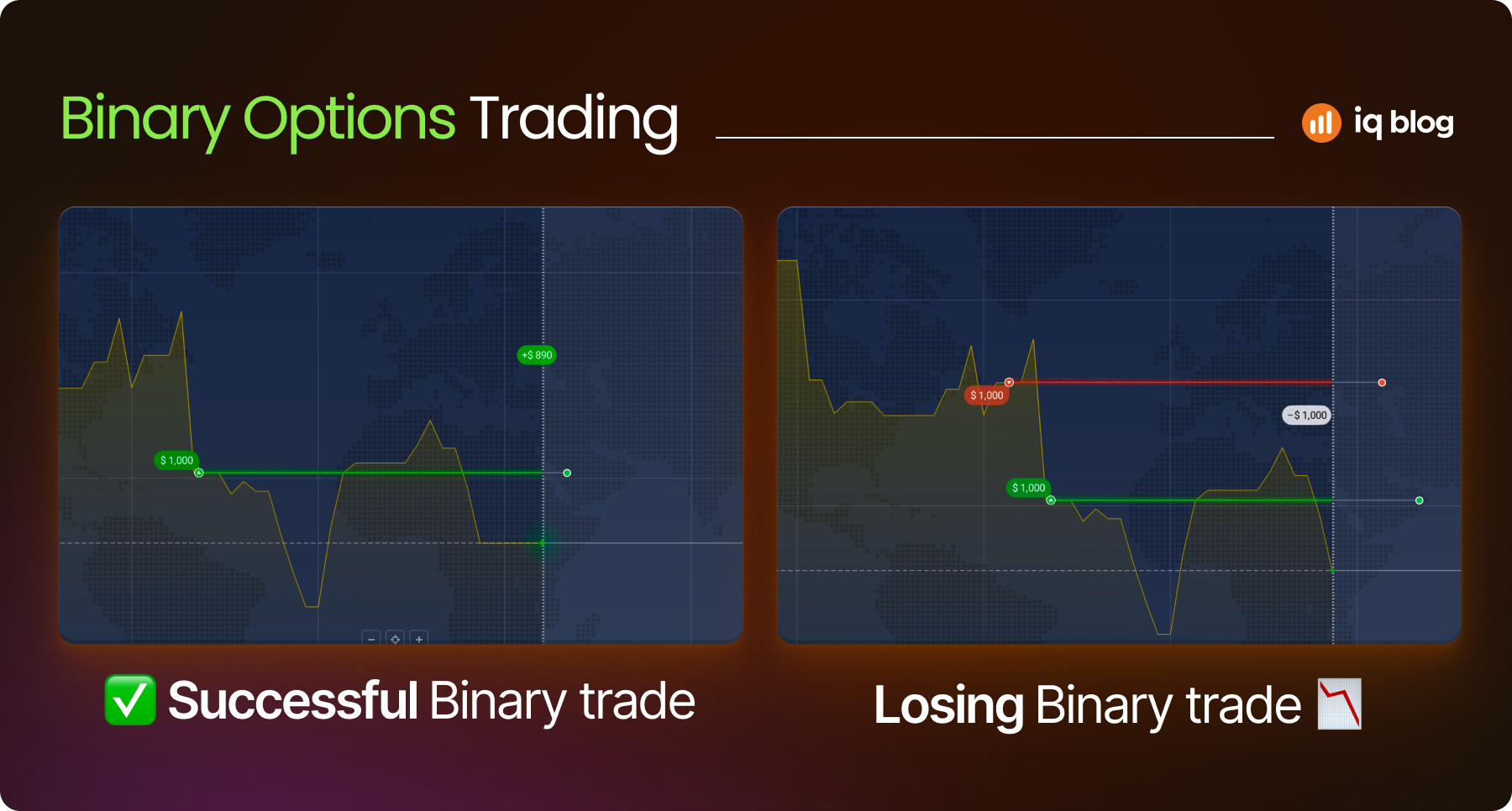
Binary options are so-called since they are binary in nature – two outcomes with no middle ground between them. You either succeed and get the agreed payout or fail and lose the amount you invested.
Let’s assume Apple stock is trading for $150. You believe that it will rise above $150 in the next hour. You purchase an 80% payout call option for $100. If Apple rises even to $150.01 on expiration, you receive $180 (the $100 amount invested + $80 profit). If Apple doesn’t move either above or below $150, you lose your $100 investment.
The Binary Nature Explained
Traditional investments require you to predict the direction and magnitude of price movement. Binary options require only direction. Apple could go up to $150.01 or $160, and your reward is the same.
Such simplicity removes the complexities associated with determining profit based on the size of the price movement. Your minimum loss and maximum profit are always determined before you trade.
Historical Background and Development
Binary options originated from exotic options marketed by institutions in the 1970s. Retail availability began in 2008, when the Securities and Exchange Commission (SEC) sanctioned over-the-counter binary options.
Democratization occurred through online platforms that provided access to instruments previously exclusive to discerning investors. Now, millions of retail traders worldwide trade in binary options markets.
Current Market Landscape
The binary options market has significantly evolved since its retail inception. Fears of fraudulent brokers and abusive marketing practices have lured more regulatory attention to the market.
Legitimate brokers now trade under strict regulatory oversight in jurisdictions like Cyprus, Australia, and the United Kingdom. Regulation protects traders while providing market integrity.
How do Binary Options Work?
The Prediction Mechanism
All binary options trades begin with selecting an underlying asset and predicting its price direction. You can choose from a wide range of assets, including leading stocks, forex pairs, commodities, and cryptocurrency.
Your prediction should tell you whether the asset price will be higher or lower than the current level at a given expiry time. Your prediction becomes the basis of your binary options contract.
Expiry Time Concept
Expiry periods vary from 60 seconds up to a few months, though the majority of retail trading utilizes expiries of between 5 minutes
and end-of-day. Expiry periods decide the point at which your position settles, and the result is determined.
Shorter expiries provide fast results but demand accurate timing. Longer expiries provide time for fundamental influences on price movement, but keep your capital for longer.
Payout Structure Explanation
Binary options brokers provide you with an early percentage payout upfront before you place a trade. Typical payouts are 70-90% of your investment for correct forecasts.
If you invest $100 in an 85% payout option, a successful trade returns $185 total ($100 investment + $85 winnings). Losing trades cost you the entire $100 investment.
Brokers occasionally provide partial refunds (5-15%) on losing trades, but they usually have lower payout percentages on successful trades.
Asset Types Available
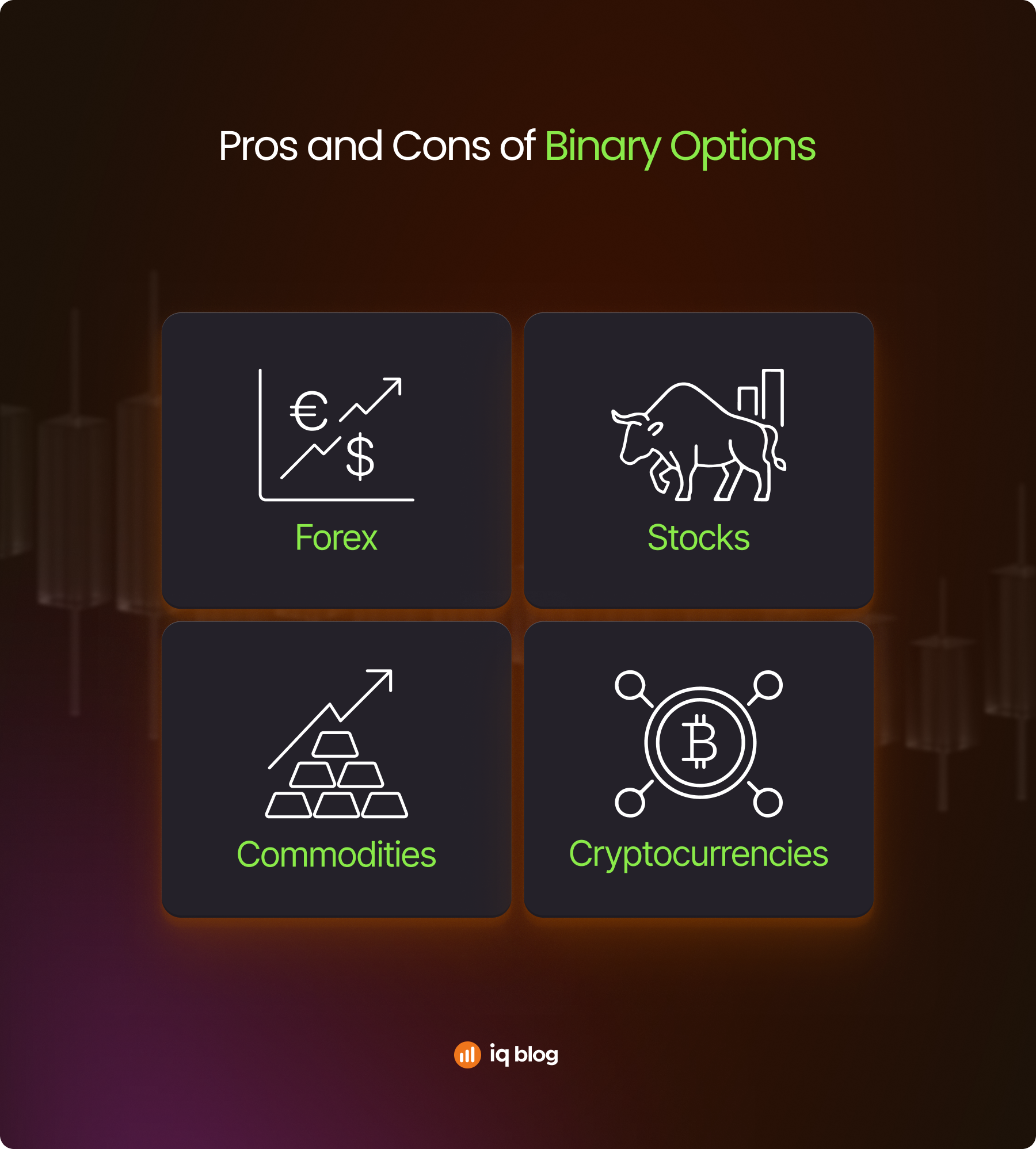
1. Forex Pairs: Major currency pairs like EUR/USD, GBP/USD, and USD/JPY are highly liquid and tightly traded. Economic data announcements continually create trading opportunities.
2. Stocks: Stocks of individual equities listed on major exchanges offer known trading opportunities. Earnings reports and sector news influence price action.
3. Commodities: Gold, silver, oil, and agricultural commodities offer diversification beyond traditional financial markets. Supply and demand fundamentals powerfully influence commodity prices.
4. Cryptocurrencies: Bitcoin, Ethereum, and other cryptocurrencies present 24/7 trading possibilities with high volatility.
Read our article on “How to Trade Commodities?” for more.
Examples of Trades
Example 1: EUR/USD Currency Trade
EUR/USD current rate: 1.15333
Your prediction: Euro will strengthen (call option)
Investment: $50
Expiry: 30 minutes
Payout: 82%
Result: EUR/USD settles at 1.15476 (successful trade)
Return: $91 in total ($50 investment + $41 gain)
Example 2: Gold Commodity Trade
Current gold price: $3,446/ounce
Your prediction: Gold will decline (put option)
Investment: $75
Expiration: End of day
Payoff: 78%
Outcome: Gold at $3,438 (successful transaction)
Return: $133.50 total ($75 investment + $58.50 profit)
Forms of Binary Options
1. High/Low (Call/Put) Options: These simple binary options represent the overwhelming majority of retail trades. You simply predict whether the asset price at expiration will be higher or lower than the current level.
Call options profit when the asset price is higher than the strike price. Put options profit when the asset price is lower than the strike price. This ease of use makes high/low options ideal for beginners.
2. One Touch Options: One-touch options require the asset price to reach a target level at some time before expiry. The target will typically be significantly higher or lower than the current level, paying more (up to 500%) for the increased challenge.
They are suitable for highly volatile markets where significant price movement is expected. Key economic announcements typically generate one-touch trading opportunities.
3. Boundary Options: Boundary choices have two outcomes: the asset price will remain between a range (in-boundary) or break the range (out-of-boundary) before expiry.
Sideways price action favors in-boundary options. Out-boundary options benefit from significant price action in either direction. Choose based on your market volatility expectations.
4. 60-Second Options: Ultra-short expiry options expire after one minute of trading—such a trade appeals to thrill-seeking traders seeking rapid results.
However, 60-second options are mainly at the mercy of market noise and fluctuating price movements. Fundamental analysis is no longer relevant with such short time frames.
5. Ladder Options: Ladder options display multiple strike prices with different payout rates. More aggressive risk predictions (prices further away from current levels) create higher payout rates.
This structure allows risk-reward calibration based on your degree of certainty and market view. Conservative predictions yield lower but more probable returns.
When to Use Each Type
- High/Low: Day trading with a clear directional bias
- One Touch: Breakout or significant news event scenarios
- Boundary: Having defined support/resistance in ranging markets
- 60-Second: Scalping in high-volatility scenarios
- Ladder: When you need to have customized risk/reward ratios
Advantages and Disadvantages of Binary Options Trading
Pros
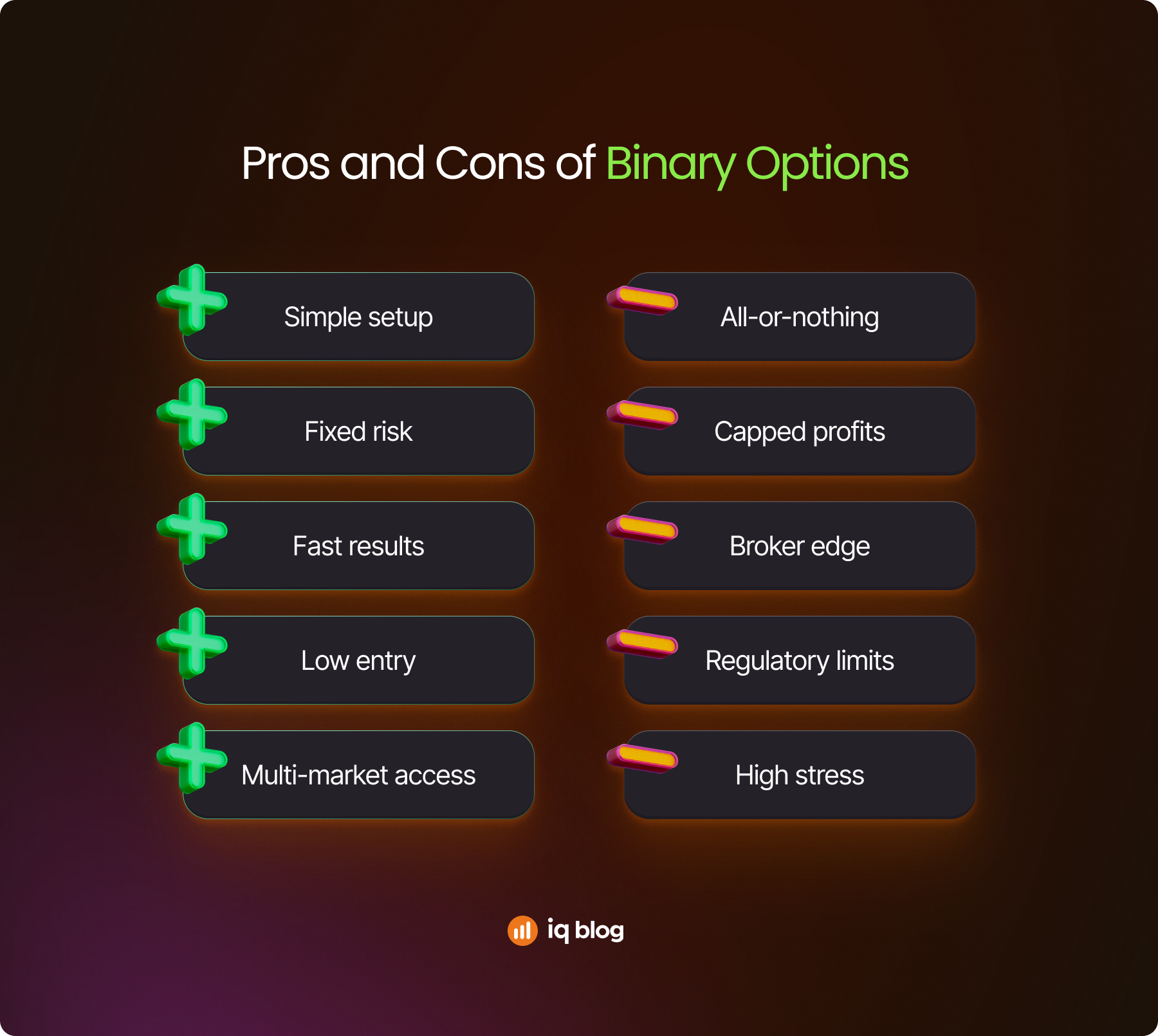
- Ease: Binary options eliminate sophisticated order types, margin calls, and position size calculations. You simply determine direction, amount invested, and expiry time.
- Defined Risk: Your entire loss is your investment. In contrast to leveraged trading, you can lose only what you invest per trade.
- Rapid Results: Short expiry times provide instant feedback on your trades. You can make multiple trades a day on many assets.
- Accessibility: Binary options with low minimum investments (typically $1-10 per trade) are accessible to traders with small accounts.
- Market Variety: Trade stocks, forex, commodities, and cryptocurrencies on one platform without opening different accounts.
Cons
- All-or-Nothing Outcome: Unlike traditional trading, where you can close out positions before expiry to limit losses, most binary options run to expiry with maximum loss exposure.
- Limited Profit Potential: Payouts are capped regardless of how far the asset price moves in your favor. Massive price movements don’t increase your reward.
- House Edge: Broker profit stems from the disparity between payout rates and true odds. This mathematical deficit affects profitability in the long run.
- Regulatory Issues: Some regulators have banned or restricted binary options because they are reminiscent of gambling and are susceptible to exploitation.
- High-Stress Environment: Quick trading choices with rapid results may lead to uncontrolled trading habits that quickly deplete accounts.
Comparison with Traditional Investments
Traditional stock investing allows for unlimited profit potential as stock prices rise. Binary options cap your profits at predetermined payout rates, no matter the size of the price movement.
Stock ownership comes with dividend income and voting rights. Binary options lack ownership benefits since you never actually purchase the underlying instrument.
Binary options lack margin requirements or overnight carry charges, which affect traditional leveraged buying. Your cost structure is transparent and predictable.
Assessment of Profitability
Many retail binary options traders lose money in the long term due to the mathematical house edge and emotional trading choices. Prosperity requires outstanding discipline and market knowledge.
Expert traders view binary options as only one among numerous tools and not a primary source of income. The straightforward design is easy to use for specific market conditions, but it is not adaptable to each situation.
Tips on Regulation and Safety for Binary Options Trading
1. Regulatory Landscape
Binary options regulation varies widely around the world. European regulators impose strict bans based on consumer protection concerns, whereas others follow more open-minded policies.
The European Securities and Markets Authority banned the retail sale of binary options in 2018. However, professional clients can still gain access to these products under specific conditions.
2. Identify Legitimate Brokers
Regulated brokers segregate customer money from business operating accounts. This segregation protects deposits if the broker’s financial health runs into trouble.
Good platforms disclose fair pricing without manipulative or sneaky fees. They welcome regulatory inquiry and maintain immaculate compliance records.
3. Trader Protection Features
Deposit protection schemes in some jurisdictions insure client funds to specified levels—research protections in your broker’s region of regulation.
Independent dispute resolution services settle disputes between traders and brokers. They provide a substitute for expensive legal proceedings.
4. Red Flags to Steer Clear Of
Avoid brokers who promise profits or risk-free trading methods. Binary options are risky by nature and cannot be evaded.
Be wary of aggressive sales pitches or limited-duration bonus offers that require enormous deposits. Real brokers care about learning and lasting relationships, not short deposits.
Unregulated brokers typically restrict withdrawals with advanced bonus terms or check delays. Use regulated alternatives even when they offer fewer bonuses.
How to Get Started Trading Binary Options
1. Get a Trading Strategy
The nature of binary options usually requires a trading style that focuses on short-term market movements. Honing your technical analysis skills, therefore, becomes crucial. Common approaches to trading this market include trend-following or breakout strategies.
Whatever trading style you settle with, it’s vital to have confluences, especially for your trade entries. You’ll need to figure out what works best for you with due diligence by backtesting and forward testing different strategies while demo trading before you go live. However, it is essential to be disciplined in your trade executions and not to neglect risk management.
2. Choose a Regulated Broker
Regulatory supervision safeguards your money and guarantees equitable trading terms. Seek brokers authorized by reputable financial regulators such as CySEC, FCA, or ASIC.
Check licensing claims independently on regulator websites instead of relying on broker marketing communications. Reputable brokers embrace scrutiny and display license numbers prominently.
2. Account Setup Process
Registration requires minimal personal information, including full name, address, and contact details. Brokers complete account verification in 24-48 hours for regular documents of verification.
Be prepared with government-issued ID and proof of address (utility bill or bank statement) for verification. This documentation prevents withdrawal delays in the future.
3. Demo vs Live Trading
Demo accounts let you practice strategies without financial risk. Use practice trading to become accustomed to platform tools and develop consistent styles.
Gradually transition to live trading with small position sizes. The psychological stress of real money affects decision-making differently compared to demo trading.
4. Initial Deposit Considerations
Start with stakes you can risk losing completely. Binary options are risky, and learning curves typically come with losing phases.
Don’t make significant amounts of money to put up front, despite bonus offers or promotions. Build your account through steady returns rather than large starting deposits.
You can check out our “A-Z Guide on How to Trade Binary Options” for more helpful info.
Conclusion
Binary options are a unique financial instrument that bridges traditional investing and speculative trading in the manner in which they reduce the yes-or-no format. Although they bring comfort of accessibility, formalized risk, and quick feedback that appeal to most traders, the reality is that the majority of players are faced with daunting barriers on the basis of mathematical house edge, regulatory restrictions, and psychological pressures of all-or-nothing returns.
Success requires great discipline, market research, and modest expectations of profitability. To what extent you view binary options as legitimate trading vehicles or speculative wagers depends on your strategy, risk profile, and regulatory environment. To those who want to trade binary options, adequate education, demo account experience, and starting with regulated brokerages with only capital you can afford and are willing to potentially lose entirely are imperative first steps.