



High-frequency trading (HFT) is a form of algorithmic trading that uses advanced computers to make thousands of trades in a matter of milliseconds. It relies on speed, automation, and advanced algorithms to detect tiny market opportunities before they disappear.
In short, HFT is about trading faster and more frequently than any human could.
What Is High-Frequency Trading?
High-frequency trading is algorithmic trading where computers trade very rapidly. Instead of holding securities for days, weeks, or months, HFT systems can purchase and sell the same security in milliseconds.
Unlike traditional trading, in which human operators examine charts and place orders manually, HFT depends on algorithms, top-of-the-line equipment, and live market data feeds. The goal is not making money from huge price fluctuations but to capture infinitesimal differences in prices a few times per second.
Speed and technology form the very basis of HFT. High-performance servers, low-latency connectivity to the internet, and even colocation (housing trading machines directly alongside exchange servers) give the traders a huge advantage. Microseconds matter here: the faster the system, the higher the chances of making a profit.
How High-Frequency Trading Works
High-frequency trading relies on a blend of algorithms, powerful computers, and direct access to exchanges. The entire process happens in microseconds, far beyond what human beings can do. Below is a simple breakdown of how it works:
- Market Data Feeds – Software continuously scans real-time market information from multiple exchanges.
- Algorithms Analyze – Algorithms search for small opportunities: price gaps, trends, or inefficiencies.
- Order Placement – After they have been identified, the system automatically places buy and sell orders.
- Speed of Execution – Trades are executed in microseconds, often before other traders.
- Advantage of Colocation – Various HFT firms position their servers inside or nearby stock exchange data centers to reduce latency.
- Exit within Seconds (or Even Faster) – Positions are closed for milliseconds or for a few seconds at most, not long-term.
Characteristics of High-Frequency Trading
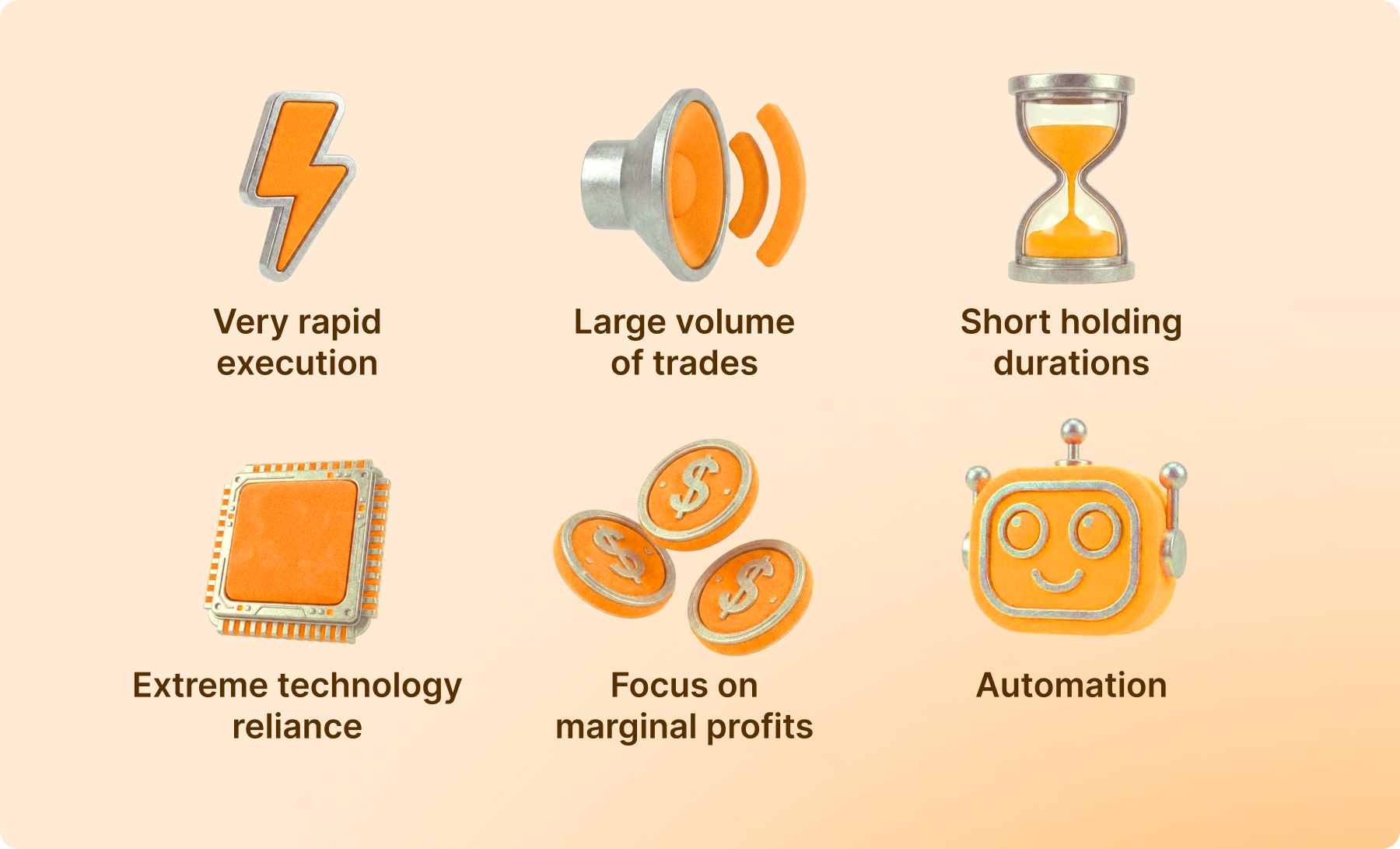
High-frequency trading has some characteristics that distinguish it from other forms of trading:
- Very rapid execution – Orders are placed and executed in microseconds.
- Large volume of trades – Thousands of small trades are made every day, each targeting infinitesimal price differences.
- Short holding durations – Securities are typically held for a brief period of less than one second prior to selling.
- Extreme technology reliance – Reliance on advanced hardware, algorithms, and very low-latency connections.
- Focus on marginal profits – Each trade earns a fraction of a cent, but quantity makes it viable.
- Automation – No hand intervention in the execution: computers do it all.
These features make HFT both very effective and very controversial since only firms with advanced technology can effectively compete.
Methods Used in High-Frequency Trading
High-frequency trading firms utilize several methods to reap profits in small spans of time. The most favorite ones are:
Market Making
- HFT systems place buy and sell orders for the same security.
- They profit from the difference between bid and ask price (the spread).
- Example: Selling at $100.02 and buying at $100.01 hundreds of times a second.
Arbitrage
- Making a profit from small price differences between markets or exchanges. You can trade across Forex, Stocks, and Crypto CFDs – a perfect sandbox to try out arbitrage logic.
- Example: If Apple stock is $150.00 on one and $150.02 on another, a HFT algorithm can buy at the lower and sell at the higher exchange in a flash.
Trend Following
- Algorithms detect short-term trends and buy and sell accordingly.
- Example: If a stock is nudged up several times in a matter of milliseconds, the system may buy to capture that micro-trend.
Event-Based Trading
- Algorithms react to news or data releases faster than humans.
- Example: A well-received earnings announcement could lead to instant buy orders before analysts even open the whole report.
These strategies generally look for niches not accessible to human traders but, when duplicated in high volume, equal significant earnings.
Pros of High-Frequency Trading
Advocates of HFT argue that it provides real benefits for financial markets. Its primary advantages are:
Greater Liquidity
- HFT firms constantly buy and sell, which keeps markets open.
- This makes entering and exiting positions more convenient for the traders.
Narrower Bid-Ask Spreads
- HFT companies challenge each other to minimize the spread between buy and sell prices.
- Example: From a $1 spread, it is minimized to mere cents – cheaper for normal traders.
Faster Price Discovery
- Markets adjust rapidly to new information since HFT systems respond instantaneously.
- This keeps prices fair and true to supply and demand.
Reduced Transaction Costs for Retail Traders
- Greater competition in the marketplace reduces trading costs for non-HFT participants.
Though unpopular, such benefits highlight why HFT has become so dominant in modern markets.
Cons and Criticisms of High-Frequency Trading
While HFT has its benefits, it also raises serious issues. Critics argue that it can make markets riskier and less fair. Primary drawbacks include:
Market Volatility
- Extremely rapid trades can amplify minuscule price movements, making markets volatile.
- Example: The 2010 “Flash Crash,” where U.S. stocks plummeted nearly 1,000 points in minutes, was blamed on HFT activity.
Flash Crashes
- Automated systems can trigger sudden crashes when several algorithms react at the same time.
- Prices recover, but such episodes erode investor confidence.
Unfair Advantage
- Only those firms with expensive technology (fast servers, colocation) can participate. Beginners can still safely learn by using a free demo account to practice without real risk.
- This raises questions about fairness for retail investors and traders.
Systemic Risk
- When algorithms go wrong, massive losses can be suffered in seconds.
- Example: Knight Capital lost $440 million in 2012 due to a software glitch.
Regulatory Concerns
- Regulators worry about transparency, market manipulation, and excessive speed.
- New regulations continue to emerge to limit risks of HFT.
These issues are why high-frequency trading is so heavily debated among economists, regulators, and market insiders.
BIS research shows that “latency arbitrage,” where the fast player wins races over very short-lived prices, occurs approximately once a minute for FTSE 100 stocks. These micro-races, involving only 5-10 microseconds, represent 20% of turnover and contribute one-third of effective spread, adding about 0.5 basis points to the cost of liquidity.
High-Frequency Trading Around the World
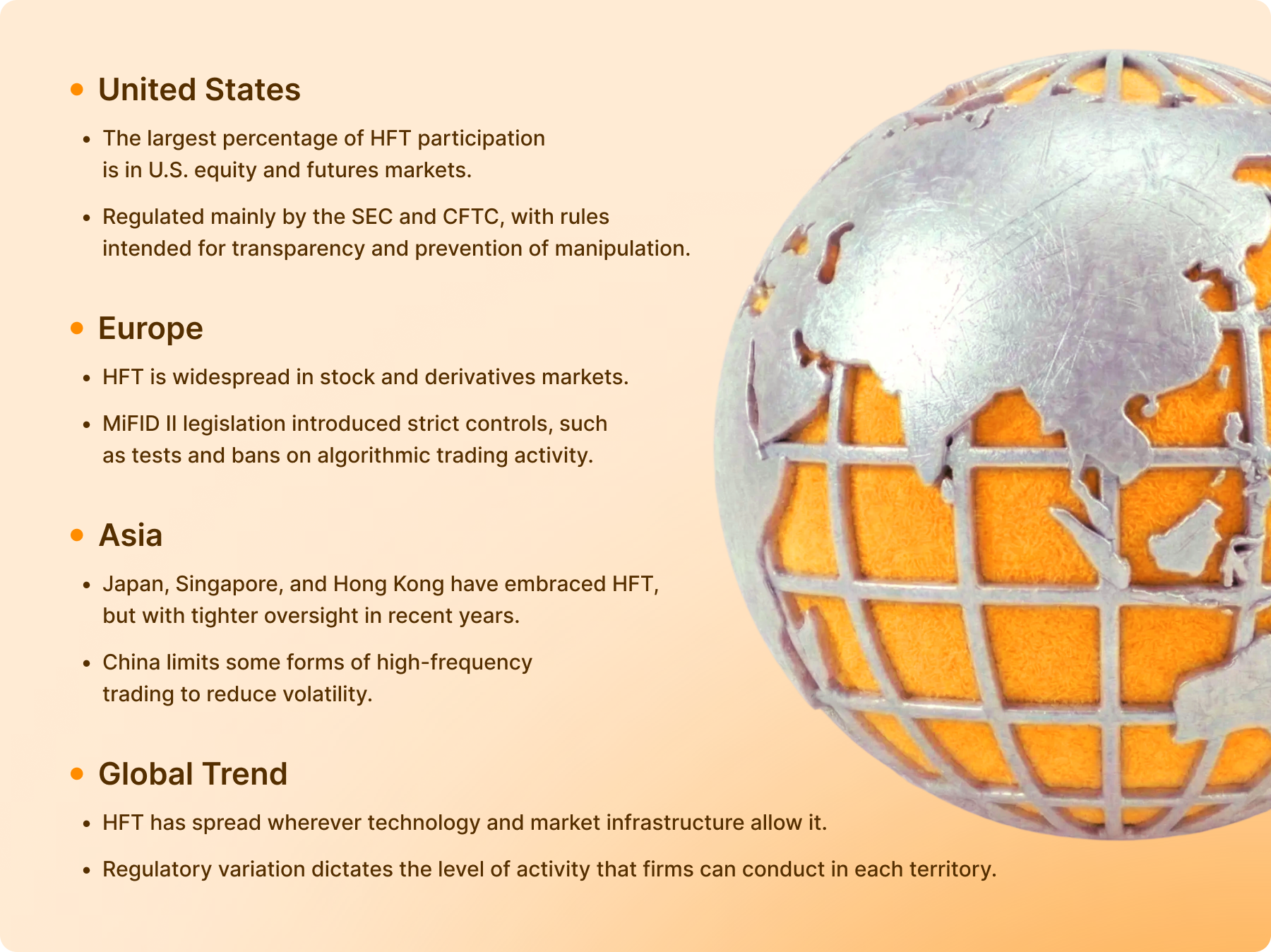
High-frequency trading is not a U.S. only phenomenon. It is now a global trend, though adoption and regulation vary by region.
United States
- The largest percentage of HFT participation is in U.S. equity and futures markets.
- Regulated mainly by the SEC and CFTC, with rules intended for transparency and prevention of manipulation.
Europe
- HFT is widespread in stock and derivatives markets.
- MiFID II legislation introduced strict controls, such as tests and bans on algorithmic trading activity.
Asia
- Japan, Singapore, and Hong Kong have embraced HFT, but with tighter oversight in recent years.
- China limits some forms of high-frequency trading to reduce volatility.
Global Trend
- HFT has spread wherever technology and market infrastructure allow it.
- Regulatory variation dictates the level of activity that firms can conduct in each territory.
Technology Behind High-Frequency Trading
Sophisticated technology is the lifeblood of HFT. State-of-the-art infrastructure is a requirement for these trades.
Algorithms
- Core of HFT: computer programs with instructions on when to buy or sell.
- Constantly revised to react to market developments in microseconds.
Powerful Computers
- Specialized hardware built for speed and reliability.
- Can handle massive volumes of data simultaneously.
Colocation Facilities
- HFT firms rent space inside or near exchange data centers.
- This reduces latency (the time signals take to travel) near zero.
Ultra-Fast Connections
- Use of fiber-optic cables and microwave links to transmit data.
- Even a one-millisecond advantage can mean millions in profit.
Artificial Intelligence & Machine Learning
- Being ever more used to recognize patterns and optimize strategies.
- Helps algorithms react to changing market conditions.
Regulation of High-Frequency Trading
Because of its speed and size, high-frequency trading has drawn feverish regulatory attention around the world. Regulations are supposed to balance innovation with market stability.
United States (SEC & CFTC)
- Require HFT firms to register as broker-dealers.
- Focus on market manipulation and system error testing.
- Example: Rules against “spoofing,” placing false orders to mislead markets.
Europe (ESMA & MiFID II)
- MiFID II gave strict directives for algorithmic trading.
- Firms must implement controls on risk, testing procedures, and large record-keeping.
- Goal: increase transparency and reduce systemic risks.
Asia
- Japan and Singapore allow HFT but impose reporting requirements.
- China has imposed tighter limits to inhibit excessive speculation.
Global Challenge
- Technology evolves faster than regulations.
- Regulators are constantly adapting to ensure markets are safe while allowing the potential for fair competition for everyone.
Real-World Examples of High-Frequency Trading
High-frequency trading has left its mark on financial markets – sometimes with dramatic effects.
The 2010 Flash Crash
- On May 6, 2010, U.S. stock markets fell nearly 1,000 points within minutes, only to recover a short while later.
- HFT algorithms intensified the sell-off as they reacted to each other’s orders with lightning speed.
- The event fueled global concerns about the risks of automation in trading.
The SEC and CFTC issued a detailed joint report on this event, outlining how algorithmic trading and rapid automated executions contributed to the crash activity.
Knight Capital’s 2012 Glitch
- A software glitch at Knight Capital, one of the biggest HFT players, caused it to flood markets with faulty trades.
- In 45 minutes, the company lost approximately $440 million and nearly shut down.
- The incident highlighted the dangers of employing insufficiently tested algorithms.
Day-to-Day Effect
Apart from crashes, HFT also affects day-to-day trading. For example, spreads on highly traded stocks are narrower today in large part because HFT companies provide constant liquidity.
Future of High-Frequency Trading
High-frequency trading will remain a vast part of global markets, but its shape is changing.
More AI and Machine Learning
- Algorithms will become smarter, not always faster.
- Systems will learn to adapt to shifting markets in real time.
Stronger Regulation
- Regulators will keep tighting up rules to limit threats like flash crashes.
- Expect more stress testing, reporting, and transparency rules.
Global Expansion
- Asia, Latin America, and Africa can anticipate increasing HFT as infrastructure improves.
- Firms will look for expansion where the regulatory environment is favorable and competition is reduced.
Tech Arms Race
- Even faster connections, maybe even quantum computing in the future.
- Firms will keep investing big money into infrastructure for even slight speed gains.
Continuing Debate
- Some consider HFT to be making the markets more efficient.
- Others believe that it adds unnecessary risk. This debate will determine its fate.
Conclusion
High-frequency trading has transformed markets in the twenty-first century. By employing high-powered computers and algorithms, it accelerates trading, reduces spreads, and enhances liquidity. At the same time, it challenges fairness, market stability, and the risk of too much reliance on automation.
Whether one regards it as positive or negative, HFT is here to stay. Its destiny will depend on the direction technological innovation takes and how regulators can find a delicate balance between innovation and security. To investors and traders, studying HFT is crucial to understanding how today’s financial markets truly function.