



A dark pool is a private exchange where large buy and sell orders are executed without revealing them to the public order book until after the trade has been completed. Unlike conventional exchanges, the trades are not visible until they’re reported, hence preventing sudden price movement.
Dark pools are important because they enable institutional traders such as hedge funds and pension funds to shift large positions anonymously without advertising their intentions to the market. For retail traders, the knowledge that there is dark pool activity can explain mysterious price movements and give hints about institutional sentiment behind the scenes.
What Are Dark Pools?
Definition and Primary Characteristics
- Dark pools are private exchanges on which traders sell or buy big volumes of securities without revealing their orders to the public.
- Orders are kept anonymous until executed, and trade details are reported after the trade is completed.
- They were created to minimize market impact – so large trades won’t move prices prior to being filled.
How Dark Pools Are Different from Lit (Public) Exchanges
- Order visibility – At public exchanges, buy and sell orders are shown in the order book. In dark pools, they are not.
- Price impact – Public orders can push prices up or down if the market takes in large demand or supply. Dark pools conceal that pressure until after the trade.
- Timing of disclosure – Lit exchanges publish trades in real time. Dark pools report them with a delay, typically after the market has moved on.
- Participants – Lit markets consist of a mix of retail and institutional traders. Dark pools are used almost solely by large institutional investors.
Types of Dark Pools
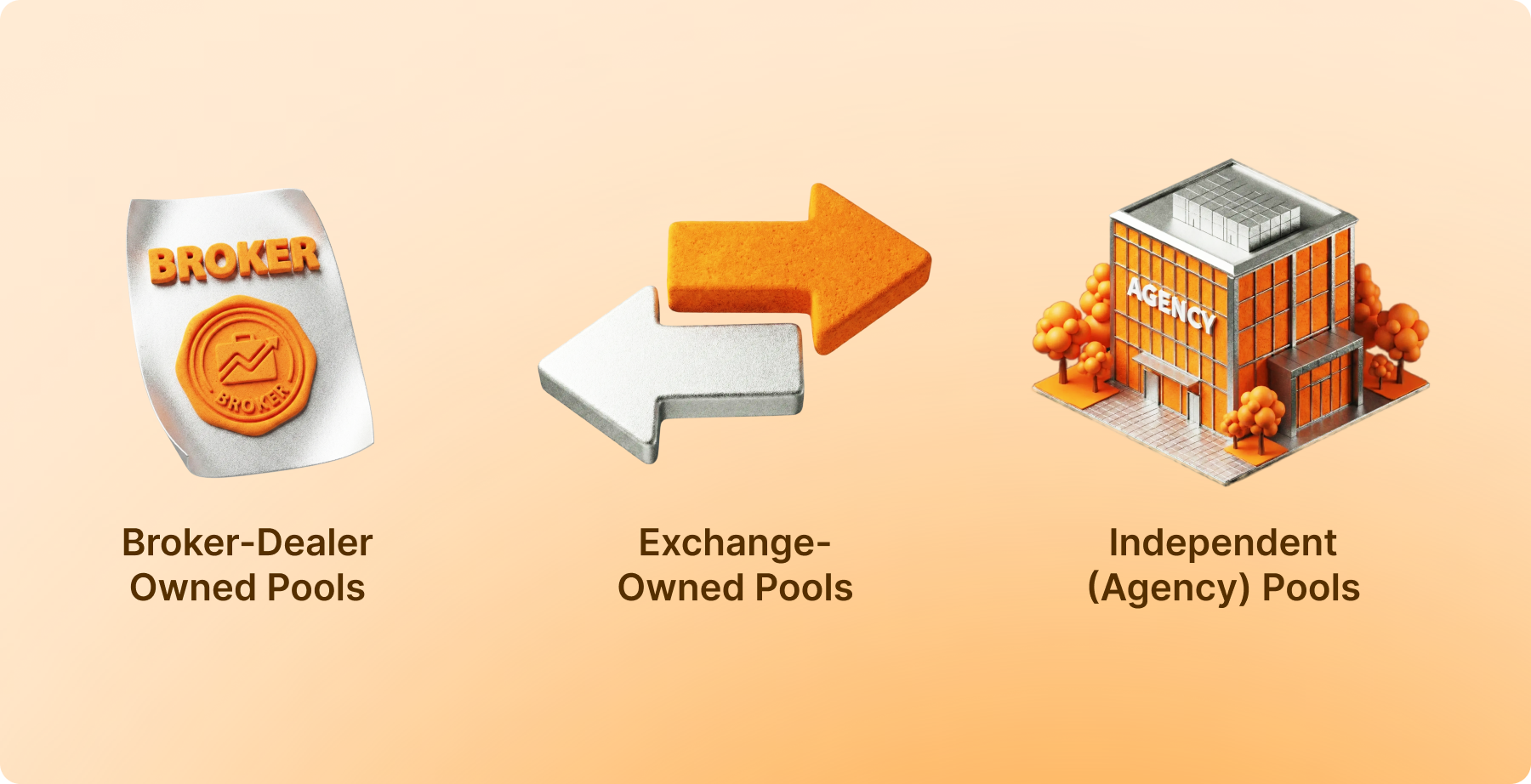
Broker-Dealer Owned Pools
- Owned by large brokerage firms or investment banks.
- They are more likely to match orders internally between their own customers.
Exchange-Owned Pools
- Large stock exchanges (like NYSE or Nasdaq) run them as private, separate venues.
- Provide anonymity while using the same technology as their public markets.
Independent (Agency) Pools
- Operated by and owned by independent firms that do not trade on their own account.
- Only match client orders and usually act as neutral intermediaries.
Why Dark Pools Exist
Primary Advantages for Institutional Traders
Minimize market impact
- Placing a large order on a public exchange can move the price against the trader.
- Dark pools enable traders to trade anonymously, without revealing their size or intentions.
Maintain anonymity
- Other market participants can’t see who is buying or selling until after the trade.
- This protects institutional strategies from front-running or copying.
Lower transaction cost
- Dark pools have tighter spreads and lower fees than public exchanges.
- Internal order crossing can make exchange fees irrelevant.
When They Are Used
Block trades
- Large funds may want to buy or sell millions of shares without moving the market.
Portfolio rebalancing
- Institutions rebalancing positions at quarter-ends use dark pools to do this quietly.
Stealth entry or exit
- When breaking into a new position or liquidating a losing one, remaining concealed avoids price increments or decrements due to their own trades.
How Dark Pools Function in the Real World
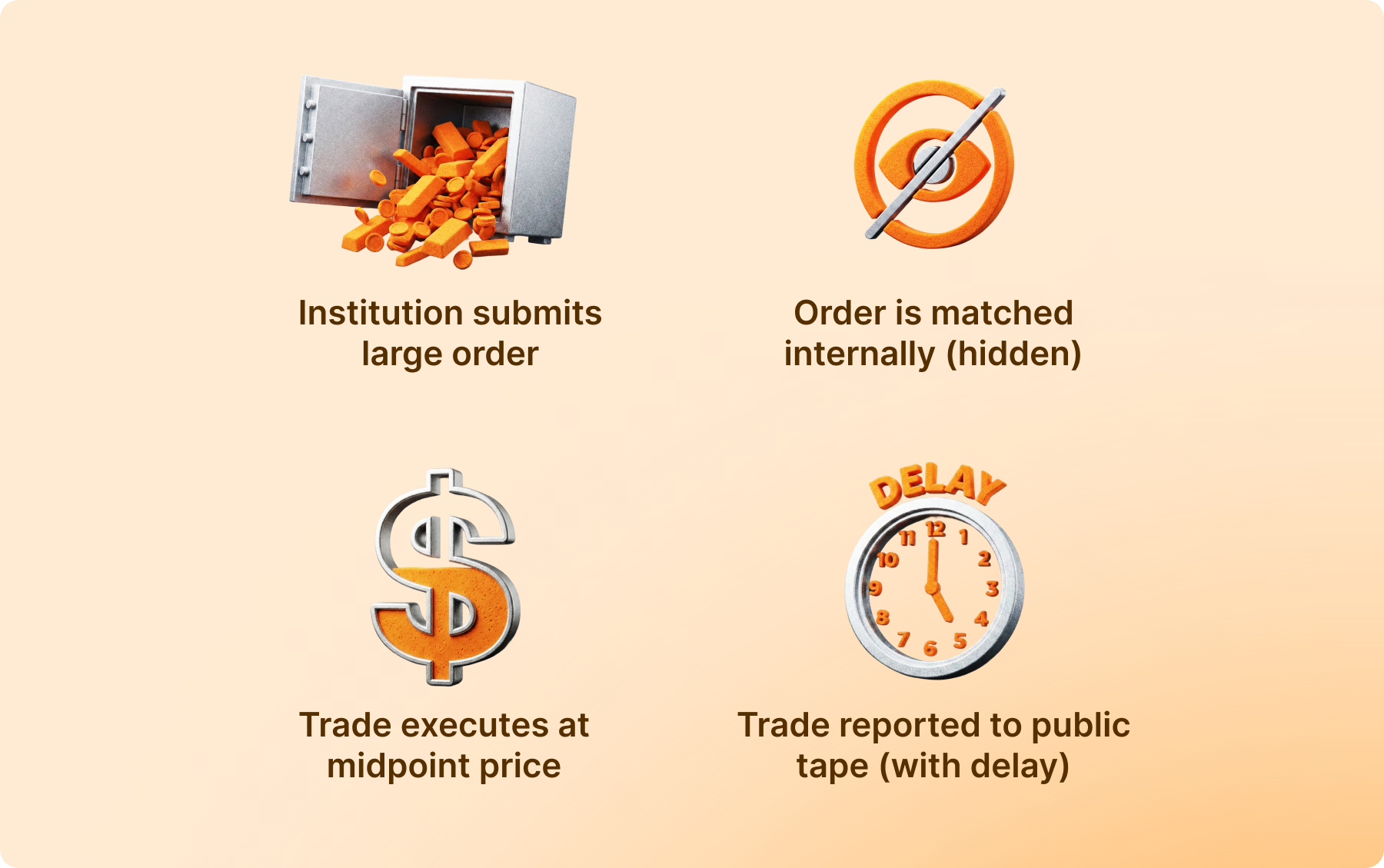
Order Matching and Pricing
- Dark pools match buy and sell orders internally without making them visible to the entire market.
- Orders are typically executed at the midpoint between the national best bid and offer (NBBO) to facilitate fair prices.
- Certain pools use volume-weighted average price (VWAP) or other benchmark-driven methods to determine execution prices.
Trade Reporting and Disclosure
- Trades are not displayed on the public order book before execution.
- They are then posted to the consolidated tape upon execution, usually in minutes.
- This lag reduces market impact, as by the time it appears in the trade, price has usually already stabilized.
Liquidity and Participants
- Dark pools are utilized mainly by institutional investors (mutual funds, pension funds, hedge funds) who need to sell large quantities of stock.
- High-frequency traders (HFTs) may step in from time to time to provide liquidity, although this is controversial.
- Retail traders are not directly accessible but can be indirectly affected if their brokers route orders through dark pools.
Weaknesses and Criticisms
Lack of Transparency
- Dark pools don’t disclose order flow, and therefore other market participants can’t see who is buying or selling.
- This can reduce price transparency and make it harder to calculate true supply and demand.
Effect on Price Discovery
- Because large trades are being done away from the exchange, less volume is seen on public exchanges.
- This can distort price signals and complicate it for the market to set a fair price for a security.
Abuse Potential
- There is the potential for conflicts of interest if the dark pool is run by a broker who also trades on its own behalf.
- HFTs can exploit dark pools by discovering hidden large orders and trading against them (“latency arbitrage”).
- A few have been charged with gouging specific clients or cheating investors by advising them with whom they are doing business.
Regulatory Issues
- Regulators worry about unlevel playing fields and market fragmentation as a result of too much dark pool use.
- A number of high-profile enforcement actions and fines have targeted operators who failed to comply with disclosure rules.
- Continuing U.S. and EU reforms call for additional transparency and reporting obligations.
Dark Pools and Retail Traders
Do Dark Pools Influence Retail Traders?
- Retail traders usually don’t trade directly in dark pools, but they are indirectly impacted nevertheless.
- When a block institutional trade off-exchange trades, it can shift market prices on disclosure, affecting retail accounts.
- This trading can sometimes explain unexplained price movement with no apparent news.
How Retail Orders Might Get Routed
- There are some retail brokers who route orders in dark pools in an attempt to get better prices or pay less in fees.
- These orders tend to be small and aggregated before being matched against flows from institutions.
- Retail traders may not be aware their orders went through a dark pool.
Can Retail Traders Utilize Dark Pool Data?
- Although real-time dark pool data are limited, certain analytical software offer reported dark pool prints after the fact.
- Monitoring this data can offer insights regarding institutional sentiment, especially if large blocks appear before price moves.
- Traders should treat this as context, not signals, and combine it with other analysis and risk controls.
Recent Trends and Regulatory Environment
Increasing Regulatory Scrutiny
- EU (SEC) and U.S. (ESMA) regulators both have become more stringent in reporting requirements to draw dark pool activity out of the shadows.
- European markets have restrictions on dark trading volume to prevent too much liquidity from being taken away from the exchange.\
- U.S. proposals focus on faster reporting and improved disclosures about how dark pools operate and who is participating in them.
Shift Toward More Transparency
- Additional post-trade disclosure of execution time, price, and counterparties (anonymous) is provided by some dark pools.
- Technologies for market surveillance are becoming more powerful, making it harder for participants to employ dark pools for manipulative purposes.
- This has improved regulatory monitoring and investor confidence without undermining their main purpose, reducing market impact.
Changing Role of Dark Pools
- Dark pool trading as a share of total market volume has stabilized after decadal growth in the 2010s.
- More trades are being routed between lit and dark venues by utilizing smart order routing algorithms.
- New platforms combine dark pool anonymity with a more transparent price and attempt to strike the best balance between fairness and efficiency.
Conclusion
Dark pools are off-exchange markets where large orders are anonymously traded to reduce the impact on the market. Despite being targeted towards institutional investors, their trading indirectly influences retail market prices visible on public exchanges.
Understanding how dark pools work – their use, risks, and regulatory status – will help traders more effectively understand sudden price action and market behavior. They’re not something the vast majority of retail traders will ever implement directly, but having an awareness that they exist is a very valuable context for market behavior.
Use dark pool data as part of your broader strategy, combined with technical indicators, market news, and tight risk control. Knowledge, and not activity, is what will be profitable for you here. To explore how markets work in practice, you can open a free practice account on IQ Option and test your strategies safely before trading real funds.