


ETF trading offers new investors a low-cost method of investing in a wide range of markets in one vehicle. An ETF or Exchange-Traded Fund, is a collection of assets such as stocks, bonds or commodities. They are combined into a single fund and traded like a stock on an exchange.
This is because the investor can purchase or sell an ETF’s shares as easily as they can purchase or sell stock in Apple or Tesla. However, unlike individual stocks, ETFs provide instant diversification, which minimizes risk for new traders.
Here, you will discover how ETF trading is done, why it’s gaining such popularity, how to begin trading ETFs, and what to be aware of as a beginner.
How ETFs Work in Trading
ETFs are structured to track the performance of a prevailing index, sector, commodity or asset class. Each ETF has a portfolio of underlying assets and its price varies with the aggregate value of assets. This makes it easier for traders to get exposure in broad markets without choosing individual stocks.
When you trade an ETF, you’re buying shares of a fund that represents ownership in multiple assets. For example, a technology ETF may include shares of companies like Apple, Microsoft and Nvidia. If those stocks rise, the ETF’s price goes up. If they fall, the ETF declines.
ETFs are traded exchange-traded throughout the day. This differs from mutual funds, which settle once daily at the close of the market. Because of this structure, ETFs are more flexible for day traders and swing traders.

Types of ETFs Beginners Should Know
Knowing the primary types of ETFs enables beginners to traverse various asset classes and market strategies with less uncertainty. Let’s have a closer look at each one of them.
Stock ETFs
Stock ETFs take shares of numerous companies and package them together in a single fund. They can either follow general indexes like the S&P 500 or focus on one industry like technology, healthcare or energy. For example, an ETF that follows tech could have shares in Apple, Nvidia and Meta. ETFs are ideal for beginners because they reduce single-stock risk with ongoing exposure to equity market trends. They are very liquid and also have low management fees.
Bond ETFs
Bond ETFs invest in fixed-income bonds. Also include government bonds, corporate bonds or municipal debt. Bond ETFs provide investors with steady income in terms of payments of interest and are less volatile than stock ETFs. For those who wish to play it safe or are looking for a hedge when the markets are depressed, bond ETFs provide a more stable option. Examples include U.S. Treasury bond ETFs and investment-grade corporate bond funds.
Commodity ETFs
Commodity ETFs give exposure to raw materials such as gold, silver, oil or natural gas. Rather than dealing directly in futures contracts or physical delivery, investors can employ these ETFs to take positions in commodity prices. Gold ETFs such as GLD are especially popular for protecting against inflation risk or currency risk. Commodity ETFs can be volatile, however, depending on supply-demand considerations along with geopolitical happenings.
Currency ETFs
Currency ETFs are built to replicate the performance of a single currency or a currency index. They serve as an alternative to betting on the foreign exchange market. For instance, the Invesco UUP follows the U.S. dollar against a basket of foreign currencies. Currency ETFs enable investors to win or hedge currency movements without the need for leverage or complex trading platforms. They’re also utilized to hedge portfolios against exchange rate risk in international investments.
Thematic and Sector ETFs
These ETFs are built around specific investment themes or areas of the industry. For example, there are ETFs focused on clean energy, artificial intelligence, blockchain or e-commerce. They allow traders to bet on new trends or innovation without the need to pick individual winners. Sector ETFs, like financials or biotech, also allow traders to rotate exposure based on a shift in the economic cycle. While these funds offer focussed opportunities, they tend to be more volatile due to the concentrated nature of their holdings.
Why ETFs Appeal to Beginner Traders
ETFs are very recommended for new traders since they offer a perfect mix of simplicity, flexibility, and diversification. Instead of buying a single stock or bond, traders can purchase a variety of assets within one trade.
- Instant Diversification – Having multiple assets, ETFs reduce the risk of a single investment. A stock ETF that replicates a broad index by spreading exposure to hundreds of companies is one such example. Even if one stock collapses, losses are offset by gains elsewhere.
- Low Cost of Entry – Most ETFs carry lower management fees than mutual funds. Minimum investment levels are not substantial, and buying them on a platform like IQ Option is quick and straightforward.
- Real-Time Trading – Unlike mutual funds, ETFs are traded on an exchange during market hours. This enables traders to buy or sell them at prevailing prices, just like stocks. This is especially helpful for short-term strategies.
- Access to Niche Markets – TFs allow traders to access industries or themes that would otherwise be impossible to enter, for example, lithium mining, cybersecurity or frontier markets. This makes them critical to strategy building.
- Tax Efficiency – ETFs use a special structure that allows for more efficient capital gains handling. While not all ETFs are tax-friendly, many generate fewer taxable events than traditional funds.
How to Start Trading ETFs: Step-by-Step for Beginners
Getting started with ETF trading is simple, especially if you’re on a user-friendly platform like IQ Option. Here is a simple step-by-step guide to help you get started.
- Sign up for a Trading Account – Simply choose a broker that is licensed and offers ETF trading. IQ Option allows you to open an account within minutes. Verify your identity and deposit the funds you plan to use.
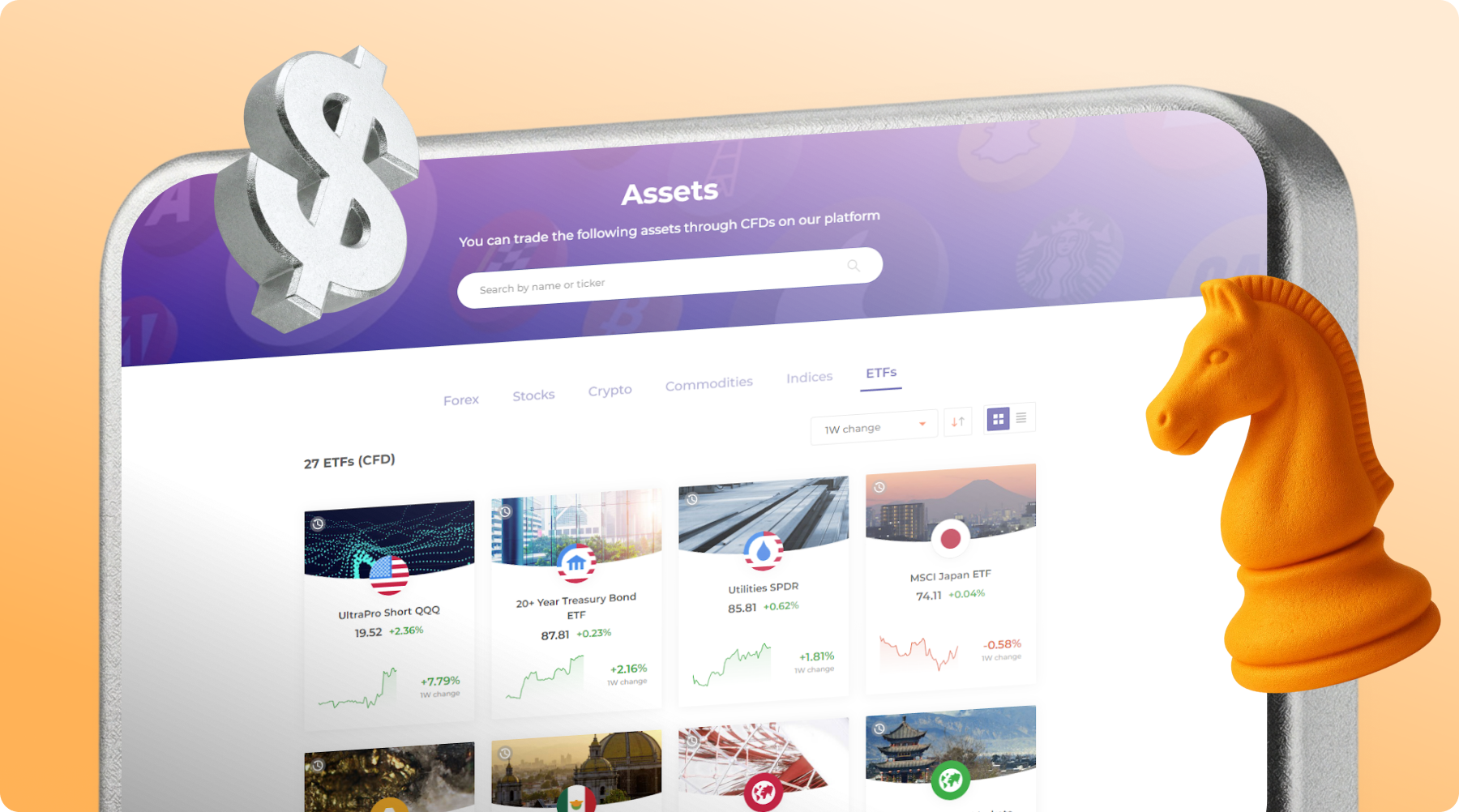
- Learn the Platform – Familiarise yourself with the broker’s interface. Look at where you can find ETFs, place buy or sell orders and view your positions. Demo accounts are available on most platforms too so you can test risk-free.
- Choose an ETF to Trade – Use filters or categories to search ETFs by asset class, region, or sector. Novice investors can start with large index ETFs, like those tracking the S&P 500 or Nasdaq. More advanced users may want to use leveraged or thematic ETFs.
- Study the ETF – See what the ETF is actually invested in, how it has performed, the fees and volatility. Study charts and indicators to find out when to buy or exit a position. The ETF fact sheets or profiles will allow you to understand the fund’s strategy.
- Put on a Trade – Select how much you wish to invest and place a buy or sell order. Market orders (executed at current price) or limit orders (executed at specific price) can be used. Fractional ETF investing is supported by some brokers.
- Monitor and Adjust – Track the ETF price and market news tracked by the ETF. Set stop-loss or take-profit levels if you have a risk management plan. Review your positions on performance or changing objectives.
ETFs vs Mutual Funds vs Stocks: Key Differences
For beginners, understanding how ETFs differ from mutual funds and individual stocks can help shape better trading decisions. While these products all involve market exposure, their structure and use cases vary.
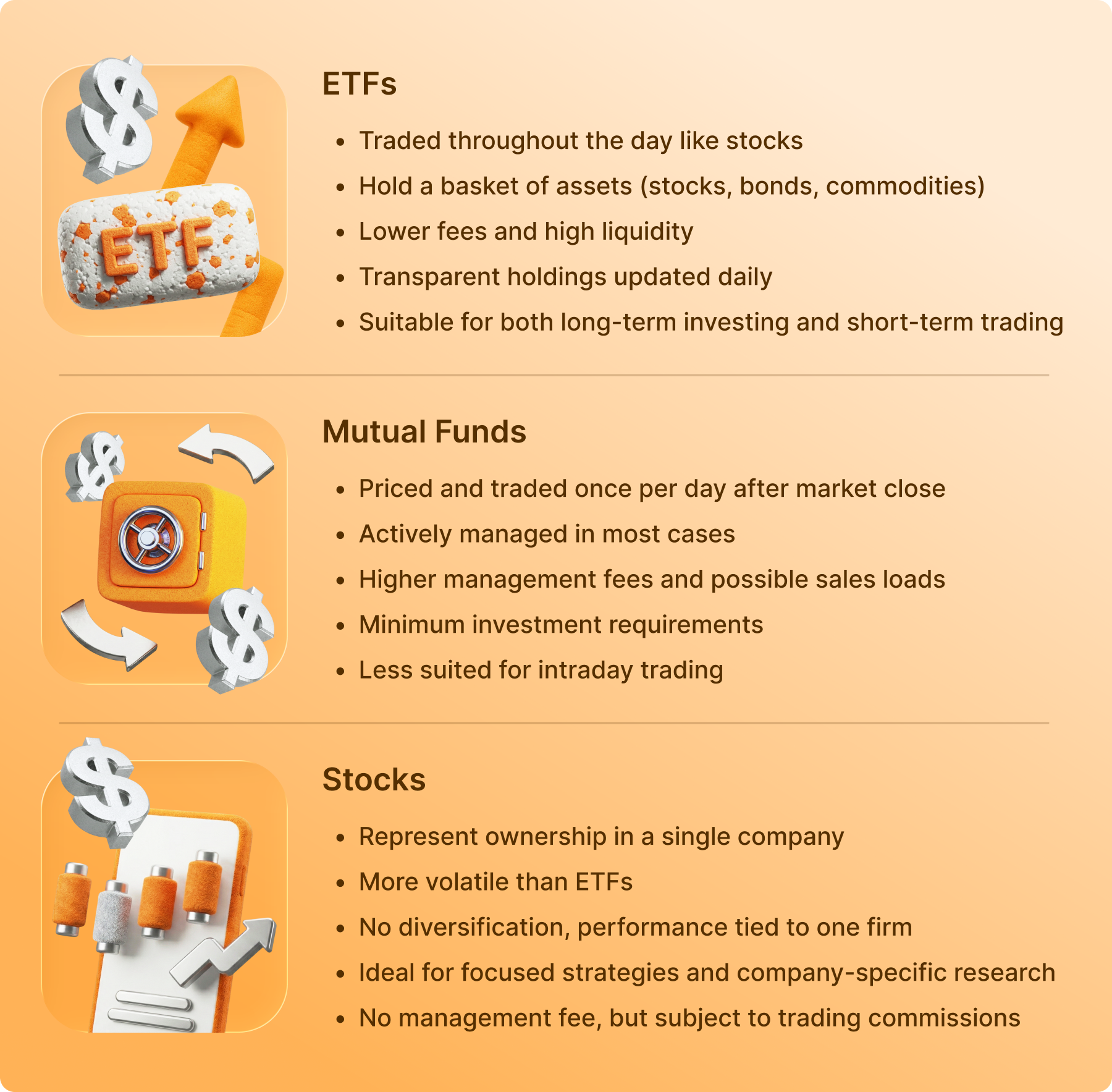
ETFs
- Traded throughout the day like stocks
- Hold a basket of assets (stocks, bonds, commodities)
- Lower fees and high liquidity
- Transparent holdings updated daily
- Suitable for both long-term investing and short-term trading
Mutual Funds
- Priced and traded once per day after market close
- Actively managed in most cases
- Higher management fees and possible sales loads
- Minimum investment requirements
- Less suited for intraday trading
Stocks
- Represent ownership in a single company
- More volatile than ETFs
- No diversification, performance tied to one firm
- Ideal for focused strategies and company-specific research
- No management fee, but subject to trading commissions
Each product serves different needs. ETFs combine the flexibility of stocks with the diversification of mutual funds, making them especially appealing for new traders who value both simplicity and control.
Risks of ETF Trading
ETFs are widely regarded as newbie-friendly, but they also pose actual risk. One should understand what can impact an ETF’s performance prior to investing.
Market Risk
ETFs reflect the value of underlying assets. If the index or sector the ETF tracks goes down, down the ETF will go. For instance, a tech-focused ETF plummeting when the technology sector is in downturn. Even diversified ETFs cannot completely cushion against broad-market drops, especially during economic crises or extreme volatility.
Liquidity Risk
Some ETFs, especially those that follow niche markets or emerging economies, might not see a lot of trading volume during the day. Low liquidity creates wider bid-ask spreads, so you could buy higher and sell lower than intended. During volatile markets, this can also generate slippage, as your order gets filled worse than you intended.
Tracking Error
ETFs attempt to mirror an index, but the match is not always perfect. Fees, fund construction and trading costs can all cause an ETF’s return to diverge from its benchmark. Minor tracking differences may not matter to long-term investors, but to accuracy-driven traders, they can affect performance.
Leveraged and Inverse ETF Risks
Some ETFs use derivatives to amplify daily returns (3x or 2x) or provide inverse tracking of an index. They are for short-term investment. In the long term, compounding effects can cause returns to behave unpredictably. For beginners, such instruments are riskier and must be monitored closely.
Currency and Global Risks
International ETFs provide exposure to foreign markets but with increased risk. Returns come with a risk of exchange rate of currency. Political developments, foreign legislation or different trading times can also impact performance. For example, a European stock ETF can be exposed to both euro-dollar exchange rate and European Central Bank policy actions.
ETF Trading Strategies for Beginners
ETFs are bought and sold using different strategies depending on the trader’s experience and funding goals. Simple rule-based approaches benefit beginners by reducing emotional decisions and risk management explicitly. The below are five strategies with detailed explanations:
Dollar-Cost Averaging (DCA)
Dollar-cost averaging involves buying a fixed dollar amount of an ETF at fixed intervals, say weekly or monthly. The method spreads buying over changing market prices to balance cost per share in the long run. DCA is useful during volatile market periods as it avoids investing a large amount of money at a peak price. It encourages frequency and long-term discipline, especially for small-capital traders or new ones.
Sector Rotation
Sector rotation is the movement of funds from one sector of ETFs to another based on where stability or growth is most probable. For example, when the economy is recovering, the investor can shift to technology or consumer discretionary ETFs. In case of downside or volatility, they may shift to defensive sectors like healthcare, utilities or consumer staples. Sector rotation requires an understanding of macroeconomic indicators and trends, but ETFs can make it easy to buy a whole sector in a matter of a few trades.
Trend Following
This strategy is based on the fact that markets have a tendency to move in long directions, either upwards or downwards. Traders consider ETFs with good momentum to the upside using moving averages, MACD or RSI. Once a trend has been confirmed, they enter positions with the hope of capturing the middle part of the move, preferably not the top or the bottom. Trend following requires patience, clear entry/exit criteria and the capability to avoid responding emotionally to short-term noise in the market.
Buy-and-Hold
Buy-and-hold investors own ETFs for years or months, riding through short-term volatility. It is common among passive investors or novice investors for exposure over the long run without trading actively. Index ETFs like those tracking the S&P 500 or MSCI World are popular choices. This type of investment avoids market timing but requires portfolio surveillance and occasional rebalancing to ensure the investment achieves long-run goals.
Stop-Loss Orders
A stop-loss order sets a certain price at which the trade will close in case the ETF moves against the trader. The instrument is employed to protect capital and remain disciplined. For example, if a trader buys an ETF for $100 and has a stop-loss of $95, the position closes automatically when the price drops to $95. This strategy is required when handling risk, especially when trading with more volatile or leveraged ETFs and it prevents small losses from becoming huge ones.
Tools for Tracking ETF Performance
Monitoring ETF performance is required for an informed trading choice. Different tools ease traders in assessing how well an ETF performs, what it contains and whether it is appropriate for their goals. Such tools are diverse and extend from basic charting packages to advanced portfolio monitors.
- Broker Platforms – Most online brokers, including IQ Option, offer integrated tools to show ETF charts, price history and performance data. Users are able to track daily price change, volume and compare multiple ETFs on one screen. Technical indicators like moving averages, MACD and RSI are offered by many platforms.
- ETF Fact Sheets – Every ETF has an accompanying fact sheet released by the issuer. It includes the fund’s objective, largest holdings, fees, historical returns and benchmark performance. New investors can view these sheets on the website of the ETF provider (e.g., iShares, Vanguard, SPDR) or on aggregator sites like ETF.com or Morningstar.
- Portfolio Trackers – Tools like Yahoo Finance, Morningstar or Google Finance enable investors to create watchlists and track real-time price movements in their ETF holdings. They show performance, dividends, fees and allocation breakdown. This helps users track their positions without constantly logging into their broker account.
- ETF Screener Tools – Screener tools filter out ETFs based on specific criteria such as sector, geography, expense ratio or performance. Examples are the ETF screener at ETF.com or tools provided by investment sites. They are useful when looking for ETFs for a strategy or market viewpoint.
- Mobile Apps – Brokers’ or financial information services’ mobile applications offer ETF tracking in the mobile space. They offer price alerts, daily performance updates and portfolio reports. The majority of beginners prefer mobile apps as they are easy and convenient to use, with real-time access to market data.
ETF Fees and Costs Explained
It is essential to understand the costs associated with ETFs in order to arrive at net returns. Even minor fees can eat into profits in the long run, particularly for traders who take long-term positions. Although ETFs are low-cost, they are not completely free from fees.
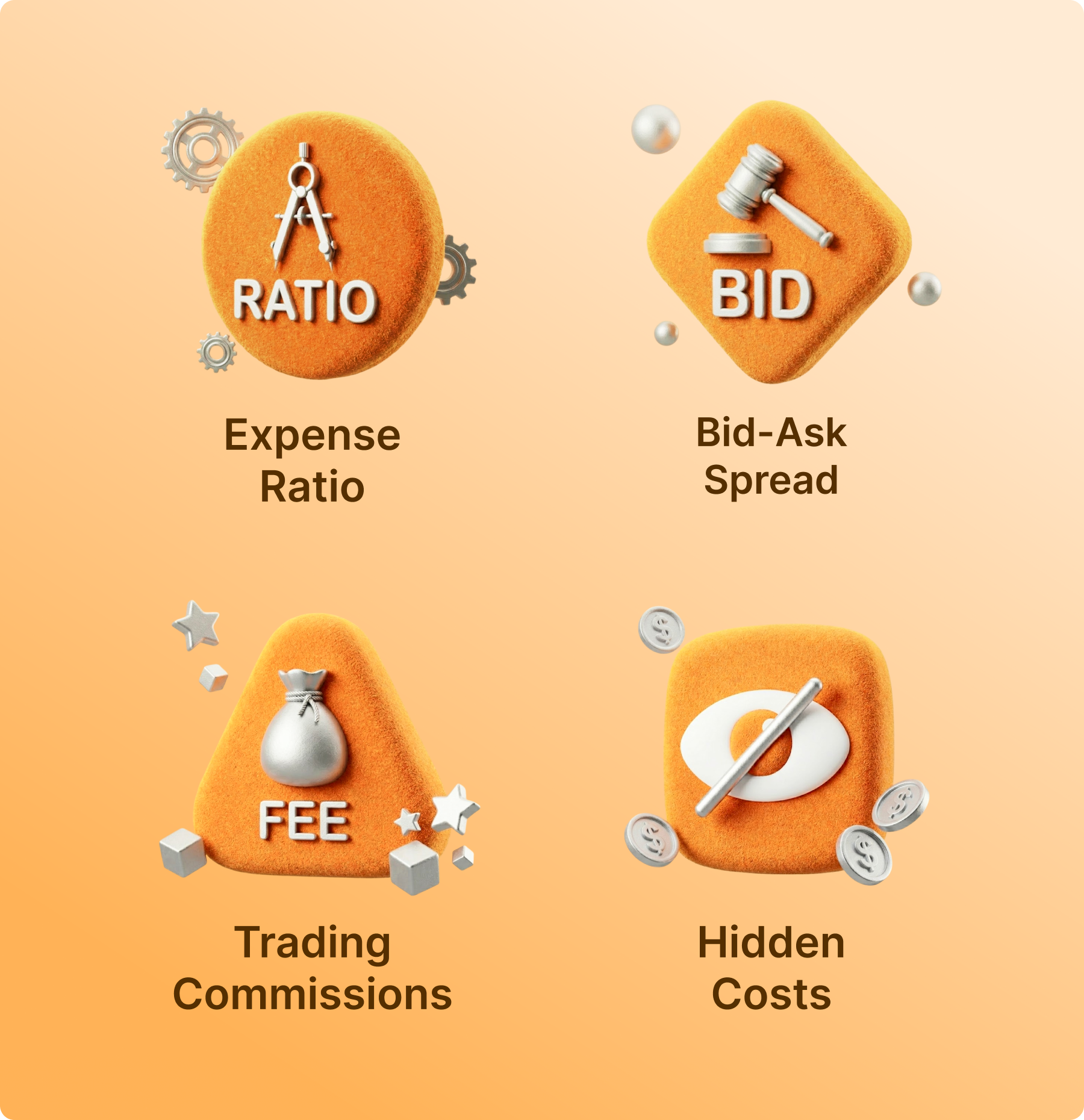
Expense Ratio
This is the annual fee of the fund provider, expressed as a percentage of assets. For example, an ETF with an expense ratio of 0.15% charges $1.50 a year for every $1,000 invested. Expense ratios are below 0.2% for the majority of index-based ETFs, but actively managed or specialized ETFs are more expensive.
Bid-Ask Spread
This is the difference between an ETF’s buying price (ask) and selling price (bid). Narrow spreads are typical for high-liquidity ETFs, while less actively traded ones can have wider spreads, making your entrance or exit trades more expensive.
Trading Commissions
There is perhaps a small commission fee for trading ETFs, based on the broker. The majority of brokers offer commission-free ETF trading, especially for popular funds. IQ Option, for example, offers zero-commission trading on specific instruments.
Hidden Costs
Not always obvious, costs like tracking error (difference between ETF and index performance), taxes on dividends and currency conversion (for international ETFs) can chip away at your return. Reviewing the ETF fact sheet and using total return data enables you to put a number on the true cost.
ETF Trading Hours and Liquidity
Understanding when and how to trade ETFs is important to timing entries and exits. While ETFs are organized like mutual funds, they are traded like stocks in trading mechanics.
Trading Hours
ETFs exchange on normal stock market hours, typically from 9:30 a.m. to 4:00 p.m. EST for U.S.-listed ETFs. Some brokers, like IQ Option, may offer extended-hour trading, but liquidation is generally less than during normal sessions. Huge trades should be avoided during market opening and closing times, when volatility is typically greater.
Intraday Pricing
Unlike daily-pricing mutual funds, however, ETFs can be sold during the trading day. They have their price varying in real time, allowing traders to react to short-term signals, manage risk more actively and apply technical analysis.
Liquidity Factors
Liquidity of an ETF depends upon two factors: traded ETF shares volume and underlying assets’ liquidity. Active ETFs (like SPY or QQQ) will have narrow bid-ask spreads and minimal slippage. In contrast, ETFs tracking small cap stocks or niche industries are bound to have thin volume, leading to poor execution.
Market Makers and Authorized Participants
These investors induce the creation or redemption of ETF shares to meet investor needs. They provide fair pricing, reduce large intraday deviations from the net asset value (NAV) and improve liquidity even in thin trading volume situations.
Common ETF Trading Mistakes to Avoid
New traders approach ETFs as if they were stocks, but there are inherent differences that require expertise. Avoid the most common pitfalls to protect your capital and make better decisions.
Bypassing Liquidity
Not all ETFs are liquid. Some low-volume ETFs exhibit wide bid-ask spreads and shallow market depth. Traders who trade without checking volume may pay higher prices or find themselves stuck in positions when markets become volatile.
Purchasing at Market Open
The initial 15 – 30 minutes of trading tend to experience higher volatility and price gaps. Market orders placed at this time may produce unwanted fills. Novices are advised to wait until spreads narrow and prices stabilize before entering.
Ignoring the Expense Ratio
Some ETFs have significantly higher fees than others offering comparable exposure. Failing to compare expense ratios reduces long-term return. Investors must choose low-cost ETFs unless there is a clear justification to pay extra for active management or expert coverage.
Misusing Leveraged or Inverse ETFs
Leveraged ETFs are meant to be short-term trading vehicles, not holding things for extended periods. Keeping them for weeks or more creates the risk of compounding effects outside of predicted performance. New traders abuse these tools and lose in ways they did not anticipate.
Not Understanding the Underlying Index
All ETFs track something, an index, sector, or strategy. Participants must understand what is in the fund, how it is weighted, and if the holdings are what they want. Blindly picking ETFs by name or popularity can lead to mismatches.
Conclusion and Final Tips
ETF trading represents a convenient and versatile option for involvement in the financial markets. With several hundred funds split between stocks, bonds, commodities, sectors and worldwide regions, ETFs provide new investors with exposure to diversified portfolios without the intricacies of having to manage separate assets.
Trading ETFs on platforms like IQ Option opens the doors to novices with learning tools, live charts and low entry points. Thorough research and regular drills, and ETF trading can be a core part of a larger investment strategy.